
You know the words. You know the movements, more or less. But somewhere in the middle of Dhuhr, a quiet doubt appears: am I actually doing this correctly?
That doubt is the reason thousands of sisters search for how to pray in Islam for women every single month. It is not a lack of faith — it is a sincere desire for certainty in the one act of worship you repeat five times a day.
At Sister Nourhan Academy, we hear this question daily from sisters in the UK, the US, Canada, and across Europe. So we built this guide the way our female teachers actually teach it: slowly, warmly, and with evidence.
By the end, you will have a clear sequence for every prayer, the specific rulings that apply to sisters, and the confidence to stand for salah without second-guessing yourself.
Key Highlights of This Article:
The exact conditions that must be met before your prayer counts as valid.
A complete walkthrough of how to pray in Islam for women, movement by movement.
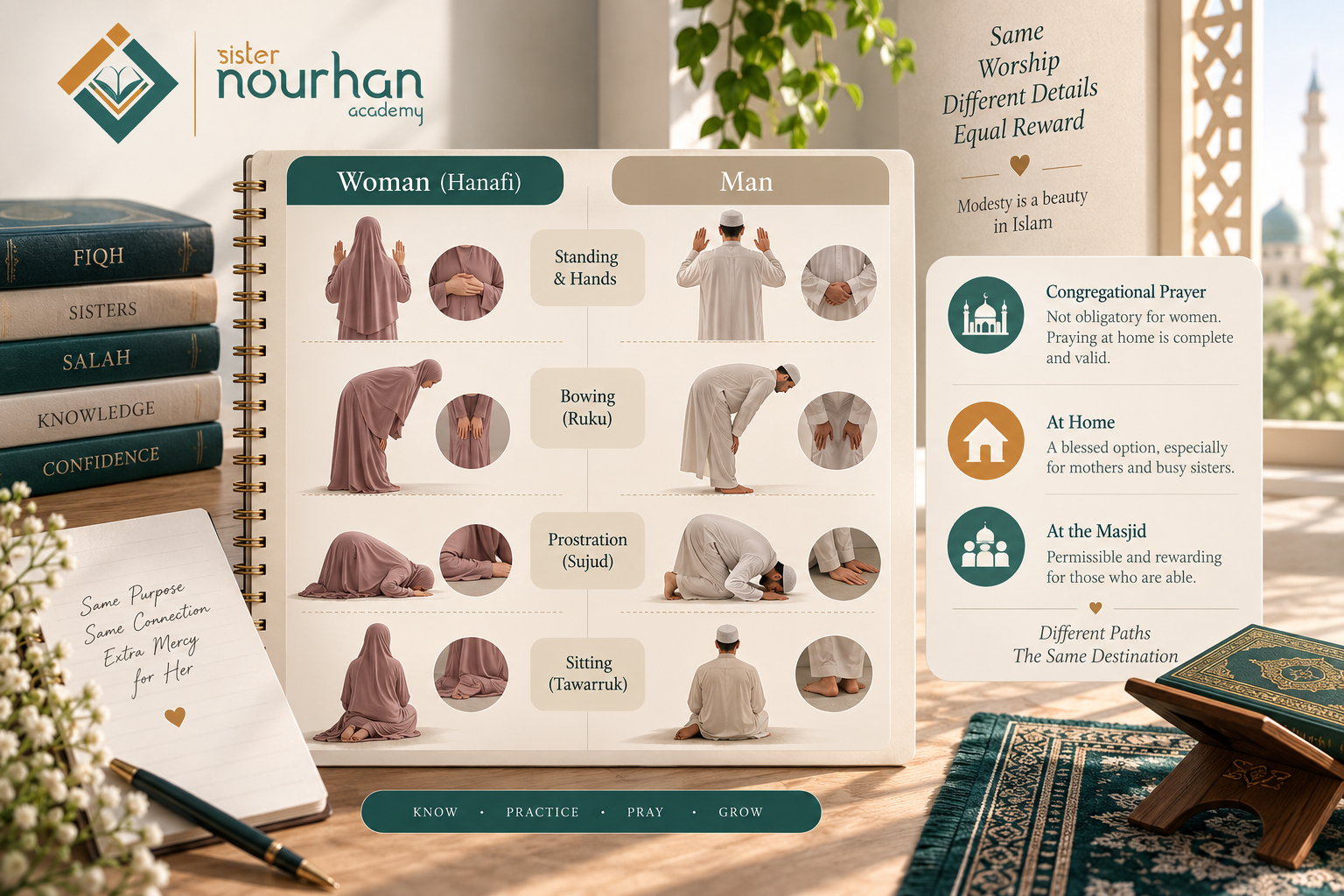
The specific postures where a woman's prayer differs in Hanafi fiqh.
Clear rulings for menstruation, postpartum, travel, and missed prayers.
Why Learning How To Pray In Islam For Women Matters
Salah is not a routine you perform on autopilot. It is a daily appointment with your Creator, and learning how to pray in Islam for women properly protects the quality of that appointment for the rest of your life.
Before we reach the mechanics, it helps to understand why precision matters so much here — and what "valid" actually means in Islamic law.
The Rank Of Salah In A Muslim Woman's Daily Life
Prayer is the second pillar of Islam and the only pillar that returns to you five times a day. Nothing else in worship is repeated with that frequency, which is exactly why its details deserve your attention.
Allah, Exalted be He, says:
“حَافِظُوا عَلَى الصَّلَوَاتِ وَالصَّلَاةِ الْوُسْطَى وَقُومُوا لِلَّهِ قَانِتِينَ”
"Observe the ˹five obligatory˺ prayers—especially the middle prayer—and stand in true devotion to Allah." — Surah Al-Baqarah 2:238
The Prophet ﷺ also placed salah at the very front of the reckoning. He said:
“إِنَّ أَوَّلَ مَا يُحَاسَبُ بِهِ الْعَبْدُ يَوْمَ الْقِيَامَةِ مِنْ عَمَلِهِ صَلَاتُهُ”
"Indeed the first deed by which a servant will be called to account on the Day of Resurrection is his Salat. If it is complete, he is successful and saved, but if it is defective, he has failed and lost." — Jami' at-Tirmidhi 413
For a sister managing a home, a job, or studies, this reframes everything. Salah is not one more task on the list — it is the anchor that holds the rest of the day in place.
Women's Prayer According To Quran And Sunnah - What Makes It Valid
A prayer is valid when its conditions are met and its essential pillars are performed in order. Miss a condition, and the prayer must be repeated; rush a pillar, and it becomes deficient.
The scholarly framework here comes directly from the Prophet's own instruction. He ﷺ said:
“صَلُّوا كَمَا رَأَيْتُمُونِي أُصَلِّي”
"Pray as you have seen me praying." — Sahih al-Bukhari 631
This is why the entire structure of women's prayer according to Quran and Sunnah is built on imitation of the Prophetic model, not personal preference or family habit. Where the sources make no distinction between men and women, the prayer is identical.
Where a difference is transmitted — and there are a handful, mostly in posture — the schools of fiqh record it carefully. We cover those in detail further down.
Conditions Of Islamic Prayer For Women Before You Begin
Most invalid prayers are not ruined by a wrong movement. They are ruined before the first takbir, by a condition that was quietly missed.
Learning how to pray in Islam for women therefore starts outside the prayer mat. Every valid islamic prayer for women rests on three things you settle beforehand: purity, covering, and timing.
1. Purity Of Body, Clothes, And Place
Ritual purity is a non-negotiable condition. Without a valid wudu, the prayer does not count, no matter how perfectly the rest is performed.
The Prophet ﷺ said:
"لَا تُقْبَلُ صَلَاةُ مَنْ أَحْدَثَ حَتَّى يَتَوَضَّأَ"
"The prayer of a person who does Hadath is not accepted till he performs the ablution." — Sahih al-Bukhari 135
Beyond your own state, three things must be free of impurity: your body, the clothes you are praying in, and the spot where you stand and prostrate. A quick habit of checking your prayer clothes and mat weekly prevents a lot of anxiety later.
If your wudu itself feels shaky — especially the order, the obligatory parts, and what invalidates it — that is worth fixing at the root. Our Wudu Course for Females and Sisters at Sister Nourhan Academy walks through it practically with a female teacher, step by step.

2. Covering The Awrah Correctly During Prayer
In prayer, a woman must cover her entire body except her face and hands; the Hanafi school also excepts the feet. This standard applies whether you pray alone in a locked room or in a masjid.
The evidence is explicit. It is narrated from Aisha (may Allah be pleased with her) that the Prophet ﷺ said:
"لَا يَقْبَلُ اللَّهُ صَلَاةَ حَائِضٍ إِلَّا بِخِمَارٍ"
"Allah does not accept the prayer of a woman who has reached puberty unless she wears a veil." — Sunan Abi Dawud 641, graded Sahih by Al-Albani
Practically, this means loose clothing that does not reveal the shape of the body, sleeves that stay down in ruku, and a khimar that stays in place during sujud. A dedicated prayer garment saves you from mid-prayer adjustments.
One point confuses many sisters: covering is a condition of salah, not a condition of reading Quran. We unpacked the difference fully in Do You Have to Wear Hijab When Reading Quran? Clear Rulings for Every Sister.
3. Prayer Times, Qiblah, And Choosing Your Prayer Space
Each of the five prayers has a fixed window, and praying before it opens is invalid. Fajr, Dhuhr, Asr, Maghrib, and Isha each have an entry and exit time that shifts with your location and the season.
You must also face the Qiblah. If you are travelling and genuinely cannot determine the direction after making a reasonable effort, you pray according to your best judgement and the prayer is accepted.
Allah reminds us that prayer adapts to circumstance without being abandoned:
"فَإِذَا قَضَيْتُمُ الصَّلَاةَ فَاذْكُرُوا اللَّهَ قِيَامًا وَقُعُودًا وَعَلَى جُنُوبِكُمْ"
"When the prayers are over, remember Allah—whether you are standing, sitting, or lying down." — Surah An-Nisa 4:103
Choose a spot that is clean, quiet, and free from interruption. Sisters who set aside one permanent corner for salah report far more consistency than those who move around the house.

Samples from our live courses
Enrich Your Islamic Knowledge
Deepen your understanding of Fiqh, Aqeedah, and Hadith with dedicated female scholars at Sister Nourhan Academy.
Start Your Free Trial NowIslamic Prayer Step By Step Women Can Follow At Home
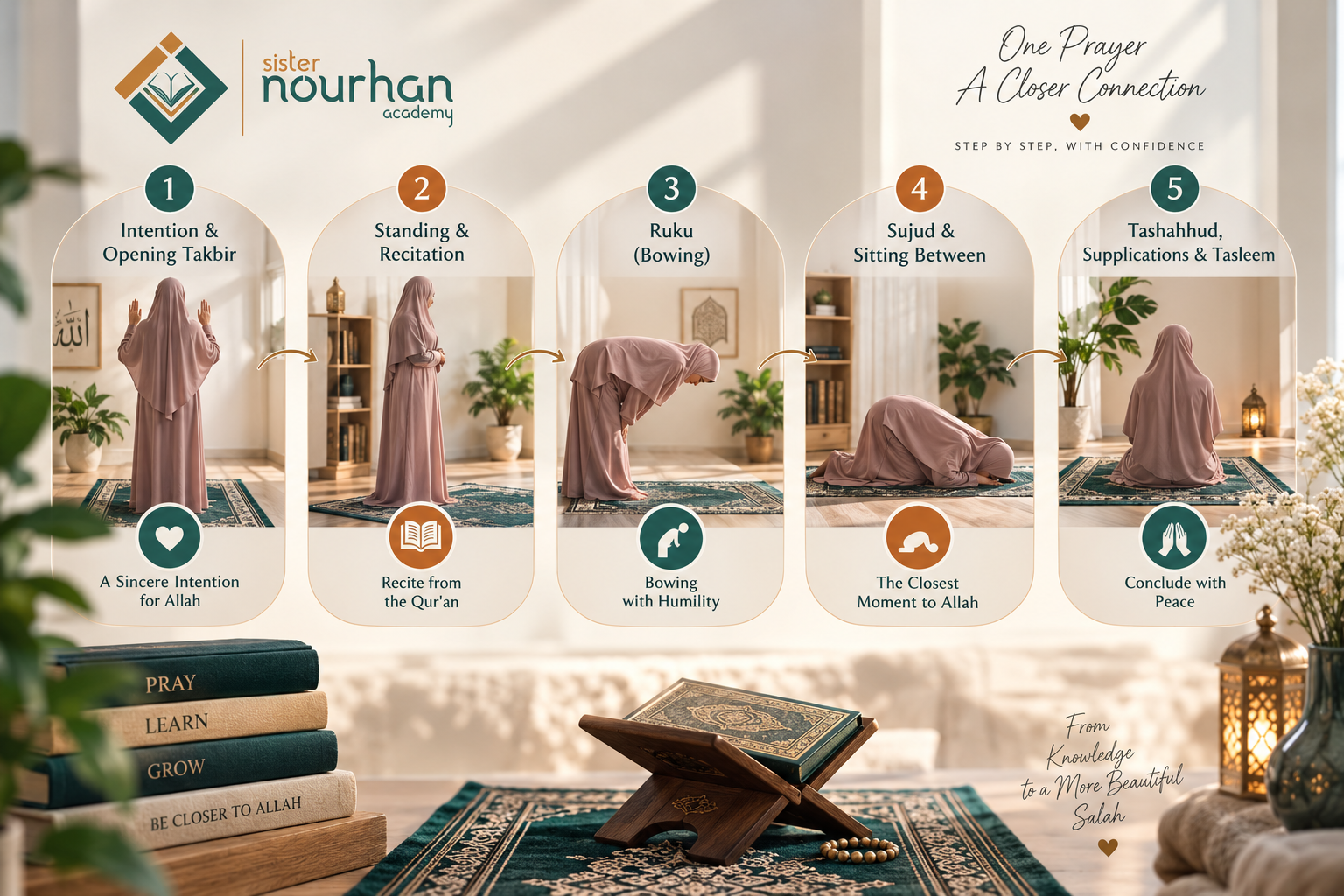
This is the core of the guide: islamic prayer step by step for women, from intention to tasleem. The sequence below applies to every obligatory prayer; only the number of rak'ahs changes.
The Prophet ﷺ summarised the whole structure for a man who had prayed carelessly:
"إِذَا قُمْتَ إِلَى الصَّلَاةِ فَكَبِّرْ، ثُمَّ اقْرَأْ مَا تَيَسَّرَ مَعَكَ مِنَ الْقُرْآنِ، ثُمَّ ارْكَعْ حَتَّى تَطْمَئِنَّ رَاكِعًا"
"When you stand for Prayer say Takbir and then recite from the Holy Qur'an (of what you know by heart) and then bow till you feel at ease..." — Sahih al-Bukhari 757
Notice the repeated phrase: till you feel at ease. Stillness is not decoration; it is part of the prayer.
Step 1 — Niyyah And The Opening Takbir
Your intention is formed in the heart, not on the tongue. Simply know which prayer you are about to perform and that you are performing it for Allah alone — that is a complete niyyah.
Then raise your hands and say Allahu Akbar. In the Hanafi school, a woman raises her hands to shoulder level rather than to the ears, keeping her arms close to her body.
This opening takbir is the boundary line. The moment it is pronounced, ordinary speech, eating, and unnecessary movement are no longer permitted until the prayer ends.
Step 2 — Standing And Recitation (Qiyam)
Standing is where most of the prayer's speech happens. Begin with the opening supplication (Subhanaka Allahumma...), then seek refuge and recite the Basmala quietly.
Next comes Surah Al-Fatihah, which is recited in every rak'ah. In the first two rak'ahs of each obligatory prayer, follow it with another short surah or a few verses you know well.
Keep your gaze at the place of prostration and your voice appropriate to the prayer — quiet in Dhuhr and Asr, audible in the audible prayers when praying alone.
If your recitation of Al-Fatihah still feels uncertain, the Salah / Prayer Course for Females and Sisters corrects pronunciation and posture together in live one-to-one sessions.
Step 3 — Ruku (Bowing)
Say Allahu Akbar and bow forward, placing your hands on your knees. A woman in the Hanafi school bows less deeply than a man, keeps her fingers together rather than spread, and does not grip the knees firmly.
While bowing, say Subhana Rabbiyal Azeem three times, unhurried. Then rise saying Sami' Allahu liman hamidah, Rabbana wa lakal hamd.
The mistake to avoid here is speed. Bowing and rising should each come to a genuine pause — a bow that flows straight into prostration without stillness is deficient.
Step 4 — Sujud And The Sitting Between Prostrations
Say Allahu Akbar and go down into prostration, placing forehead, nose, both palms, knees, and toes on the ground. In sujud, a woman keeps her limbs drawn in: elbows close to the sides, abdomen near the thighs, and the body low and compact.
Say Subhana Rabbiyal A'la three times. Then sit up saying Allahu Akbar, pause briefly in a settled sitting position, and prostrate a second time in the same way.
Sujud is the closest position to Allah in the entire prayer, which makes it the best moment for a private du'a in your own words.
Sisters who want a stronger repertoire of authentic supplications often continue with the Dua & Adhkar Course for Females and Sisters.

Step 5 — Tashahhud, Final Supplications, And Tasleem
After the second prostration of the second rak'ah, sit for the tashahhud and recite At-Tahiyyatu lillah..., raising the index finger at the testification of faith. In a two-rak'ah prayer, continue directly to the salawat.
Follow the tashahhud with Allahumma salli 'ala Muhammad... and then a short du'a of your choosing before concluding. In three- and four-rak'ah prayers, you stand again after the first tashahhud and complete the remaining units.
Finish by turning your head to the right saying Assalamu alaikum wa rahmatullah, then to the left with the same words. Your prayer is now complete — and this final greeting is what closes it, not standing up.
Recommended reading: Do You Need Wudu to Read the Quran? A Complete Guide
Hanafi Fiqh Women's Prayer - How It Differs From A Man's
A woman's prayer is largely identical to a man's: same pillars, same words, same order. The recorded differences are limited to posture and a few contextual rulings, and they are the subject of established discussion in hanafi fiqh women's prayer literature.
Before the details, one honest note: the schools of fiqh differ here, and each position rests on transmitted reports and scholarly reasoning. What follows is the Hanafi position specifically.
Posture Differences Recognised In The Hanafi School
The underlying Hanafi principle is sitr — modesty through compactness. Where a man extends and separates his limbs, a woman gathers them in.
This is not a lesser form of prayer. It is the same worship shaped around the dignity and modesty that Islamic law consistently protects for women.
For verification and further rulings on prayer, you can consult the extensive English-language collection at the Islamweb fatwa archive on Salah, which addresses hundreds of practical prayer questions.
A. Standing And Hand Placement
A woman raises her hands to shoulder level for the takbir, not to the earlobes. Her arms stay close to her sides rather than out from the body.
She then places her right hand over the left on her chest, laid flat without clasping the wrist. Men in this school place their hands lower, below the navel.
B. Bowing And Prostration
In ruku, she bows only as much as needed to reach her knees, keeps her knees slightly bent, and keeps her legs closer together. Her fingers rest together on the knees without gripping.
In sujud, she lowers herself so that the abdomen is close to the thighs and the elbows are close to the ground and to the sides. The overall shape is contained rather than raised.
C. The Sitting Position (Tawarruk)
Between and after prostrations, a woman sits in tawarruk: both feet are brought out to the right side and she sits on her left hip. A man instead sits upon his left foot with the right foot upright.
This single adjustment is the one sisters most often learn late — and the one most quickly corrected once a teacher shows it live.
Congregational Prayer And Praying At Home
Congregational prayer in the masjid is not obligatory upon women as it is upon men. A sister who prays her five prayers at home has fulfilled her obligation completely.
Attending the masjid remains permissible and, for many sisters, spiritually valuable — for Jumu'ah, Taraweeh, or lessons. The point is that the obligation is not tied to the building.
This ruling is also mercy in practice. A mother with young children can pray on time in her own home without treating it as a compromise, which is precisely how salah for islamic sisters stays consistent across busy life stages.
Expand your knowledge: Important Quran Verses to Memorize for Every Muslim
Special Situations Every Sister Should Understand
Life does not always fit the textbook. These are the situations where sisters most often become unsure, and where a clear ruling brings immediate relief.
Understanding them completes your grasp of how to pray in Islam for women, because worship is judged in real circumstances, not ideal ones.
1. Menstruation, Postpartum Bleeding, And Missed Prayers
During menstruation and postpartum bleeding (nifas), prayer is not performed — and, importantly, those prayers are not made up afterwards. This differs from fasting, which is made up later.
There is no sin in this and no spiritual deficit. You remain in worship through dhikr, du'a, listening to Quran, seeking knowledge, and charity, and many sisters find this a rich time for learning.
Prayers missed for other reasons — oversleeping, forgetting, or negligence — are a different matter and must be performed as qada as soon as you are able. The Fiqh Course covers these rulings on purity and missed prayers in the depth they deserve.

2. Prayer While Travelling, Sick, Or Short On Time
While travelling, four-rak'ah prayers are shortened to two. This concession applies once your journey meets the distance recognised in your school of fiqh, and it applies to sisters exactly as it does to men.
Illness brings its own allowances. If standing is not possible, you pray sitting; if sitting is not possible, you pray lying down — the prayer is never dropped while consciousness remains.
When time is genuinely short, protect the obligatory rak'ahs first and let the voluntary ones go. A brief, valid, focused prayer on time is worth far more than a long one performed after its window has closed.

Learn Salah For Islamic Sisters Live With A Qualified Female Teacher At Sister Nourhan Academy
Reading a guide fixes your knowledge. Watching a teacher — and being watched back — fixes your prayer.
That is the gap Sister Nourhan Academy was built to close. Every class is one-to-one and live with a certified female teacher, many of them Al-Azhar qualified, so you can hold up your hands and ask, "Is this the right position?" and get an answer in the same second.
For sisters, that female-only environment changes everything. Questions about awrah in salah, wudu after menstruation, postpartum rulings, or the exact way to sit in tawarruk are asked freely, in plain words, without hesitation or embarrassment.
The scheduling is built around real life, not around a fixed timetable. Sisters join from the UK, US, Canada, Australia, and Europe at times that fit school runs, night shifts, and time zones — and rescheduling is normal, not a penalty.
You also get a structured path rather than scattered videos. Your teacher assesses where you actually are, corrects recitation and posture together, and gives you a plan that carries you from "I think this is right" to complete certainty.
Many sisters begin with salah and continue into Quran, Tajweed, Arabic, and Islamic studies through the Islamic Studies for Sisters Course.

Fix Your Salah In One Free Session With A Sister Who Teaches It Daily!
Your next prayer is coming in a few hours. You can pray it the way you always have, or you can pray it knowing every movement is correct — and that decision takes one click.
Book a completely free trial lesson with one of our female teachers now. In a single session, she will watch your prayer from takbir to tasleem, correct what needs correcting, and show you the Hanafi postures specific to sisters, live.
There is no payment, no commitment, and no pressure to continue. Choose a time that suits you, meet your teacher, and see for yourself how quickly certainty replaces doubt. Book your free trial now.
Discover our Islamic Studies Courses
- Islamic Studies
- Islamic Studies for Kids
- Islamic Studies for Females / Sisters
- Islamic Studies for Kindergarten
- Islamic Studies for Adults
- 5 Pillars of Islam for Kids
- Fiqh Course (Islamic Jurisprudence)
- Aqeedah Course (Islamic Creed)
- Seerah Course
- Islamic History Course
- Hadith Course
- Dua & Adhkar Course
- Salah / Prayer Course
- Wudu Course
- Alimah Course (for Females)
- Darse Nizami / Traditional Alim Course
- Essential Islam / Introduction to Islam
- Tazkiyah / Spiritual Development Course
- Intensive Islamic Course
- Islamic Summer Camp

Watch the video below to see how we bring these vital lessons to life in our virtual classrooms.
Enrich Your Islamic Knowledge
Deepen your understanding of Fiqh, Aqeedah, and Hadith with dedicated female scholars at Sister Nourhan Academy.
Start Your Free Trial NowConclusion
Salah rests on conditions before it rests on movements: purity, correct covering, the right time, and the right direction. Get those four right and the prayer itself becomes straightforward.
From there the sequence is fixed — intention and takbir, standing and recitation, bowing, prostration, and the sitting that ends with tasleem. The differences for sisters are real but limited, gathered mostly in the Hanafi postures of standing, bowing, prostrating, and sitting in tawarruk.
The ultimate takeaway is this: precision in prayer is not perfectionism, it is respect. Learning how to pray in Islam for women properly, once and thoroughly, is an investment that pays back five times a day for the rest of your life.
And you do not have to work it out alone. A qualified female teacher can settle in one hour what years of quiet uncertainty never resolved.
Frequently Asked Questions
How To Pray In Islam For Beginners Female Pdf?
A PDF can give you the words and the order, but it cannot tell you that your hands are too low or your sujud is too raised. That is why Sister Nourhan Academy pairs written step-by-step guidance with a live female teacher who corrects you as you pray.
Can I Pray Namaz Without A Bra?
Yes, your prayer is valid without one, since the condition is that your clothing covers you and does not outline the shape of your body. A loose prayer garment or an extra layer is enough to meet that requirement.
What Are The Three Forbidden Times To Pray In Islam?
Voluntary prayers are prohibited at sunrise until the sun has fully risen, at the sun's zenith at midday, and while the sun is setting. Obligatory prayers that were missed remain an exception and are performed as soon as you are able.
How Do I Pray Fajr As A Beginner?
Fajr is two rak'ahs of obligatory prayer, preceded by two highly recommended sunnah rak'ahs, with the recitation said aloud. Beginners at Sister Nourhan Academy usually start with Fajr in their first lesson because its short structure makes every step easy to master.
What To Say In Prayer In Islam Step By Step?
You say the opening takbir, the opening supplication, Al-Fatihah with a short surah, then the tasbih of ruku and sujud, and finally the tashahhud with salawat before tasleem. Sister Nourhan Academy's teachers drill these phrases with correct pronunciation until you can say each one without pausing to remember it.