
Finding the right Islamic universities for women requires more than choosing a famous institution.
Women looking for serious Islamic education need to compare the actual program, admission rules, language of instruction, study format, and whether female students are eligible for the specific degree they want.
Women can pursue Islamic education through a women-only institution, a dedicated female college or campus within a larger university, or a university that admits both men and women to Islamic Studies programs.
Today, women can pursue Islamic studies, Sharia, Fiqh, Quran and Sunnah, Aqeedah, Da'wah, and Arabic through established universities in Muslim-majority countries, while some institutions are also expanding distance and online study.
This guide explains what women can study, highlights notable universities, and provides a practical framework for choosing between an academic degree and flexible online Islamic education.
1- Al-Azhar University
Al-Azhar University is one of the most recognized institutions for women seeking formal Islamic and Arabic scholarship in Egypt. Its dedicated Faculties of Islamic and Arabic Studies for Girls operate in Cairo, Mansoura, Kafr El-Sheikh, and other locations, although the available departments and programs vary by branch.
Depending on the faculty and specialization, female students may study Islamic Sharia and Fiqh, Usul Al-Fiqh, Tafsir, Hadith, Aqeedah, Quranic sciences, Arabic grammar, morphology, rhetoric, and literature.
Some faculties also provide specialized study in Qira’at, including the ten recognized Quranic readings. These colleges are particularly suitable for women seeking traditional, university-level Islamic education primarily through Arabic.
However, prospective students should check the specific faculty before applying, as Al-Azhar’s women’s colleges do not all offer an identical curriculum, and available departments, specializations, and admission options can differ by location.

2- Qatar University
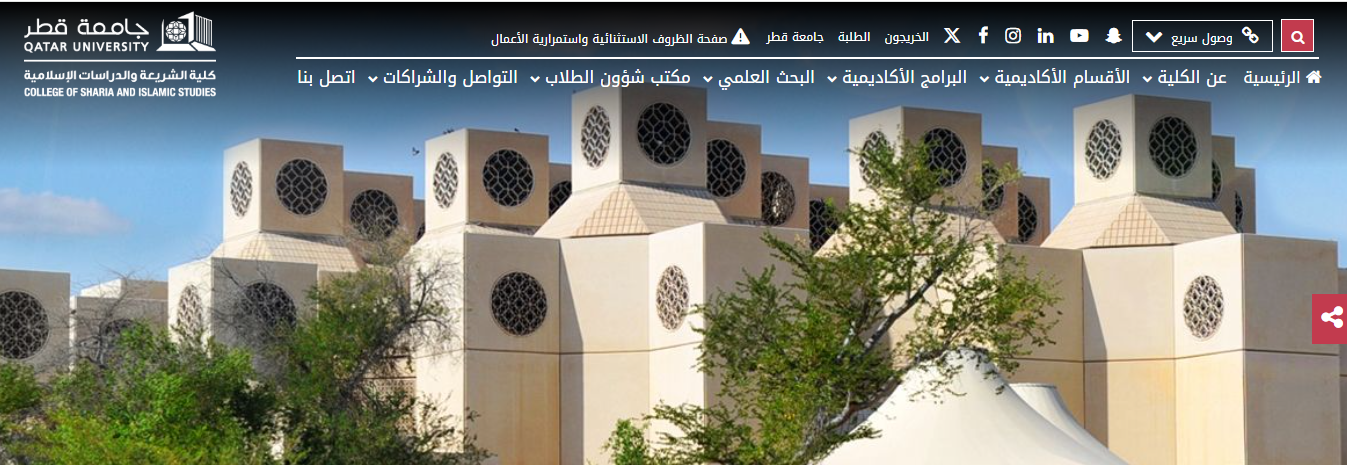
Qatar does not have a separate institution officially called “Qatar Islamic University,” but women seeking university-level Islamic education can find relevant programs through established universities in the country.
One of the main options is the College of Sharia and Islamic Studies at Qatar University, where female students can pursue academic study in areas such as Fiqh and Usul Al-Fiqh, Aqeedah and Da‘wah, Quran and Sunnah, and Islamic Studies, with undergraduate and postgraduate pathways available depending on the specialization.
Women interested in a more research-oriented approach can also explore the College of Islamic Studies at Hamad Bin Khalifa University (HBKU), which offers graduate-level study in areas such as Islamic Studies, Islamic Finance, and Islam and Global Affairs, alongside doctoral research opportunities.
These institutions may be especially suitable for women who want recognized academic qualifications while studying Islamic subjects within Qatar’s university system.
International female students may also be eligible to apply, but admission requirements, language of instruction, scholarships, program availability, and policies for international applicants should always be confirmed with the individual university before applying.
3- Umm Al-Qura University
Umm Al-Qura University (UQU), located in Makkah, Saudi Arabia, is one of the Kingdom’s most established universities for Islamic and Arabic scholarship and offers higher-education opportunities for female students across a wide range of disciplines.

Its origins date to 1369 A.H., when the College of Shari‘ah was established as one of the earliest modern higher-education institutions in Saudi Arabia, while Umm Al-Qura University was formally established under its present structure by royal decree in 1401 A.H.
Its Islamic academic heritage remains particularly strong through the College of Shari‘ah and Islamic Studies, College of Da‘wah and Fundamentals of Religion, College of Arabic Language, and Institute of Arabic Language for Non-Native Speakers, alongside programs connected with Quranic and Islamic sciences.
Today, UQU has expanded beyond its original religious focus to include fields such as medicine, engineering, applied sciences, technology, social sciences, and business, with undergraduate and postgraduate study pathways available across its colleges.
For Muslim women, it can be particularly attractive for combining traditional Islamic and Arabic studies with the resources and research environment of a large public university in Makkah.
International female students may also explore study opportunities at UQU, but current admission requirements, scholarship eligibility, language requirements, and the availability of specific programs for international applicants should be verified before applying.
4- Imam Mohammad Ibn Saud Islamic University for Women
Imam Mohammad Ibn Saud Islamic University (IMSIU) is a major public university in Riyadh, Saudi Arabia, and a strong option for women seeking formal university-level education in Islamic and Arabic studies.
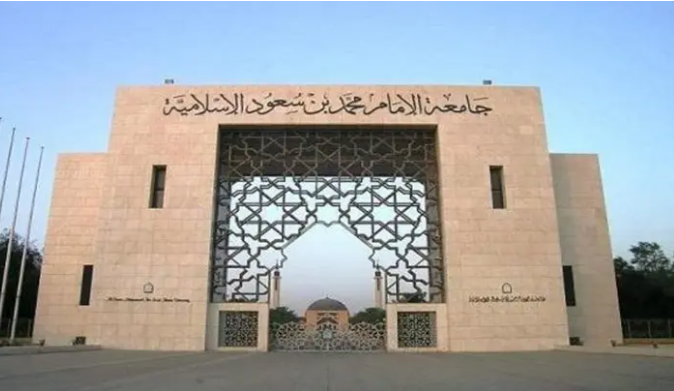
The institution traces its academic roots to 1953, when its College of Sharia was established, and it became a full university by royal decree in 1974. Although IMSIU began with a strong focus on Sharia, Islamic studies, and Arabic, it has developed into a comprehensive multidisciplinary university offering fields such as medicine, engineering, computer science, business, languages, and social sciences.
Islamic scholarship nevertheless remains central to its academic identity, with study opportunities in Sharia, Usul Al-Din, Da‘wah, Arabic, and related Islamic and humanities disciplines. The university provides diploma, bachelor’s, master’s, and doctoral programs, while its Arabic Language Teaching Institute supports non-native Arabic speakers.
For women, a notable feature is the university’s integrated educational city for female students, which provides a dedicated environment for university study and student services.
IMSIU also has an international presence through institutes and educational branches outside Saudi Arabia, including in countries such as Indonesia and Djibouti, reflecting its broader role in Arabic and Islamic education.
In addition, the university supports academic research through research centers, scholarly societies, and academic journals, combining its Islamic heritage with contemporary higher education.
International female students may explore available admission and scholarship opportunities, but specific program availability, eligibility criteria, language requirements, and current international admission policies should be checked directly with the university before applying.
Shots from Our Classes
Take a moment to view the video below to see how our teachers provide clear, supportive corrections during a session.
Enrich Your Islamic Knowledge
Deepen your understanding of Fiqh, Aqeedah, and Hadith with dedicated female scholars at Sister Nourhan Academy.
Start Your Free Trial Now5- Islamic University of Madinah for Women
The Islamic University of Madinah is an international public university in Madinah, Saudi Arabia, established by royal decree in 1961 and located approximately 10 kilometers from the Prophet’s Mosque. Known particularly for Islamic scholarship, the university includes specialized colleges for Sharia, the Quran and Islamic Studies, and Hadith, while its academic scope has expanded to modern disciplines such as engineering and computer and information systems. It offers bachelor’s, master’s, and doctoral degrees, as well as Arabic-language study for non-native speakers, and has a strongly international character, historically attracting students from more than 180 countries. For women considering the university, however, eligibility needs to be checked at the program level rather than assuming that all on-campus programs are open to female students. Current program information has indicated female eligibility for certain Sharia study pathways, while other programs may remain restricted to male students. The university has also announced plans for a distance bachelor’s degree in Sharia for international male and female students, making it particularly relevant to women exploring remote Islamic higher education. International applicants can explore available programs and admission routes through the university and Saudi Arabia’s official study portal, but because women’s eligibility, distance-learning availability, scholarships, and admission conditions can change, prospective female students should verify the current requirements for their chosen program before applying.
6. International Islamic University Malaysia
International Islamic University Malaysia offers another model of higher Islamic education, combining Islamic revealed knowledge with broader humanities and contemporary academic disciplines.
Its IIUM Academy currently lists a Bachelor of Islamic Revealed Knowledge and Heritage (Honours) among its undergraduate offerings, with flexible arrangements for full-time and part-time students.
The university's academic profiles also demonstrate established teaching and research in areas such as Quran and Sunnah Studies, Tafsir, Muslim women and family studies, and Islamic thought.
Best suited for: students looking for Islamic scholarship within a broader international university environment.
What Do Women Study in an Islamic Studies Degree?
An Islamic higher education for women typically combines core Islamic sciences with Arabic language and supporting academic subjects, although the exact curriculum depends on the degree and institution.
Quran and Quranic Studies
Students may study Quran recitation, Quranic sciences, Tafsir, principles of interpretation, and—in specialized programs—Qira'at.
Some institutions organize Quran and Sunnah as a complete university major rather than treating Quran study as only one module within a general Islamic Studies degree.
Hadith and Sunnah
Hadith studies can include selected Hadith texts, Hadith terminology, evaluation and transmission methodologies, and the study of the Prophet's Sunnah and Seerah.
Advanced specialization becomes considerably more academic than simply reading collections of Hadith.
Fiqh and Usul Al-Fiqh
Fiqh is the study of Islamic legal rulings, while Usul Al-Fiqh studies the principles through which those rulings are derived.
Students may encounter worship, transactions, family law, comparative Fiqh, legal maxims, and methodologies of Islamic jurisprudence depending on their specialization.
Aqeedah and Da'wah
Aqeedah programs examine Islamic creed and related theological questions, while Da'wah studies focus on communicating Islamic teachings effectively.
Some universities combine the two areas within one department or bachelor's degree.
Arabic Language
Arabic is not simply an additional subject in serious Islamic scholarship.
Students may need Nahw, Sarf, Balaghah, reading comprehension, classical texts, and academic writing because advanced Islamic source material depends heavily on Arabic proficiency.
If your Arabic foundation is not yet strong enough for university-level texts, structured study through Sister Nourhan Academy can help you strengthen the Quranic and Arabic skills needed before attempting more demanding material.
Our Female Teachers bring strong subject knowledge, clear teaching methods, and experience working with learners at different levels, providing careful guidance that helps sisters improve their Arabic, Quranic understanding, and confidence step by step.

Are There Islamic Universities for Women Online?
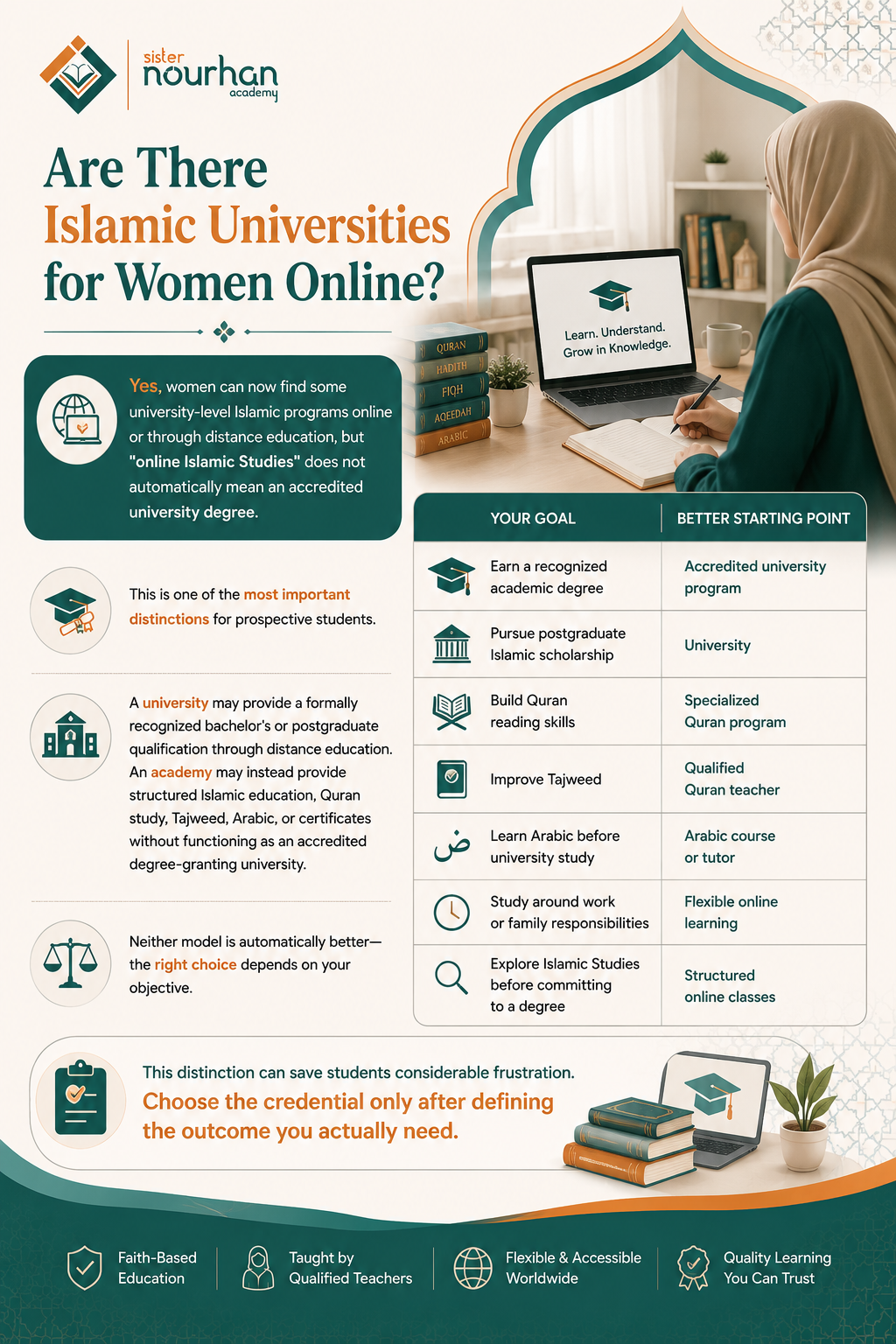
Yes, women can now find some university-level Islamic programs online or through distance education, but "online Islamic Studies" does not automatically mean an accredited university degree.
This is one of the most important distinctions for prospective students.
A university may provide a formally recognized bachelor's or postgraduate qualification through distance education. An academy may instead provide structured Islamic education, Quran study, Tajweed, Arabic, or certificates without functioning as an accredited degree-granting university.
Neither model is automatically better—the right choice depends on your objective.
This distinction can save students considerable frustration. Choose the credential only after defining the outcome you actually need.
For women who want structured learning but are not currently seeking a university degree, Sister Nourhan Academy provides flexible online study that can fit around family, work, and other commitments while building the Quranic and Islamic foundations needed for deeper study.
How to Choose an Islamic University for Women
Choosing between universities offering Islamic studies for women should begin with the program rather than the university's reputation.
1. Define Your Intended Outcome
Ask what you want the education to produce.Someone preparing for academic research has very different needs from someone who primarily wants to understand the Quran, strengthen her religious knowledge, teach children, or study Fiqh systematically.
2. Verify Female Eligibility for the Exact Program
Never assume that because a university admits women, every faculty admits women. The reverse can also be true: older online discussions may describe an institution as male-only even though particular programs have subsequently opened to female students.
Always verify the current admissions page for the specific degree, year, and applicant category.
3. Check the Language of Instruction
This criterion eliminates unsuitable programs surprisingly quickly.Many traditional Sharia programs are taught primarily in Arabic.
A student may understand conversational Arabic but still struggle with classical Fiqh, Tafsir, Usul terminology, and academic examinations.Your real question should therefore be:
Can I study complex academic material in this language—not merely communicate in it?
4. Check Accreditation and Degree Recognition
If you need the qualification for postgraduate study or employment, investigate who recognizes the degree before enrolling.
Do not confuse an attendance certificate, academy certificate, Ijazah, diploma, and accredited bachelor's degree. Each can have genuine value, but they serve different purposes.
5. Compare the Curriculum, Not Just the Degree Title
Two programs called "Islamic Studies" can be very different.One may emphasize Quran and Hadith, another Fiqh and Usul, and another Islamic civilization, philosophy, comparative religion, or contemporary humanities.Review individual modules before deciding.
6. Consider the Learning Environment
Women studying on campus may also need to investigate female facilities, accommodation, transportation, student support, campus arrangements, and the surrounding living environment.
For international applicants, visa requirements and accommodation can be just as decisive as the academic curriculum.
7. Compare Online and On-Campus Study Realistically
Online study provides flexibility, but certain skills require interaction.Quran recitation is the clearest example. Reading Tajweed theory independently cannot show you every error in Makhraj, Sifaat, Ghunnah, Madd, or practical recitation.
This is why a hybrid approach can work particularly well: use academic study for knowledge while maintaining live teacher-guided Quran practice for applied recitation.
See our teaching methods
Experience the quality of our instruction firsthand by watching a live lesson snippet below.
Enrich Your Islamic Knowledge
Deepen your understanding of Fiqh, Aqeedah, and Hadith with dedicated female scholars at Sister Nourhan Academy.
Start Your Free Trial NowBuild Your Foundation With Sister Nourhan Academy
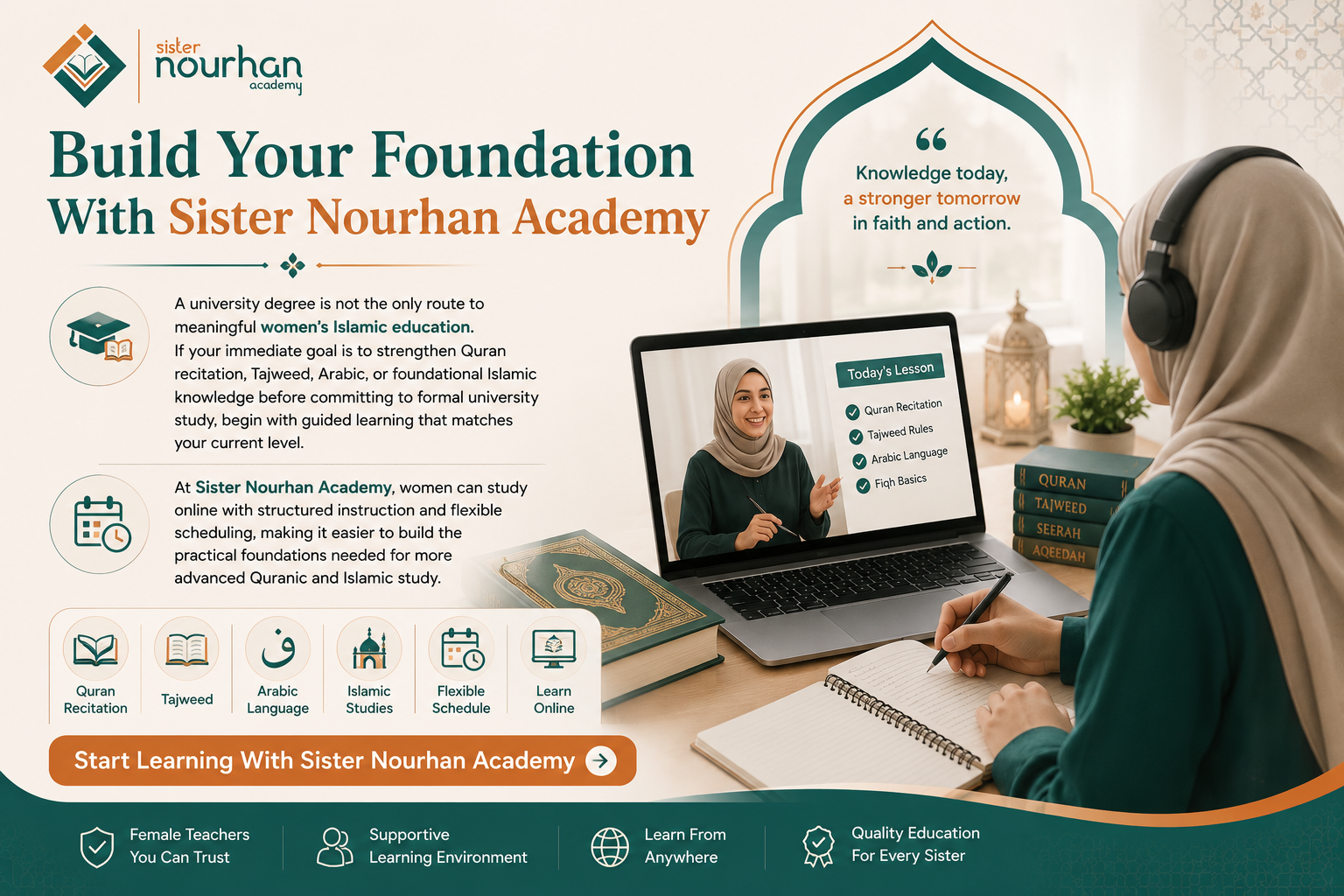
A university degree is not the only route to meaningful women's Islamic education. If your immediate goal is to strengthen Quran recitation, Tajweed, Arabic, or foundational Islamic knowledge before committing to formal university study, begin with guided learning that matches your current level.
At Sister Nourhan Academy, women can study online with structured instruction and flexible scheduling, making it easier to build the practical foundations needed for more advanced Quranic and Islamic study.
Discover our Islamic Studies Courses
Conclusion
The best Islamic university for a given student depends on what she wants to study, where she can study, her Arabic proficiency, and whether she needs a formally recognized academic qualification.
Al-Azhar, Qatar University, Umm Al-Qura University, Imam Mohammad Ibn Saud Islamic University, the Islamic University of Madinah, and International Islamic University Malaysia represent different pathways into Islamic higher education for women.
Most importantly: investigate the specific program rather than relying on the university's name alone. Women's eligibility, study format, admission requirements, and available specializations change over time — a prestigious university is only useful if its program actually matches your goal.
FAQs
Where can women study Islamic Studies?
At universities including Al-Azhar, Qatar University, Umm Al-Qura University, Imam Mohammad Ibn Saud Islamic University, and IIUM, among others. Always check the current female admissions rules for the specific program.
Can women get an Islamic Studies degree online?
Some universities offer distance or online Islamic programs to women — for example, the Islamic University of Madinah has reported plans for a distance bachelor's program in Sharia for international male and female students. Confirm current availability directly with the university.
What subjects are included in an Islamic Studies degree for women?
Programs may include Quran and Tafsir, Hadith, Fiqh, Usul Al-Fiqh, Aqeedah, Da'wah, Seerah, Arabic, and Islamic culture. The exact combination depends on the university and specialization.
Do I need to know Arabic before studying Islamic Studies?
It depends on the program, but strong Arabic is essential for many traditional Sharia and Islamic Studies degrees — for example, Qatar University's undergraduate Sharia and Islamic Studies programs are Arabic-medium.
How do I choose the best Islamic university for women?
Consider your intended specialization, female eligibility, accreditation, language of instruction, curriculum, study format, and career or academic goal — and verify these directly with the university before applying.
Is an online Islamic academy the same as an Islamic university?
No. A university generally awards formally recognized academic qualifications, while an online academy typically focuses on practical Quran, Tajweed, Arabic, or Islamic education. Both can be valuable, but they serve different purposes.