A woman inherited her own wealth, ran an international trade caravan, hired her future husband, and proposed marriage to him. That woman was Khadijah bint Khuwaylid — and this happened in 7th-century Arabia.
Her story is not an exception to the rules. It is the clearest possible introduction to the role of women in Islam: a position built on dignity, ownership, knowledge, and spiritual equality long before any modern charter existed.
Yet most sisters today learn this topic through headlines rather than through Qur'an and Sunnah. That gap is exactly what Sister Nourhan Academy was built to close, with certified female teachers guiding women one-on-one.
In the next few minutes, you'll see what the sources actually say — the rights, the responsibilities, and the misunderstandings that keep getting repeated.
Key Highlights of This Article:
What the Qur'an and authentic Sunnah say about the role of women in Islam.
The four honoured roles a Muslim woman holds — spiritual, family, intellectual, and social.
How the Islamic way of life for a woman works in real, daily practice.
Where culture has been mistaken for religion, and how to tell them apart.
What Is The Role Of Women In Islam?
The role of women in Islam is to worship Allah, seek knowledge, uphold family bonds, and contribute to society — with the same spiritual worth as men and with rights protected by divine law. It is a partnership role, not a secondary one.
A Soul Judged By Faith, Not By Gender
Islam evaluates a woman by her taqwa and her deeds, never by her gender. Reward, accountability, and closeness to Allah are measured identically.
Allah, the Most High, says:
“مَنْ عَمِلَ صَالِحًا مِّن ذَكَرٍ أَوْ أُنثَىٰ وَهُوَ مُؤْمِنٌ فَلَنُحْيِيَنَّهُ حَيَاةً طَيِّبَةً”
"Whoever does righteousness, whether male or female, while he is a believer — We will surely cause him to live a good life." — Surah An-Nahl 16:97
This single verse settles the foundation. Two believers, two genders, one standard of judgement.
Rights Islam Gave Women Fourteen Centuries Ago
Islam granted women rights that were revolutionary for their time and remain binding today. These were legal entitlements, not social favours.
The right to own, inherit, and trade property independently.
The right to accept or refuse a marriage proposal.
The right to keep her own name and legal identity.
The right to seek religious and worldly knowledge.
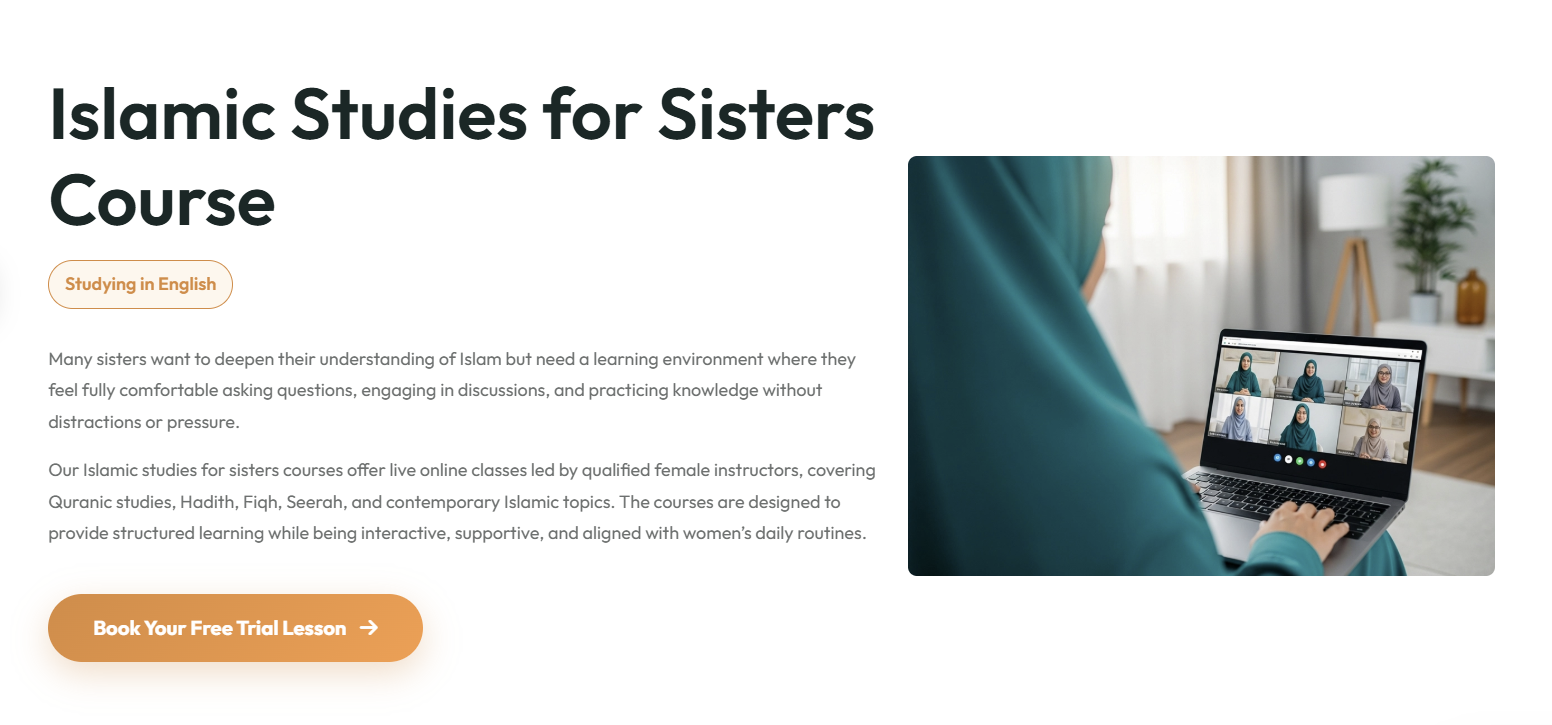
Ready to study these rights from the primary sources? Our women-only classes turn scattered information into structured understanding — Islamic Studies for Sisters (Women-Only).
The Core Roles Islam Honours For A Woman
Islamic teaching does not confine a woman to a single function. It recognises several honoured roles that reinforce each other rather than compete.
1. The Woman As A Seeker Of Sacred Knowledge
Learning is an obligation on every Muslim woman, and the Prophet ﷺ actively made space for it. The women of Madinah asked him for dedicated teaching time — and he granted it.
It is narrated in Sahih al-Bukhari that the women said to the Prophet ﷺ:
“غَلَبَنَا عَلَيْكَ الرِّجَالُ فَاجْعَلْ لَنَا يَوْمًا مِنْ نَفْسِكَ”
"The men have got the better of us with you, so appoint a day for us from yourself." — Sahih al-Bukhari 101, narrated by Abu Sa'id al-Khudri
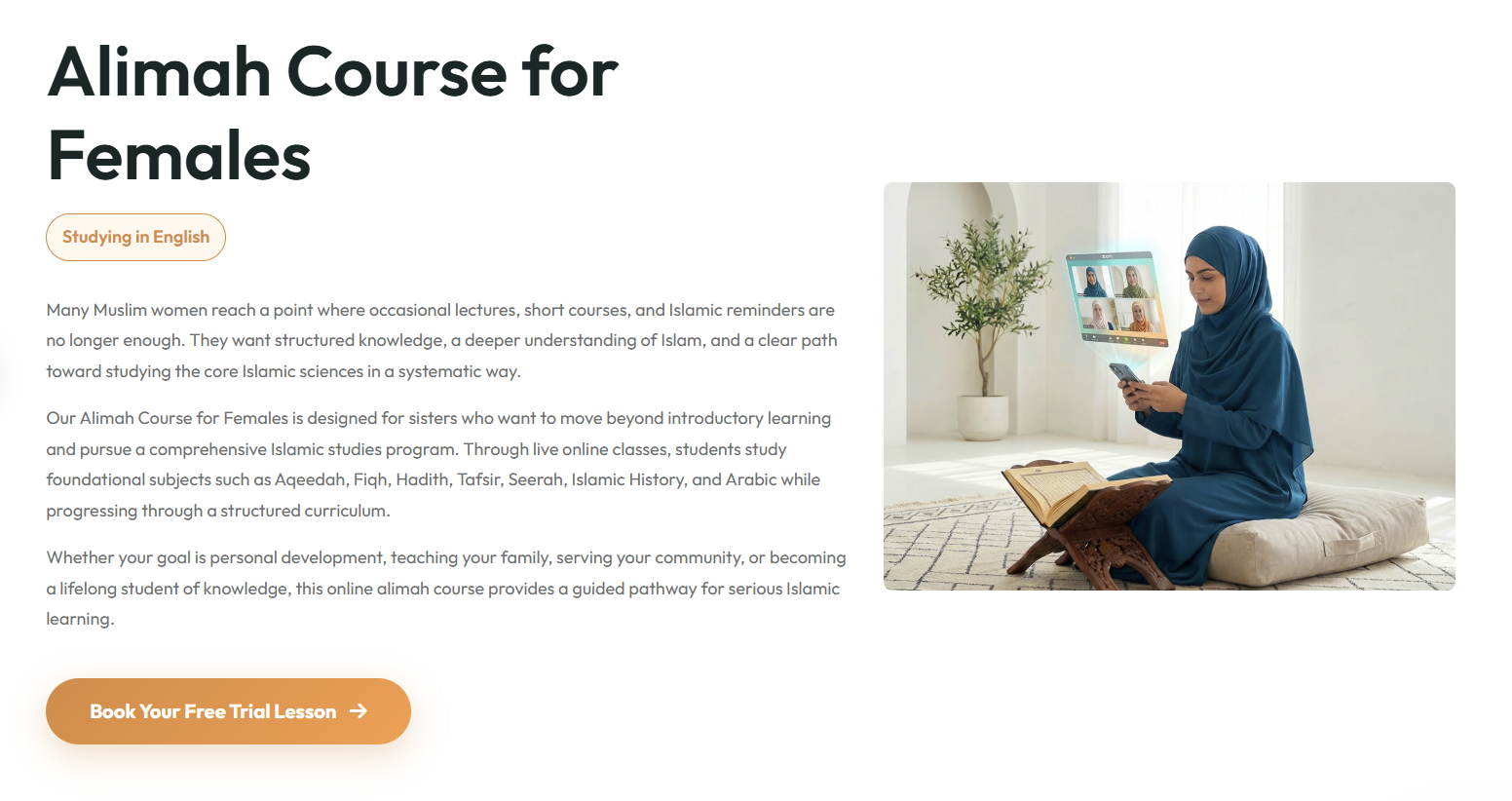
Aisha (RA) went on to become one of the greatest jurists of the Ummah. Serious female scholarship is a prophetic precedent, which is why our Alimah Course for Females follows a traditional scholarly path.
2. The Woman As Daughter, Wife, And Mother
Family roles in Islam carry immense reward — and clear obligations on the men around her, not only on her.
The Messenger of Allah ﷺ said:
“خَيْرُكُمْ خَيْرُكُمْ لِأَهْلِهِ وَأَنَا خَيْرُكُمْ لِأَهْلِي”
"The best of you is the best to his wives, and I am the best of you to my wives." — Jami' at-Tirmidhi 3895, graded Sahih
Motherhood is elevated above almost every other station, and raising righteous children is treated as ongoing charity, not unpaid labour.
3. The Woman As A Builder Of Her Community
Islam women's roles extend well beyond the home. Believing women are commanded to shape public morality alongside believing men.
Allah, Glorified and Exalted, says:
“وَالْمُؤْمِنُونَ وَالْمُؤْمِنَاتُ بَعْضُهُمْ أَوْلِيَاءُ بَعْضٍ يَأْمُرُونَ بِالْمَعْرُوفِ وَيَنْهَوْنَ عَنِ الْمُنكَرِ”
"The believers, both men and women, are guardians of one another. They encourage good and forbid evil." — Surah At-Tawbah 9:71
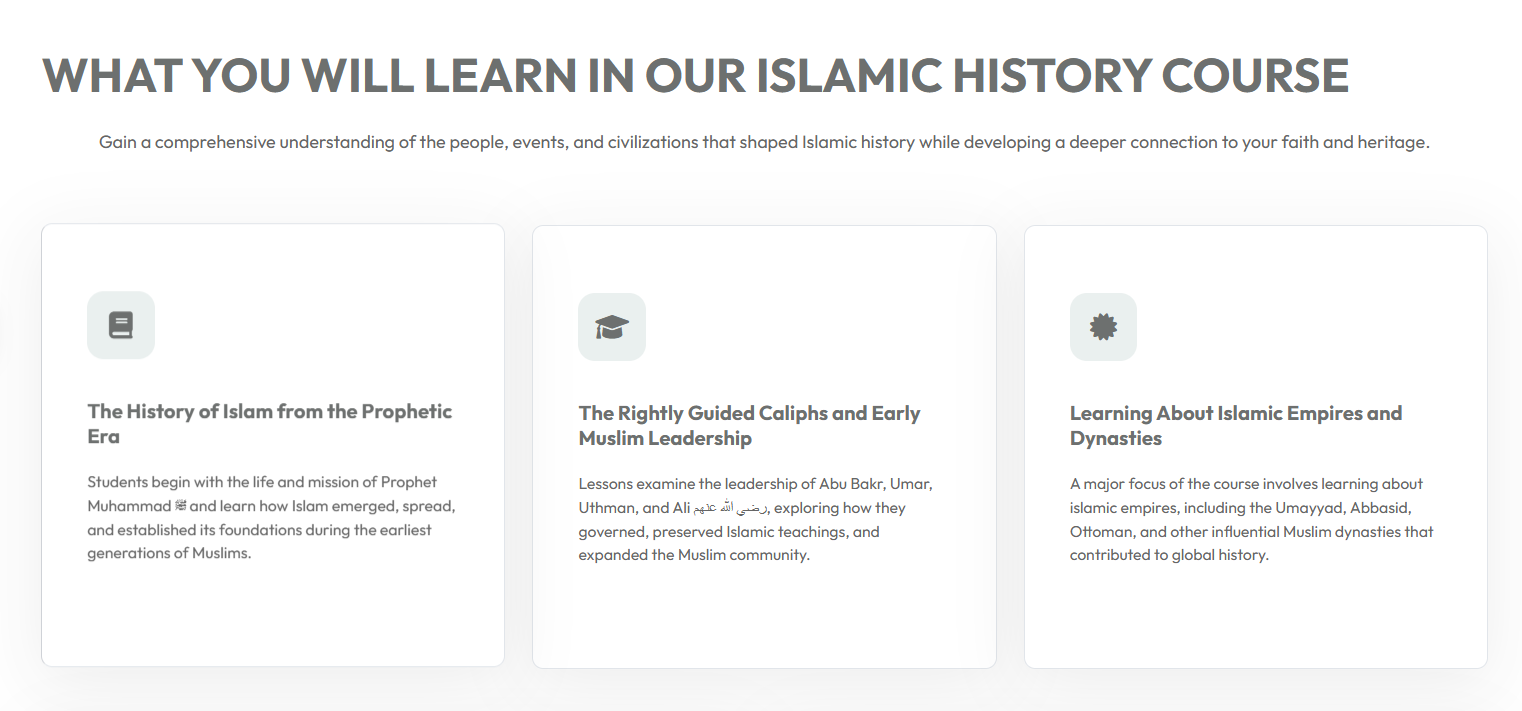
Women in Islamic history taught, funded mosques, narrated hadith, treated the wounded, and issued legal opinions — a legacy explored in our Islamic History Course for sisters.
Shots from Our Classes
Take a moment to view the video below to see how our teachers provide clear, supportive corrections during a session.
Enrich Your Islamic Knowledge
Deepen your understanding of Fiqh, Aqeedah, and Hadith with dedicated female scholars at Sister Nourhan Academy.
Start Your Free Trial NowThe Islamic Way Of Life For A Woman In Daily Practice
Theory matters, but sisters usually need answers for Tuesday afternoon — not just for theology class. Here is how the framework translates into ordinary days.
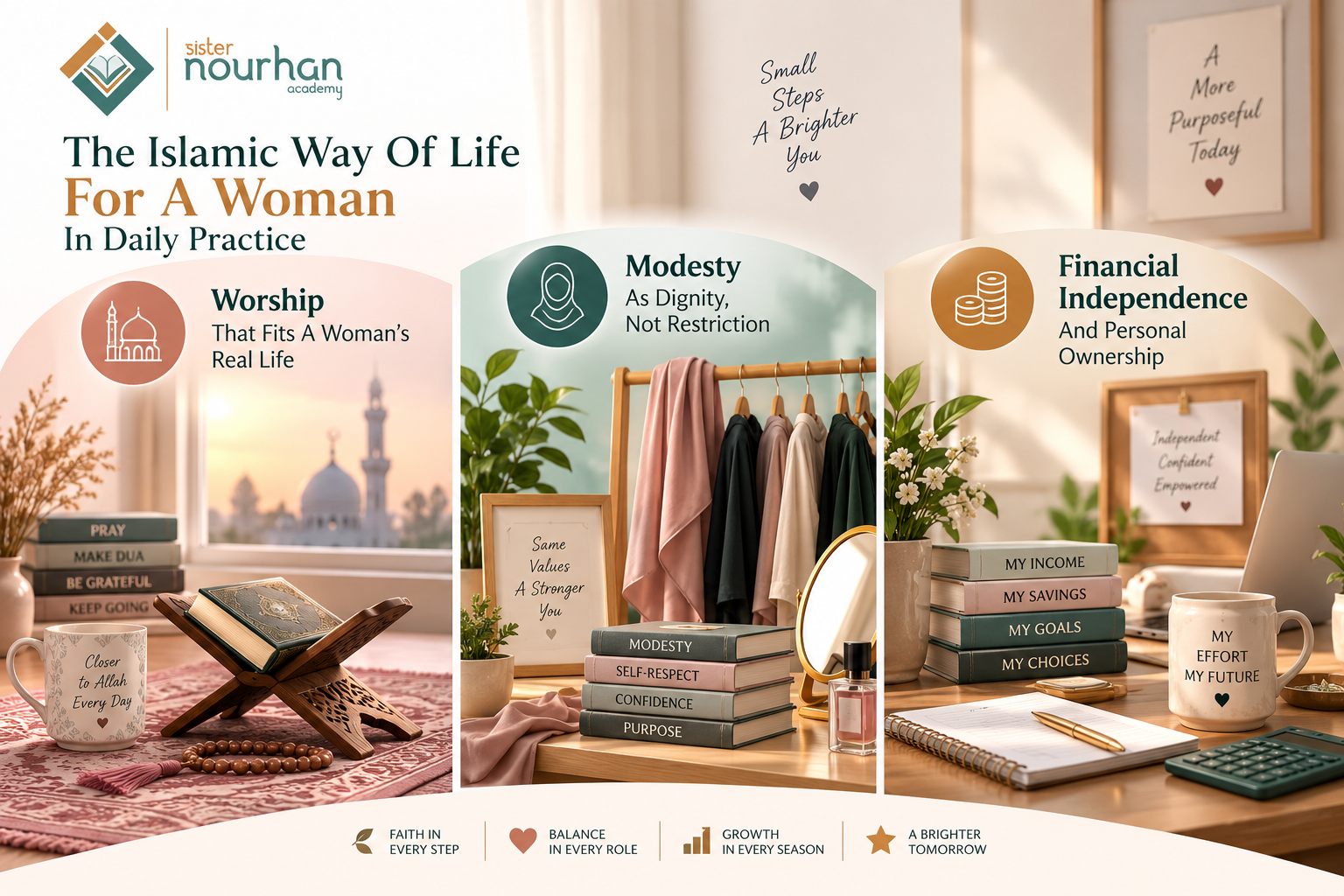
1. Worship That Fits A Woman's Real Life
Islamic law is deliberately flexible around a woman's biology and responsibilities. Missed prayers during menstruation are not made up, travel and illness bring concessions, and attending the masjid is a right, not a requirement.
Many sisters have practical questions here, which is why we wrote a full guide on whether Can I Read the Quran on My Period? What Every Muslim Woman Should Know. For daily remembrance that anchors a busy schedule, the Dua & Adhkar Course for Females and sisters is a strong starting point.
2. Modesty As Dignity, Not Restriction
Hijab in Islam is an act of worship and an assertion of self-definition, not a mark of inferiority. It governs behaviour, speech, and gaze for both genders — men are addressed first in the Qur'an's modesty verses.
If you're unsure about specific rulings, our article on Do You Have to Wear Hijab When Reading Quran? Clear Rulings for Every Sister breaks down the evidence clearly.
3. Financial Independence And Personal Ownership
A Muslim woman's money is entirely hers. Her husband cannot claim her salary, her mahr, or her inheritance, and he remains financially responsible for the household regardless of her wealth.
For rulings on contracts, inheritance shares, and financial obligations, official bodies publish English-language guidance — Egypt's Dar Al-Ifta is one recognised authority. To study these principles systematically, sisters often begin with our Fiqh Course.
Common Misconceptions About Women's Roles In Islam
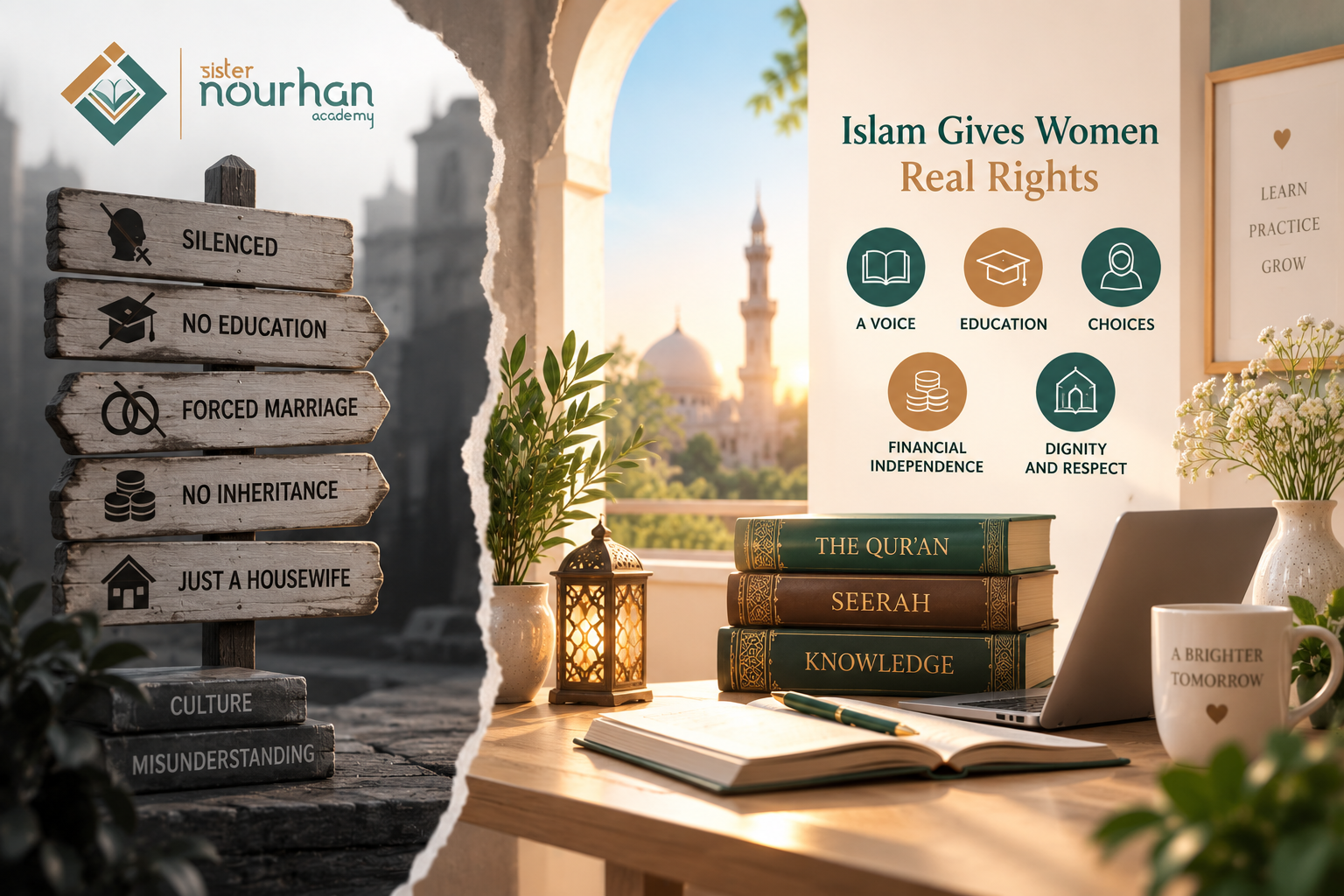
Most confusion about women's roles in Islam comes from two sources: selective quotation, and cultural practice presented as revelation. Both are correctable with evidence.
Does Islam Silence Women?
No — Islamic sources record women openly questioning, correcting, and negotiating with authority. A woman publicly challenged Umar ibn al-Khattab on mahr limits during his caliphate, and he accepted her argument.
Academic overviews confirm this diversity of experience; Harvard University's Pluralism Project notes there is no singular role or experience for women in Islam, and that many Muslim women describe their faith as liberating rather than restrictive.
Culture Is Not The Same As Islamic Law
Forced marriage, denial of education, and denial of inheritance are cultural violations that Islamic law explicitly prohibits. Confusing local custom with sharia is the single most common error in this discussion.
The clearest antidote is studying the Prophet's own conduct with the women around him, which is exactly the focus of our Seerah Course for Sisters.
See our teaching methods
Experience the quality of our instruction firsthand by watching a live lesson snippet below.
Enrich Your Islamic Knowledge
Deepen your understanding of Fiqh, Aqeedah, and Hadith with dedicated female scholars at Sister Nourhan Academy.
Start Your Free Trial NowStudy The Role Of Women In Islam With Sister Nourhan Academy
Everything above raises one honest question: where does a sister actually go to learn this properly, without judgement and without a men's classroom?
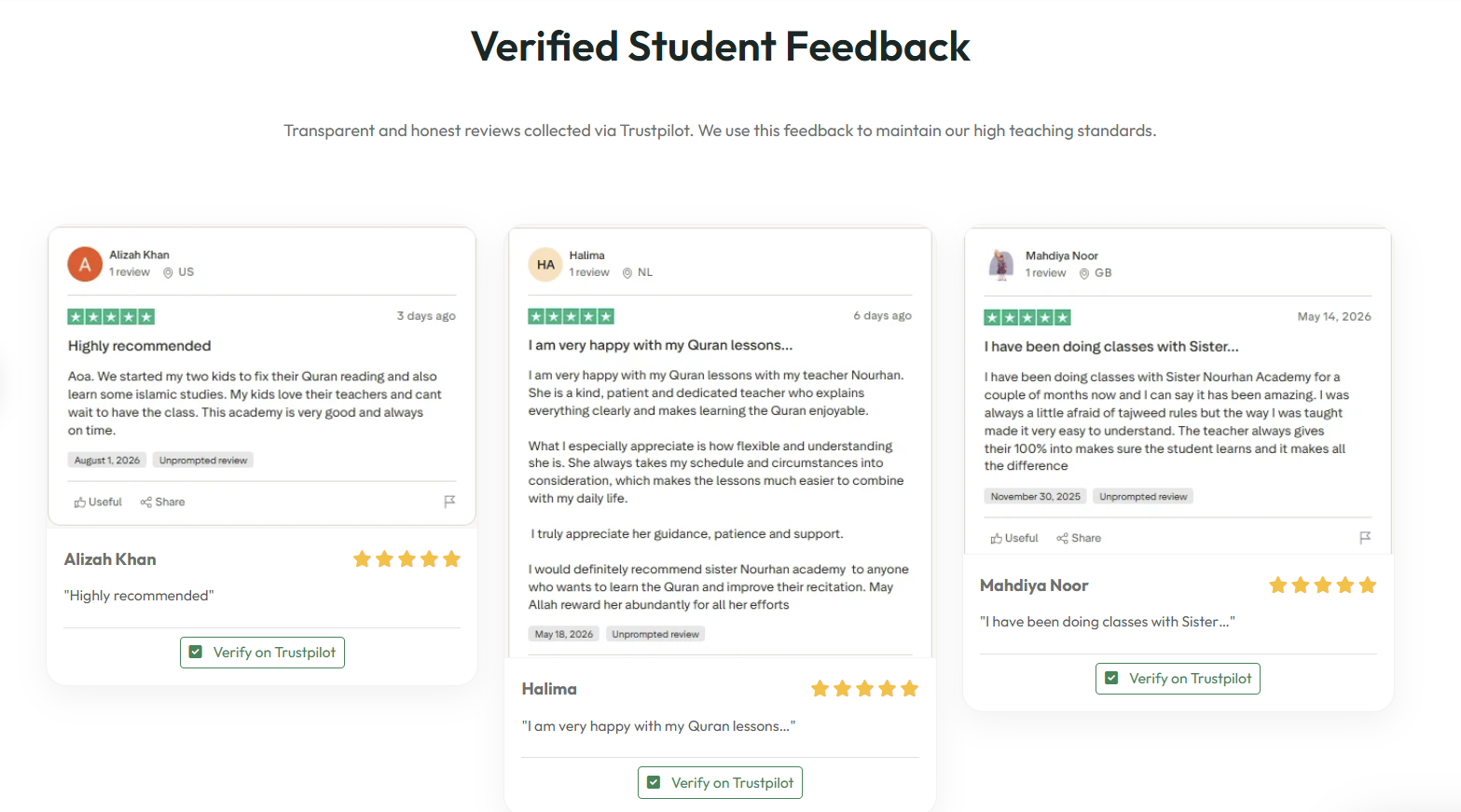
That's the exact gap Sister Nourhan Academy has filled since 2018. Every class is one-on-one and live, so you're never one voice in a crowded room — you ask the awkward question, you get a direct answer.
All of our sisters' programmes are taught by certified female instructors, several Al-Azhar qualified. That matters enormously for this topic: rulings on hijab, purity, marriage, and inheritance are easier to discuss woman-to-woman.
Our scheduling runs from 8 AM to 2 AM Egypt Time, which means classes fit around school runs, night shifts, and every time zone from Toronto to Kuala Lumpur. Sessions are rescheduled, not lost, when life happens.
You also choose your depth. Some sisters want the essentials of practice — how to pray correctly, what breaks wudu, what her rights are in marriage. Others want the full scholarly track through fiqh, tafseer, and hadith methodology. Both paths exist here.
And if your goal is reading the evidence yourself rather than through translation, our Arabic and Qur'an tracks connect directly to it. Understanding bil-ma'ruf in Arabic changes how you read every verse about women.
Book Your Free Trial Lesson Today!
Take one free trial class with a certified female teacher this week. No payment details, no commitment — just a real lesson so you can judge the teaching quality yourself.
Tell us where you are right now: brand new to Islamic studies, returning after years away, or ready for advanced scholarship. We'll match you with the teacher and track that fits, not a generic package.
Visit Sister Nourhan Academy, choose your programme, and pick a time that suits your week. Your first session can be scheduled within 24 hours.
Discover our Islamic Studies Courses

Conclusion
The role of women in Islam rests on four pillars: equal spiritual worth, protected legal rights, honoured family standing, and an active place in community life. The Qur'an judges by faith and action, not gender. The Sunnah shows a Prophet ﷺ who made teaching time for women and set the standard for how they should be treated.
Most of the confusion around this subject dissolves the moment you separate revelation from custom, and read the sources rather than the summaries.
The one thing to walk away with: your dignity as a Muslim woman is not something you have to argue for — it is already written into the religion. Your job is to learn it well enough to live it confidently.
Frequently Asked Questions
What Are The Main Rules Of Islam For Women?
The core rules are the same five pillars required of every Muslim, plus specific guidance on modesty, purity, and family rights. Sister Nourhan Academy covers these essentials step by step in our women-only classes, so nothing stays vague.
How Are Women Treated In Islam?
Islam obligates kindness, financial support, and respect toward women, and the Prophet ﷺ made his own treatment of his wives the measuring stick for every man. Understanding this properly comes from the primary texts, which is exactly what our certified female teachers walk sisters through.
What Can A Woman Not Do In Islam?
The restrictions are few and specific: no worship of anyone besides Allah, no unlawful relationships, no immodest public dress, and no prayer or fasting during menstruation. Almost everything else framed as "forbidden for women" is cultural custom rather than Islamic ruling.
Why Do Women Convert To Islam?
Most cite the clarity of monotheism, the direct relationship with God without intermediaries, and the legal protections Islam gives women over property and marriage. Our Intro to Islam Course for females at Sister Nourhan Academy is designed specifically for new Muslim sisters starting from zero.
Can A Wife Say No To Her Husband In Islam?
Yes — she can refuse anything involving disobedience to Allah, harm to her health, or a genuine excuse, and marriage in Islam is built on mutual consultation and mercy. Obedience is never unconditional, and no ruling permits coercion.