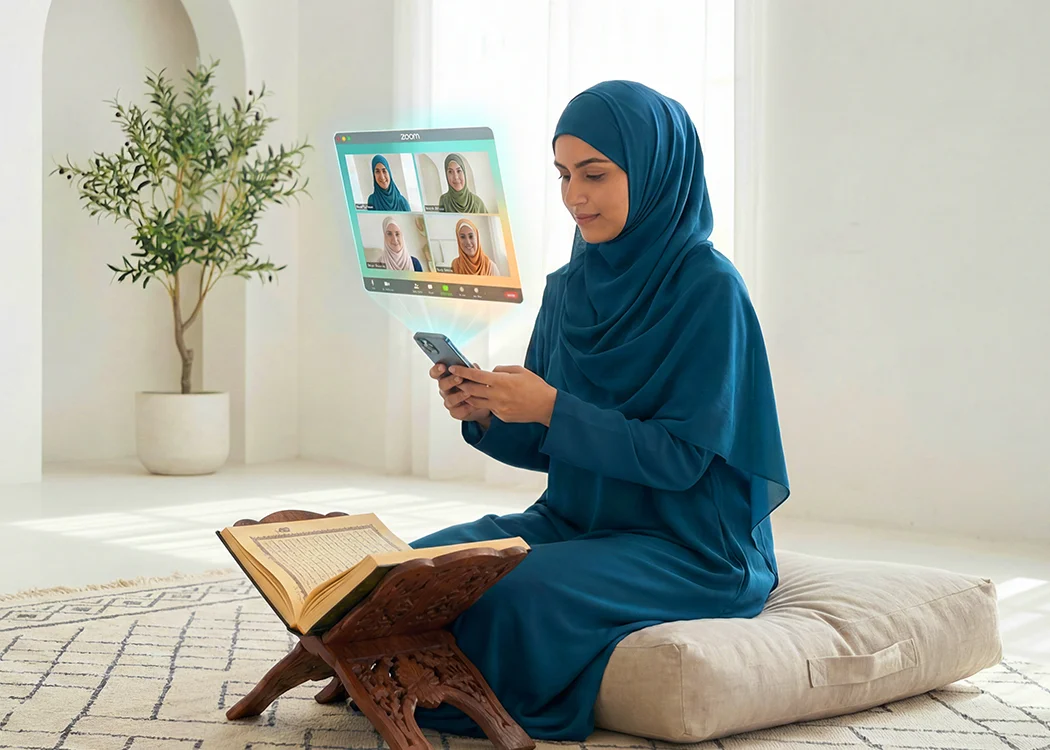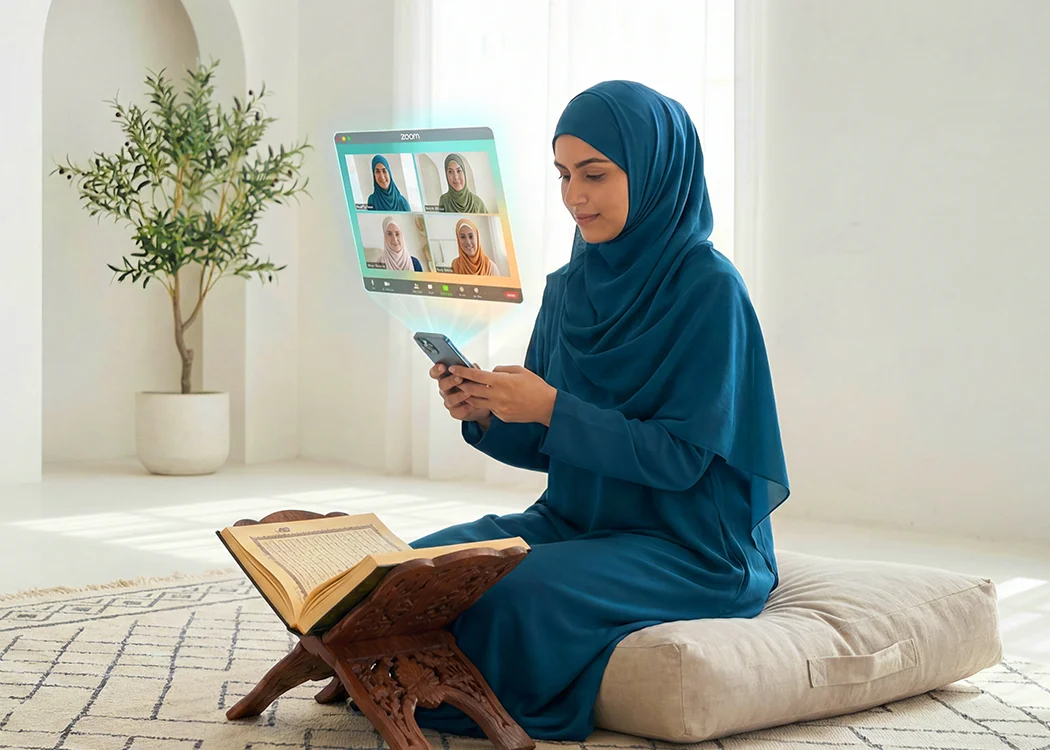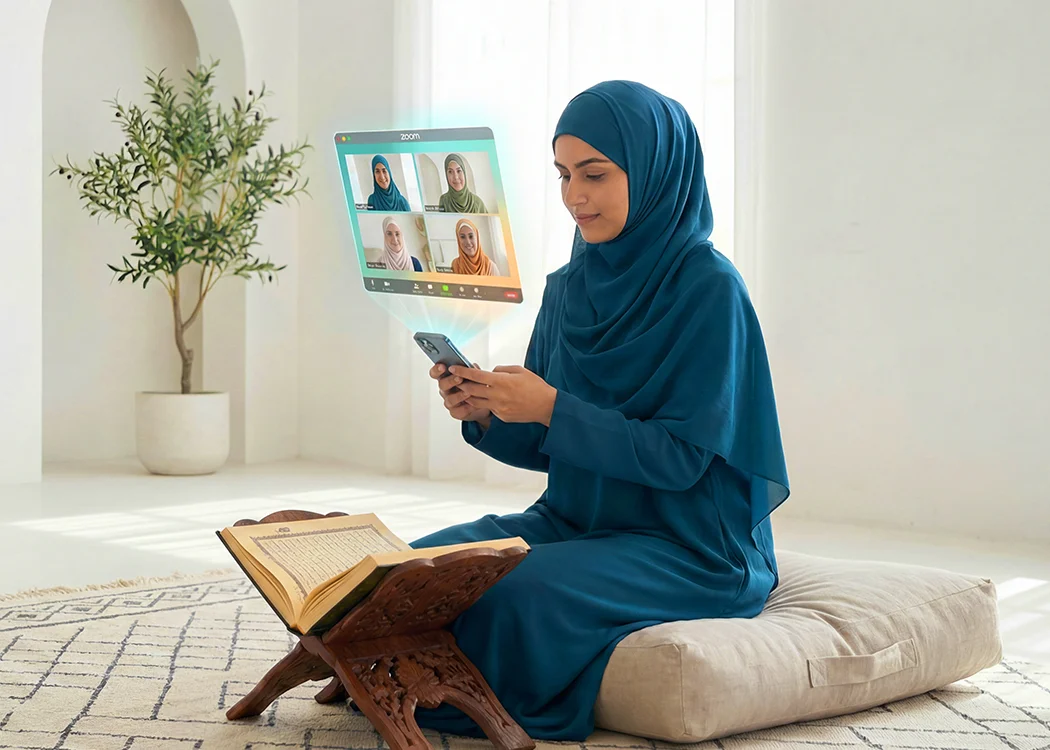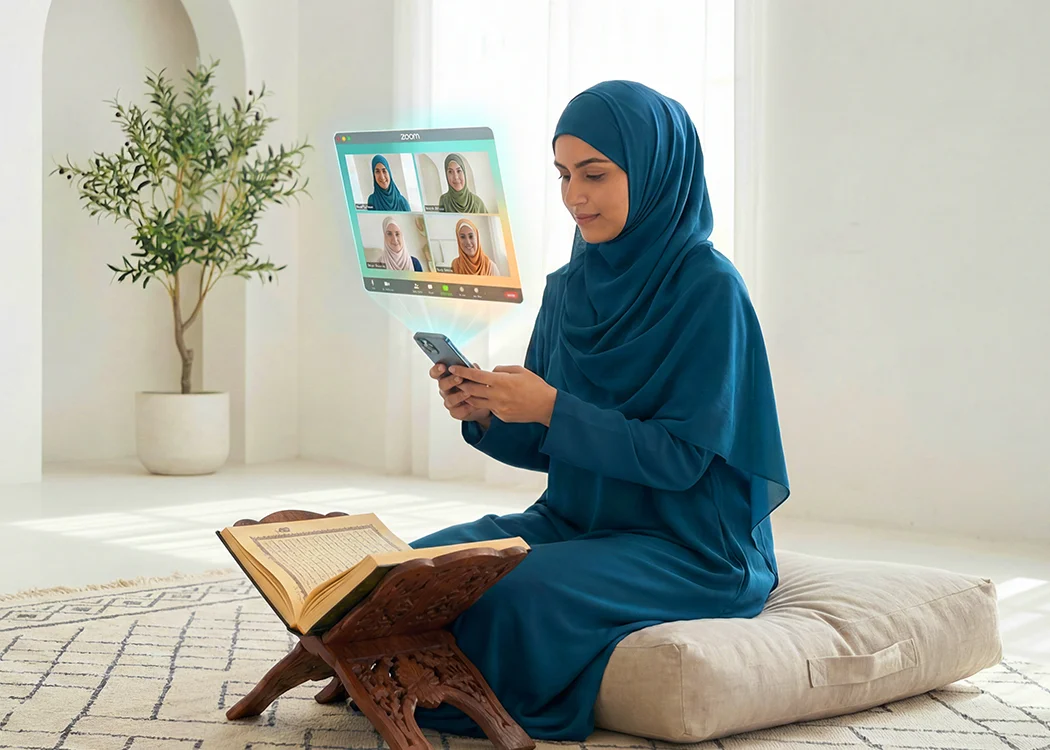
Do all Muslim women have to wear hijab? In mainstream Islamic jurisprudence, hijab is a religious obligation for an adult Muslim woman in the presence of men who are not her mahrams. However, saying that hijab is obligatory is different from saying that every Muslim woman actually wears it.
Muslim women differ in their practice, circumstances, understanding, and personal journey. Some wear hijab consistently, some do not, and others may be working toward observing it.
It is also important to distinguish hijab from niqab. Covering the hair and dressing modestly are not exactly the same question as covering the face, an issue on which Islamic jurists have discussed different rulings.
Understanding these distinctions helps answer the question without reducing hijab either to a cultural custom or to a simple piece of fabric.
Do All Muslim Women Have to Wear Hijab According to Islam?
Yes. According to the mainstream position of Islamic jurisprudence, an adult Muslim woman is required to observe hijab before non-mahram men. Hijab in this context includes covering the hair and body according to Islamic standards of modest dress.
The obligation should not, however, be confused with actual practice. A religious duty can remain a duty even when an individual Muslim does not consistently observe it.
What Does Hijab Mean in Islam?
Hijab is the Islamic principle of modesty and appropriate covering that regulates dress and interaction between men and women.
In everyday English, hijab usually means the headscarf worn by Muslim women to cover the hair and neck while leaving the face visible. In Islamic discussions, however, the concept of hijab is broader than a scarf.
It involves modest clothing, conduct, speech, and boundaries between unrelated men and women. Men also have Islamic requirements concerning modesty, although their dress requirements differ from those of women.
Do Muslim Women Have to Cover Their Hair?
According to the mainstream scholarly position, Muslim women have to cover their hair in front of non-mahram men after reaching puberty.
The hair is therefore not treated as an optional part of modest dress in the traditional legal understanding of hijab.
A woman does not have to keep her hair covered in every setting. For example, hijab rules differ when she is alone, with her husband, or among people before whom Islamic law does not require the same covering.
Practitioner note: This distinction matters because the statement “Muslim women must cover their hair” can sound as though the hair must remain covered continuously. Islamic dress rulings depend on who is present and the setting, not simply whether a woman is outside her home.
Does Every Muslim Woman Wear Hijab?
No, not every Muslim woman wears hijab, even though mainstream Islamic scholarship considers it obligatory.
Muslims, like followers of other religions, vary in how consistently they practice religious teachings. A Muslim woman who does not wear hijab does not automatically cease to be Muslim because of that choice.
This distinction provides the clearest answer to the related question “Do all Muslim women wear hijabs?” Religious obligation and individual observance are two separate questions.
For women who want to strengthen their daily connection with Allah through authentic supplications and remembrance, Sister Nourhan Academy’s Dua & Adhkar Course for Females and Sisters offers structured, female-focused guidance to help you understand, learn, and confidently incorporate essential Duas and Adhkar into everyday life.
What Does the Quran Say About Hijab and Covering?
The Quran discusses modesty through several passages rather than presenting women's dress in one isolated verse. Understanding these passages together is important when asking why Muslim women cover their hair.
Two particularly important passages concerning women's clothing are Surah An-Nur 24:31 and Surah Al-Ahzab 33:59.
Surah An-Nur 24:31 and the Khimar
Surah An-Nur instructs believing women concerning modesty and explains how the khimar should be worn to cover the chest and neckline.
وَقُل لِّلْمُؤْمِنَاتِ يَغْضُضْنَ مِنْ أَبْصَارِهِنَّ وَيَحْفَظْنَ فُرُوجَهُنَّ وَلَا يُبْدِينَ زِينَتَهُنَّ إِلَّا مَا ظَهَرَ مِنْهَا ۖ وَلْيَضْرِبْنَ بِخُمُرِهِنَّ عَلَىٰ جُيُوبِهِنَّ
“And tell the believing women to lower their gaze and guard their chastity, and not to reveal their adornments except what normally appears. Let them draw their veils over their chests.”— Surah An-Nur (24:31)
The word khumur is the plural of khimar, while juyub refers to the openings around the chest or neckline. Classical Muslim scholars understood this instruction as requiring the existing head covering to be drawn over the neck and chest.
This linguistic detail is important because the verse does not discuss modesty only as an abstract principle. It gives a specific instruction concerning how the covering should be worn.
Surah Al-Ahzab 33:59 and the Outer Garment
Another central Quranic passage addresses women's public clothing by instructing the Prophet ﷺ to tell his wives, daughters, and believing women to draw their outer garments over themselves.
يَا أَيُّهَا النَّبِيُّ قُل لِّأَزْوَاجِكَ وَبَنَاتِكَ وَنِسَاءِ الْمُؤْمِنِينَ يُدْنِينَ عَلَيْهِنَّ مِن جَلَابِيبِهِنَّ ۚ ذَٰلِكَ أَدْنَىٰ أَن يُعْرَفْنَ فَلَا يُؤْذَيْنَ ۗ وَكَانَ اللَّهُ غَفُورًا رَّحِيمًا
“O Prophet! Ask your wives, daughters, and believing women to draw their cloaks over their bodies. In this way it is more likely that they will be recognized and not be harassed. And Allah is All-Forgiving, Most Merciful.”— Surah Al-Ahzab (33:59)
The verse establishes a recognizable standard of modest public dress through the jilbab, an outer garment worn over the body.
Taken together, Surah An-Nur 24:31 and Surah Al-Ahzab 33:59 form an important part of the Quranic foundation from which classical Muslim jurists developed the rules concerning women's hijab and public dress.
Read also: Does the Quran consider males and females to be equal?
Surah Al-Ahzab 33:53 contains the phrase “from behind a hijab” and directly addresses interaction with the wives of the Prophet ﷺ.
This verse deserves careful treatment because the Quranic word hijab here means a barrier, screen, or partition rather than simply the modern headscarf.
Shots from Our Classes
Take a moment to view the video below to see how our teachers provide clear, supportive corrections during a session.
Enrich Your Islamic Knowledge
Deepen your understanding of Fiqh, Aqeedah, and Hadith with dedicated female scholars at Sister Nourhan Academy.
Start Your Free Trial NowWhy Do Muslim Women Cover Their Hair?
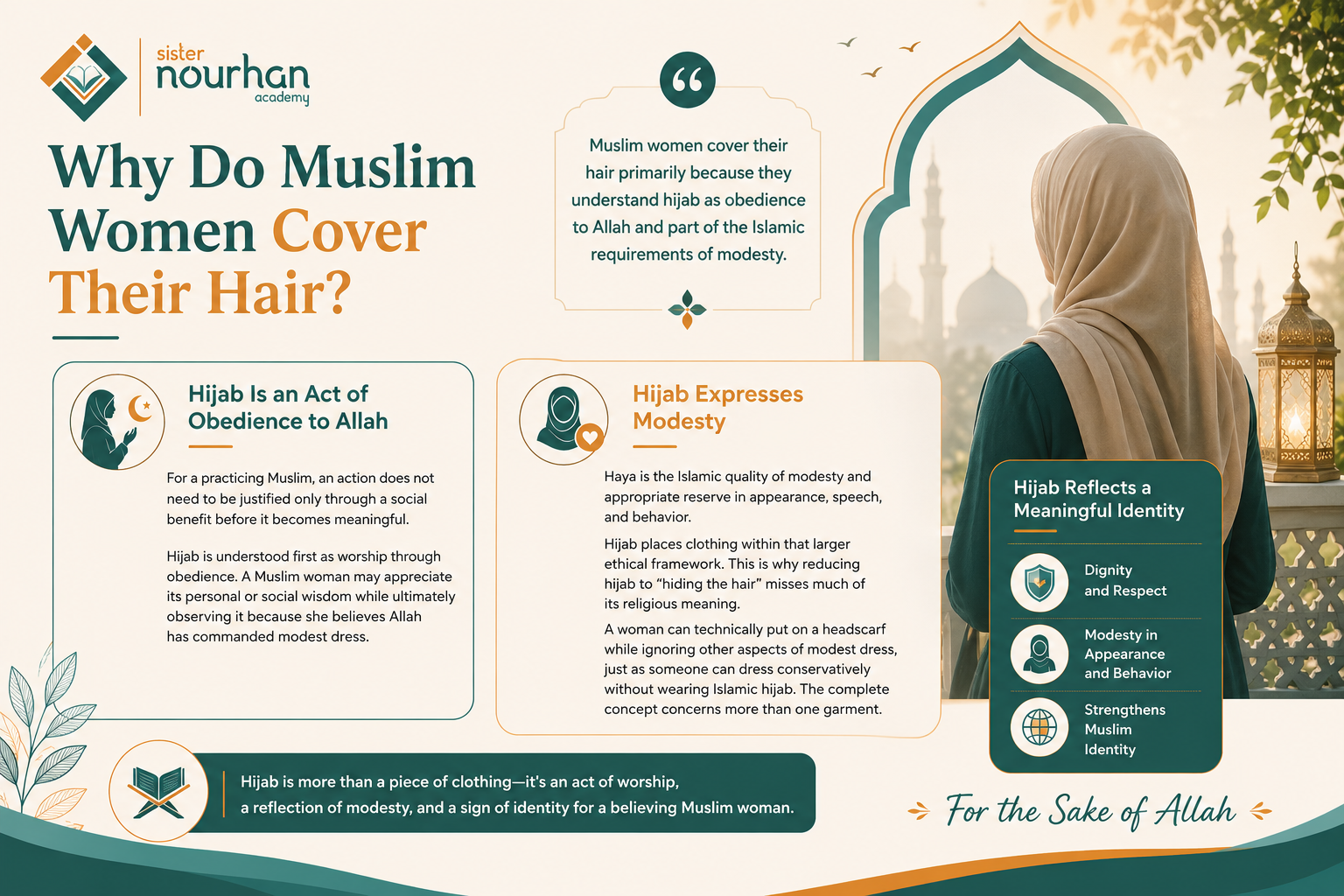
Muslim women cover their hair primarily because they understand hijab as obedience to Allah and part of the Islamic requirements of modesty.
Modesty, dignity, and Muslim identity can all be meaningful aspects of hijab, but religious obedience comes first when explaining its Islamic basis.
Hijab Is an Act of Obedience to Allah
For a practicing Muslim, an action does not need to be justified only through a social benefit before it becomes meaningful.
Hijab is understood first as worship through obedience. A Muslim woman may appreciate its personal or social wisdom while ultimately observing it because she believes Allah has commanded modest dress.
Read also: Does Islam permit men to hit their wives according to the Quran?
Hijab Expresses Modesty
Haya is the Islamic quality of modesty and appropriate reserve in appearance, speech, and behavior.
Hijab places clothing within that larger ethical framework. This is why reducing hijab to “hiding the hair” misses much of its religious meaning.
A woman can technically put on a headscarf while ignoring other aspects of modest dress, just as someone can dress conservatively without wearing Islamic hijab. The complete concept concerns more than one garment.
Hijab Can Express Muslim Identity
For many women, hijab also becomes a visible expression of Islamic identity.That meaning should still be distinguished from the source of the ruling.
Muslim women do not have to justify hijab solely as a cultural symbol or identity statement; within Islam, its primary basis is religious.
If questions about hijab lead to deeper questions about faith, worship, and the foundations of Islamic belief, Sister Nourhan Academy offers structured learning for women through its Aqeedah Course (Islamic Creed) for Sisters, helping sisters understand essential matters of Aqeedah with clear, teacher-guided instruction.

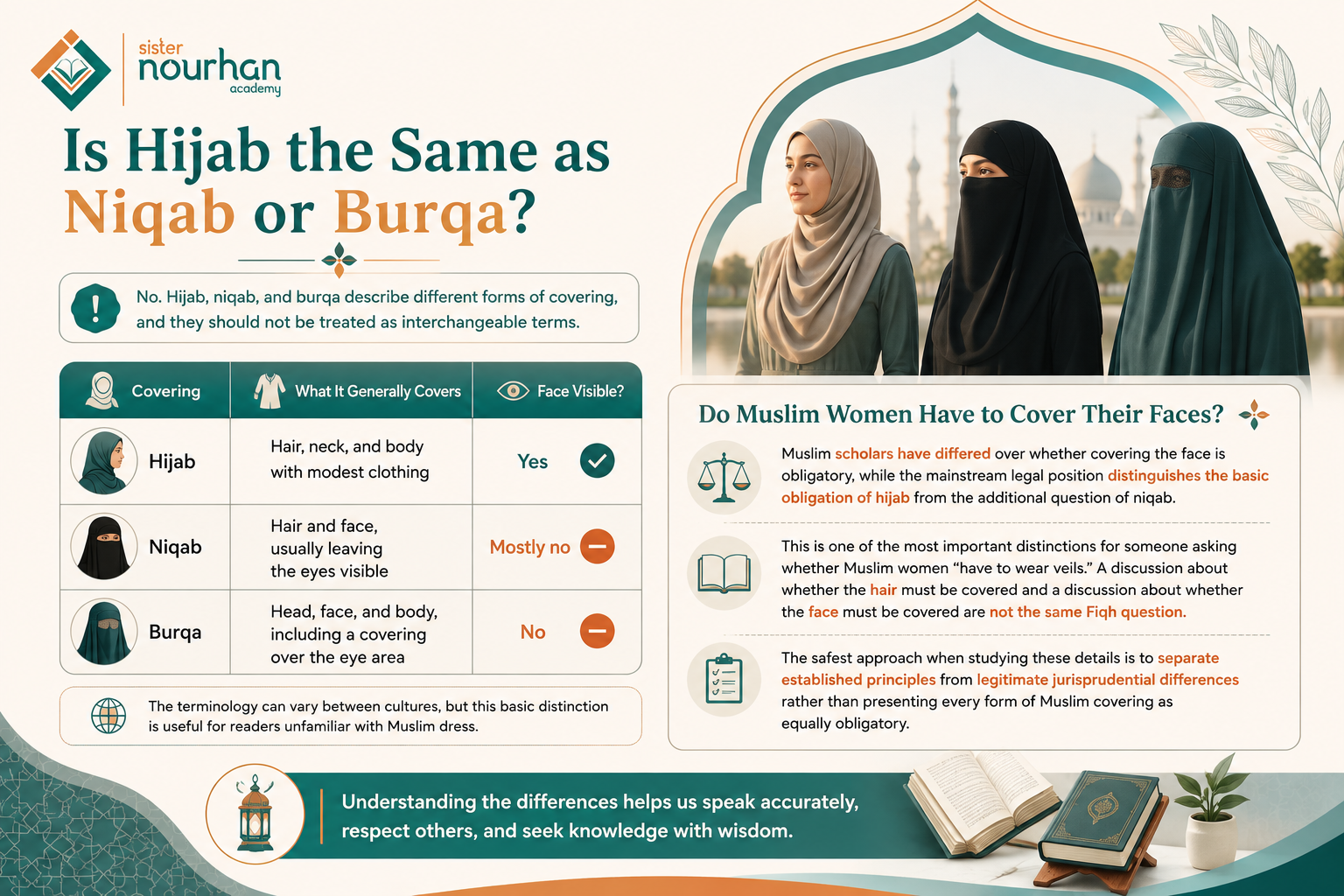
Is Hijab the Same as Niqab or Burqa?
No. Hijab, niqab, and burqa describe different forms of covering, and they should not be treated as interchangeable terms.
The terminology can vary between cultures, but this basic distinction is useful for readers unfamiliar with Muslim dress.
Do Muslim Women Have to Cover Their Faces?
Muslim scholars have differed over whether covering the face is obligatory, while the mainstream legal position distinguishes the basic obligation of hijab from the additional question of niqab.
This is one of the most important distinctions for someone asking whether Muslim women “have to wear veils.”
A discussion about whether the hair must be covered and a discussion about whether the face must be covered are not the same Fiqh question.
The safest approach when studying these details is to separate established principles from legitimate jurisprudential differences rather than presenting every form of Muslim covering as equally obligatory.
Read also: Can women read the Quran during their period?
Hijab Is a Religious Ruling, but Muslim Women's Experiences Are Not Identical
Understanding hijab requires holding two facts together: Islamic law establishes religious standards, while individual Muslim women live those standards in different circumstances.This framework avoids several common misunderstandings.
A Muslim woman wearing hijab may do so willingly as an act of worship. Another Muslim woman may believe hijab is obligatory while struggling to observe it. A third may be learning about the ruling for the first time.
It is therefore inaccurate to assume that every hijabi woman has the same personal story, just as it is inaccurate to conclude that hijab has no religious basis because some Muslim women do not wear it.
Original insight: The most useful way to discuss hijab is through three separate questions: What does Islam teach? What do scholars differ about? What does an individual woman practice? Mixing these three levels is responsible for much of the confusion surrounding hijab online.
See our teaching methods
Experience the quality of our instruction firsthand by watching a live lesson snippet below.
Enrich Your Islamic Knowledge
Deepen your understanding of Fiqh, Aqeedah, and Hadith with dedicated female scholars at Sister Nourhan Academy.
Start Your Free Trial NowStart Learning the Islamic Rulings That Affect Your Daily Life
Questions about hijab often open the door to larger questions about Fiqh, worship, modesty, and women's responsibilities in Islam.
Study these subjects systematically with Sister Nourhan Academy through its Islamic Studies for Sisters Course, where female learners can study Quran, Hadith, Fiqh, Seerah, and practical Islamic topics through structured live classes.
Discover our Islamic Studies Courses
Conclusion
So, do all Muslim women have to wear hijab? According to the mainstream position of Islamic jurisprudence, adult Muslim women are required to observe hijab before non-mahram men, including covering their hair and dressing modestly.
That does not mean every Muslim woman actually wears hijab, nor does it mean every form of covering has exactly the same ruling. The obligation of basic hijab should be distinguished from scholarly discussions surrounding face covering.
Above all, hijab in Islam is understood primarily as an act of obedience and modesty, not simply a cultural fashion or ethnic tradition.
FAQs
Do all Muslim women wear hijabs?
No. Not all Muslim women wear hijab in practice, although mainstream Islamic jurisprudence considers hijab obligatory for adult Muslim women before non-mahram men. Religious teaching and individual practice should not be confused.
Do Muslim women have to cover their hair?
Yes, according to the mainstream Islamic scholarly position, an adult Muslim woman covers her hair before non-mahram men as part of hijab. She does not have to keep her hair covered in every private or family setting.
Why do Muslim women cover their hair?
Muslim women cover their hair primarily because hijab is understood as obedience to Allah and part of Islamic modesty. It can also express haya, dignity, and Muslim identity.
Do Muslim women have to wear niqab?
Scholars have differed over whether covering the face is obligatory, so niqab should not simply be treated as synonymous with the basic hijab requirement. The jurisprudential discussion about the face is distinct from covering the hair and body.
Is hijab only a headscarf?
No. Hijab is a broader Islamic concept of modesty, although in everyday English the word commonly refers to a woman's headscarf. Islamic modesty also concerns clothing, behavior, speech, and interactions with others.