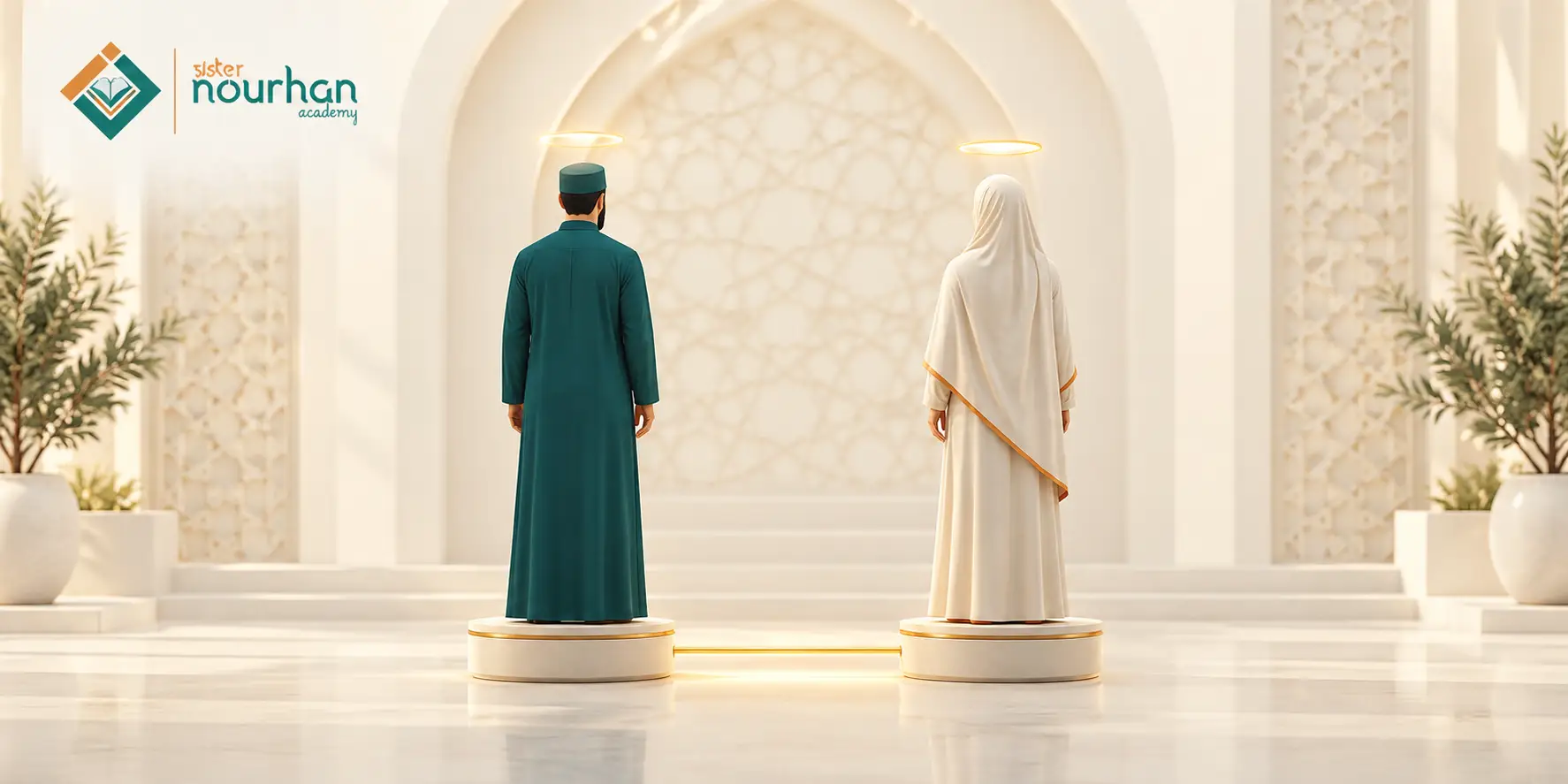
Yes. The Quran establishes men and women as equal in their essential human dignity, spiritual responsibility, moral accountability, and eligibility for Allah’s reward.
However, equality in the Quran does not necessarily mean that men and women have identical roles, duties, or legal rulings in every situation.
The Quran does not present one gender as inherently more human, more worthy of Allah’s mercy, or automatically more righteous than the other. Both men and women share the same human origin, are accountable before Allah, can reach the highest levels of faith, and receive reward according to their deeds.
At the same time, Islamic law recognizes differences between men and women in some family responsibilities, financial obligations, and religious rulings.
The Quranic framework is therefore best understood as equality in human and spiritual worth alongside differences in certain responsibilities and rulings.
Does the Quran Say Men and Women Are Equal?
Yes. The Quran establishes that men and women share the same essential human worth and spiritual accountability before Allah. Both are judged according to faith and righteousness, both are responsible for their deeds, and both are promised reward for good actions.
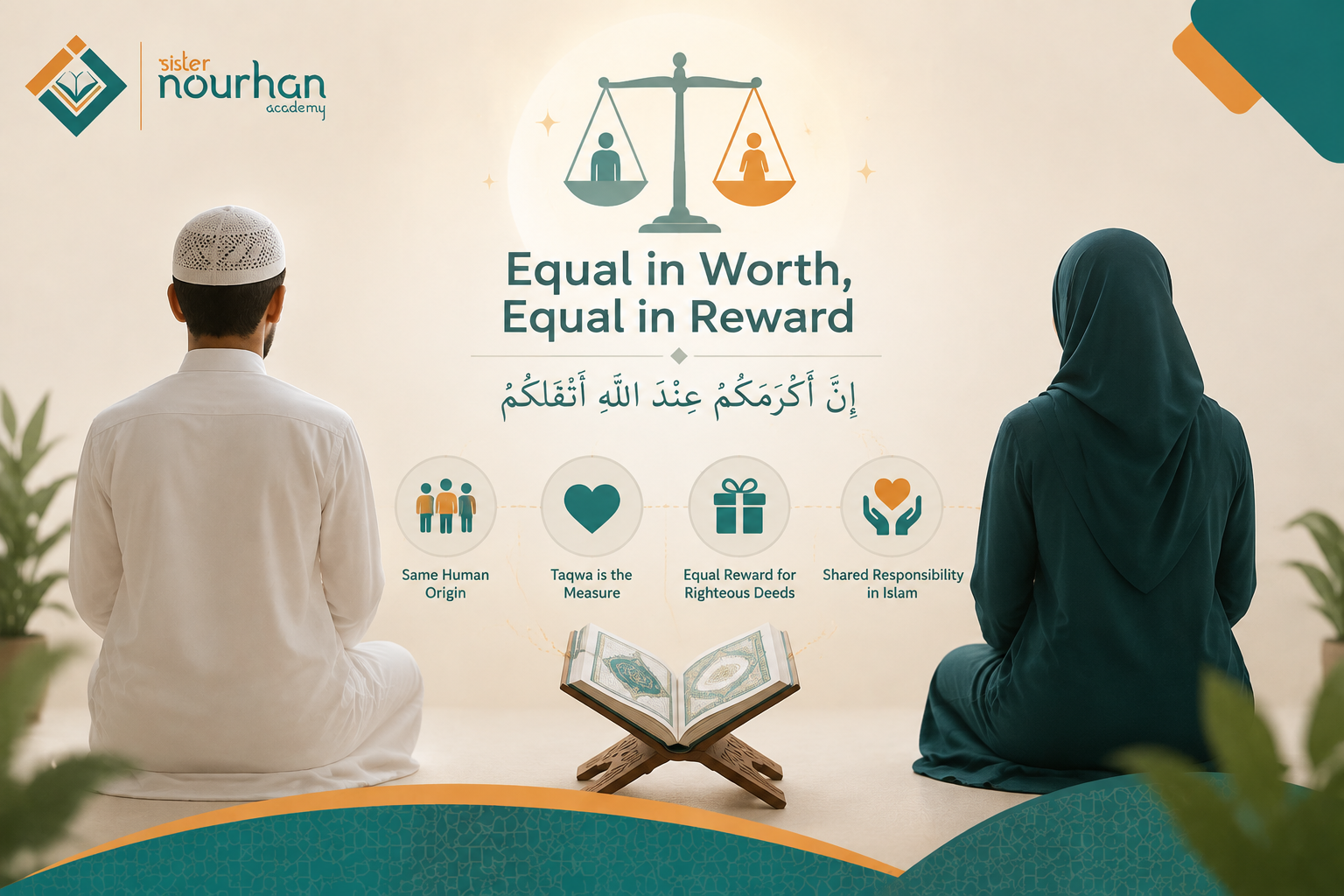
Men and Women Have the Same Human Worth Before Allah
The Quran begins with the shared human origin of men and women:
يَا أَيُّهَا النَّاسُ اتَّقُوا رَبَّكُمُ الَّذِي خَلَقَكُمْ مِنْ نَفْسٍ وَاحِدَةٍ وَخَلَقَ مِنْهَا زَوْجَهَا
“O mankind, fear your Lord, who created you from one soul and created from it its mate.” Surah An-Nisa (4:1)
The verse presents men and women as part of the same human creation rather than assigning them different levels of human worth.
The Quran Makes Taqwa the Measure of Superiority
The Quran does not make being male or female the measure of a person's status before Allah. Instead, it states:
إِنَّ أَكْرَمَكُمْ عِنْدَ اللَّهِ أَتْقَاكُمْ
“Indeed, the most honored of you in the sight of Allah is the most righteous of you.” Surah Al-Hujurat (49:13)
A man is therefore not automatically spiritually superior to a woman simply because he is male. Taqwa—righteousness and consciousness of Allah—is the standard of spiritual excellence.
Allah Promises Men and Women Equal Reward for Righteous Deeds
The Quran explicitly promises that the righteous deeds of both men and women will be recognized:
أَنِّي لَا أُضِيعُ عَمَلَ عَامِلٍ مِنْكُمْ مِنْ ذَكَرٍ أَوْ أُنْثَىٰ بَعْضُكُمْ مِنْ بَعْضٍ
“I will never allow the work of any worker among you to be lost, whether male or female; you are of one another.” Surah Aal Imran (3:195)
The same principle appears in Surah Al-Ahzab (33:35), where Allah mentions Muslim, believing, truthful, patient, charitable, fasting, and God-remembering men and women side by side, promising both forgiveness and a great reward.
Men and Women Are Both Responsible for Upholding Islam
The Quran also describes believing men and women as participants together in the religious and moral life of the Muslim community:
وَالْمُؤْمِنُونَ وَالْمُؤْمِنَاتُ بَعْضُهُمْ أَوْلِيَاءُ بَعْضٍ
“The believing men and believing women are allies of one another.”Surah At-Tawbah (9:71)
The verse describes both as encouraging what is right, discouraging what is wrong, establishing prayer, giving zakah, and obeying Allah and His Messenger.
The Quran therefore establishes shared human dignity, spiritual accountability, moral responsibility, and access to Allah's reward for men and women. Differences in some Islamic rulings or family responsibilities do not mean that one sex possesses greater human or spiritual worth before Allah.
Women who want to strengthen their own relationship with the Quran can also study through 1-on-1 Private Quran Lessons Online, with personalized guidance from a female Quran teacher based on their individual level and learning goals.
In What Ways Are Men and Women Equal in Islam?
Equality in Islam appears most clearly in four major areas: human dignity, spiritual accountability, reward, and individual responsibility before Allah.
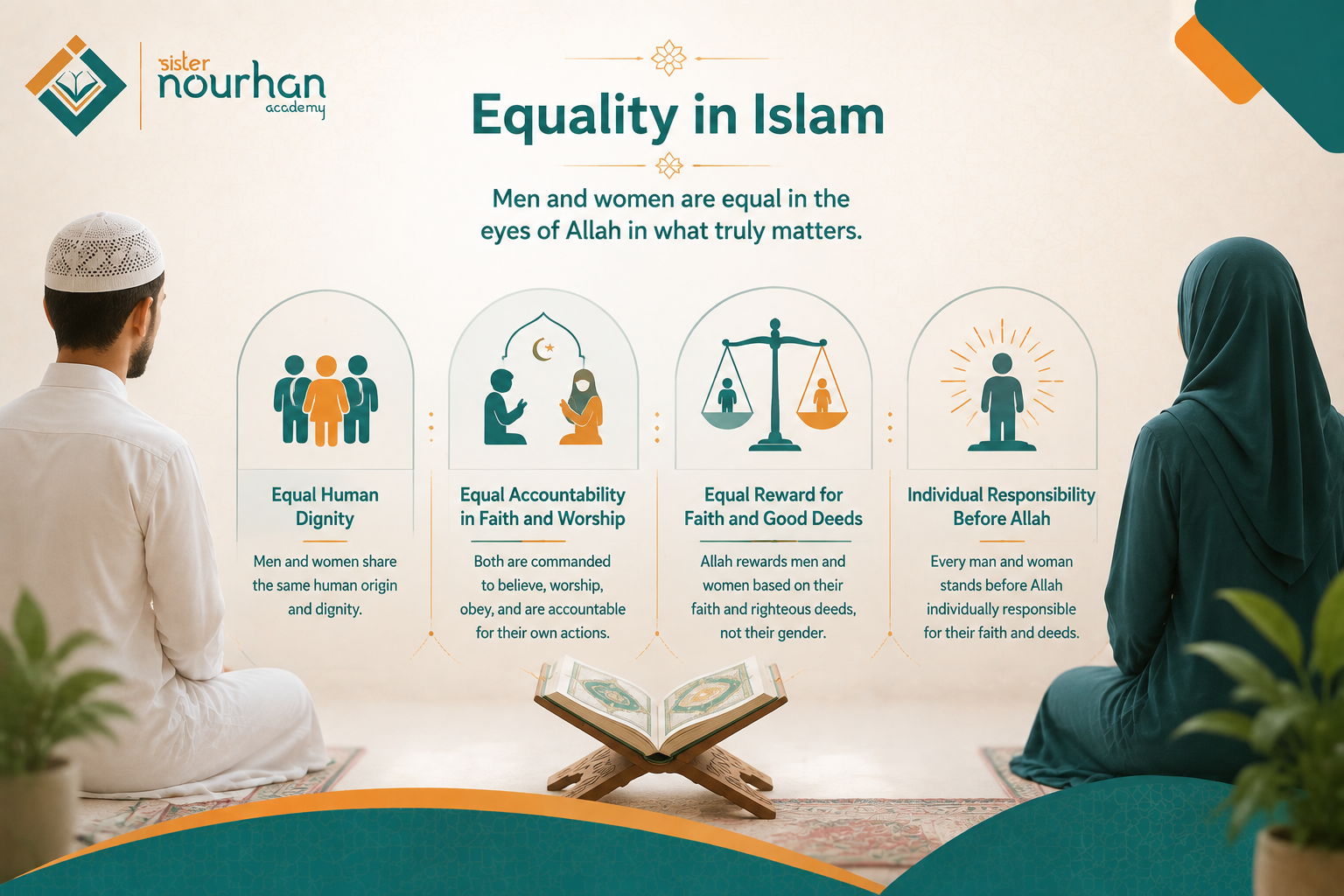
Men and Women Share Equal Human Dignity
Men and women share the same human origin, and neither is presented by the Quran as belonging to a lesser category of humanity.
Being male or female does not determine whether a person is more worthy of Allah's mercy or more valuable as a human being.
Men and Women Are Equally Accountable for Faith and Worship
Both men and women are commanded to believe, worship Allah, obey His guidance, avoid sin, and pursue righteousness. Each person is accountable for his or her own choices.
A woman's religious responsibility is not transferred to her husband, father, or another man. Likewise, a man's righteousness does not remove another person's responsibility for his or her own faith and actions.
Allah Rewards Men and Women According to Their Faith and Good Deeds
The Quran repeatedly promises reward based on faith and righteous deeds rather than gender. Righteous deeds performed by women are not given a lower spiritual value simply because they are performed by women.
Both men and women can earn Allah's forgiveness and reward through sincere faith and obedience.
Every Man and Woman Is Individually Responsible Before Allah
Men and women ultimately stand before Allah as morally responsible individuals. A man cannot rely on being male as a source of spiritual superiority, and a woman does not gain righteousness automatically through the faith of her husband or family.
Each person's faith, choices, and deeds determine his or her individual accountability before Allah.
Shots from Our Classes
Take a moment to view the video below to see how our teachers provide clear, supportive corrections during a session.
Enrich Your Islamic Knowledge
Deepen your understanding of Fiqh, Aqeedah, and Hadith with dedicated female scholars at Sister Nourhan Academy.
Start Your Free Trial NowDoes Equality in the Quran Mean Men and Women Have the Same Roles?
No. Quranic equality does not necessarily mean that men and women must perform identical roles or carry identical legal responsibilities in every situation.
Two people can possess equal human dignity while carrying different responsibilities.
Islamic teachings recognize biological, familial, and practical differences between men and women. Pregnancy and childbirth, for example, are physical experiences specific to women, while traditional Islamic family law places financial maintenance primarily upon the husband.
These differences do not automatically establish greater human worth for either party A responsibility may actually create an additional obligation rather than an additional privilege.
The key distinction is therefore between equal value and identical functions Islamic equality concerns dignity, justice, moral accountability, and spiritual worth. It does not require every legal or family responsibility to be mechanically identical.
Read also: What does Islamic scripture say about female believers in Paradise?
Are Husbands and Wives Equal in Islam?
Yes, husbands and wives have equal human and spiritual worth in Islam, but equality in marriage does not mean that every role or responsibility is identical. Islamic marriage gives both spouses rights, duties, and responsibilities toward one another.
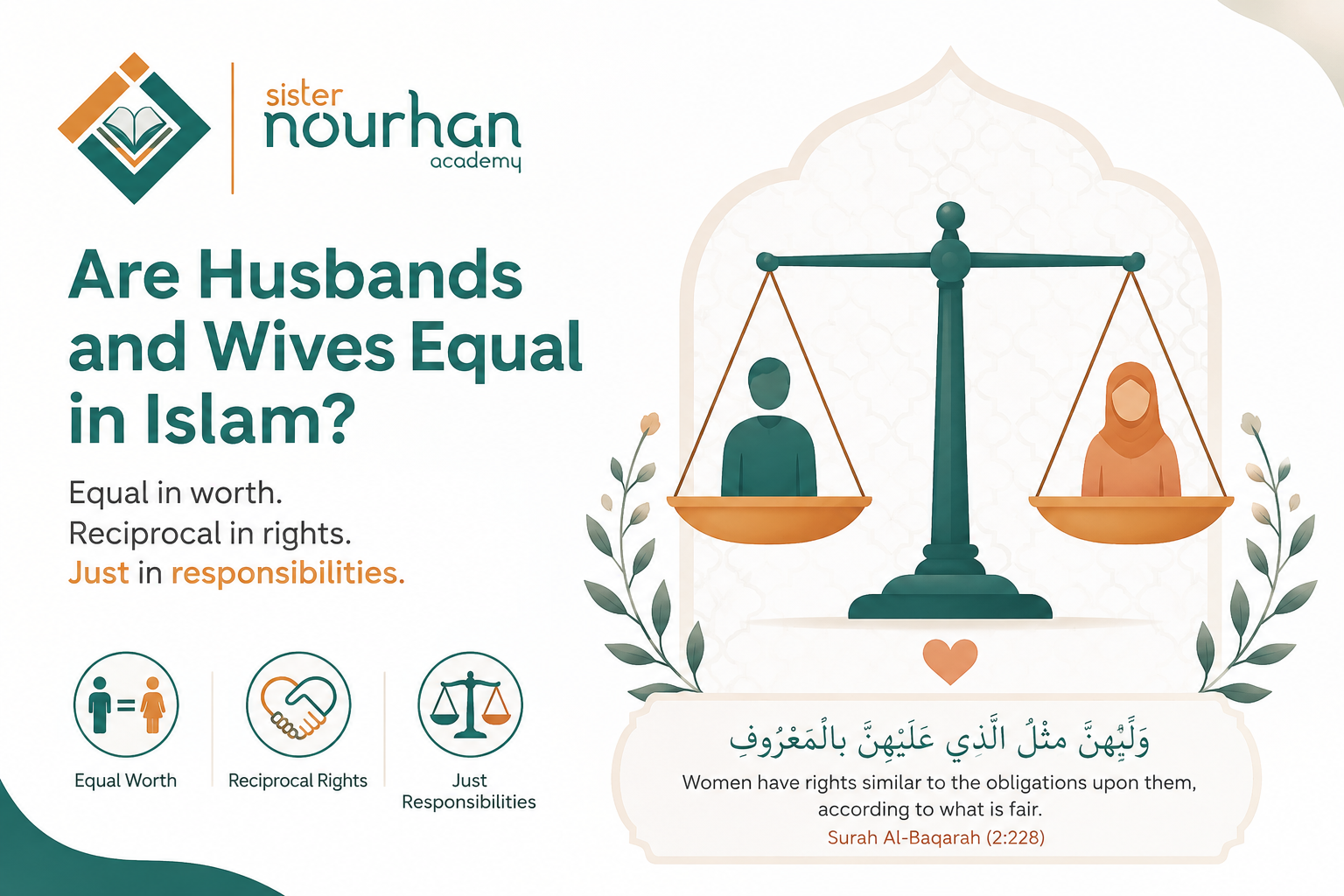
Allah says:
وَلَهُنَّ مِثْلُ الَّذِي عَلَيْهِنَّ بِالْمَعْرُوفِ
“Women have rights similar to the obligations upon them, according to what is fair.” Surah Al-Baqarah (2:228)
This verse establishes an important principle of reciprocity. Marriage is not presented as a relationship in which the husband has rights while the wife only has duties. Both spouses have rights, both have responsibilities, and both are expected to treat one another according to ma‘ruf—what is fair, honorable, and good.
However, reciprocal rights do not necessarily mean identical responsibilities in every area. For example, traditional Islamic law places the primary obligation of financial maintenance upon the husband, while the wife is not generally required to spend her personal wealth on supporting him.
Equality within Islamic marriage is therefore best understood as equal human worth, reciprocal rights, and justice between spouses rather than identical roles in every aspect of married life.
Read also: Does the Quran permit or address female employment and careers?
Why Does Quran 2:228 Say Men Have a “Degree” Over Women?
The “degree” mentioned in Quran 2:228 does not mean that every man is inherently or spiritually superior to every woman. The phrase appears within a verse discussing marital rights and responsibilities.
Allah says:
وَلِلرِّجَالِ عَلَيْهِنَّ دَرَجَةٌ
“And men have a degree over them.” Surah Al-Baqarah (2:228)
Classical Muslim scholars discussed this darajah (degree) in different ways, including in relation to the husband's particular authority and responsibilities within marriage.
These responsibilities are also connected with obligations placed upon husbands, such as financial maintenance and responsibility for the family.
The important distinction is between a particular marital role and universal human or spiritual superiority. The verse does not say that every man is more righteous, valuable, or honored before Allah than every woman.
Elsewhere, the Quran establishes taqwa rather than gender as the standard of spiritual excellence:
إِنَّ أَكْرَمَكُمْ عِنْدَ اللَّهِ أَتْقَاكُمْ
“Indeed, the most honored of you in the sight of Allah is the most righteous of you.” Surah Al-Hujurat (49:13)
The “degree” in Quran 2:228 should therefore be understood within its marital context, rather than transformed into a general claim that men possess greater human or spiritual worth than women.
Read also: Does Islam require every Muslim woman to wear a headscarf?
What Does “Men Are Qawwamun Over Women” Mean in Quran 4:34?
Qiwamah in Quran 4:34 refers to a husband's particular responsibility within the family, including financial maintenance, care, and management; it does not mean that every man is spiritually superior to every woman or that a husband has unlimited control over his wife.
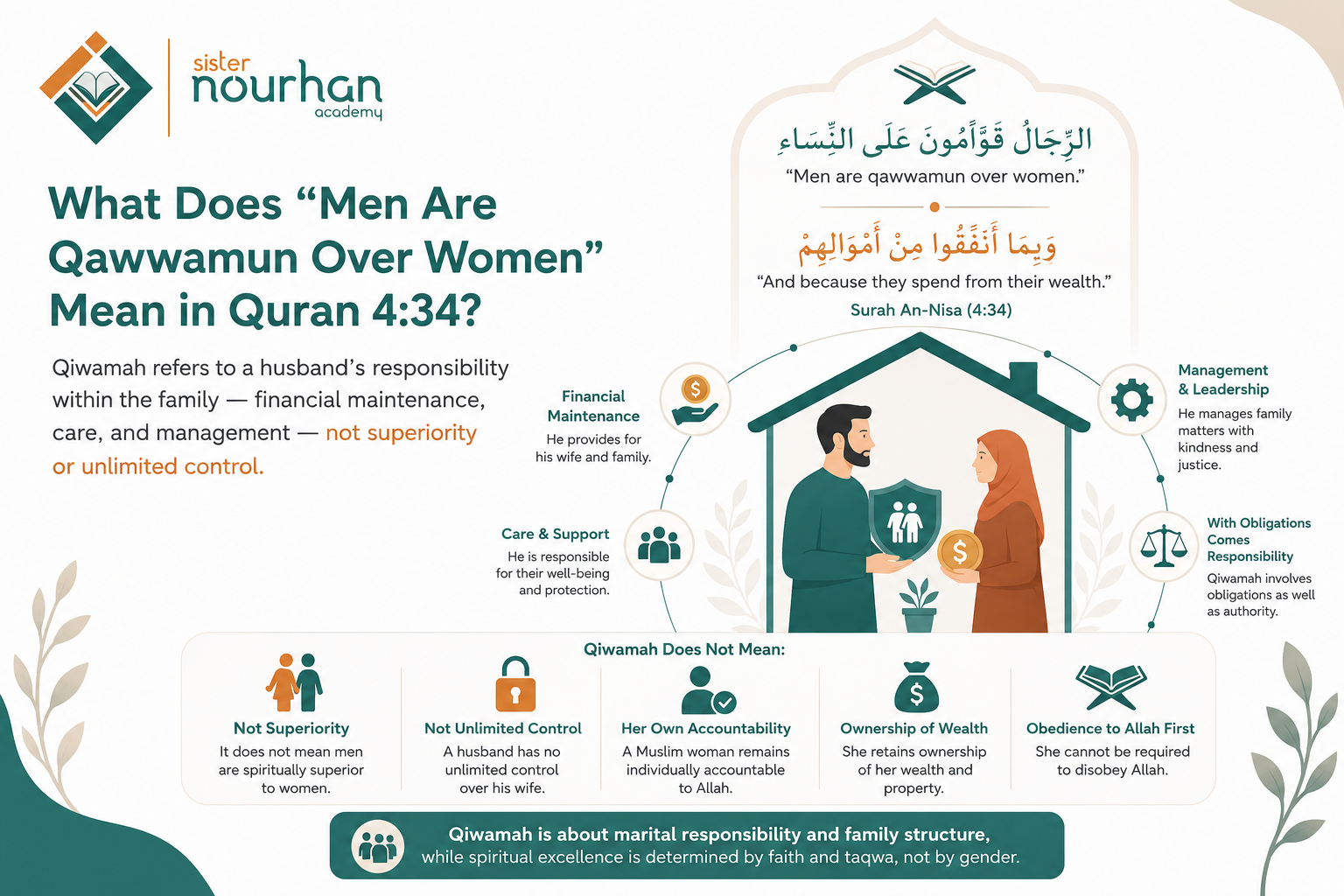
Allah says:
الرِّجَالُ قَوَّامُونَ عَلَى النِّسَاءِ
“Men are qawwamun over women.”
The verse itself connects this responsibility with financial provision:
وَبِمَا أَنْفَقُوا مِنْ أَمْوَالِهِمْ
“And because they spend from their wealth.” Surah An-Nisa (4:34)
The concept of qiwamah has traditionally been understood in connection with the husband's responsibilities within marriage.
One of the clearest is financial maintenance: a husband is obligated to provide for his wife and family, while a wife is not generally required to spend her personal wealth on supporting her husband.
Qiwamah therefore involves obligations as well as authority. It should not be understood simply as a declaration that men possess greater human or spiritual worth.
Nor does qiwamah mean that a husband has unlimited control over his wife. A Muslim woman remains individually accountable to Allah, has her own religious obligations, retains ownership of her wealth, and cannot be required to disobey Allah.
Qiwamah is therefore best understood within the context of marital responsibility and family structure, while spiritual excellence remains determined by faith and taqwa rather than gender alone.
Why Do Men and Women Have Different Islamic Rulings If They Are Equal?
Equality in Islam does not mean that men and women must have identical rulings in every situation. The Quran establishes shared human worth and spiritual accountability, while Islamic law also assigns some different responsibilities and exemptions to men and women.
For example, husbands carry the primary obligation of financially maintaining their wives and families, while wives are not generally required to spend their personal wealth on their husbands.
Women also have rulings connected to menstruation that do not apply to men. During menstruation, a woman does not perform salah, and she does not fast; missed Ramadan fasts are made up later, while missed prayers are not.
These differences concern legal duties, responsibilities, and exemptions. They do not mean that one gender is automatically more righteous, sincere, or valuable before Allah.
Islam therefore distinguishes between spiritual worth and legal responsibility. Men and women may have different rulings in particular areas while remaining equally accountable to Allah and equally capable of attaining spiritual excellence.
Read also: Can a woman recite quran loudly in salah?
Does Islam Teach That Men Are Superior to Women?
No. Islam does not teach that every man is inherently superior to every woman simply because he is male. The Quran makes taqwa—faith, righteousness, and consciousness of Allah—the standard of honor before Him, rather than gender alone.
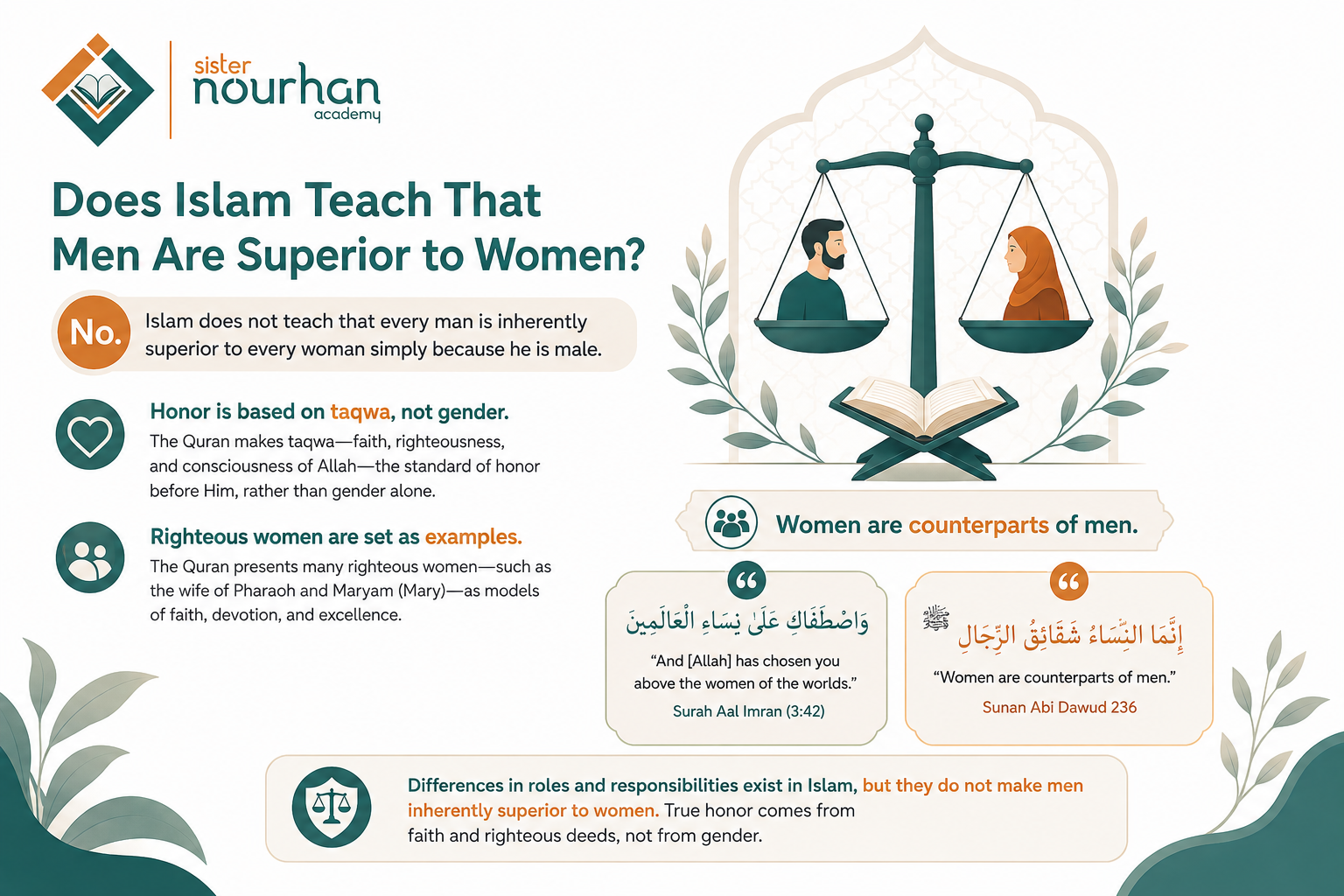
The Quran itself demonstrates this by presenting righteous women as examples for believers. The wife of Pharaoh is praised for her faith despite being married to one of the most oppressive men mentioned in the Quran, while Maryam (Mary) is given exceptional honor for her devotion and purity.
Allah says:
وَاصْطَفَاكِ عَلَىٰ نِسَاءِ الْعَالَمِينَ
“And [Allah] has chosen you above the women of the worlds.” Surah Aal Imran (3:42)
The Prophet ﷺ also said:
إِنَّمَا النِّسَاءُ شَقَائِقُ الرِّجَالِ
“Women are counterparts of men.” Sunan Abi Dawud 236
This does not mean that men and women are biologically identical or that every Islamic ruling concerning them must be the same.
Rather, differences in particular roles or legal responsibilities should not be turned into a claim that men as a gender possess greater human or spiritual worth than women.
A righteous woman may therefore be spiritually superior to an unrighteous man, just as a righteous man may be superior to an unrighteous woman. Gender alone does not determine a person's rank before Allah.
For women who want to develop a deeper understanding of the Quran through Arabic, Tafseer, and traditional Islamic studies, structured programs such as the Al-Azhar Quran Course provide an opportunity to continue that tradition of serious Islamic learning with qualified teachers.

What Roles Did Women Have in Early Islam?
Women played important roles in the religious, intellectual, and social life of the early Muslim community. They learned and taught Islamic knowledge, transmitted hadith, migrated for their faith, advised other Muslims, and contributed to the preservation of religious teachings.
One of the clearest examples is Aishah (may Allah be pleased with her), who became one of the most knowledgeable scholars among the Companions.
Her knowledge extended to hadith, Quranic interpretation, Islamic law, worship, inheritance, and other areas, and both men and women learned from her.
Women were also among the trusted transmitters of hadith, with their narrations preserved and studied by later generations of Muslim scholars. Their participation demonstrates that the pursuit and transmission of Islamic knowledge were not treated as exclusively male responsibilities.
The history of early Islam therefore does not support the idea that women were considered intellectually or religiously inferior by default. Women could learn, teach, preserve religious knowledge, and become respected authorities within the Muslim community.
See our teaching methods
Experience the quality of our instruction firsthand by watching a live lesson snippet below.
Enrich Your Islamic Knowledge
Deepen your understanding of Fiqh, Aqeedah, and Hadith with dedicated female scholars at Sister Nourhan Academy.
Start Your Free Trial NowBuild a Deeper Understanding of the Quran
Questions about equality, rights, and responsibilities in Islam are best understood by studying the Quran as a complete message rather than relying on individual verses or translations without context.
Learning Arabic, Tafseer, and the foundations of Islamic studies can help students understand how different Quranic teachings connect with one another.
Sister Nourhan Academy offers women a supportive online environment to continue that learning with qualified female teachers.
Students can progress from Quran reading and recitation to deeper Islamic studies according to their level and goals, with structured guidance throughout their learning journey.
Book a free trial lesson and find the learning path that works for you.
Discover our Islamic Studies Courses
Conclusion
The Quran presents men and women as sharing the same human dignity, spiritual accountability, and opportunity for reward before Allah. Neither gender is automatically more righteous or more valuable simply because of being male or female; faith, good deeds, and taqwa remain central to a person’s standing before Allah.
At the same time, equality in Islam does not require identical roles or rulings in every area. Men and women may have different responsibilities in matters such as family life, financial obligations, and certain religious rulings, but these differences should not be confused with differences in human or spiritual worth.
Ultimately, the Quranic framework combines shared dignity and accountability with justice in rights and responsibilities. Men and women are both responsible before Allah, both capable of spiritual excellence, and both valued members of the believing community.
Frequently Asked Questions About Men and Women in the Quran
What Quran Verse Says Men and Women Are Equal?
Several Quranic verses establish principles of equality between men and women. Surah Aal Imran 3:195 states that Allah does not allow the work of any believer, male or female, to be lost. Surah Al-Ahzab 33:35 also lists believing men and women side by side and promises forgiveness and a great reward.
Are Men Better Than Women According to the Quran?
Not simply because they are men. Surah Al-Hujurat 49:13 makes taqwa the standard of honor before Allah. Therefore, a righteous woman can be spiritually superior to an unrighteous man.
Are Men and Women Given the Same Reward in Islam?
Yes. The Quran repeatedly states that righteous deeds are rewarded regardless of whether the believer is male or female.
Are Husbands and Wives Equal in Their Rights?
Quran 2:228 establishes reciprocal rights and obligations between spouses according to what is fair. Their specific duties are not always identical, but marriage is not presented as a relationship in which only one spouse possesses rights.
Does Equality in Islam Mean Men and Women Must Have Exactly the Same Roles?
No. Equality in Islam concerns human dignity, justice, moral accountability, and spiritual value. Some family, financial, and religious responsibilities differ without making one gender inherently more valuable than the other.
Does Qiwamah Mean a Husband Is Better Than His Wife?
No. Qiwamah relates to family responsibility, maintenance, and financial provision. It does not automatically make a husband more righteous or spiritually superior to his wife.