The Quran is clear that believing women can enter Jannah and receive its complete reward and happiness just as believing men do. Paradise is not presented as a reward reserved for men, nor are women described as receiving a lesser form of salvation because they are female.
Allah repeatedly mentions believing men and women together when promising forgiveness, Paradise, eternal life, beautiful dwellings, and His pleasure. The Quran also gives a broader promise about Jannah: its people will receive what their souls desire, enjoy what delights them, and be free from the suffering and unhappiness of worldly life.
Many questions about what the Quran says about women in heaven concern marriage, family, beauty, rewards, and whether women will receive everything they desire. Some of these questions are answered directly by Quranic verses, while other detailed scenarios are discussed through hadith and scholarly interpretation.
The Quran Explicitly Promises Jannah to Believing Women
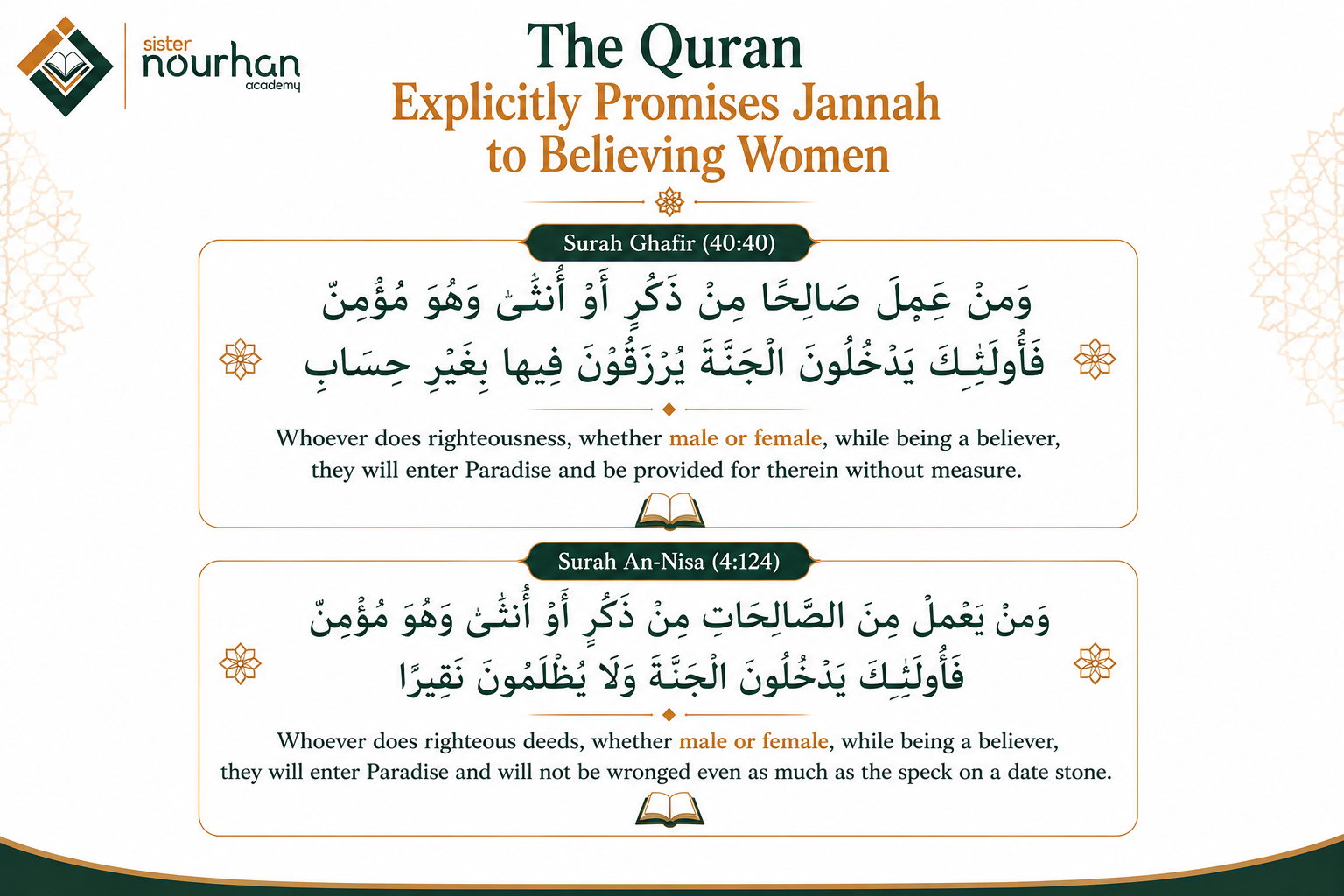
The Quran explicitly states that believing women who do righteous deeds will enter Jannah.
Allah says:
وَمَنْ عَمِلَ صَالِحًا مِنْ ذَكَرٍ أَوْ أُنْثَىٰ وَهُوَ مُؤْمِنٌ فَأُولَٰئِكَ يَدْخُلُونَ الْجَنَّةَ يُرْزَقُونَ فِيهَا بِغَيْرِ حِسَابٍ
“Whoever does righteousness, whether male or female, while being a believer, they will enter Paradise and be provided for therein without measure.” Surah Ghafir (40:40)
The wording is direct: “male or female.” A woman’s gender does not prevent her from attaining Paradise or receiving Allah’s reward. What matters in the verse is faith accompanied by righteous deeds.
The Quran reinforces the same principle in Surah An-Nisa:
وَمَنْ يَعْمَلْ مِنَ الصَّالِحَاتِ مِنْ ذَكَرٍ أَوْ أُنْثَىٰ وَهُوَ مُؤْمِنٌ فَأُولَٰئِكَ يَدْخُلُونَ الْجَنَّةَ وَلَا يُظْلَمُونَ نَقِيرًا
“Whoever does righteous deeds, whether male or female, while being a believer, they will enter Paradise and will not be wronged even as much as the speck on a date stone.” Surah An-Nisa (4:124)
Together, these verses give a clear Quranic answer: believing women who live righteously are promised entrance into Jannah, just as believing men are, and they will not be deprived of the reward Allah has promised them.
Women who want to develop this practice can explore the Dua & Adhkar Course for Females to learn essential duas and daily adhkar as part of a more consistent Islamic routine.
Allah Promises Believing Women the Blessings of Paradise
The Quran does not merely include women indirectly in general descriptions of the people of Paradise.
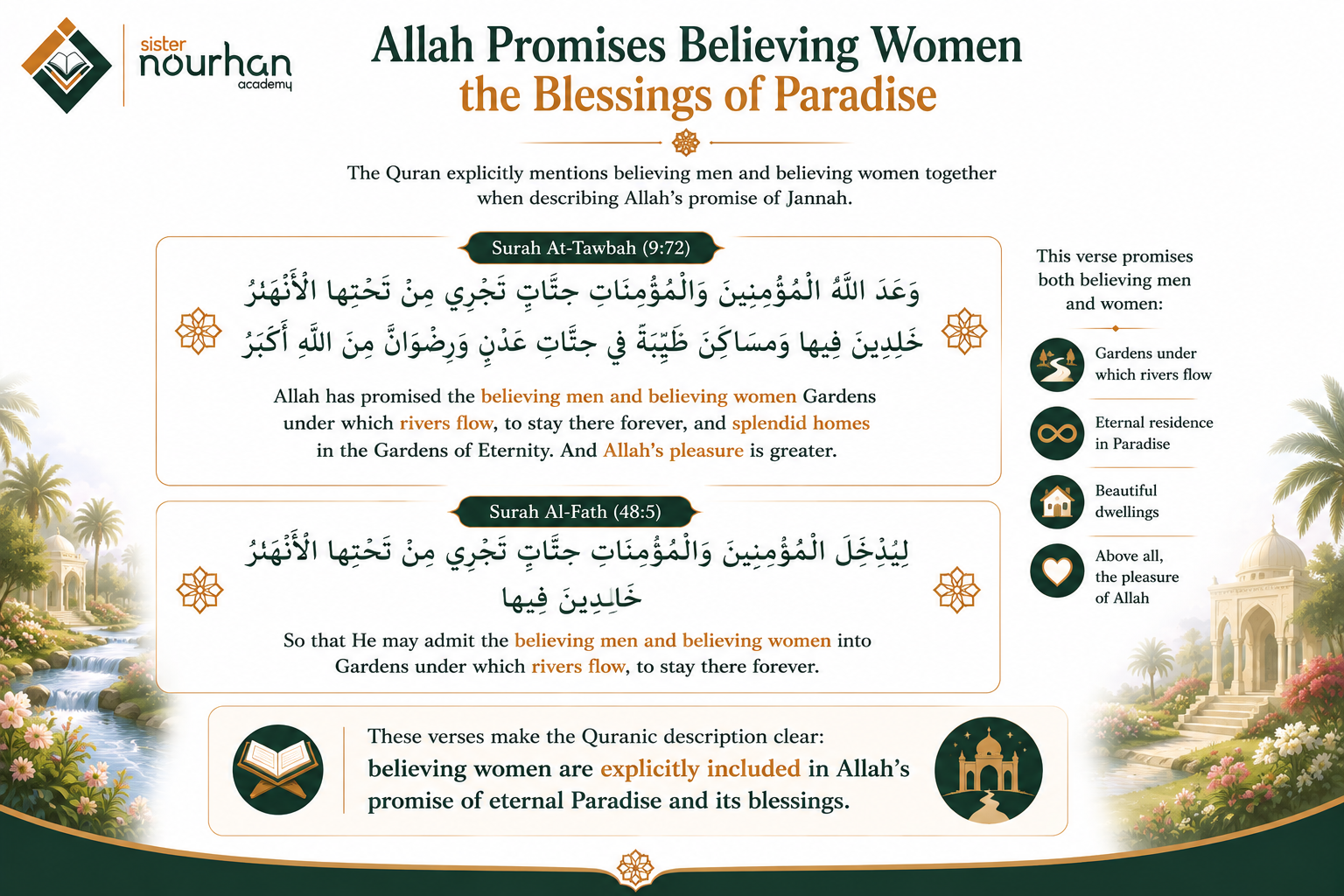
Allah explicitly mentions believing men and believing women together when describing His promise of Jannah.
Allah says:
وَعَدَ اللَّهُ الْمُؤْمِنِينَ وَالْمُؤْمِنَاتِ جَنَّاتٍ تَجْرِي مِنْ تَحْتِهَا الْأَنْهَارُ خَالِدِينَ فِيهَا وَمَسَاكِنَ طَيِّبَةً فِي جَنَّاتِ عَدْنٍ وَرِضْوَانٌ مِنَ اللَّهِ أَكْبَرُ
“Allah has promised the believing men and believing women Gardens under which rivers flow, to stay there forever, and splendid homes in the Gardens of Eternity. And Allah's pleasure is greater.” Surah At-Tawbah (9:72)
This verse describes several blessings promised explicitly to both believing men and women: eternal residence in Paradise, beautiful dwellings, and, greater than all of these, the pleasure of Allah.
The same promise appears again in Surah Al-Fath:
لِيُدْخِلَ الْمُؤْمِنِينَ وَالْمُؤْمِنَاتِ جَنَّاتٍ تَجْرِي مِنْ تَحْتِهَا الْأَنْهَارُ خَالِدِينَ فِيهَا
“So that He may admit the believing men and believing women into Gardens under which rivers flow, to stay there forever.” Surah Al-Fath (48:5)
These verses make the Quranic description clear: believing women are explicitly included in Allah’s promise of eternal Paradise and its blessings. They are not merely assumed to be included in a general promise; the Quran names them directly alongside believing men.
Shots from Our Classes
Take a moment to view the video below to see how our teachers provide clear, supportive corrections during a session.
Enrich Your Islamic Knowledge
Deepen your understanding of Fiqh, Aqeedah, and Hadith with dedicated female scholars at Sister Nourhan Academy.
Start Your Free Trial NowWomen in Jannah Will Have What Their Souls Desire
The Quran describes Jannah as a place where its inhabitants will receive what their souls desire and what brings them delight. Since believing women are explicitly promised entrance into Paradise, these general promises of Jannah include them as well.
Allah says:
وَفِيهَا مَا تَشْتَهِيهِ الْأَنْفُسُ وَتَلَذُّ الْأَعْيُنُ وَأَنْتُمْ فِيهَا خَالِدُونَ
“There you will have whatever your souls desire and whatever delights the eyes, and you will be there forever.” Surah Az-Zukhruf (43:71)
Allah also says:
فَلَا تَعْلَمُ نَفْسٌ مَا أُخْفِيَ لَهُمْ مِنْ قُرَّةِ أَعْيُنٍ جَزَاءً بِمَا كَانُوا يَعْمَلُونَ
“No soul can imagine what delights are kept in store for them as a reward for what they used to do.” Surah As-Sajdah (32:17)
These verses do not describe separate rewards for men and women. Instead, they establish a broader promise about Paradise itself: its inhabitants will experience extraordinary delight and receive blessings beyond what they can presently imagine.
For believing women in Jannah, this means that Paradise should be understood through Allah’s promise of fulfillment, delight, and lasting happiness.
Where the Quran does not provide specific details about every individual desire, it is better to rely on this clear promise rather than speculate about exactly what each woman will receive.
Women in Jannah Will Be Free From Worldly Pain and Resentment
The Quran describes Jannah as a place where its inhabitants are free from the hardships and negative feelings associated with worldly life.
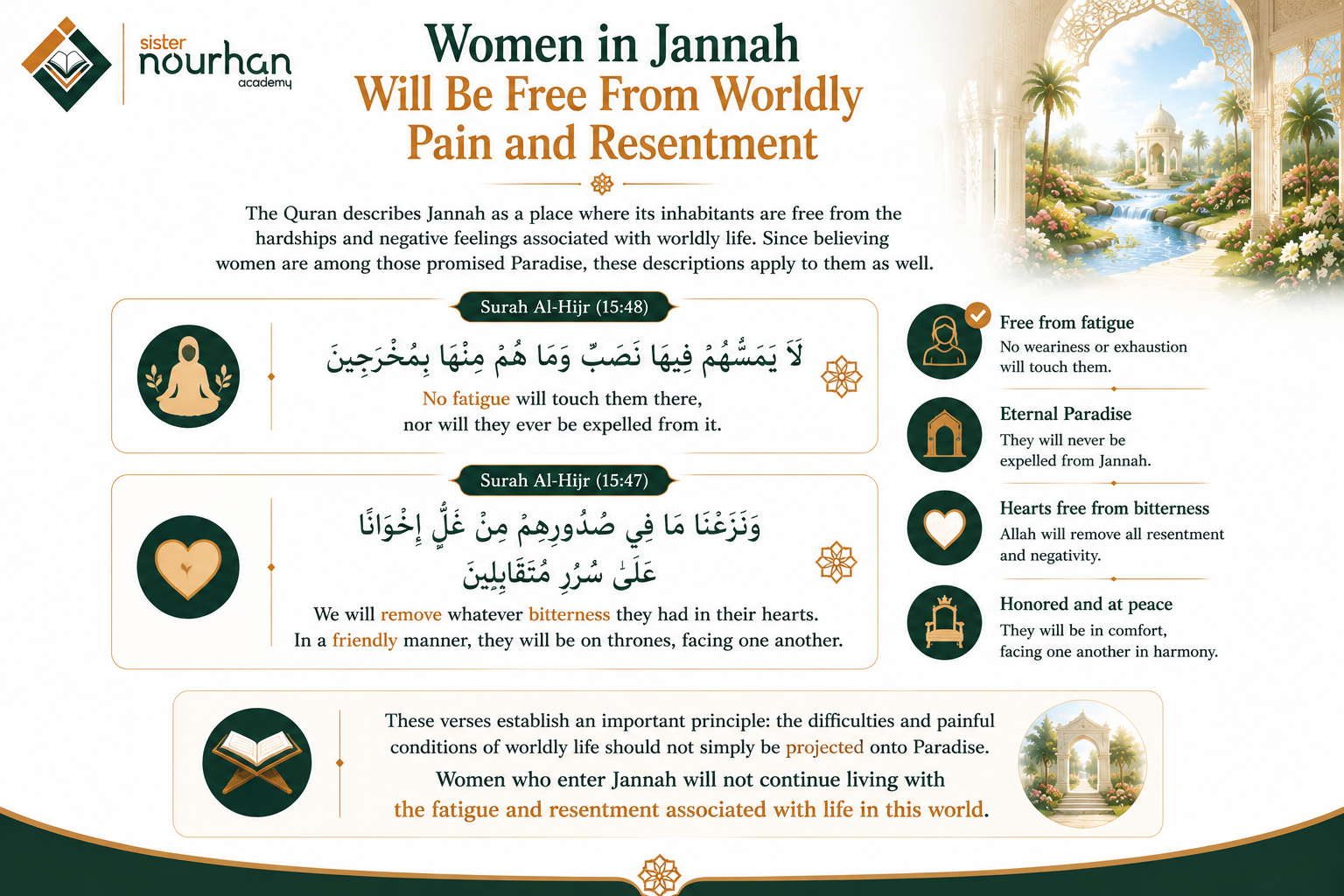
Since believing women are among those promised Paradise, these descriptions apply to them as well.
Allah says:
لَا يَمَسُّهُمْ فِيهَا نَصَبٌ وَمَا هُمْ مِنْهَا بِمُخْرَجِينَ
“No fatigue will touch them there, nor will they ever be expelled from it.” Surah Al-Hijr (15:48)
The Quran also describes Allah removing resentment from the hearts of the people of Paradise:
وَنَزَعْنَا مَا فِي صُدُورِهِمْ مِنْ غِلٍّ إِخْوَانًا عَلَىٰ سُرُرٍ مُتَقَابِلِينَ
“We will remove whatever bitterness they had in their hearts. In a friendly manner, they will be on thrones, facing one another.” Surah Al-Hijr (15:47)
These verses establish an important principle when considering the experience of women in Jannah: the difficulties and painful conditions of worldly life should not simply be projected onto Paradise.
Women who enter Jannah will not continue living with the fatigue and resentment associated with life in this world.
Instead, the Quran presents Paradise as an eternal existence from which such suffering has been removed.
Questions about what women will experience there should therefore be understood according to the Quran’s description of Jannah itself, rather than by assuming that the problems of dunya will continue unchanged in the Hereafter.
Read also: Verses in the Quran about women
Women Will Be Rewarded for Their Own Faith and Righteous Deeds
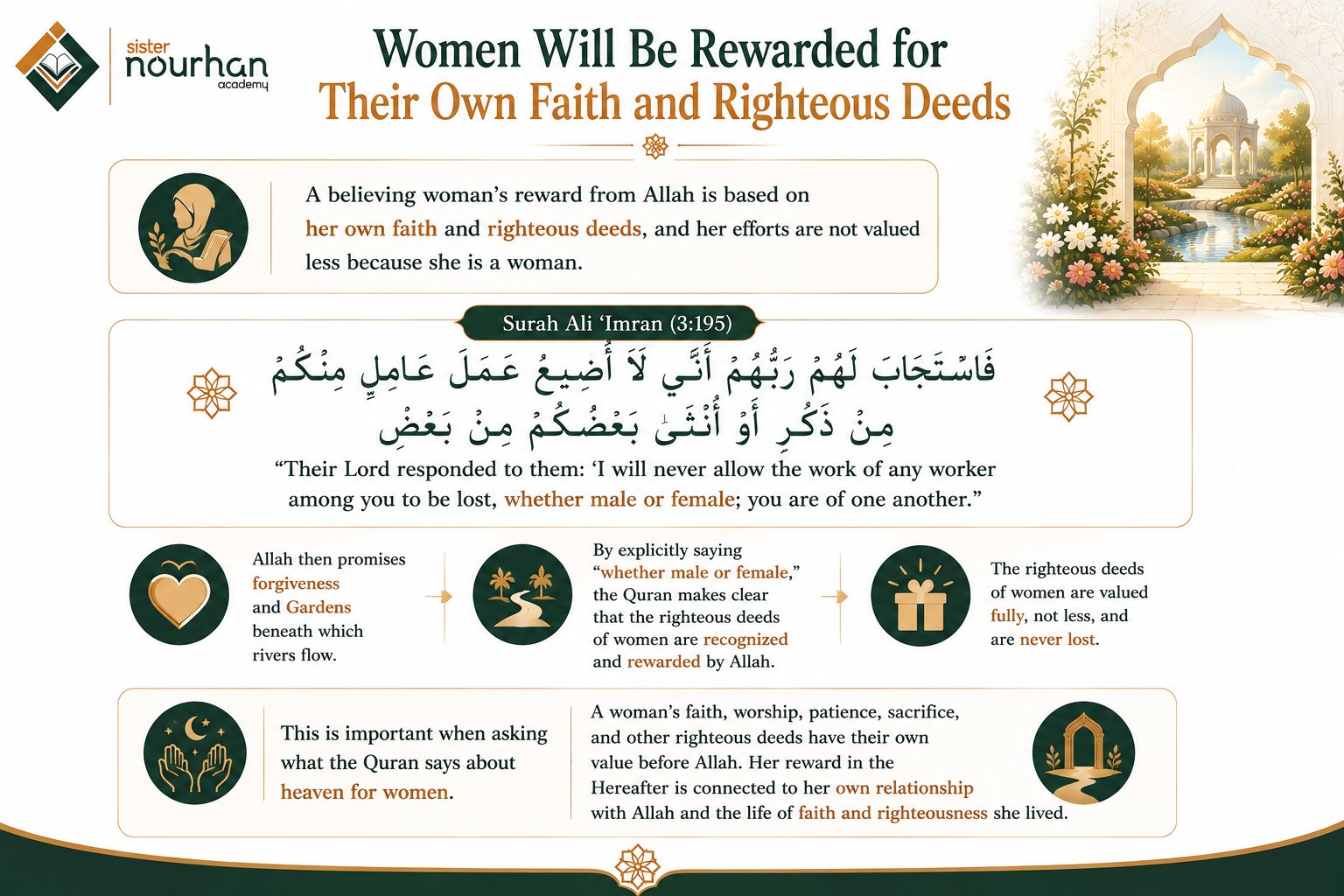
A believing woman’s reward from Allah is based on her own faith and righteous deeds, and her efforts are not valued less because she is a woman.
Allah says:
فَاسْتَجَابَ لَهُمْ رَبُّهُمْ أَنِّي لَا أُضِيعُ عَمَلَ عَامِلٍ مِنْكُمْ مِنْ ذَكَرٍ أَوْ أُنْثَىٰ بَعْضُكُمْ مِنْ بَعْضٍ
“Their Lord responded to them: ‘I will never allow the work of any worker among you to be lost, whether male or female; you are of one another.’” Surah Ali ‘Imran (3:195)
The verse continues by promising forgiveness and Gardens beneath which rivers flow to those who remained faithful and endured for Allah’s sake. By explicitly saying “whether male or female,” the Quran makes clear that the righteous deeds of women are recognized and rewarded by Allah.
This is important when asking what the Quran says about heaven for women. A woman’s faith, worship, patience, sacrifice, and other righteous deeds have their own value before Allah. Her reward in the Hereafter is therefore connected to her own relationship with Allah and the life of faith and righteousness she lived.
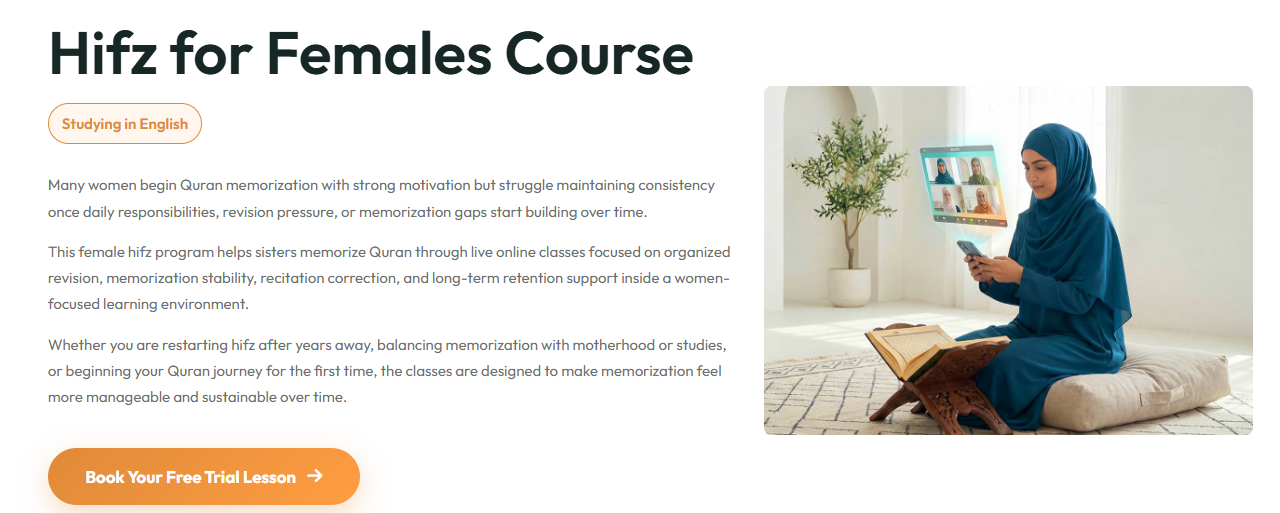
For Muslim women who want to strengthen that relationship with Allah through consistent Quran study, memorization can become an important part of their spiritual journey.
Sister Nourhan Academy’s Hifz for Females course provides structured guidance for women who want to memorize the Quran while improving their recitation and maintaining steady progress.
Will Women Be Reunited With Their Families in Jannah?
Yes. The Quran gives believing women and men hope of being reunited with their righteous family members in Jannah.
Allah says:
جَنَّاتُ عَدْنٍ يَدْخُلُونَهَا وَمَنْ صَلَحَ مِنْ آبَائِهِمْ وَأَزْوَاجِهِمْ وَذُرِّيَّاتِهِمْ
“They will enter the Gardens of Eternity, along with the righteous among their parents, spouses, and descendants.” Surah Ar-Ra'd (13:23)
This verse explicitly mentions righteous parents, spouses, and descendants entering the Gardens of Eternity together.
The Quran also says:
وَالَّذِينَ آمَنُوا وَاتَّبَعَتْهُمْ ذُرِّيَّتُهُمْ بِإِيمَانٍ أَلْحَقْنَا بِهِمْ ذُرِّيَّتَهُمْ
“As for those who believe and whose descendants follow them in faith, We will unite them with their descendants.” Surah At-Tur (52:21)
For women in Jannah, these verses provide Quranic grounds for hoping for reunion with righteous family members. Paradise is therefore not described as an existence in which believers are necessarily separated from their families.
Rather, the Quran explicitly includes the reunion of believing families among the blessings of the Hereafter.
Read also: Can a Menstruating Woman Listen to Quran?
What Does the Quran Say About Marriage for Women in Jannah?
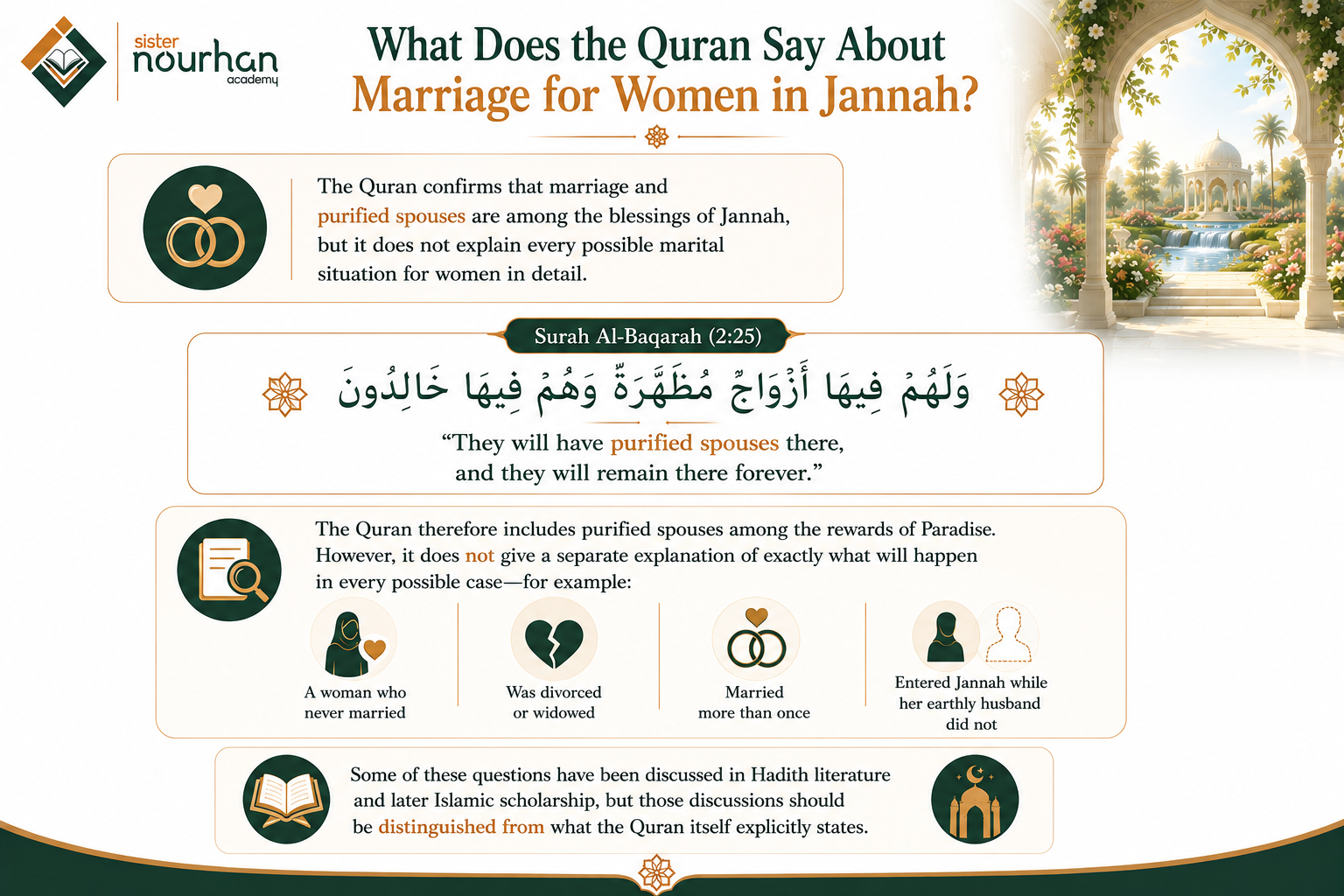
The Quran confirms that marriage and purified spouses are among the blessings of Jannah, but it does not explain every possible marital situation for women in detail.
Allah says:
وَلَهُمْ فِيهَا أَزْوَاجٌ مُطَهَّرَةٌ وَهُمْ فِيهَا خَالِدُونَ
“They will have purified spouses there, and they will remain there forever.” Surah Al-Baqarah (2:25)
The Quran therefore includes purified spouses among the rewards of Paradise. However, it does not give a separate explanation of exactly what will happen in every possible case—for example, a woman who never married, was divorced or widowed, married more than once, or entered Jannah while her earthly husband did not.
Some of these questions have been discussed in Hadith literature and later Islamic scholarship, but those discussions should be distinguished from what the Quran itself explicitly states.
What the Quran does establish is that believing women who enter Jannah will receive the blessings Allah has promised to the people of Paradise. As described elsewhere, Jannah contains “whatever the souls desire” (Surah Az-Zukhruf 43:71).
Therefore, where the Quran remains silent about a woman’s exact marital circumstances in Jannah, it is better not to speculate. The Quranic emphasis remains on the perfection of Paradise and the fulfillment Allah has promised its inhabitants.
Read also: Does the Quran allow women to work?
What Does Surah Al-Waqi'ah Say About Women in Jannah?
Surah Al-Waqi'ah describes women in Paradise as being created in a perfected state, although commentators have differed over exactly whom these verses describe.
Allah says:
إِنَّا أَنْشَأْنَاهُنَّ إِنْشَاءً فَجَعَلْنَاهُنَّ أَبْكَارًا عُرُبًا أَتْرَابًا
“Indeed, We will have created them in a special creation, making them virgins, loving and of equal age.” Surah Al-Waqi'ah (56:35–37)
Muslim commentators have discussed the identity of the women described in these verses. Some interpretations connect the passage with women of this world being recreated in a perfected state in the Hereafter, while other interpretations understand it as referring to women created for Paradise.
Because the passage has been interpreted in more than one way, it should not be used to claim that the Quran gives only one detailed explanation of the identity of these women.
What the verses clearly contribute to the Quranic picture of Jannah is the idea of renewed and perfected creation. They should therefore be understood alongside the Quran’s wider descriptions of Paradise rather than used to speculate beyond what the text itself establishes.
Read also: Does the Quran encourage learning and knowledge for women?
Will Women in Jannah Remain Young and Beautiful?
The Quran consistently describes Paradise as a realm of perfection rather than aging, sickness, and physical deterioration.
Some scholarly interpretations of Surah Al-Waqi'ah 56:35–37 include the believing women of this world within the description of a renewed creation.
However, claims about the exact appearance of women in Jannah should remain within what authentic revelation establishes.
Statements sometimes circulated online—such as precise comparisons claiming that worldly women will be a certain number of times more beautiful than the hoor al-'ayn—should not be presented as established facts without reliable evidence.
The secure principle is that believers in Paradise will experience beauty, health, happiness, and a perfected condition without the defects of worldly life.
Will Women in Jannah See Allah?
Yes. According to mainstream Sunni Islamic teaching, believing women in Jannah will share with believing men in the blessing of seeing Allah. The Quran does not restrict this reward to men.
Allah says:
وُجُوهٌ يَوْمَئِذٍ نَاضِرَةٌ إِلَىٰ رَبِّهَا نَاظِرَةٌ
“On that Day some faces will be radiant, looking at their Lord.” Surah Al-Qiyamah (75:22–23)
These verses describe the blessed people of the Hereafter without limiting the promise to one gender. Since the Quran explicitly includes believing women among those admitted to Jannah, women are included in this promise according to mainstream Sunni interpretation.
The Sunnah further explains the extraordinary nature of this reward. In an authentic Hadith, the Prophet ﷺ explained that after the people of Paradise enter Jannah, Allah will grant them something greater than the blessings they have already received: the opportunity to look upon their Lord.
This is connected to Allah’s promise:
لِلَّذِينَ أَحْسَنُوا الْحُسْنَىٰ وَزِيَادَةٌ
“For those who do good is the finest reward and an increase.” Surah Yunus (10:26)
Therefore, when asking what women will receive in heaven, the Islamic description extends beyond its material blessings.
Believing women will share in the spiritual rewards of Jannah, including Allah’s pleasure and, according to mainstream Sunni belief, the extraordinary blessing of seeing their Lord.
Will Women Experience Jealousy or Sadness in Jannah?
Women in Jannah will not experience the bitterness and emotional suffering associated with worldly life.
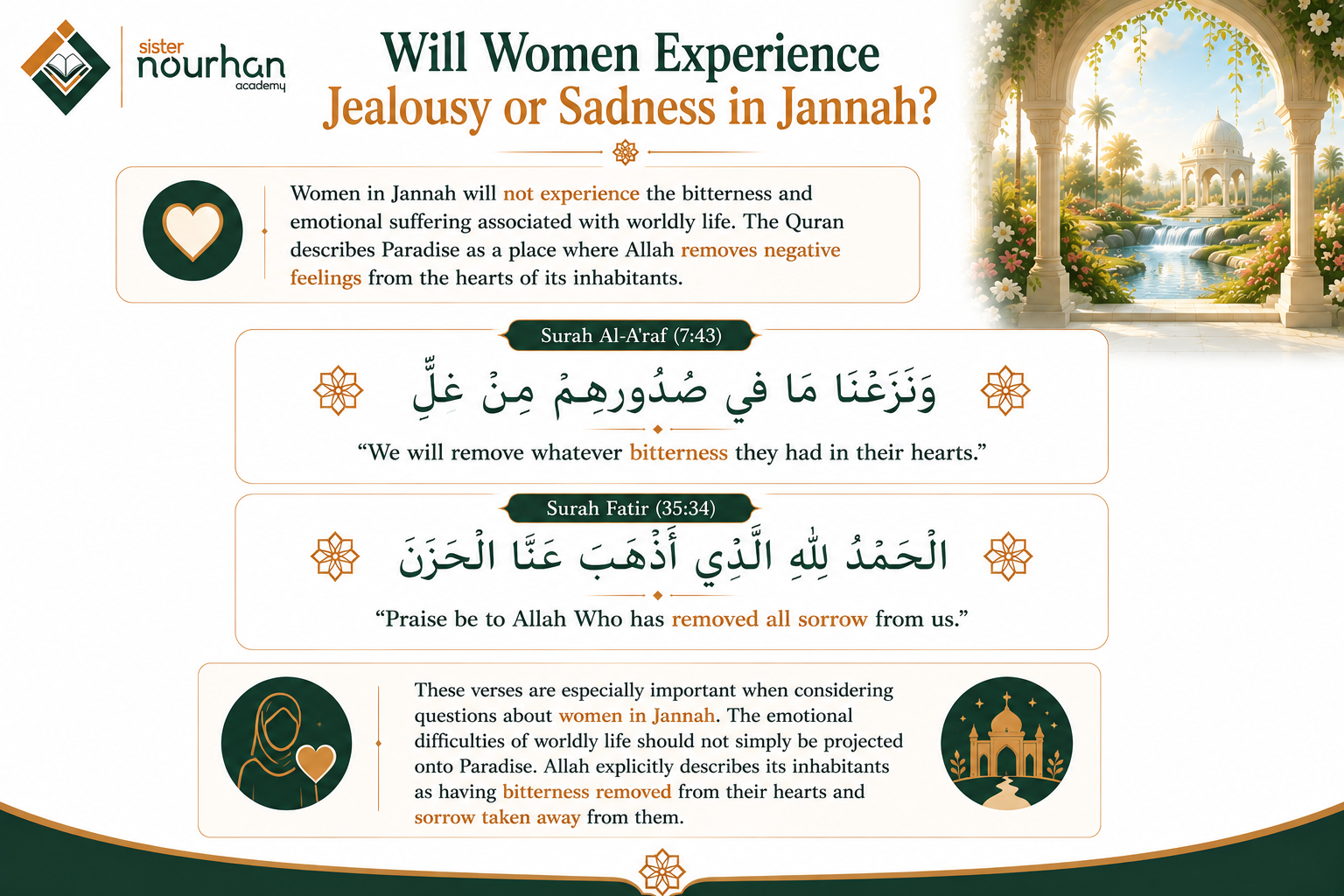
The Quran describes Paradise as a place where Allah removes negative feelings from the hearts of its inhabitants.
Allah says:
وَنَزَعْنَا مَا فِي صُدُورِهِمْ مِنْ غِلٍّ
“We will remove whatever bitterness they had in their hearts.” Surah Al-A'raf (7:43)
The Quran also describes the people of Paradise saying:
الْحَمْدُ لِلَّهِ الَّذِي أَذْهَبَ عَنَّا الْحَزَنَ
“Praise be to Allah Who has removed all sorrow from us.” Surah Fatir (35:34)
These verses are especially important when considering questions about women in Jannah.
The emotional difficulties of worldly life should not simply be projected onto Paradise. Allah explicitly describes its inhabitants as having bitterness removed from their hearts and sorrow taken away from them.
Therefore, a believing woman will not enter Jannah only to remain trapped in sadness, resentment, or emotional suffering. The Quran instead presents Paradise as a place where the causes of such distress have been removed and its inhabitants live in lasting peace and contentment.
Read also: Can i read the quran while on my period?
What Is the Greatest Promise the Quran Gives Women About Jannah?
The strongest promise is not that women receive one particular object or relationship.
It is that believing women are fully among the people for whom Allah prepared Paradise.
They are promised:
Entrance into Jannah through faith and righteous deeds.
Eternal residence.
Gardens and beautiful dwellings.
Everything that truly delights the soul.
Freedom from fatigue and suffering.
Purified relationships.
Reunion with righteous loved ones.
Allah's forgiveness and pleasure.
Rewards beyond what a human being can presently imagine.
The Quran therefore does not ask believing women to strive for an afterlife designed only for men. It repeatedly addresses men and women together as believers who worship, struggle, receive forgiveness, and enter Paradise.
See our teaching methods
Experience the quality of our instruction firsthand by watching a live lesson snippet below.
Enrich Your Islamic Knowledge
Deepen your understanding of Fiqh, Aqeedah, and Hadith with dedicated female scholars at Sister Nourhan Academy.
Start Your Free Trial NowDeepen Your Understanding of the Quran With Sister Nourhan Academy
Questions about Jannah show why understanding the Quran requires more than reading isolated translations. Learning the meanings of verses, their context, and how scholars understand them can help Muslim women approach the Quran with greater clarity and confidence.
At Sister Nourhan Academy, women and girls can study the Quran through structured online learning designed to strengthen recitation, Tajweed, memorization, and Islamic knowledge with qualified guidance.
Book your classes today and begin building a stronger, more informed connection with the Quran.
Discover our Islamic Studies Courses

Conclusion
What the Quran says about women in heaven is ultimately reassuring and direct: believing women are promised Jannah, complete reward, and lasting happiness. Their righteous deeds are not diminished because they are women, and Paradise is not described as a lesser experience for them.
Although revelation does not answer every speculative question about marriage, appearance, or individual relationships in exhaustive detail, it gives a much greater promise: the women of Jannah will experience no injustice, deprivation, sorrow, or dissatisfaction. They will receive Allah's reward, enjoy the blessings of Paradise, and remain there eternally.
For Muslim women, the focus should therefore not be fear that Jannah will somehow fail to satisfy them, but faith in Allah's promise and striving through belief and righteous deeds for the Paradise He has prepared for His believing servants.
FAQs About Women in Jannah
Do Women Go to Jannah According to the Quran?
Yes. The Quran explicitly promises Paradise to believing women who have faith and perform righteous deeds. Surah Ghafir 40:40 and Surah An-Nisa 4:124 both specifically mention “male or female” when describing those who will enter Jannah.
What Will Women Get in Jannah?
The Quran promises believing women the blessings of Paradise, including eternal life, beautiful dwellings, Allah’s pleasure, freedom from suffering, and the fulfillment promised to the inhabitants of Jannah. Surah Az-Zukhruf 43:71 states that Paradise contains whatever the souls desire and whatever delights the eyes.
Will Women Have Husbands in Jannah?
The Quran describes purified spouses as one of the blessings of Paradise in Surah Al-Baqarah 2:25.
However, it does not explain every individual situation in detail, such as what happens to a woman who was unmarried, divorced, widowed, or married more than once. Where revelation does not provide specific details, those details should not be stated as Quranic facts.
Will Women Be With Their Families in Jannah?
The Quran gives believers hope of reunion with righteous family members. Surah Ar-Ra'd 13:23 mentions parents, spouses, and descendants entering the Gardens of Eternity together, while Surah At-Tur 52:21 describes believing descendants being united with their families.
Will Women Feel Jealous of the Hoor al-'Ayn in Jannah?
The Quran does not specifically describe women in Jannah being jealous of the hoor al-'ayn. What it does say is that Allah will remove ghill—bitterness or resentment—from the hearts of the people of Paradise, and that the inhabitants of Jannah will praise Allah for removing sorrow from them.
It is therefore inappropriate to assume that the painful jealousy or resentment experienced in worldly life will continue unchanged in Paradise.
Will Women in Jannah Get Everything They Desire?
The Quran says that in Paradise there will be “whatever the souls desire and whatever delights the eyes” (Surah Az-Zukhruf 43:71). Since believing women are explicitly included among the people of Jannah, this general promise includes them.
The Quran does not, however, explain every individual desire in detail, so it is better to affirm Allah’s promise without speculating about matters revelation has left unspecified.