
She may listen to the Quran from another person, a teacher, an audio recording, a Quran app, a video, or an online class. This allows her to remain connected to the Quran during menstruation for worship, reflection, memorization, Hifz revision, or Tajweed practice.
For example, she may listen to:
Surahs for reflection and worship
Verses she has already memorized
New passages she is preparing to memorize
A teacher demonstrating correct Tajweed
A reciter to improve her pronunciation
Tafseer lessons that include Quranic verses
It is important, however, to distinguish listening to the Quran from verbally reciting it or touching a physical Mushaf. These are separate issues in Islamic jurisprudence and should not automatically be given the same ruling.
Can a Woman Listen to Quran on Her Period?
Yes, a woman can listen to the Quran on her period. She may play Quran recitation on her phone, computer, tablet, television, or another device, and she may also attend Quran lessons where verses are recited.
This can be particularly useful for women who follow a scholarly opinion that restricts verbal recitation during menstruation. Listening allows them to continue reviewing pronunciation, Tajweed, and previously memorized verses without completely interrupting their Quran routine.
For Hifz students, regular listening can also help maintain familiarity with the order, pronunciation, and transitions of memorized verses until verbal recitation is resumed according to the scholarly opinion they follow.
Is Listening to the Quran the Same as Reciting It?
No. Listening and reciting are two different actions When you listen to the Quran, you hear another person or a recording reciting the verses.
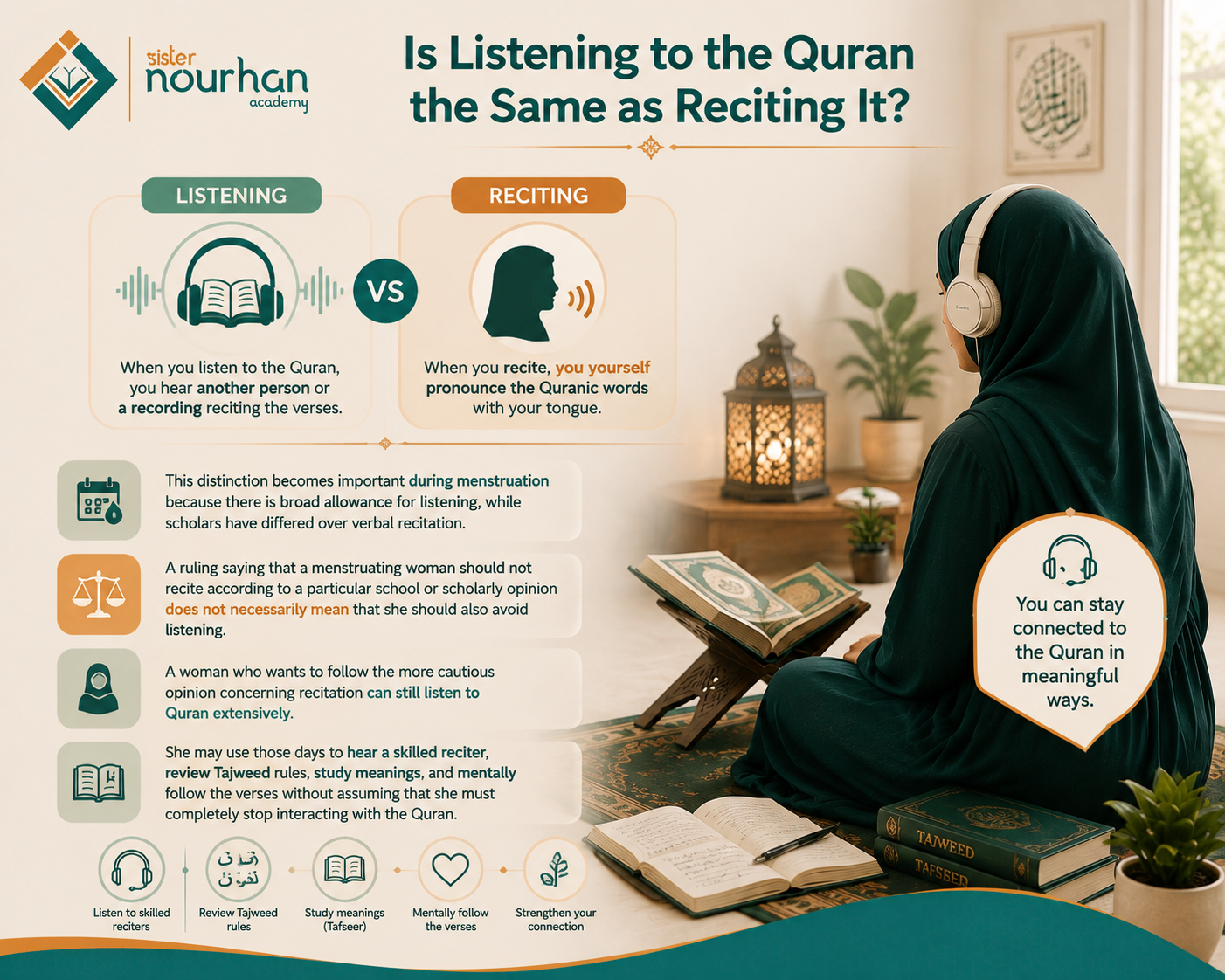
When you recite, you yourself pronounce the Quranic words with your tongue This distinction becomes important during menstruation because there is broad allowance for listening, while scholars have differed over verbal recitation.
Therefore, a ruling saying that a menstruating woman should not recite according to a particular school or scholarly opinion does not necessarily mean that she should also avoid listening.
A woman who wants to follow the more cautious opinion concerning recitation can still listen to Quran extensively.
She may use those days to hear a skilled reciter, review Tajweed rules, study meanings, and mentally follow the verses without assuming that she must completely stop interacting with the Quran.
Can a Menstruating Woman Recite the Quran?
The question can a menstruating woman recite the quran is an area of recognized scholarly disagreement.
The majority of classical jurists held that a menstruating woman should not verbally recite Quran until her menstruation has ended and she has become pure.
They made exceptions for Quranic phrases used as general dhikr or dua rather than intentionally as formal tilawah.
For example, phrases such as:
بِسْمِ اللَّهِ الرَّحْمَنِ الرَّحِيمِ
or:
إِنَّا لِلَّهِ وَإِنَّا إِلَيْهِ رَاجِعُونَ
may occur naturally as remembrance of Allah or supplication However, other scholars permitted a menstruating woman to recite Quran.
Among the arguments presented for permission is that there is no clear, authentic text explicitly prohibiting menstruating women from Quran recitation.
Scholars who favored this view also noted an important difference between menstruation and janabah.
A person in janabah can remove that condition relatively quickly by performing ghusl. Menstruation, however, cannot be ended voluntarily and may continue for several days.
If a woman were prevented from reciting throughout every menstrual period, this could create particular difficulty for Quran students, teachers, and women who have memorized significant portions of the Quran.
Because of this scholarly disagreement, a woman may follow the position of the school of jurisprudence or qualified scholar she trusts.
Women who wish to study Islamic rulings like these in greater depth can benefit from a structured program such as the Alimah Course for Females, where questions of worship, purity, Quran, and women's fiqh can be approached within a broader Islamic studies framework.

Why Do Scholars Differ About Quran Recitation During Menstruation?
Much of the disagreement concerns the evidence used to prohibit recitation One narration often mentioned states that a menstruating woman and a person in janabah should not recite anything from the Quran.
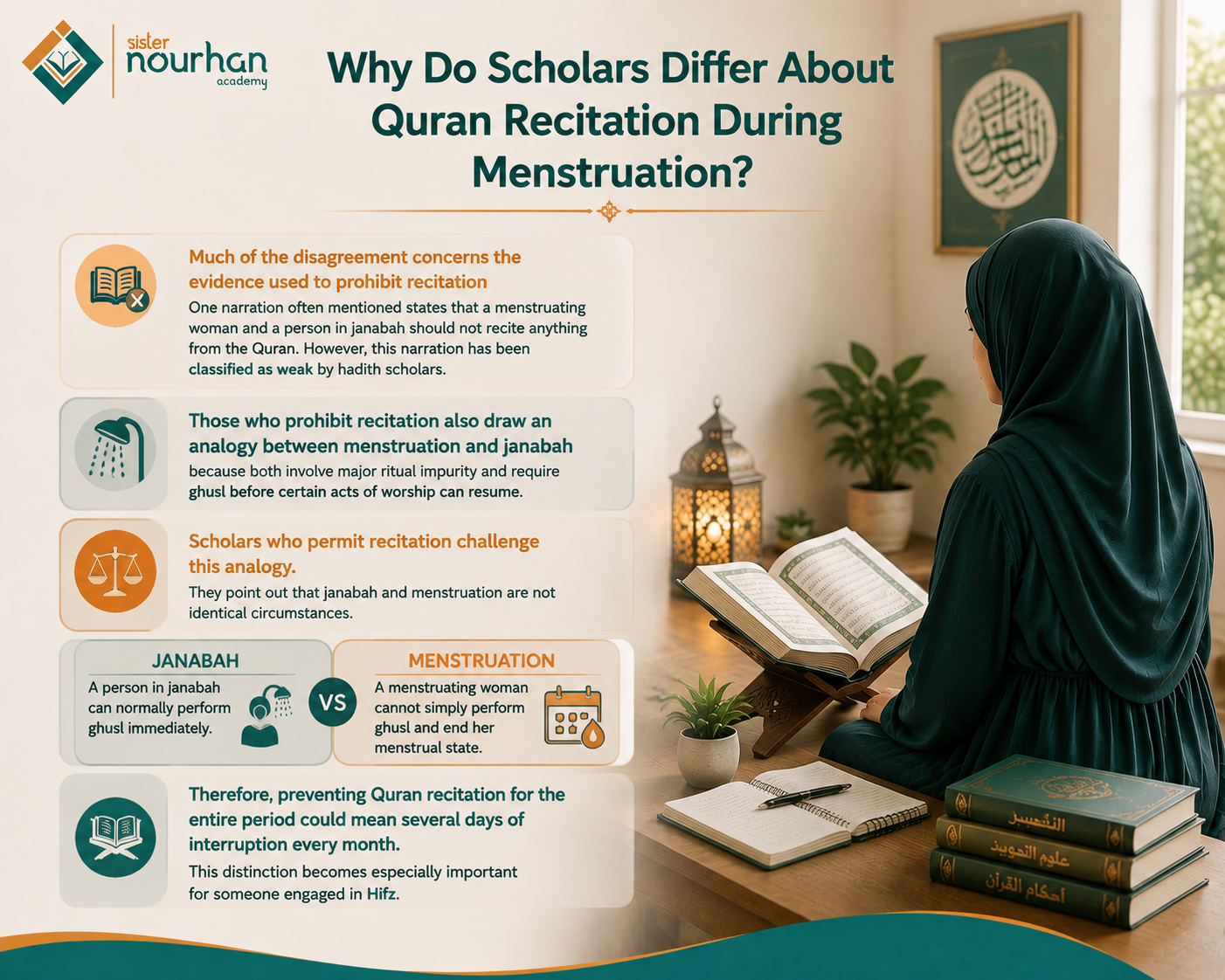
However, this narration has been classified as weak by hadith scholars.Those who prohibit recitation also draw an analogy between menstruation and janabah because both involve major ritual impurity and require ghusl before certain acts of worship can resume.
Scholars who permit recitation challenge this analogy They point out that janabah and menstruation are not identical circumstances.
A person in janabah can normally perform ghusl immediately. A menstruating woman cannot simply perform ghusl and end her menstrual state. She must wait until menstruation naturally finishes.
Read also: How to take ghusl bath for females?
Therefore, preventing Quran recitation for the entire period could mean several days of interruption every month This distinction becomes especially important for someone engaged in Hifz.
Shots from Our Classes
Take a moment to view the video below to see how our teachers provide clear, supportive corrections during a session.
Enrich Your Islamic Knowledge
Deepen your understanding of Fiqh, Aqeedah, and Hadith with dedicated female scholars at Sister Nourhan Academy.
Start Your Free Trial NowCan a Menstruating Woman Listen to Quran for Hifz?
Absolutely Listening is one of the most useful activities a Hifz student can continue during menstruation.
Even if she follows an opinion that restricts verbal recitation, she can repeatedly listen to the passages she has memorized.This can help reinforce:
The sequence of verses
Correct pronunciation
Tajweed patterns
Where verses begin and end
Similar-looking or similar-sounding ayat
The rhythm of longer passages
Transitions between pages or sections
Listening can therefore prevent a complete break in the memorization routine. For sisters pursuing memorization seriously, the Hifz for Females program can provide structured guidance for memorization and revision, including maintaining consistency throughout the different stages of a woman's monthly routine.

Can You Repeat Verses While Listening During Your Period?
This depends on whether repeating the verses becomes Quran recitation If a woman follows the opinion that permits menstruating women to recite Quran, she may repeat the verses as part of her learning and revision.
If she follows the more restrictive opinion, she may choose to listen without verbally repeating the complete verses as formal tilawah This is why it is useful to distinguish between listening and reciting.
Simply hearing the Quran does not automatically become verbal recitation A woman following a cautious opinion can therefore listen attentively, mentally follow the passage, study its meaning, and review the structure of the surah without necessarily pronouncing each verse herself.
Read also: Hadith references concerning women applying fragrance before leaving the house
Can You Listen to Quran While Studying Tajweed During Your Period?
Yes Menstruation does not prevent a woman from studying Tajweed theory or listening to demonstrations of correct Quranic pronunciation. This can actually be a productive use of the time.
Rather than viewing menstruation as a complete pause from Quran learning, a student can focus on subjects such as:
Makharij al-huruf
Sifat al-huruf
Rules of noon sakinah and tanween
Rules of meem sakinah
Madd
Qalqalah
Tafkhim and tarqiq
Waqf and ibtida
Common pronunciation errors
She can listen to examples and compare different sounds.A teacher can also explain rules and demonstrate them even if the student chooses not to verbally recite according to the fiqh opinion she follows.
Can a Menstruating Woman Read Quran from Her Phone?
This issue should also be distinguished from touching a physical Mushaf Many contemporary scholars do not give smartphones, tablets, and computers the same legal ruling as the printed Mushaf.
A phone is a multipurpose device. Quranic text appears temporarily on a screen rather than existing as permanently printed Quranic pages.
On this basis, scholars who permit Quran recitation during menstruation commonly allow women to read verses from a phone or Quran app.
The attached source material likewise distinguishes the digital Quran from the physical Mushaf and states that handling the phone does not carry the same ruling as directly touching Quranic pages.
If a woman follows a scholarly view that prohibits verbal recitation itself during menstruation, however, reading words from a phone does not automatically remove that issue. The question of the device and the question of verbal recitation are two separate matters.
Read also: What Does the Quran Say About Women in Heaven?
Does a Woman Need Wudu to Listen to Quran?
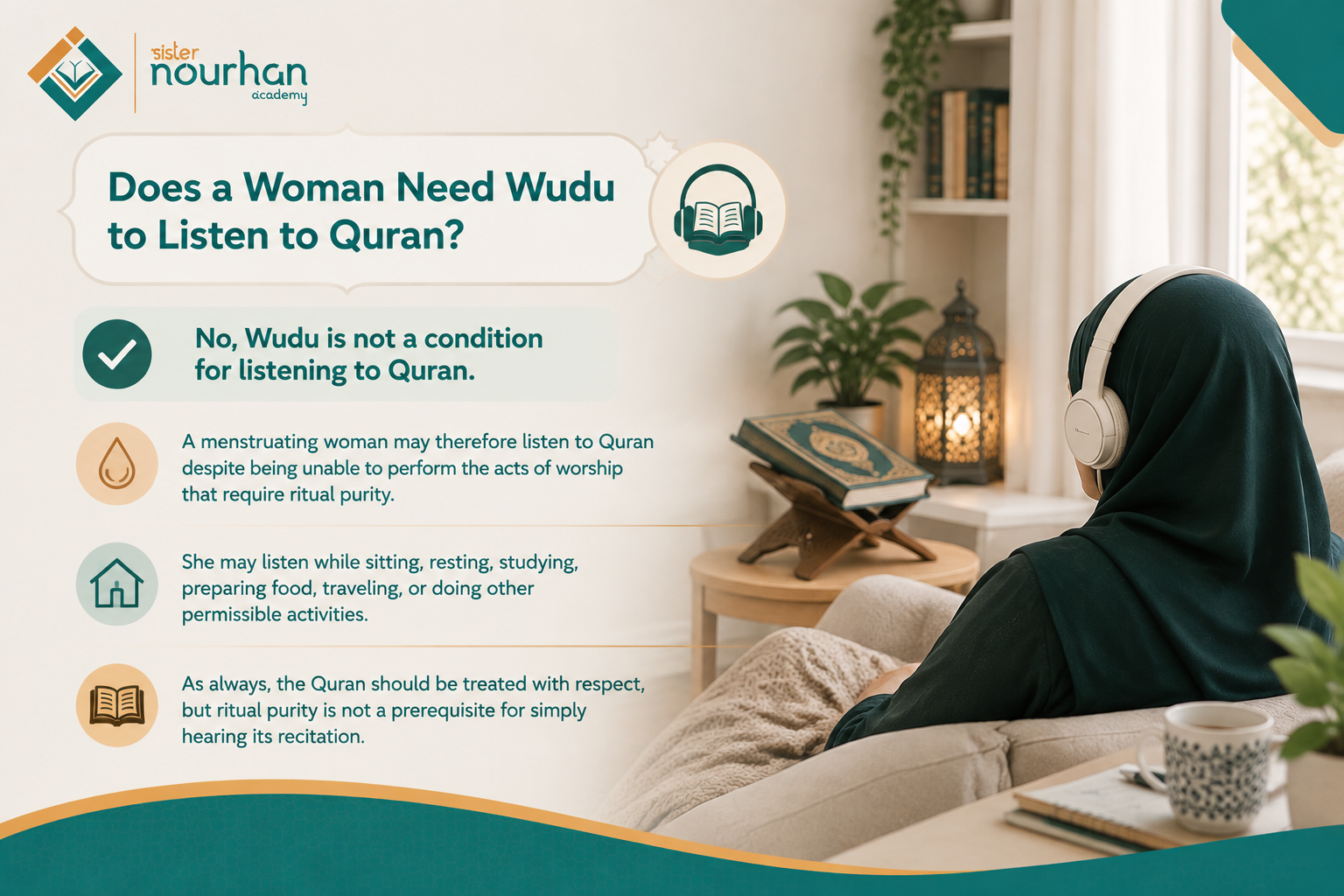
No Wudu is not a condition for listening to Quran.A menstruating woman may therefore listen to Quran despite being unable to perform the acts of worship that require ritual purity.
She may listen while sitting, resting, studying, preparing food, traveling, or doing other permissible activities.
As always, the Quran should be treated with respect, but ritual purity is not a prerequisite for simply hearing its recitation.
Read also: How to perform wudu for woman step by step
Can a Menstruating Woman Touch the Physical Mushaf?
According to the majority of classical scholars, a menstruating woman should not directly touch the physical Mushaf. This ruling is separate from listening to the Quran, which is generally permitted during menstruation.
Among the evidences commonly discussed in relation to touching the Mushaf is the verse:
لَا يَمَسُّهُ إِلَّا الْمُطَهَّرُونَ
“None touch it except the purified.” Surah Al-Waqi‘ah (56:79)
Scholars also cite the prophetic instruction:
أَلَّا يَمَسَّ الْقُرْآنَ إِلَّا طَاهِرٌ
“No one should touch the Quran except one who is pure.”
For this reason, permission to listen to the Quran should not automatically be understood as permission to directly handle a printed Mushaf during menstruation. Listening and touching the Mushaf are separate issues, and the latter is subject to stricter rulings concerning ritual purity.
What About Reading Tafseer During Menstruation?
Studying the meanings of the Quran is another valuable activity women can continue. Books of Tafseer are not always treated exactly like a physical Mushaf, particularly when the book contains substantial commentary in addition to Quranic verses.
Women can also study translations, Islamic books, lecture notes, and digital Tafseer resources This allows a menstruating woman to use the period for deeper reflection.
She may study why a verse was revealed, examine its vocabulary, learn lessons from a surah, or explore how scholars interpreted different passages.
Sometimes reducing the amount of formal recitation for a few days can even create an opportunity to concentrate more deeply on understanding.
Read also: Hadith about woman praying at mosque
Can You Attend a Quran Class While Menstruating?
Yes, menstruation does not mean Quran education has to stop entirely A woman may continue attending online Quran lessons, listening to her teacher, studying Tajweed, reviewing meanings, and following lessons.
How much verbal recitation she personally performs depends on the scholarly view she follows. A woman who follows the permissive opinion can continue reciting for learning and memorization.
A student following the more cautious opinion may use the class for listening, theory, revision planning, or other Quran-related study until she becomes pure.
The important point is that menstruation does not require a woman to disappear from Quran education for several days each month.
Can Listening to the Quran Help Maintain a Spiritual Routine During Menstruation?
Yes Many women naturally feel a change in their normal worship routine during menstruation because salah and fasting are affected.
Listening to the Quran can provide continuity A woman can establish a simple daily routine such as listening to one surah, reviewing memorized portions through audio, studying Tafseer, making dhikr, or listening to verses she finds especially meaningful.
This should not be understood as replacing salah. Rather, it is one of several permissible ways to remain engaged in worship and Islamic learning during menstruation.
Other acts such as dua, dhikr, seeking Islamic knowledge, giving charity, and reflecting on Allah's blessings also remain available.
Menstruation can also be an opportunity to strengthen other forms of worship that remain available, particularly dua and dhikr. Women who want to build a more consistent routine can explore the Dua and Adhkar Course for Females, which provides structured learning around remembrance and supplication as part of everyday Muslim life.

Menstruation vs Janabah: Why the Difference Matters?
Menstruation and janabah are both discussed within the broader subject of ritual purity, but they are not identical A person in janabah can normally remove that state by performing ghusl.
Menstruation, however, is involuntary. A woman cannot simply perform ghusl while menstruation continues and become ritually pure for salah.
This difference forms part of the reasoning of scholars who permit women to recite Quran during menstruation.
They argue that applying exactly the same restrictions to menstruation as to janabah could impose a longer and recurring interruption from recitation.
This is particularly relevant for women who memorize, teach, or study the Quran regularly.
Regardless of which opinion a woman follows regarding recitation, however, listening remains available and provides an important means of maintaining Quran engagement.
See our teaching methods
Experience the quality of our instruction firsthand by watching a live lesson snippet below.
Enrich Your Islamic Knowledge
Deepen your understanding of Fiqh, Aqeedah, and Hadith with dedicated female scholars at Sister Nourhan Academy.
Start Your Free Trial NowPractical Ways to Stay Connected to Quran During Your Period
A woman does not need to completely pause her Quran routine during menstruation. Depending on the scholarly opinion she follows regarding verbal recitation, there are several ways to continue learning, reviewing, and maintaining a connection with the Quran.
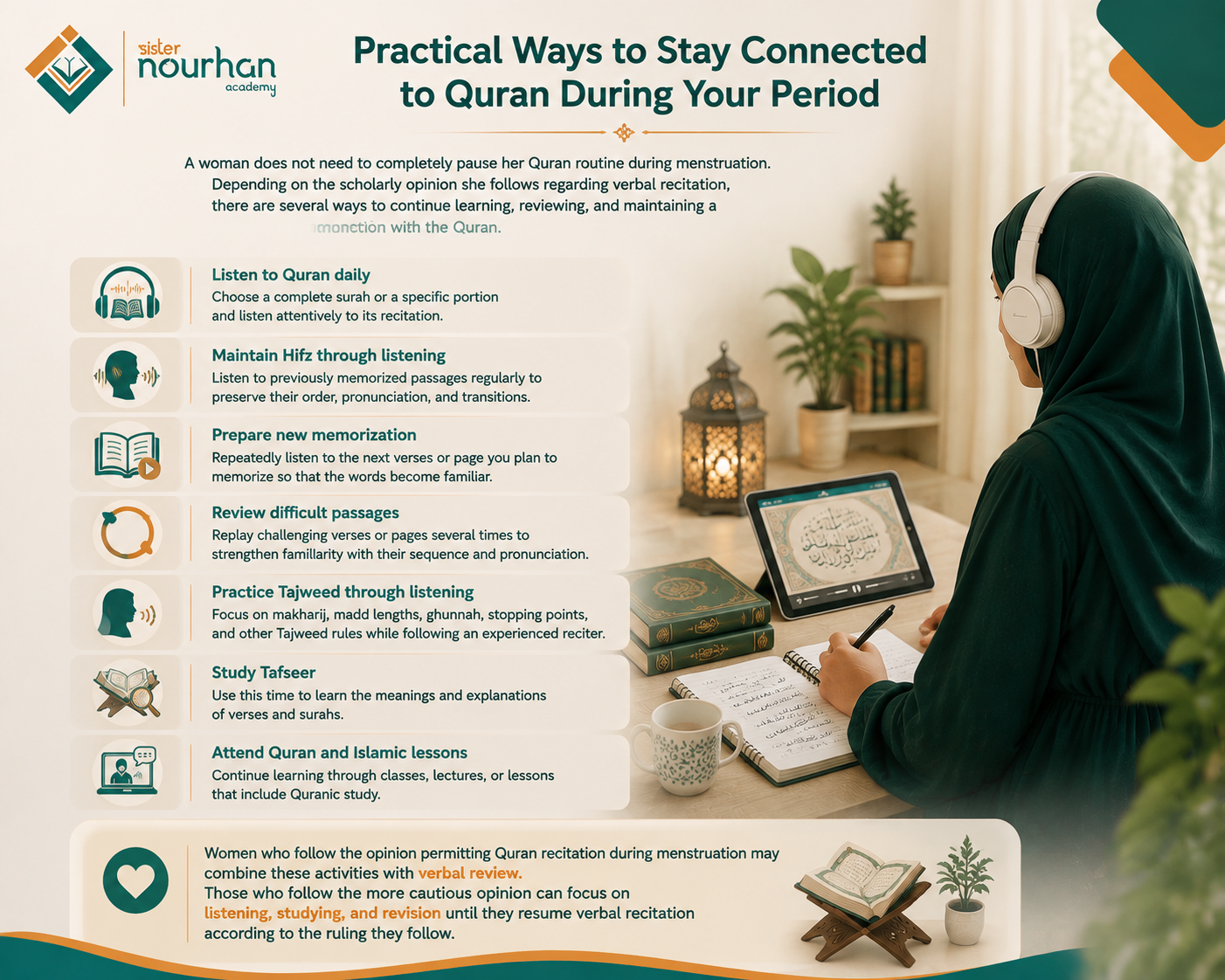
Listen to Quran daily: Choose a complete surah or a specific portion and listen attentively to its recitation.
Maintain Hifz through listening: Listen to previously memorized passages regularly to preserve their order, pronunciation, and transitions.
Prepare new memorization: Repeatedly listen to the next verses or page you plan to memorize so that the words become familiar.
Review difficult passages: Replay challenging verses or pages several times to strengthen familiarity with their sequence and pronunciation.
Practice Tajweed through listening: Focus on makharij, madd lengths, ghunnah, stopping points, and other Tajweed rules while following an experienced reciter.
Study Tafseer: Use this time to learn the meanings and explanations of verses and surahs.
Attend Quran and Islamic lessons: Continue learning through classes, lectures, or lessons that include Quranic study.
Women who follow the opinion permitting Quran recitation during menstruation may combine these activities with verbal review. Those who follow the more cautious opinion can focus on listening, studying, and revision until they resume verbal recitation according to the ruling they follow.
Continue Your Quran Journey with Sister Nourhan Academy
Your period does not have to mean putting your Quran learning on hold. Listening, reviewing memorized portions, studying Tajweed and Tafseer, and maintaining a routine of dua and dhikr can all help you continue growing in knowledge and strengthening your connection with Allah.
At Sister Nourhan Academy, female students can continue their Quran and Islamic studies through structured learning designed specifically for women.
Whether your goal is to strengthen Hifz, improve your understanding of the Quran, or build consistent Islamic habits, guided learning can help you maintain steady progress throughout every stage of the month.
Discover our Islamic Studies Courses

Conclusion
A menstruating woman may listen to the Quran, and her period does not require her to completely disconnect from Quran learning or remembrance of Allah.
She can continue listening to recitation, reviewing Hifz through audio, studying Tajweed and Tafseer, attending lessons, and engaging in other forms of worship such as dua and dhikr.
The important distinction is that listening, verbal recitation, reading from a digital device, and touching a physical Mushaf are separate issues. While listening is permissible, scholars have differed regarding some of the other activities, particularly verbal recitation during menstruation.
Whatever scholarly opinion a woman follows, menstruation does not have to become a complete break from the Quran. With an appropriate routine, these days can still be used for learning, reflection, revision, and maintaining a meaningful connection with the words of Allah.
Frequently Asked Questions
1. Can a menstruating woman listen to Quran every day?
Yes. A menstruating woman may listen to Quran every day during her period. She may listen for worship, relaxation, memorization review, Tajweed practice, or Islamic learning.
2. Can a woman listen to Quran on her period from her phone?
Yes. She may listen to Quran from a phone, tablet, computer, television, or another device during menstruation.
3. Does listening to Quran require wudu?
No. Wudu is not required merely to listen to Quran recitation.
4. Can women recite Quran on period?
Scholars differ. The majority of classical jurists restricted formal Quran recitation during menstruation, while other scholars permitted it. A woman may follow the school or qualified scholar she trusts.
5. Can a menstruating woman recite the Quran from memory?
This is part of the same scholarly disagreement. Scholars who permit recitation generally allow it from memory, particularly for learning, teaching, Hifz review, or fear of forgetting memorized passages.
6. Can a menstruating woman touch the Quran?
Directly touching the physical Mushaf is treated more restrictively than listening. The majority of classical scholars prohibited directly touching the Mushaf while in a state of major ritual impurity.