Learning the correct ghusl steps for ladies is essential for every Muslim woman because ghusl is required after certain states of major ritual impurity, including menstruation, postpartum bleeding, and janabah.
So, what is ghusl in Islam? Ghusl is a full-body ritual purification performed with the intention of removing major impurity and returning to a state in which acts of worship such as Salah can be performed.
Allah says:
وَإِن كُنتُمْ جُنُبًا فَاطَّهَّرُوا
“And if you are in a state of janabah, then purify yourselves.” Surah Al-Ma’idah 5:6
The process itself is straightforward. The following steps explain how to perform ghusl for females according to the complete Sunnah method, with additional guidance for women performing ghusl after menstruation.
1. Confirm When Ghusl Is Required for Women Before Starting
Before starting ghusl, first identify why you need to perform it. For women, ghusl is generally required:
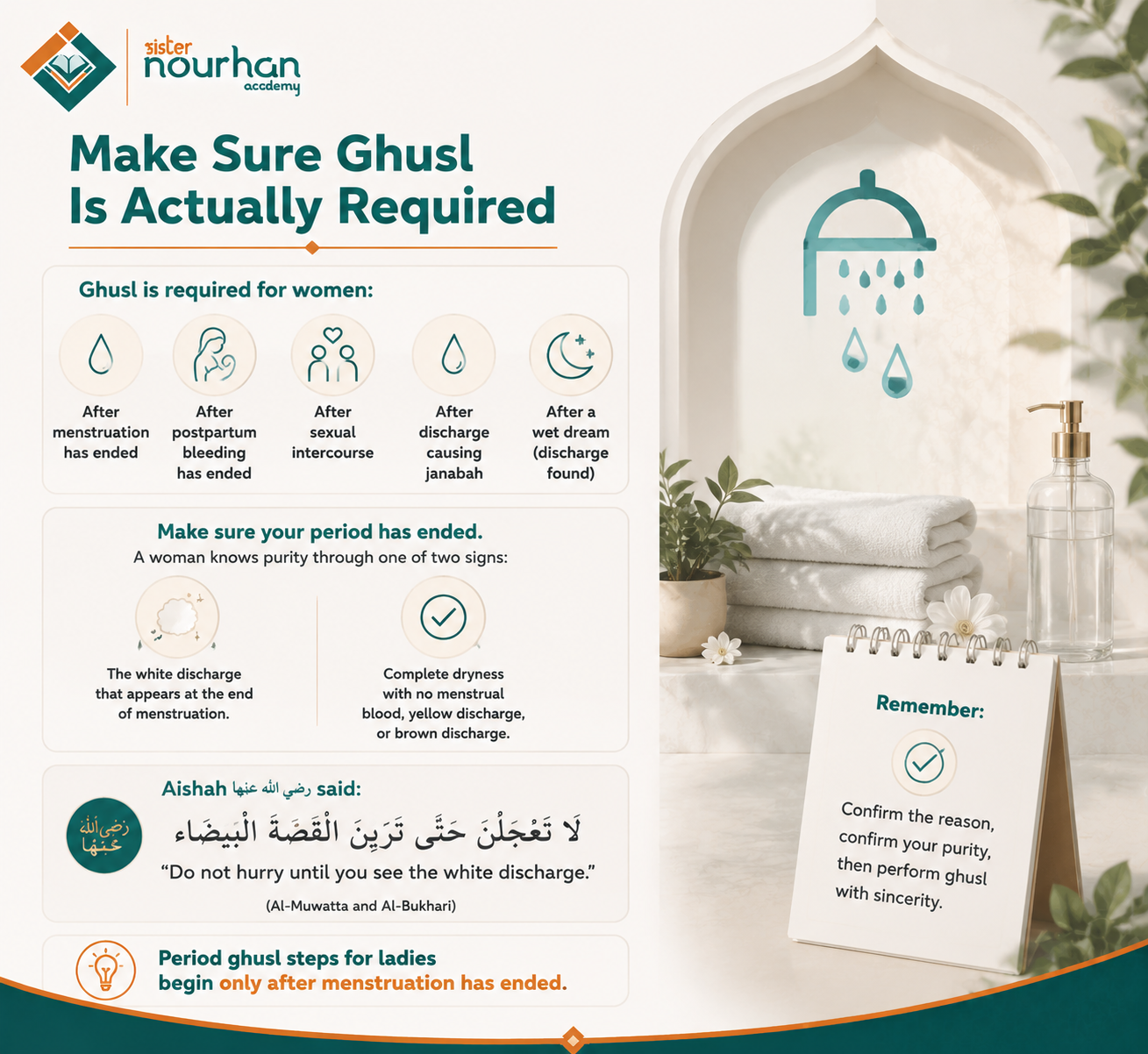
After menstruation has ended.
After postpartum bleeding has ended.
After sexual intercourse.
After discharge that causes janabah.
After a wet dream if the relevant discharge is found.
If you are performing ghusl steps for ladies after menstruation, make sure your menstrual period has actually ended before beginning.
A woman commonly recognizes purity through one of two signs:
The white discharge that appears at the end of menstruation for some women.
Complete dryness with no menstrual blood, yellow discharge, or brown discharge connected to the period.
Aishah رضي الله عنها used to advise women not to rush before confirming purity.
لَا تَعْجَلْنَ حَتَّى تَرَيْنَ الْقَصَّةَ الْبَيْضَاءَ
“Do not hurry until you see the white discharge.”
This report is narrated from Aishah رضي الله عنها in Al-Muwatta and is also mentioned by Al-Bukhari.
The practical point is simple: period ghusl steps for ladies begin only after menstruation has ended.
2. Make the Intention to Purify Yourself from Major Ritual Impurity
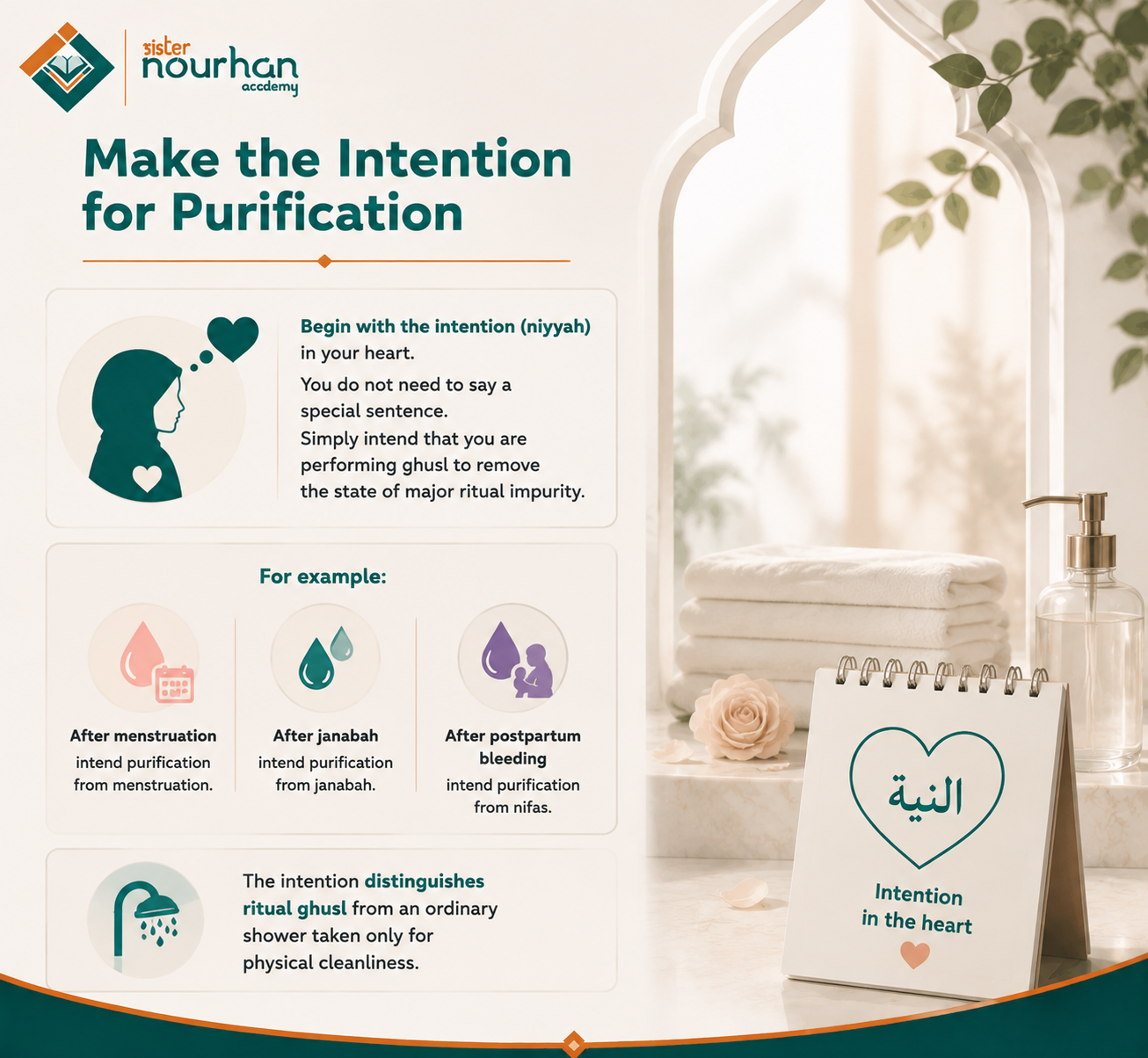
Once ghusl is required, begin with the intention (niyyah) in your heart. You do not need to say a special sentence aloud.
Simply intend that you are performing ghusl to remove the state of major ritual impurity.
For example:
After menstruation, intend purification from menstruation.
After janabah, intend purification from janabah.
After postpartum bleeding, intend purification from nifas.
The intention distinguishes ritual ghusl from an ordinary shower taken only for physical cleanliness.
3. Remove Anything That Prevents Water from Reaching Your Skin or Nails
Before washing, check whether anything forms a real barrier between the water and your skin or nails.
This may include:
Nail polish.
Thick waterproof makeup.
Adhesive substances.
Cosmetic coatings that prevent water from reaching the skin.
Ordinary color or staining that does not create a physical barrier is different.
You can use shampoo, soap, or shower gel during ghusl, but none of these products is required for the ghusl itself.
The main requirement is that water must be able to reach the areas that need to be washed.
4. Say Bismillah and Begin Ghusl by Washing Your Hands
Begin the complete Sunnah ghusl by saying:
بِسْمِ اللهِ
Bismillah — “In the name of Allah.”
Then wash both hands thoroughly, preferably three times.
Aishah رضي الله عنها described the Prophet's ﷺ ghusl and said:
كَانَ رَسُولُ اللَّهِ صلى الله عليه وسلم إِذَا اغْتَسَلَ مِنَ الْجَنَابَةِ غَسَلَ يَدَيْهِ
Meaning that when the Messenger of Allah ﷺ performed ghusl from janabah, he began by washing his hands. Sunan an-Nasa'i 420
This narration establishes the beginning of the complete prophetic method of ghusl. Through the Alimah Course for Females, students can develop a broader foundation in Islamic sciences and learn matters of worship as part of a connected body of knowledge rather than a collection of individual rulings.
5. Wash the Private Area and Remove Any Physical Impurity
After washing your hands, clean the private area carefully and remove any physical impurity before continuing with the rest of the ghusl.
For women performing ghusl after menstruation, make sure any remaining traces of menstrual blood are washed away. The aim is simply to clean the area thoroughly; excessive scrubbing, repeated washing, or constant checking is unnecessary.
Once the impurity has been removed, continue to the next stage of ghusl by performing wudu.
Enrich Your Islamic Knowledge
Deepen your understanding of Fiqh, Aqeedah, and Hadith with dedicated female scholars at Sister Nourhan Academy.
Start Your Free Trial Now6. Perform Wudu as You Normally Would Before Salah
After cleaning the private area, perform wudu in the normal way.
This generally includes:
Rinsing the mouth.
Rinsing the nose.
Washing the face.
Washing the arms to the elbows.
Wiping the head.
Washing the feet.
Aishah رضي الله عنها narrated:
ثُمَّ تَوَضَّأَ وُضُوءَهُ لِلصَّلاَةِ
“Then he performed wudu as he would for prayer.” Sunan an-Nasa'i 420
If the place where you are bathing makes it more practical, the feet may be washed at the end.
Women who want to study Prophetic narrations and understand how Islamic rulings are derived from them can explore Sister Nourhan Academy's Hadith Studies Course.
Read also: How to perform wudu for females?
7. Pour Water Over Your Head Three Times and Reach the Scalp
After wudu, pour water over your head three times.
This is particularly important for women because water must reach the scalp and roots of the hair.
Aishah رضي الله عنها explained:
ثُمَّ يُخَلِّلُ بِيَدِهِ شَعَرَهُ حَتَّى إِذَا ظَنَّ أَنَّهُ قَدْ أَرْوَى بَشَرَتَهُ أَفَاضَ عَلَيْهِ الْمَاءَ ثَلاَثَ مَرَّاتٍ
The narration describes the Prophet ﷺ working water through his hair until it reached the skin, then pouring water over his head three times. Sunan an-Nasa'i 420
Do not simply wet the outer surface of the hair.
Use your fingers where necessary to help the water reach:
The scalp.
Hair roots.
Areas beneath thick hair.
The back and sides of the head.
8. Make Sure Water Reaches the Hair Roots
This step deserves special attention because it is one of the most common concerns when women ask how to perform ghusl for females.
If your hair is long, thick, braided, or tightly arranged, make sure the water reaches the roots.
Umm Salamah رضي الله عنها asked the Prophet ﷺ whether she needed to undo her braided hair for ghusl from janabah.
She said:
يَا رَسُولَ اللَّهِ إِنِّي امْرَأَةٌ أَشُدُّ ضَفْرَ رَأْسِي أَفَأَنْقُضُهُ لِغُسْلِ الْجَنَابَةِ
The Prophet ﷺ replied that it was sufficient for her to pour water over her head three times and then pour water over her body .Sahih Muslim 330a
So, braids do not automatically need to be undone during ghusl from janabah if water can reach the roots.
However, if a hairstyle prevents water from reaching the scalp, it must be loosened enough for the water to reach properly.
9. Wash the Right Side of Your Body and Areas That Are Easy to Miss
After washing the head, begin washing the rest of the body. Starting with the right side is part of the complete preferred method.
Make sure water reaches areas that can easily be missed, including:
Under the arms.
Under the breasts.
The navel.
Behind the knees.
Skin folds.
Between the fingers.
Between the toes.
Around the outer ears.
You can gently run your hands over the body while washing to help spread the water.
There is no need to turn ghusl into an exhausting inspection. Wash yourself normally and thoroughly.
10. Wash the Left Side and Make Sure Water Reaches Your Entire Body
After the right side, wash the left side and any remaining areas. The goal is for water to reach the entire external body. Aishah رضي الله عنها described the Prophet ﷺ after washing his head:
ثُمَّ غَسَلَ سَائِرَ جَسَدِهِ
“Then he washed the rest of his body.” Sunan an-Nasa'i 420
At this point, once water has reached the required areas of the body, the main washing of ghusl is complete.
When Is Ghusl Required for a Woman?
A woman is required to perform ghusl after:
Menstruation has completely ended.
Postpartum bleeding (nifas) has ended.
Sexual intercourse.
Discharge that causes janabah, including after a wet dream when the relevant discharge is found.
Regarding purification after menstruation, Allah says:
وَيَسْأَلُونَكَ عَنِ الْمَحِيضِ قُلْ هُوَ أَذًى فَاعْتَزِلُوا النِّسَاءَ فِي الْمَحِيضِ وَلَا تَقْرَبُوهُنَّ حَتَّىٰ يَطْهُرْنَ ۖ فَإِذَا تَطَهَّرْنَ فَأْتُوهُنَّ مِنْ حَيْثُ أَمَرَكُمُ اللَّهُ ۚ إِنَّ اللَّهَ يُحِبُّ التَّوَّابِينَ وَيُحِبُّ الْمُتَطَهِّرِينَ
“And they ask you about menstruation. Say, ‘It is harm, so keep away from wives during menstruation. And do not approach them until they are pure. And when they have purified themselves, then come to them from where Allah has ordained for you.’” Surah Al-Baqarah 2:222
The verse shows that menstrual bleeding must first end before purification is performed. Once purity is confirmed, a woman can perform ghusl and resume the acts of worship that require ritual purity.
What Is the Minimum Valid Ghusl for Ladies?
It is useful to distinguish between the minimum sufficient ghusl and the complete Sunnah method described above.
At its foundation, a valid ghusl requires the intention of purification and washing the entire body so that water reaches the skin and roots of the hair. Rinsing the mouth and nose should also not be neglected, particularly because scholars differ regarding their status in ghusl.
The longer step-by-step method adds the established Sunnah actions such as washing the hands, cleaning the private area, performing wudu, and pouring water over the head three times.
This distinction is important because a woman should not believe her ghusl is automatically invalid merely because she did not repeat every part three times.
Sister Nourhan Academy's Alimah Course for Females provides women with a broader path for studying Islamic rulings and foundational Islamic sciences in a structured way.

Should You Use Musk After Ghusl Following Menstruation?
The Sunnah contains an additional recommendation for women after menstruation. Aishah رضي الله عنها narrated that a woman asked the Prophet ﷺ how to purify herself after menstruation.
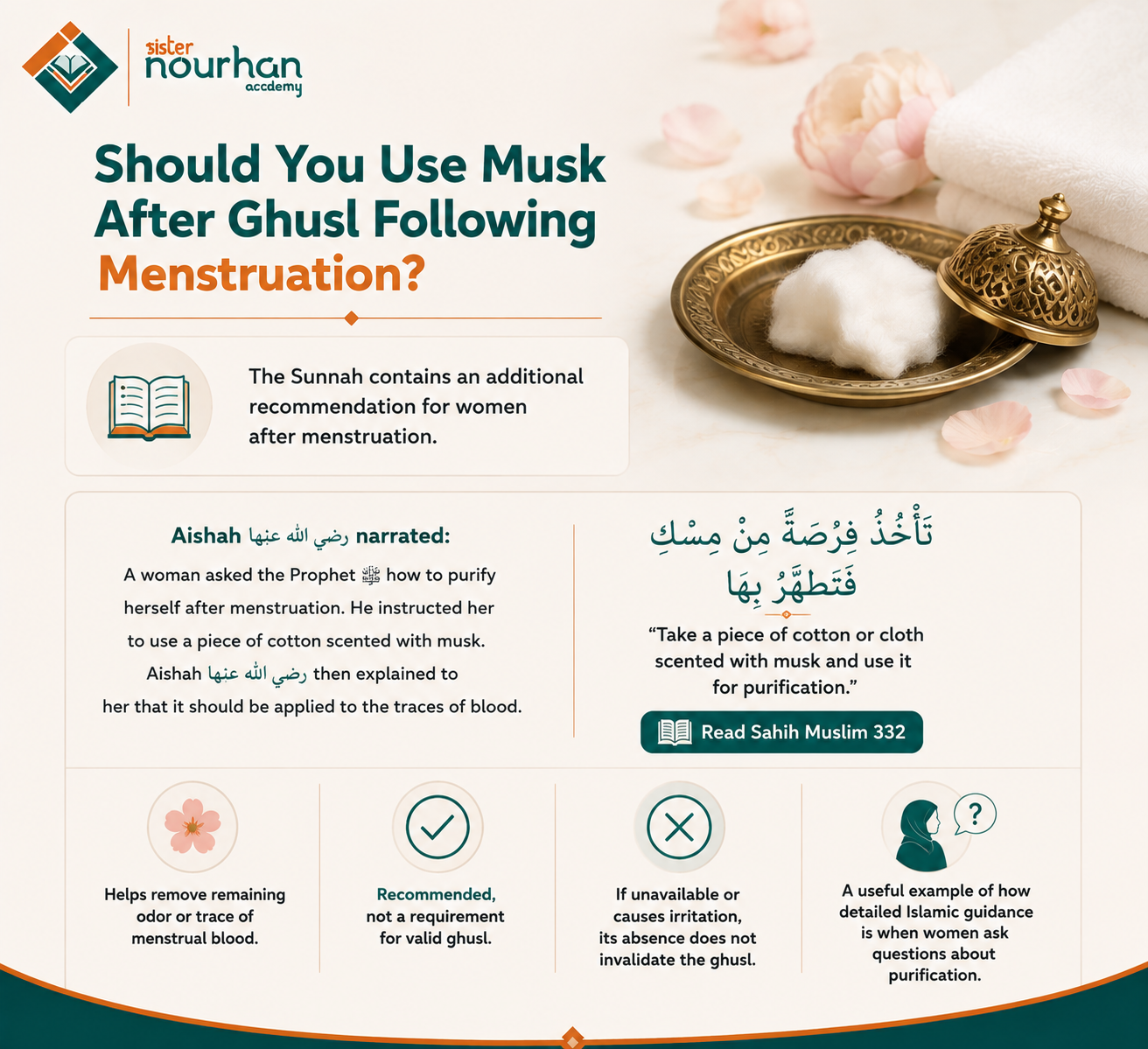
He instructed her to use a piece of cotton scented with musk. Aishah رضي الله عنها then explained to her that it should be applied to the traces of blood.
The narration says:
تَأْخُذُ فِرْصَةً مِنْ مِسْكٍ فَتَطَهَّرُ بِهَا
Meaning that she should take a piece of cotton or cloth scented with musk and use it for purification. Sahih Muslim 332
This recommendation helps remove the remaining odor or trace of menstrual blood. It is recommended, not a requirement for valid ghusl. If musk is unavailable or causes irritation, its absence does not invalidate the ghusl.
The hadith is also a useful example of how detailed Islamic guidance can be when women ask questions concerning purification.
Read also: The Five Pillars of Islam for Kids and Beginners
Do You Need to Wash Every Strand of Long Hair?
No. You do not need to wash every strand of long hair individually during ghusl. The important requirement is that water reaches the scalp, hair roots, and the hair that must be washed, without anything preventing the water from reaching them.
If your hair is long, thick, or braided, focus on working the water thoroughly into the roots rather than repeatedly washing each strand out of uncertainty. Braids do not necessarily need to be undone if water can properly reach the roots.
However, if a tight braid, hairstyle, or other arrangement prevents water from reaching the scalp and roots, loosen or undo it enough to allow the water to reach those areas properly.
What About Nail Polish, Makeup, and Waterproof Products?
Before ghusl, remove anything that creates a genuine waterproof barrier preventing water from reaching the skin or nails.
This may include:
Nail polish.
Some waterproof cosmetics.
Thick cosmetic coatings.
Adhesives or substances that form a physical layer over the skin.
Ordinary staining or color that does not create a barrier is different from a coating that actually prevents water from reaching the surface underneath.
The principle is not that a woman must remove every beauty product simply because it is visible. The issue is whether it prevents water from reaching what must be washed.
Read also: Is a woman allowed to read the Quran from her smartphone while on her period?
Does Ghusl Replace Wudu?
It depends on how the ghusl is performed and, in some details, the scholarly view being followed.
When performing the complete Sunnah ghusl, wudu is included as part of the process, as described in the hadith of Aishah رضي الله عنها. If nothing occurs during or after the ghusl that invalidates wudu, there is generally no need to perform the same wudu again before Salah.
For other forms of ghusl, scholars differ over whether the ghusl by itself also removes minor ritual impurity and therefore replaces wudu. The details can also vary between madhhabs.
For this reason, if you follow a particular madhhab, follow its established ruling or consult a qualified scholar or teacher regarding the form of ghusl you perform.
Common Mistakes Women Make When Performing Ghusl
Most mistakes happen because an essential part of purification is overlooked or because ghusl becomes unnecessarily complicated.
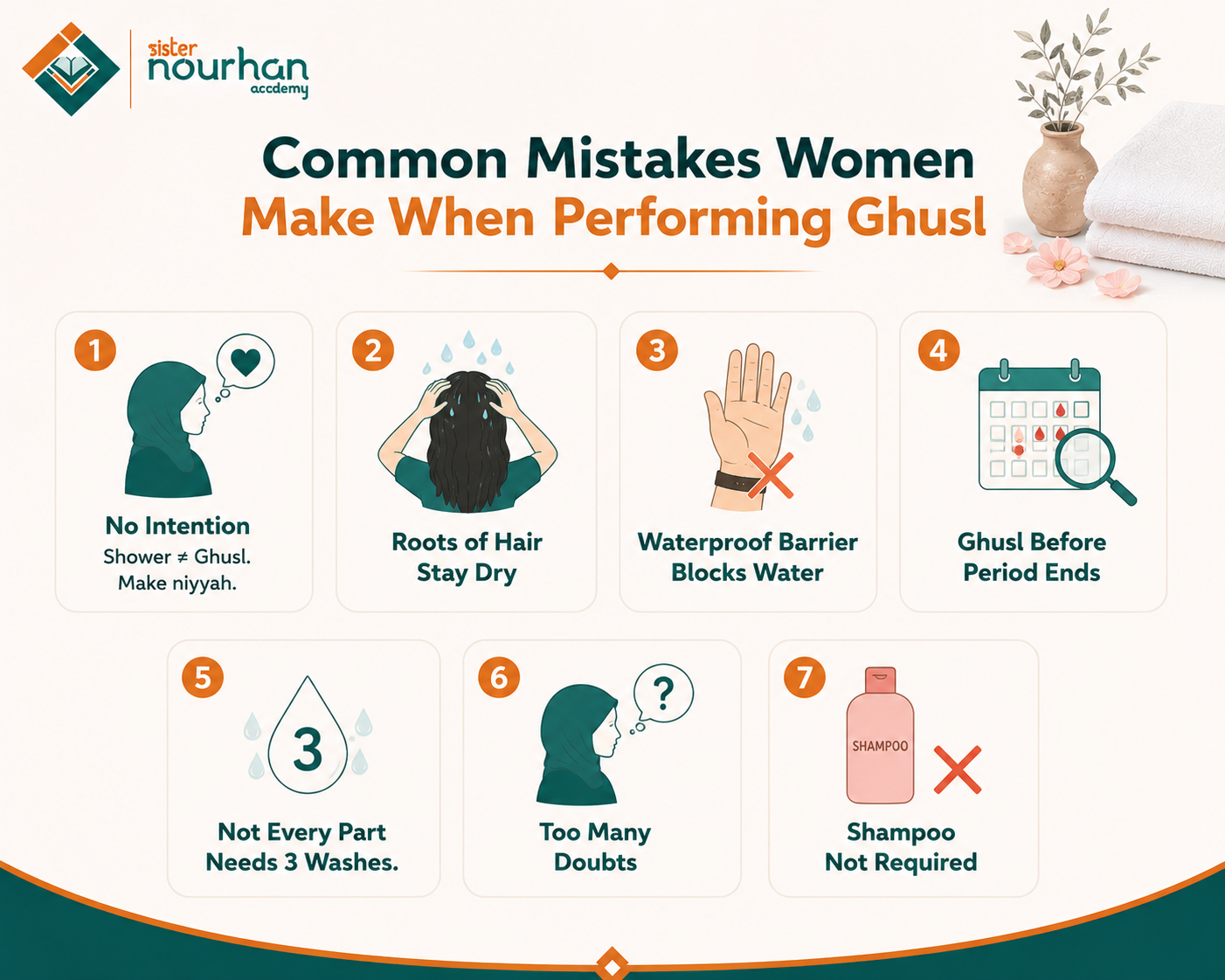
1. Treating an Ordinary Shower as Ghusl Without Intention
Physical cleanliness alone is not the same as ritual purification. Make the intention in your heart to remove the state requiring ghusl.
2. Leaving the Roots of the Hair Dry
Wet-looking hair does not necessarily mean water has reached the scalp. Work the water through thick or long hair where necessary.
3. Leaving a Waterproof Barrier on the Body
Remove anything that genuinely prevents water from reaching the skin or nails.
4. Performing Menstrual Ghusl Before the Period Has Actually Ended
First look for your recognized sign of purity. A temporary reduction in bleeding is not automatically the end of menstruation.
5. Thinking Every Body Part Must Be Washed Three Times
Pouring water over the head three times is part of the complete prophetic description, but ghusl does not require washing every part of the body three times.
6. Becoming Excessive About Small Doubts
Once you have washed yourself normally and thoroughly, do not repeatedly restart ghusl because of unsupported doubts.
7. Assuming Shampoo Is Required
Shampoo may improve physical cleanliness, but it is not what makes ritual ghusl valid.
What Should You Do After Completing Ghusl?
Once ghusl is complete, you can dry yourself and dress normally. There is no requirement to remain wet or to wait for a certain period before praying.
If the ghusl restored your ritual purity and nothing occurred afterward that invalidated wudu, you can prepare for Salah and other acts of worship according to the relevant ruling you follow.
Purification also connects naturally with the remembrance of Allah. Women who want to develop a more consistent understanding of daily supplications and remembrance can study these practices through Sister Nourhan Academy's Dua & Adhkar Course for Females.
See our teaching methods
Experience the quality of our instruction firsthand by watching a live lesson snippet below.
Experience the quality of our instruction firsthand by watching a live lesson snippet below.
Enrich Your Islamic Knowledge
Deepen your understanding of Fiqh, Aqeedah, and Hadith with dedicated female scholars at Sister Nourhan Academy.
Start Your Free Trial NowLearn Ghusl and Purification with Sister Nourhan Academy
Knowing the correct ghusl steps for ladies is an essential part of understanding purification, but women may also face questions about menstruation, janabah, wudu, Salah, and other related rulings.
Sister Nourhan Academy helps women study these matters systematically with qualified teachers, so they can understand both the rulings and the Islamic evidence behind them. This provides a stronger foundation for applying purification and other acts of worship correctly in daily life.
See our teaching methods
Experience the quality of our instruction firsthand by watching a live lesson snippet below.
Discover our Islamic Studies Courses

Conclusion
Understanding the correct ghusl steps for ladies makes purification simple and clear. The essential principle is to perform ghusl with the intention of purification and ensure that water reaches the entire body, including the scalp and roots of the hair.
Whether ghusl is required after menstruation, postpartum bleeding, or janabah, learning the correct method helps a Muslim woman return to Salah and other acts of worship with confidence.
When questions arise about specific situations or scholarly differences, seek guidance from a qualified teacher rather than allowing uncertainty to make purification unnecessarily difficult.
Frequently Asked Questions About Ghusl Steps for Ladies
What is ghusl in Islam?
Ghusl is a ritual full-body washing used to remove major ritual impurity. It is required in situations such as after menstruation, postpartum bleeding, and janabah before returning to acts of worship that require ritual purity.
How to perform ghusl for females?
Make the intention, wash your hands and private area, perform wudu, wash the head while ensuring water reaches the roots of the hair, and then wash the entire body thoroughly. This is the complete method based on the Prophetic description of ghusl.
What are the ghusl steps for ladies after menstruation?
First confirm that menstruation has ended. Then make the intention, clean away traces of blood, perform wudu, wash the head and roots thoroughly, and wash the entire body. Using musk at the previous site of bleeding afterward is recommended when appropriate.
How do I know when to perform ghusl after my period?
Look for your recognized sign of purity, usually the white discharge or complete dryness. Do not perform menstrual ghusl merely because bleeding becomes temporarily lighter.
Can I perform ghusl with braided hair?
Yes, if water reaches the scalp and roots. If your hairstyle prevents water from reaching them, you need to loosen or undo what is preventing the water.
Does my entire hair have to get wet during ghusl?
Water must properly reach the roots and scalp, and you should wash in a way that fulfills the required full-body purification. The Prophetic guidance specifically emphasizes making water reach the roots of the hair.