Ask five sisters in Cairo what "obedience" means in marriage, and you may hear five very different answers — some warm, some worried, some frankly bitter. That gap usually comes from hearing the hadith about a woman obeying her husband quoted on social media without its wording, its chain, or its context.
The Prophet ﷺ spoke about marriage with tenderness, not control. Yet a single line pulled out of a long narration can flip the whole meaning upside down.
At Sister Nourhan Academy, we teach these narrations the way they were meant to be learned: full text, verified grading, and the scholarly explanation that comes with them.
By the end of this article, you will know exactly which narrations are authentic, what they oblige, and where obedience clearly stops.
Key Highlights of This Article:
The verified wording and grading of the four most-quoted narrations on wifely obedience.
Why "prostration" appears in a hadith that commands nothing of the sort.
The precise boundaries where a wife is not required to obey.
The husband's own obligations that always travel alongside these texts.
What Is The Hadith About A Woman Obeying Her Husband?
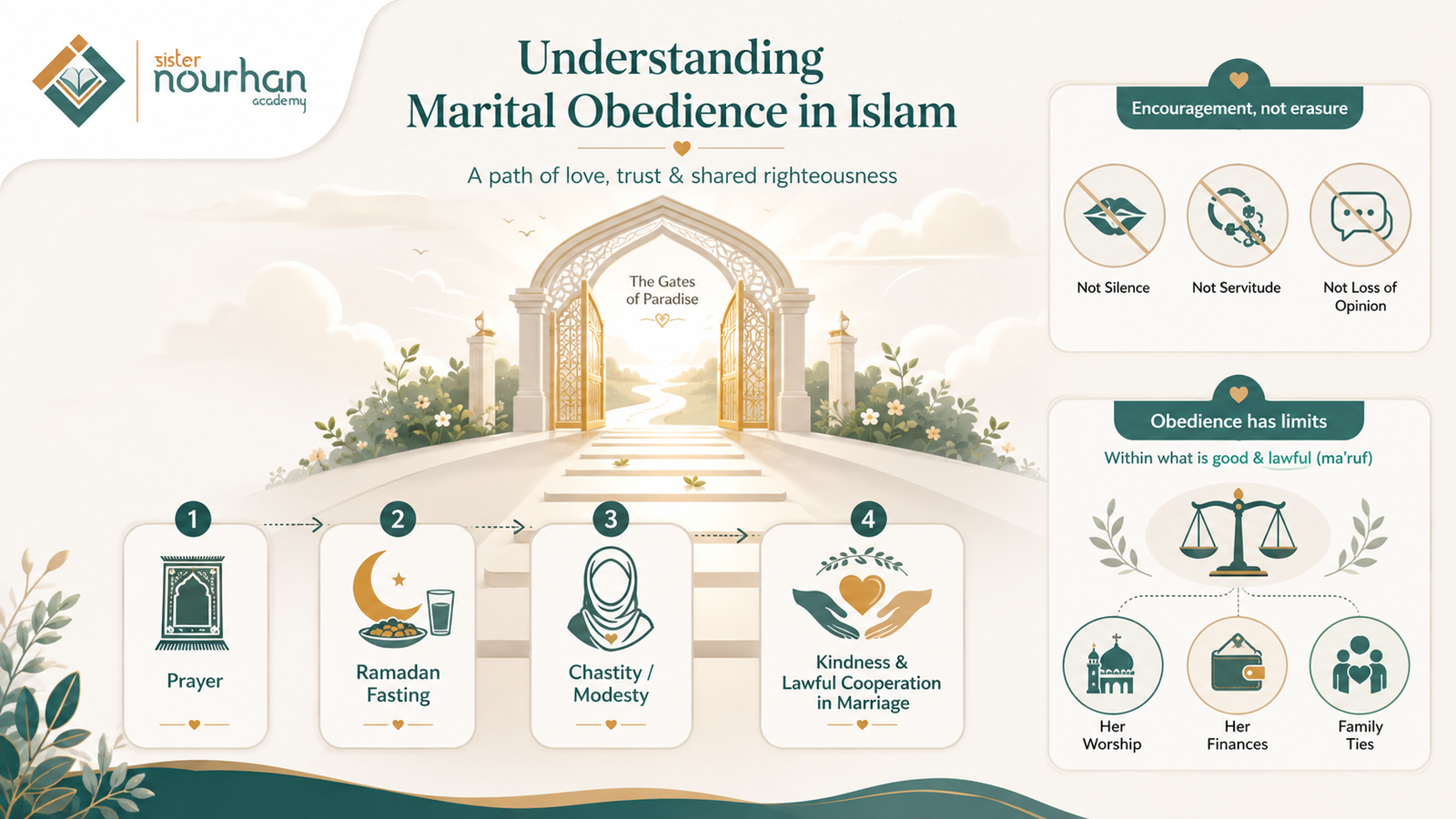
The best-known hadith about a woman obeying her husband lists obedience as one of four qualities — alongside prayer, fasting, and chastity — that open the gates of Paradise for a wife. It is a narration of encouragement, not a rulebook of commands.
Notice what it does not say. It never mentions silence, servitude, or surrendering a woman's opinion.
If A Woman Obeys Her Husband Hadith - The Full Wording
This is the narration most sisters have heard quoted at weddings and in khutbahs, usually without its source. Reading it in full shows how much of it is worship between a woman and her Lord.
Anas ibn Malik (may Allah be pleased with him) said: The Messenger of Allah (ﷺ) said:
«الْمَرْأَةُ إِذَا صَلَّتْ خَمْسَهَا، وَصَامَتْ شَهْرَهَا، وَأَحْصَنَتْ فَرْجَهَا، وَأَطَاعَتْ بَعْلَهَا، فَلْتَدْخُلْ مِنْ أَيِّ أَبْوَابِ الْجَنَّةِ شَاءَتْ».
The Messenger of Allah (ﷺ) said: "When a woman observes her five daily prayers, fasts her month, guards her chastity, and obeys her husband, let her enter Paradise by whichever of its gates she wishes."— Mishkat al-Masabih 3254
Three of the four conditions are acts of worship between a woman and her Lord. Only the fourth involves her husband — which tells you the weight distribution the Prophet ﷺ intended.
Scholars also note the reward here is a promise, not a threat. The framing is generosity: choose any gate you like.
How Scholars Define "Obedience" Inside A Marriage
Classical jurists limit marital obedience to ma'ruf — what is recognised as good and lawful. It covers cooperation in the shared life of the home, not blanket authority over a wife's body, money, family ties, or worship.
Egypt's official fatwa authority discusses this balance in detail, and you can review the institution's guidance directly on the Dar al-Ifta Egypt portal.
Her own income stays hers. Her relationship with her parents stays hers. Her prayers stay hers.
Recommended reading: Do You Have to Wear Hijab When Reading Quran? Clear Rulings for Every Sister
The Hadith About Women Prostrating To Husband, Explained
The hadith about women prostrating to husband is probably the most misquoted text in this entire discussion. Understanding its grammar removes ninety percent of the confusion around it.
Why The Prophet ﷺ Never Commanded Women To Prostrate To Their Husbands
Abu Hurairah (رضي الله عنه) narrated an authentic report in which the Prophet ﷺ used a conditional statement to emphasize the husband's rights within marriage.
«لَوْ كُنْتُ آمِرًا أَحَدًا أَنْ يَسْجُدَ لِأَحَدٍ، لَأَمَرْتُ الْمَرْأَةَ أَنْ تَسْجُدَ لِزَوْجِهَا»
“If I were to order anyone to prostrate to anyone, then I would order the wife to prostrate to her husband.” Jami‘ At-Tirmidhi 1159
Imam At-Tirmidhi classified this narration as hasan gharib, and the cited edition also grades it Hasan.
The key phrase is “If I were to order” (لَوْ كُنْتُ آمِرًا). The Prophet ﷺ presents a hypothetical situation rather than issuing an actual command. The hadith therefore emphasizes the significance of a husband's marital rights; it does not instruct Muslim women to prostrate to their husbands.
The Quran provides further context by directing believers to prostrate to Allah:
﴿لَا تَسْجُدُوا لِلشَّمْسِ وَلَا لِلْقَمَرِ وَاسْجُدُوا لِلَّهِ الَّذِي خَلَقَهُنَّ إِنْ كُنْتُمْ إِيَّاهُ تَعْبُدُونَ﴾
“Do not prostrate to the sun or to the moon, but prostrate to Allah, who created them, if it is Him that you worship.” Surah Fussilat 41:37
Taken together, these texts make the distinction clear: the hadith uses a hypothetical expression to stress marital rights, while actual prostration to another human being is not being commanded. The Quran directs prostration as an act of worship to Allah alone.
Read also: Can a Woman Listen to Quran on Her Period?
What This Narration Really Teaches About Marital Rights
It teaches that a husband's rights are serious and not to be shrugged off. But the same Sunnah that elevates his rights sets the standard for his own behaviour just as high.
Muhammad ibn Yahya narrated to us: Muhammad ibn Yusuf narrated to us: Sufyan narrated to us, from Hisham ibn 'Urwah, from his father, from 'A'ishah (may Allah be pleased with her), who said:
The Messenger of Allah (peace and blessings of Allah be upon him) said:
«خَيْرُكُمْ خَيْرُكُمْ لِأَهْلِهِ، وَأَنَا خَيْرُكُمْ لِأَهْلِي».
"The best of you is the best of you to his family, and I am the best of you to my family." Jami' at-Tirmidhi 3895
But rights in Islam are reciprocal by design. The same Sunnah that elevates his rights records the Prophet ﷺ saying, "The best of you is the best to his wives."
Curious what else you've been quoted out of context? Our live Hadith Course for Sisters hand you the chain, the grading, and the meaning — all in one session.

The "No Woman Annoys Her Husband" Hadith And Emotional Kindness
The no woman annoys her husband hadith is short, striking, and often used as a warning stick. Read properly, it is really about protecting the emotional climate of a marriage.
Wording, Narrator, And Authenticity
The imagery in this narration is vivid, which is exactly why it circulates without its chain. Here is the full text with the isnad al-Tirmidhi recorded.
Al-Hasan ibn 'Arafah narrated to us: Isma'il ibn 'Ayyash narrated to us, from Buhayr ibn Sa'd, from Khalid ibn Ma'dan, from Kathir ibn Murrah al-Hadrami, from Mu'adh ibn Jabal (may Allah be pleased with him), from the Prophet (ﷺ), who said:
«لَا تُؤْذِي امْرَأَةٌ زَوْجَهَا فِي الدُّنْيَا إِلَّا قَالَتْ زَوْجَتُهُ مِنَ الْحُورِ الْعِينِ: لَا تُؤْذِيهِ قَاتَلَكِ اللَّهُ، فَإِنَّمَا هُوَ عِنْدَكِ دَخِيلٌ يُوشِكُ أَنْ يُفَارِقَكِ إِلَيْنَا».
“No woman harms her husband in this world except that his wife among the Hur al-'Ayn says: 'Do not harm him, may Allah deal with you — he is only a guest with you, soon to part from you and come to us.'" — Jami' at-Tirmidhi 1174
The narration is graded hasan. It addresses deliberate, repeated harm — not a bad mood, an honest disagreement, or a wife raising a real problem.
Three Practical Ways Egyptian Wives Apply It At Home
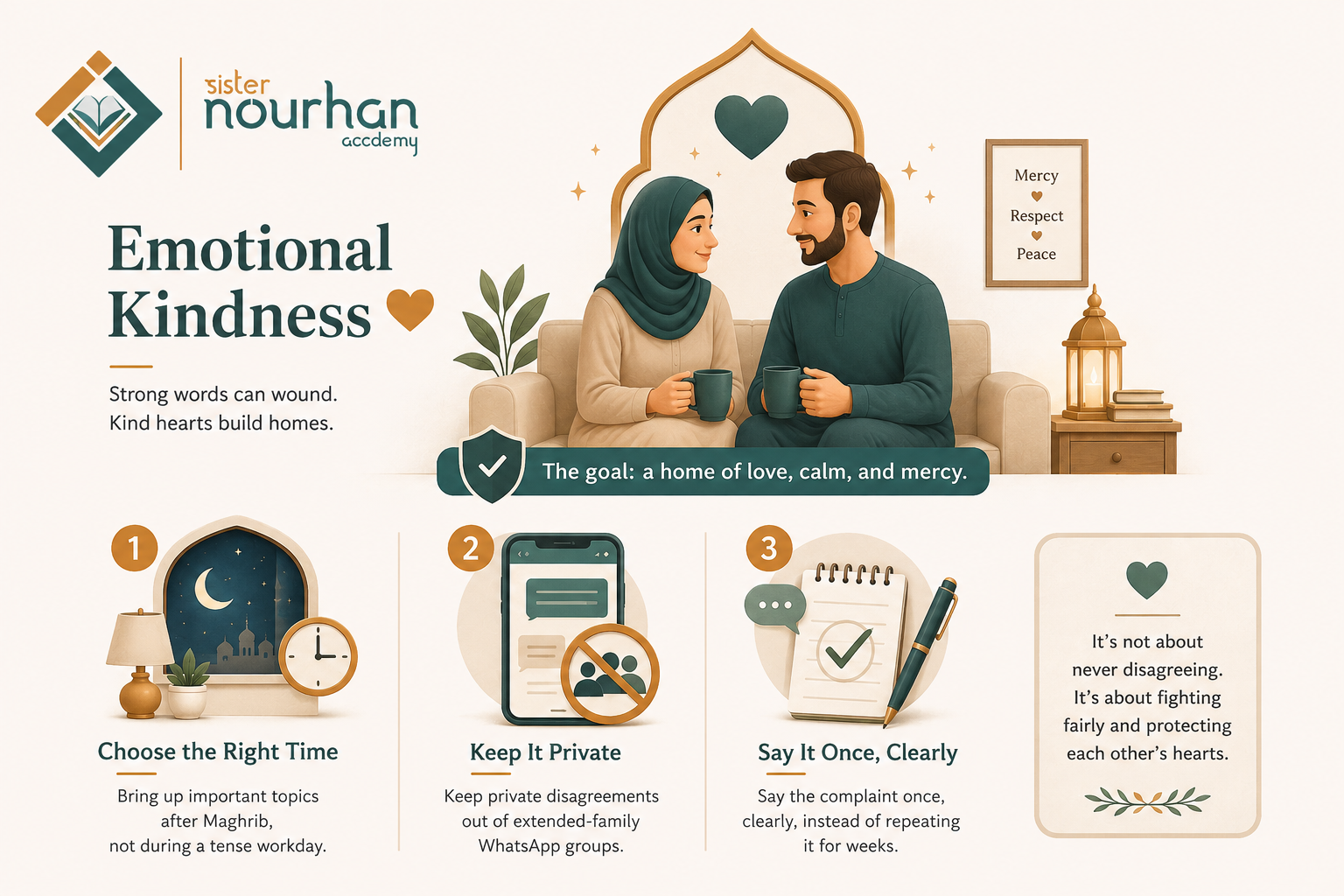
Applying this narration is less about words and more about timing and tone. Small habits protect a marriage far better than big speeches.
Raise heavy topics after Maghrib, not during a tense workday.
Keep private disagreements out of extended-family WhatsApp groups.
Say the complaint once, clearly, instead of repeating it for weeks.
None of this asks a wife to swallow harm. It asks both spouses to fight fairly.
You might also like: Can I Read the Quran on My Period? What Every Muslim Woman Should Know
Shots from Our Classes
Take a moment to view the video below to see how our teachers provide clear, supportive corrections during a session.
Enrich Your Islamic Knowledge
Deepen your understanding of Fiqh, Aqeedah, and Hadith with dedicated female scholars at Sister Nourhan Academy.
Start Your Free Trial NowThe Hadith About Women Being Ungrateful To Their Husband
The hadith about women being ungrateful to their husband is recorded in the most authentic collection we have. Its key term, kufr al-'ashir, is explained inside the hadith itself.
Abdullah ibn Maslamah narrated to us, from Malik, from Zayd ibn Aslam, from 'Ata' ibn Yasar, from Ibn 'Abbas (may Allah be pleased with them both), who said:
«أُرِيتُ النَّارَ فَإِذَا أَكْثَرُ أَهْلِهَا النِّسَاءُ يَكْفُرْنَ». قِيلَ: أَيَكْفُرْنَ بِاللَّهِ؟ قَالَ: «يَكْفُرْنَ الْعَشِيرَ، وَيَكْفُرْنَ الْإِحْسَانَ، لَوْ أَحْسَنْتَ إِلَى إِحْدَاهُنَّ الدَّهْرَ ثُمَّ رَأَتْ مِنْكَ شَيْئًا قَالَتْ: مَا رَأَيْتُ مِنْكَ خَيْرًا قَطُّ».
"I was shown the Fire, and most of its people were women who are ungrateful." It was said: "Do they disbelieve in Allah?" He said: "They are ungrateful to the husband and ungrateful for kindness. If you were good to one of them for a lifetime, then she saw something fromyou, she would say: 'I have never seen any good from you.'" — Sahih al-Bukhari 29
Read also: Does the Quran Say Men and Women Are Equal?
What "Kufr" Means In This Specific Context
The Prophet ﷺ was asked directly whether these women disbelieved in Allah, and he clarified that they did not. The word here means ingratitude, not apostasy.
The behaviour described is specific: a wife who receives years of good treatment, then says "you have never done anything good for me." That erasure of kindness is what the hadith condemns.
Misreading one word here turns a lesson in gratitude into an accusation of disbelief.
Read also: Does the Quran Allow Beating Women?
Gratitude Is A Two-Way Obligation
Before any discussion of duties, the Qur'an tells us what marriage is actually for. The purpose it names is tranquillity, not hierarchy.
Allah (Glorified and Exalted be He) says in Surah Ar-Rum, verse 21:
﴿وَمِنْ آيَاتِهِ أَنْ خَلَقَ لَكُم مِّنْ أَنفُسِكُمْ أَزْوَاجًا لِّتَسْكُنُوا إِلَيْهَا وَجَعَلَ بَيْنَكُم مَّوَدَّةً وَرَحْمَةً ۚ إِنَّ فِي ذَٰلِكَ لَآيَاتٍ لِّقَوْمٍ يَتَفَكَّرُونَ﴾
"And of His signs is that He created for you from yourselves mates that you may find tranquillity in them; and He placed between you affection and mercy. Indeed in that are signs for a people who give thought."— Quran.com 30:21
Nothing about the duty of gratitude is gender-specific, and the Sunnah states the principle in absolute terms. This next narration applies to husband and wife alike.
Muslim ibn Ibrahim narrated to us: Al-Rabi' ibn Muslim narrated to us, from Muhammad ibn Ziyad, from Abu Hurayrah (may Allah be pleased with him), from the Prophet (ﷺ), who said:
«لَا يَشْكُرُ اللَّهَ مَنْ لَا يَشْكُرُ النَّاسَ».
"He who does not thank people has not thanked Allah."— Sunan Abi Dawud 4811; also Jami' at-Tirmidhi 1954
One word — kufr — changes an entire ruling. Two live sessions a week, one female teacher, zero guesswork. Master the creed behind the wording in our Aqeedah Course (Islamic Creed) for Sisters, and stop studying your deen from screenshots.

The Limits - When A Wife Is Not Required To Obey
Every serious discussion of the hadith about a woman obeying her husband ends here, because the limits are part of the ruling — not a modern softening of it.
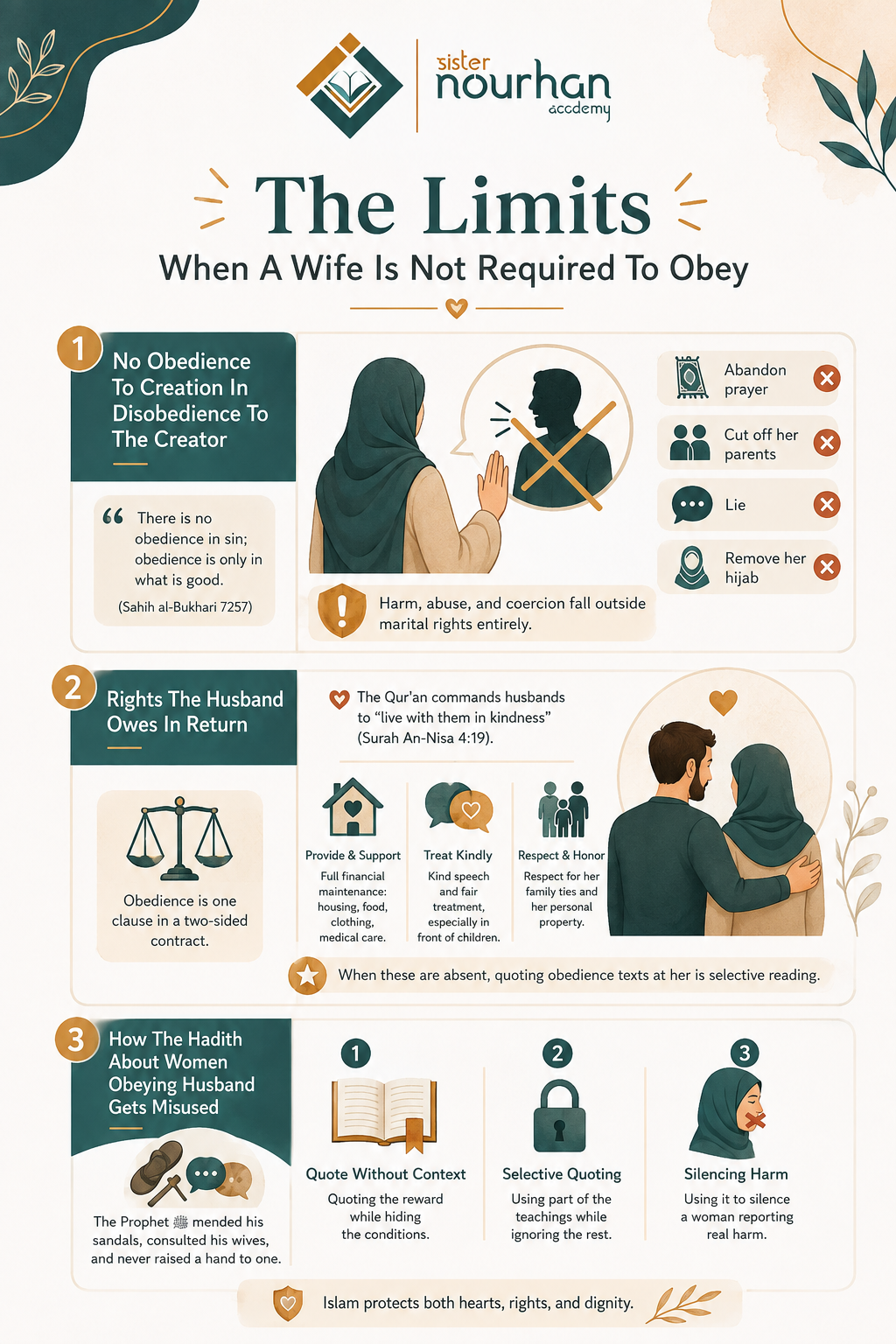
1. No Obedience To Creation In Disobedience To The Creator
The Prophet ﷺ settled this principle in a famous incident where a commander ordered his men into a fire. His verdict became a universal legal maxim.
Muhammad ibn Bashshar narrated to us: Ghundar narrated to us: Shu'bah narrated to us, from Zubayd, from Sa'd ibn 'Ubaydah, from Abu 'Abd al-Rahman, from 'Ali (may Allah be pleased with him)… and the Prophet (ﷺ) said:
«لَا طَاعَةَ فِي مَعْصِيَةٍ، إِنَّمَا الطَّاعَةُ فِي الْمَعْرُوفِ».
There is no obedience in disobedience to Allah; obedience is only in what is right."— Sahih al-Bukhari 7257
So if a husband instructs his wife to abandon prayer, cut off her parents, lie, or remove her hijab, obedience is not merely optional — it is impermissible.
Harm, abuse, and coercion fall outside marital rights entirely. Al-Azhar's institutional positions on family protection are published on the Al-Azhar official portal.
Read also: Hadith about woman praying at home
2. Rights The Husband Owes In Return
Obedience is one clause in a two-sided contract. The Qur'an addresses husbands directly with a command of its own.
Allah (Glorified and Exalted be He) says in Surah An-Nisa, verse 19:
﴿… وَعَاشِرُوهُنَّ بِالْمَعْرُوفِ ۚ فَإِن كَرِهْتُمُوهُنَّ فَعَسَىٰ أَن تَكْرَهُوا شَيْئًا وَيَجْعَلَ اللَّهُ فِيهِ خَيْرًا كَثِيرًا﴾
"…And live with them in kindness. For if you dislike them — perhaps you dislike a thing and Allah makes therein much good."— Quran.com 4:19
These rights include the following key obligations:
Full financial maintenance: housing, food, clothing, medical care.
Kind speech and fair treatment, especially in front of children.
Respect for her family ties and her personal property.
When these are absent, quoting obedience texts at her is selective reading.
Learning these texts with a qualified teacher is the simplest protection against all three — the same reason we always pair hadith study with our Fiqh Course at Sister Nourhan Academy, where rulings are taught with their evidence and their exceptions.
Read also: What is the best Islamic university for women in the Arab world?

3. How The Hadith About Women Obeying Husband Gets Misused
The most common misuse of the hadith about women obeying husband is treating it as a standalone rule detached from the Prophet's ﷺ own conduct at home. He mended his sandals, consulted his wives, and never raised a hand to one.
A second misuse is quoting the reward while hiding the conditions. A third is using it to silence a woman reporting real harm.
Why Sisters In Egypt Study Hadith With Sister Nourhan Academy
Reading a translation on your phone is a starting point, not an education. Sister Nourhan Academy was built so that sisters can study the Sunnah properly without leaving home or compromising comfort.
1. Female Teachers, Women-Only Classrooms
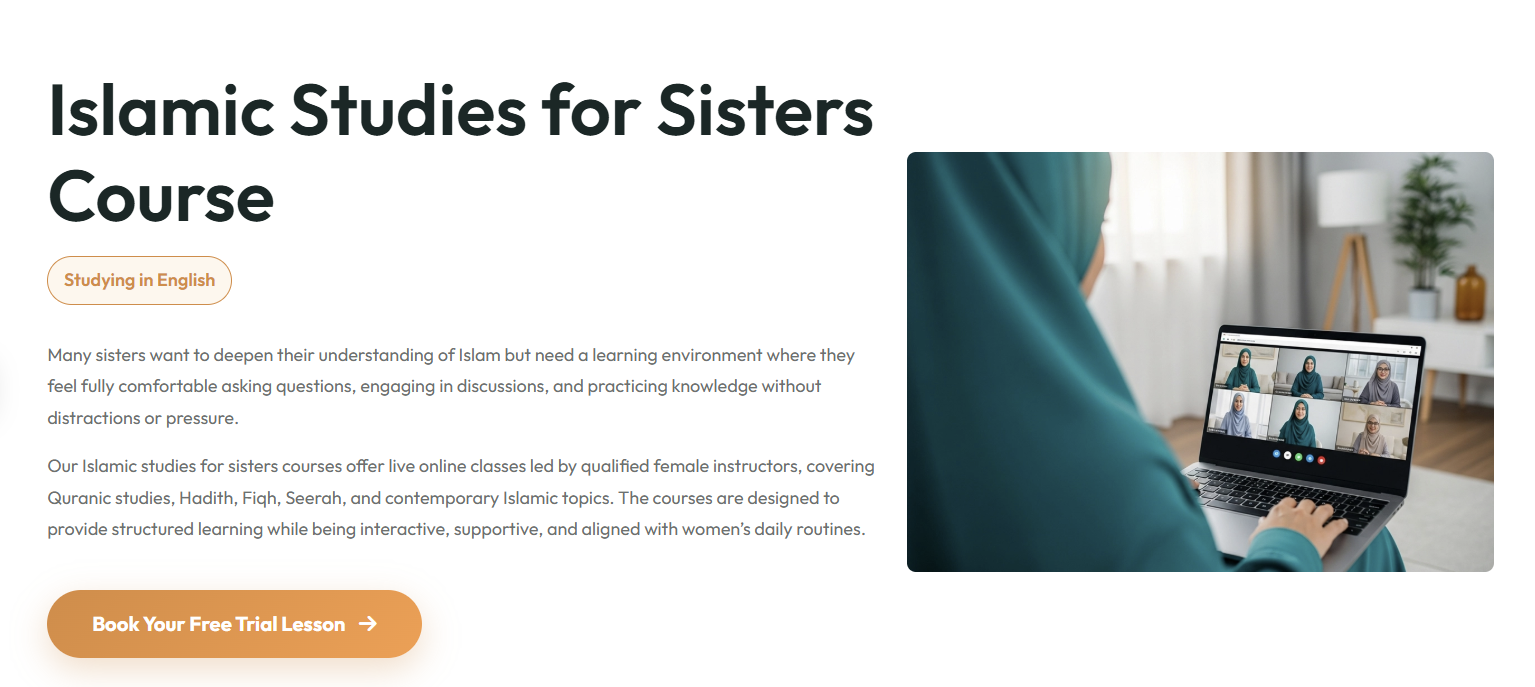
Every sister is taught by a qualified female instructor, so questions about marriage, intimacy, and family can be asked without awkwardness. Our Islamic Studies for Sisters (Women-Only) track is designed exactly for this.
Sisters routinely tell us this single detail changed how much they actually asked — and how much they learned.
2. Scheduling Built Around Egyptian Life
Classes run daily from 8:00 AM to 2:00 AM Egypt time, so you can book around school runs, work shifts, or the quiet hours after the children sleep. Sessions are one-to-one and recorded for revision.
Payment is straightforward in Egyptian pounds through the local methods you already use every day, with no long-term lock-in.

3. A Structured Pathway, Not Scattered Lessons
You start with the essentials and progress on a clear map: hadith terminology, authentication, then applied family fiqh. Serious students continue into the Alimah Course for Females for full scholarly training.
For sisters who want the heart-work alongside the knowledge, the Spiritual Development Course for females pairs beautifully with hadith study.
See our teaching methods
Experience the quality of our instruction firsthand by watching a live lesson snippet below.
Enrich Your Islamic Knowledge
Deepen your understanding of Fiqh, Aqeedah, and Hadith with dedicated female scholars at Sister Nourhan Academy.
Start Your Free Trial NowConclusion
The hadith about a woman obeying her husband is authentic, but it is one thread in a much larger fabric. Obedience in ma'ruf sits beside maintenance, kindness, gratitude, and consultation.
The prostration narration commands nothing. The ingratitude narration is about erasing kindness, not disbelief. The "annoyance" narration protects a marriage's emotional safety. And every one of them stops dead where sin or harm begins.
Walk away with this: these texts were revealed to build mercy between two people, not leverage for one over the other. Learn them fully, and they stop being a source of anxiety and start being a source of peace.
Start Your Hadith Journey With Sister Nourhan Academy Today!
Stop piecing your deen together from screenshots. Book your free trial session with Sister Nourhan Academy and study the Sunnah with a qualified female teacher who answers your actual questions.
See how our classes work in practice:
Welcome to Sister Nourhan Academy - Your Global Hub for Islamic Education
Your first session is free, one-to-one, and scheduled entirely around your day. You choose the time, the pace, and the topics you want covered first — whether that is marital fiqh, hadith authentication, or building a daily worship routine that survives a busy household.
Related courses you may want to explore:
Thousands of sisters have already replaced confusion with clarity. Reserve your seat today and start learning the Sunnah from its sources — with certainty, not guesswork.

Frequently Asked Questions
What Does The Quran Say About A Disobedient Wife?
This is the verse everyone quotes and almost nobody reads to the end. Its final clause is the one that limits everything before it.
Allah (سبحانه وتعالى) says in Surah An-Nisa, verse 34:
﴿الرِّجَالُ قَوَّامُونَ عَلَى النِّسَاءِ بِمَا فَضَّلَ اللَّهُ بَعْضَهُمْ عَلَىٰ بَعْضٍ وَبِمَا أَنفَقُوا مِنْ أَمْوَالِهِمْ ۚ فَالصَّالِحَاتُ قَانِتَاتٌ حَافِظَاتٌ لِّلْغَيْبِ بِمَا حَفِظَ اللَّهُ ۚ وَاللَّاتِي تَخَافُونَ نُشُوزَهُنَّ فَعِظُوهُنَّ وَاهْجُرُوهُنَّ فِي الْمَضَاجِعِ وَاضْرِبُوهُنَّ ۖ فَإِنْ أَطَعْنَكُمْ فَلَا تَبْغُوا عَلَيْهِنَّ سَبِيلًا ۗ إِنَّ اللَّهَ كَانَ عَلِيًّا كَبِيرًا﴾
"Men are caretakers of women by what Allah has given one over the other and by what they spend from their wealth. So righteous women are devoutly obedient, guarding in the husband's absence what Allah would have them guard. But those from whom you fear nushuz — advise them, forsake them in bed, and [finally] strike them. But if they obey you, seek no means against them. Indeed, Allah is ever Exalted and Grand."— Quran.com 4:34
When A Wife Disrespects Her Husband In Islam?
Persistent contempt, public belittling, or erasing his efforts is blameworthy, though a single argument or a bad day is not what the texts address. Our live classes help sisters tell the difference between sinful disrespect and normal marital friction.
What Is The Biggest Sin In Marriage?
Injustice and harm — zulm — is the gravest violation, and it applies equally to a controlling husband and an ungrateful wife. The Prophet ﷺ warned about it in the clearest possible terms:
Jabir ibn 'Abdillah (may Allah be pleased with them both) narrated that the Messenger of Allah (ﷺ) said:
«اتَّقُوا الظُّلْمَ فَإِنَّ الظُّلْمَ ظُلُمَاتٌ يَوْمَ الْقِيَامَةِ».
"Beware of oppression, for oppression will be darkness on the Day of Resurrection." — Sahih Muslim 2578
What To Do If Your Wife Is Disrespectful?
When a conflict outgrows the couple, the Qur'an moves it out of the house entirely. It appoints two arbiters, one from each side.
Allah (Glorified and Exalted be He) says in Surah An-Nisa, verse 35:
﴿وَإِنْ خِفْتُمْ شِقَاقَ بَيْنِهِمَا فَابْعَثُوا حَكَمًا مِّنْ أَهْلِهِ وَحَكَمًا مِّنْ أَهْلِهَا إِن يُرِيدَا إِصْلَاحًا يُوَفِّقِ اللَّهُ بَيْنَهُمَا ۗ إِنَّ اللَّهَ كَانَ عَلِيمًا خَبِيرًا﴾
"And if you fear dissension between the two, send an arbitrator from his people and an arbitrator from her people. If they both desire reconciliation, Allah will cause it between them. Indeed, Allah is ever Knowing and Acquainted."— Quran.com 4:35
Can A Wife Say No To Her Husband In Islam?
Yes — she can decline anything unlawful, harmful, or physically impossible for her, including intimacy when she is ill, in pain, or menstruating. Sister Nourhan Academy covers these rulings openly with female teachers, so sisters get clear answers without embarrassment.