People searching “does the Quran allow beating of women?” or “does the Quran allow men to hit women?” are usually asking about one of the most debated issues concerning women in Islam.
The short answer requires an important distinction: the Quran does not give men a general right to hit, injure, abuse, or terrorize women. However, the Quran does contain a passage concerning serious marital discord that many classical Muslim scholars interpreted as permitting a highly restricted physical measure between husband and wife after other measures had failed.
That interpretation came with restrictions intended to prevent injury and severe violence. The Prophet Muhammad ﷺ also did not strike his wives, criticized husbands whose wives complained of being beaten, and repeatedly emphasized good treatment of women and family.
Understanding hitting women in the Quran, therefore, requires looking not only at the disputed wording but also at what the Quran says about harm, kindness, marital conflict, reconciliation, and the wider Prophetic model.
Does the Quran Talk About Beating Women?
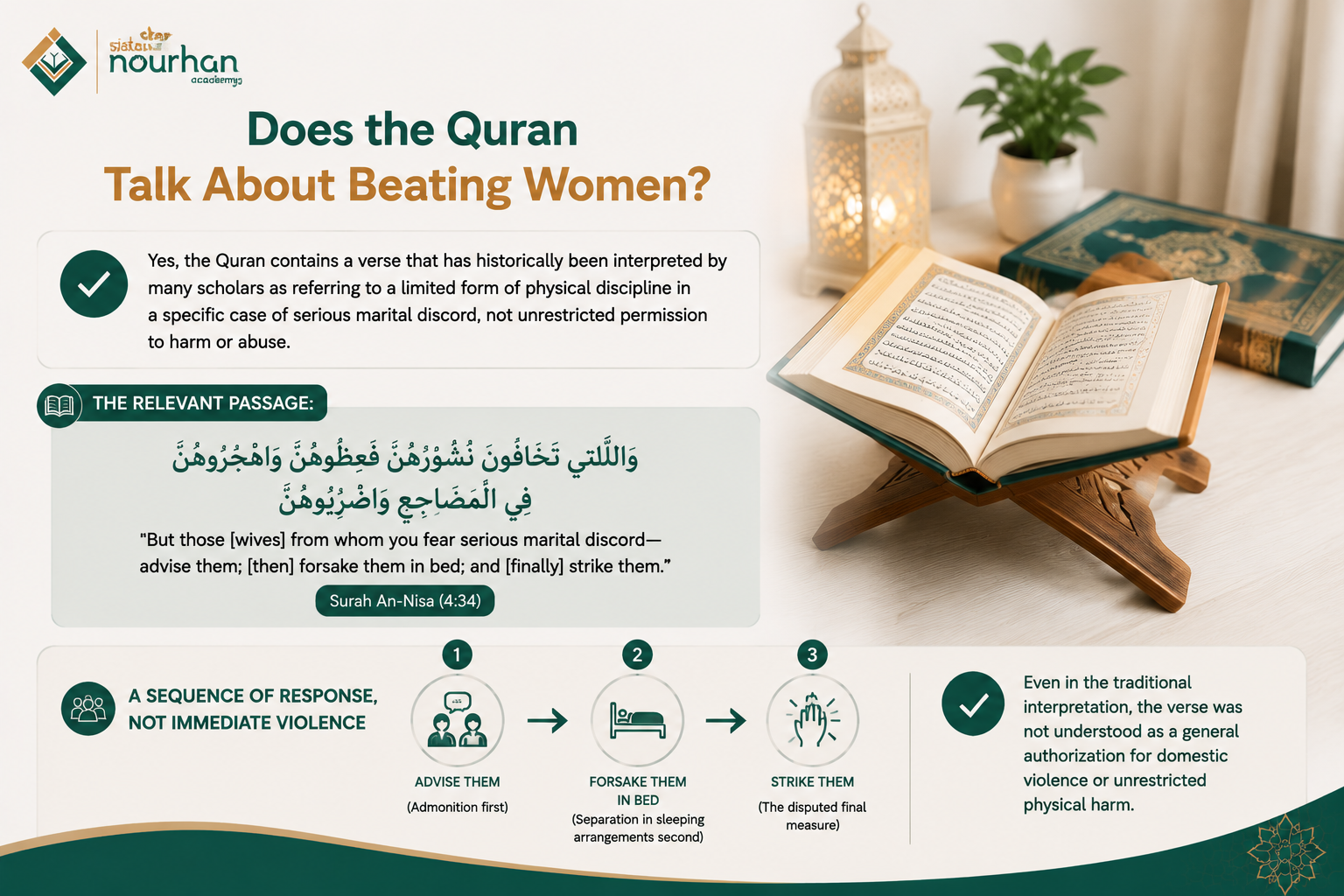
Yes, the Quran contains a verse that has historically been interpreted by many Muslim scholars as referring to a limited form of physical discipline in a specific case of serious marital discord.
However, the verse does not give husbands unrestricted permission to beat or abuse their wives.
The relevant passage states:
وَاللَّاتِي تَخَافُونَ نُشُوزَهُنَّ فَعِظُوهُنَّ وَاهْجُرُوهُنَّ فِي الْمَضَاجِعِ وَاضْرِبُوهُنَّ
“But those [wives] from whom you fear serious marital discord—advise them; [then] forsake them in bed; and [finally] strike them.” Surah An-Nisa (4:34)
The central Arabic expression is wa-idribuhunna (وَاضْرِبُوهُنَّ). Many classical Quran commentators understood the verb here as referring to physical striking, while some contemporary Muslim interpreters have argued for non-physical understandings of the expression.
Even within the traditional interpretation, however, the verse was not understood as a general authorization for domestic violence or unrestricted physical harm.
It addresses a particular situation of serious marital discord and presents a sequence of responses rather than beginning with physical action: admonition first, separation in sleeping arrangements second, and only then the disputed final measure.
The verse should also be understood alongside the Prophet Muhammad’s ﷺ teachings and conduct toward women, which place important restrictions on harmful treatment and provide essential context for how Muslim scholars have approached this passage.
Does the Quran Allow Men to Hit Women Whenever They Want?
No. The Quran does not give men unrestricted permission to hit, harm, or physically abuse women whenever they want.
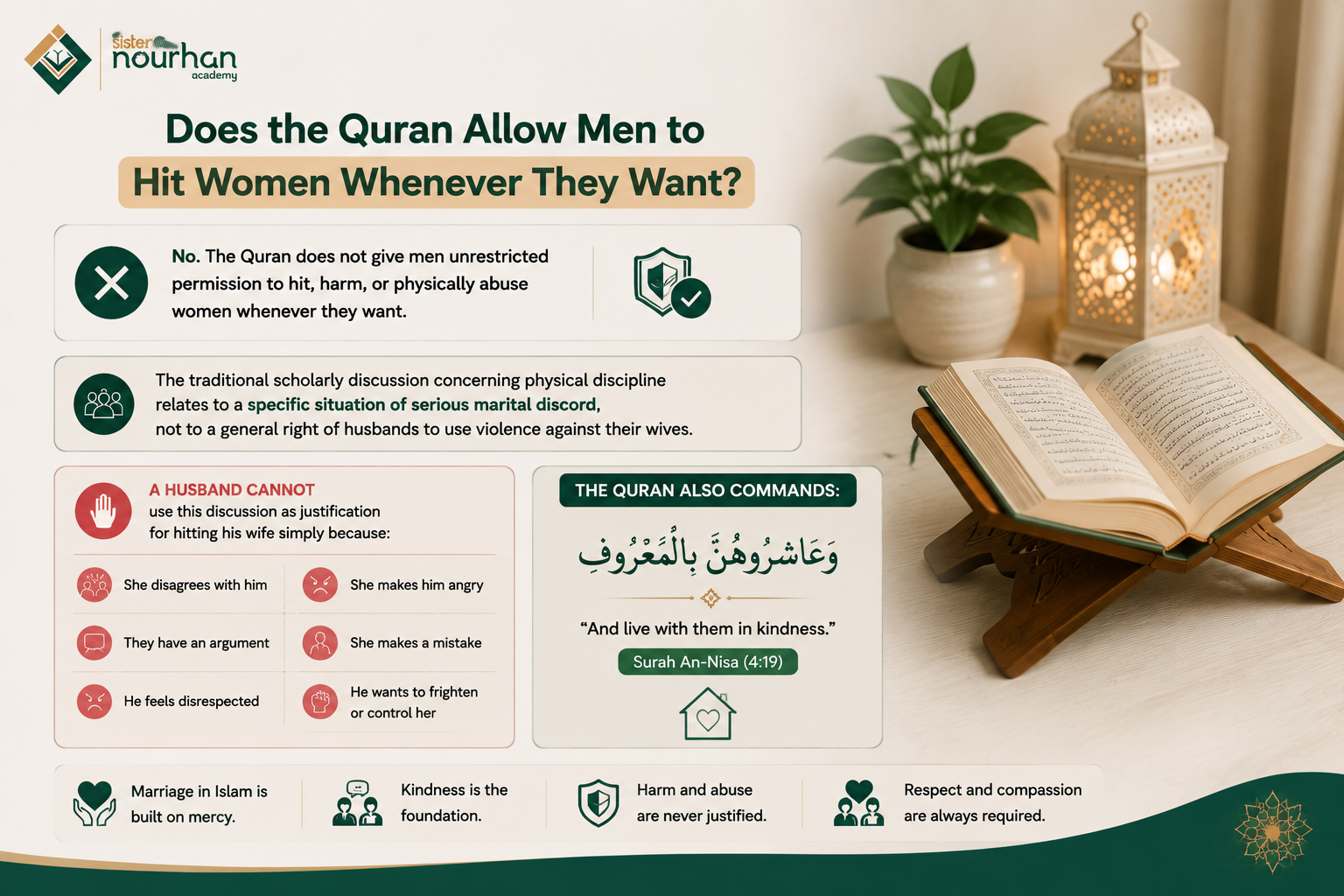
The traditional scholarly discussion concerning physical discipline relates to a specific situation of serious marital discord, not to a general right of husbands to use violence against their wives.
A husband cannot use this discussion as justification for hitting his wife simply because:
She disagrees with him
She makes him angry
They have an argument
She makes a mistake
He feels disrespected
He wants to frighten or control her
The Quran also gives husbands a broader command concerning how they should treat their wives:
وَعَاشِرُوهُنَّ بِالْمَعْرُوفِ
“And live with them in kindness.” Surah An-Nisa (4:19)
This command establishes ma‘ruf—good, honorable, and appropriate treatment—as a fundamental principle of married life.
Therefore, the disputed ruling in Surah An-Nisa 4:34 concerning a serious marital breakdown cannot reasonably be separated from the Quran’s wider teachings about kindness, justice, and proper treatment between spouses.
Understanding the issue therefore requires looking not only at a single word in one verse, but also at the limits placed on its traditional interpretation, the Prophet’s ﷺ treatment of his wives, and the broader Quranic framework governing marriage.
What Does “Hitting a Woman” Mean in the Quranic Discussion?
The English phrases “hitting women” and “beating women” can suggest punching, kicking, injuring, or repeatedly assaulting someone.
That is not how classical Muslim jurists defined the restricted physical action they discussed. Many classical scholars interpreted wa-idribuhunna physically, but placed limitations on the action.
It could not:
cause injury,
cause wounds,
leave bruises or marks,
break bones,
target the face,
be severe,
be motivated by revenge,
or become an act of humiliation.
Some classical discussions even referred to something as small as a siwak to illustrate how restricted the action was understood to be.
This distinction is essential when discussing beating women in the Quran. A restricted juristic concept cannot simply be equated with punching, severe beating, or domestic assault.
Why Do Scholars Disagree About Hitting Women in the Quran?
Much of the disagreement centers on the Arabic expression wa-idribuhunna (وَاضْرِبُوهُنَّ) in Surah An-Nisa 4:34. The root daraba (ضرب) can carry different meanings depending on its context and grammatical construction.
Historically, many classical Quran commentators understood the expression in this verse as referring to physical striking. However, they still differed over how it should be applied and what limitations should govern it. Some accepted the physical interpretation while imposing strict restrictions, while others discouraged striking, especially when it could cause harm or make reconciliation more difficult.
A view attributed to Ata ibn Abi Rabah favored expressing displeasure rather than striking. Some contemporary Muslim interpreters have also proposed a non-physical understanding of the expression, such as separation or departure.
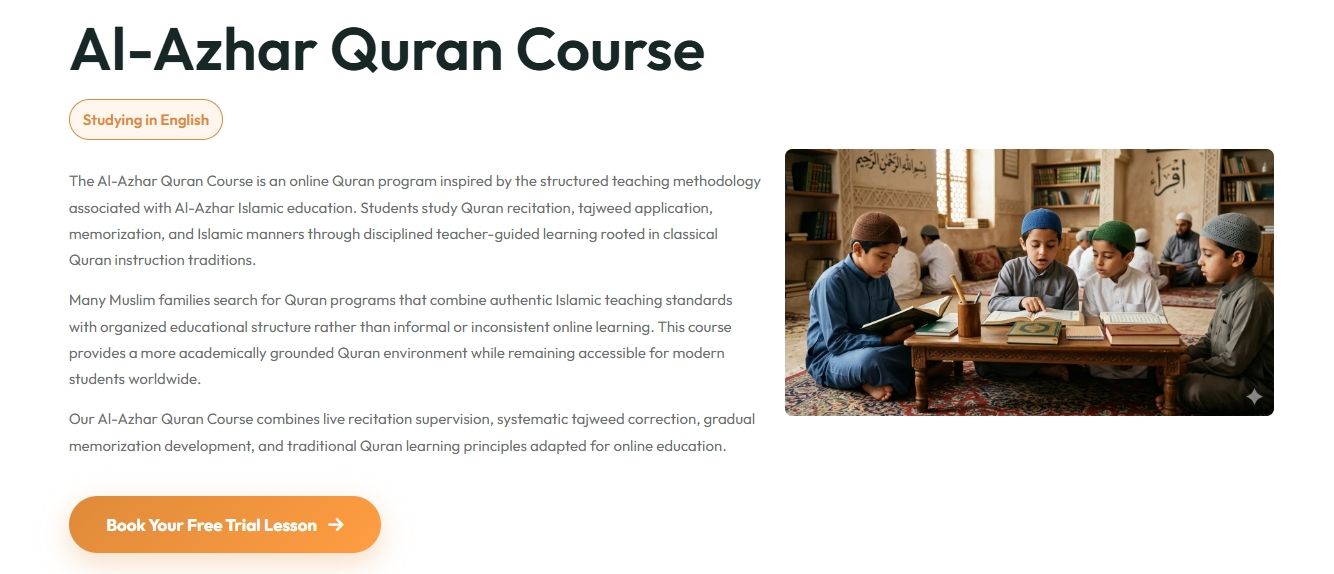
Understanding debated Quranic passages requires more than reading an English translation in isolation. Students who want to develop a stronger foundation in Quran, Arabic, and Islamic studies can explore the Al-Azhar Quran Course, which provides structured learning across traditional Islamic subjects.
What Kind of Physical Violence Against Women Is Forbidden?
Severe, harmful, and abusive violence against women is forbidden. Even within the classical interpretation of Surah An-Nisa 4:34, scholars did not understand the verse as permission for a husband to injure, terrorize, or take revenge on his wife.
It cannot be used to justify:
Punching or kicking
Choking
Striking the face
Causing wounds or bruises
Breaking bones
Repeated assault
Terrorizing or humiliating a wife
Using violence out of anger or revenge
The Quran also prohibits deliberately using a marital relationship as a means of causing harm:
وَلَا تُمْسِكُوهُنَّ ضِرَارًا لِّتَعْتَدُوا
“Do not retain them to harm them, so that you transgress.” Surah Al-Baqarah (2:231)
Although this verse appears in the context of divorce, it establishes an important principle: marital rights should not be manipulated as a means of deliberate harm or transgression.
This broader principle is essential when discussing any traditional interpretation of physical discipline within marriage.
Shots from Our Classes
Take a moment to view the video below to see how our teachers provide clear, supportive corrections during a session.
Enrich Your Islamic Knowledge
Deepen your understanding of Fiqh, Aqeedah, and Hadith with dedicated female scholars at Sister Nourhan Academy.
Start Your Free Trial NowDoes the Quran Allow Violence Against Women?
No. The Quran does not establish violence against women as a general right for men. The existence of a disputed verse concerning a specific case of serious marital conflict should not be interpreted as broad permission to physically harm, control, or abuse women.
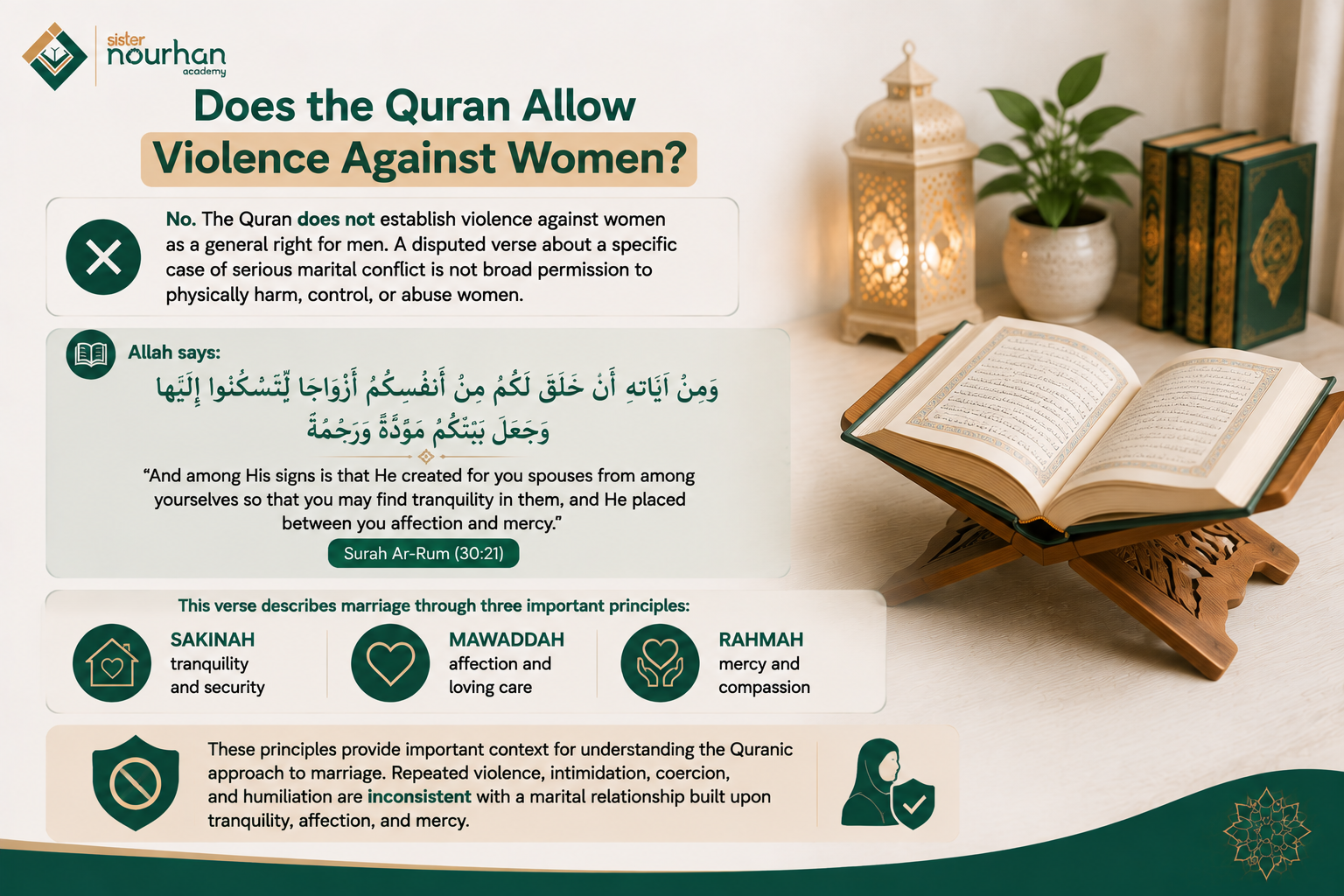
The Quran places marriage within a wider framework of good treatment, affection, mercy, and tranquility. Allah says:
وَمِنْ آيَاتِهِ أَنْ خَلَقَ لَكُمْ مِنْ أَنْفُسِكُمْ أَزْوَاجًا لِّتَسْكُنُوا إِلَيْهَا وَجَعَلَ بَيْنَكُمْ مَوَدَّةً وَرَحْمَةً
“And among His signs is that He created for you spouses from among yourselves so that you may find tranquility in them, and He placed between you affection and mercy.” Surah Ar-Rum (30:21)
This verse describes marriage through three important principles:
Sakinah: tranquility and security
Mawaddah: affection and loving care
Rahmah: mercy and compassion
These principles provide important context for understanding the Quranic approach to marriage. Repeated violence, intimidation, coercion, and humiliation are inconsistent with a marital relationship built upon tranquility, affection, and mercy.
Read also: Quran Quotes About Women
Does Islam Allow Domestic Violence?
No. Domestic violence should not be treated as synonymous with the narrowly restricted action discussed by classical jurists.
Domestic abuse can involve:
repeated physical assault,
serious injury,
threats,
intimidation,
coercive control,
humiliation,
terror,
or using violence to dominate another person.
These behaviors go far beyond the restrictions found in traditional Islamic discussions Calling abuse “discipline” does not make it religiously legitimate.
A husband cannot punch, kick, choke, injure, terrorize, or repeatedly assault his wife and then use a Quranic passage as blanket justification for his behavior.
Read also: Are there specific verses in the Quran about women's right to study and learn?
Can a Man Hit His Wife Because He Is Angry?
No. Anger, frustration, or disagreement does not give a husband permission to physically attack his wife.
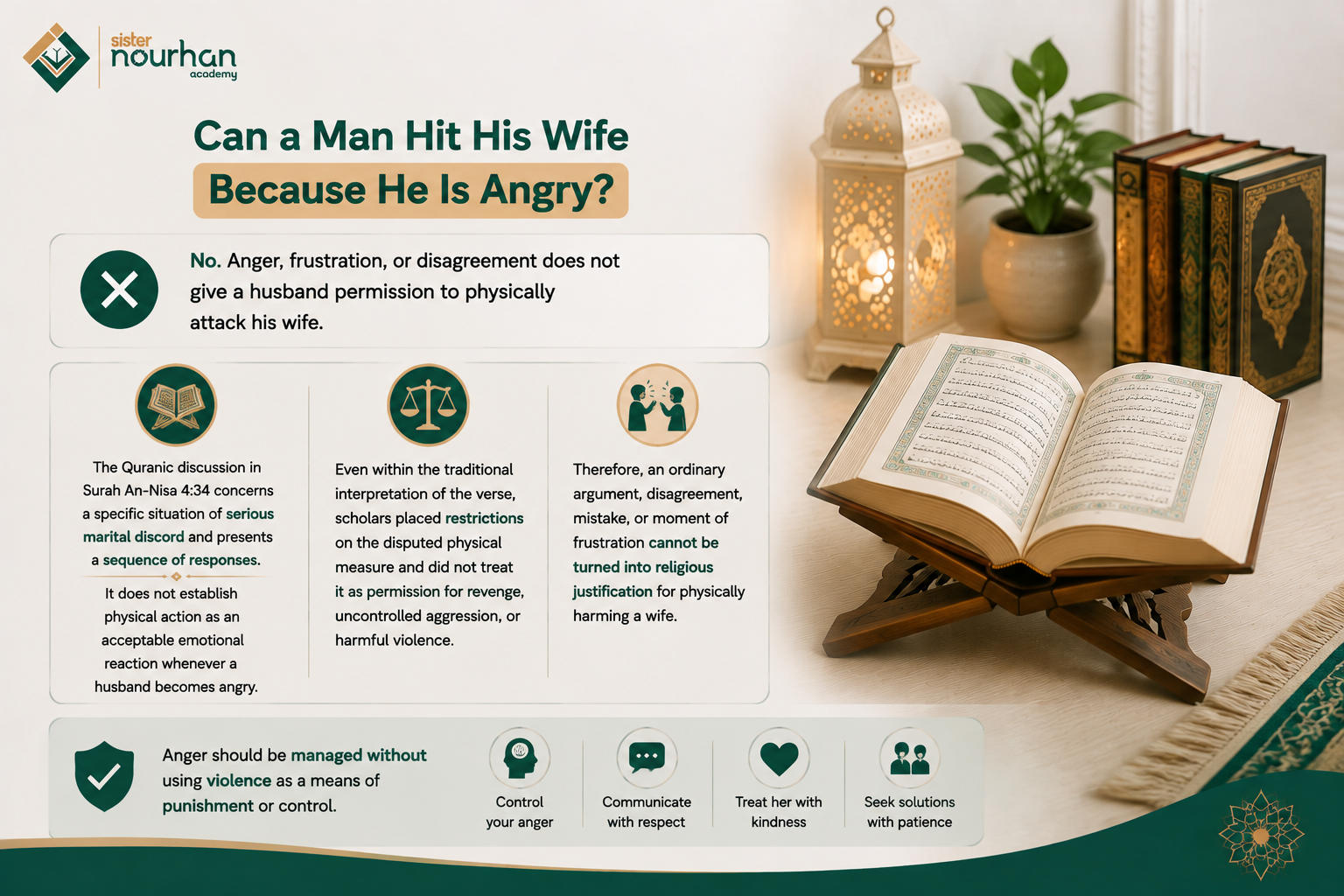
The Quranic discussion in Surah An-Nisa 4:34 concerns a specific situation of serious marital discord and presents a sequence of responses. It does not establish physical action as an acceptable emotional reaction whenever a husband becomes angry.
Even within the traditional interpretation of the verse, scholars placed restrictions on the disputed physical measure and did not treat it as permission for revenge, uncontrolled aggression, or harmful violence.
Therefore, an ordinary argument, disagreement, mistake, or moment of frustration cannot be turned into religious justification for physically harming a wife. Anger should be managed without using violence as a means of punishment or control.
Did Prophet Muhammad ﷺ Hit Women?
No. Prophet Muhammad ﷺ did not strike women, and Aishah (may Allah be pleased with her) specifically described his conduct in this regard.
She reported:
مَا ضَرَبَ رَسُولُ اللَّهِ ﷺ شَيْئًا قَطُّ بِيَدِهِ، وَلَا امْرَأَةً وَلَا خَادِمًا
“The Messenger of Allah ﷺ never struck anything with his hand, neither a woman nor a servant.” Sahih Muslim 2328a
This hadith provides an important practical Prophetic example alongside the scholarly discussion of Surah An-Nisa 4:34. Whatever legal interpretations scholars developed around the verse, the Prophet ﷺ himself did not make striking his wives the model for dealing with marital conflict.
His personal conduct therefore remains essential when considering how Muslims should understand marital treatment in practice.
Read also: What is the Islamic hadith about obeying your husband?
What Did the Prophet ﷺ Say About Men Who Hit Women?
The Prophet ﷺ explicitly discouraged men from hitting women. He said:
لَا تَضْرِبُوا إِمَاءَ اللَّهِ
“Do not beat the female servants of Allah.”
Later, when women came to the Prophet’s ﷺ household complaining about their husbands, he said:
لَقَدْ طَافَ بِآلِ مُحَمَّدٍ نِسَاءٌ كَثِيرٌ يَشْكُونَ أَزْوَاجَهُنَّ، لَيْسَ أُولَئِكَ بِخِيَارِكُمْ
“Many women have come around the family of Muhammad complaining about their husbands. Those men are not the best among you.” Sunan Abi Dawud 2146
This hadith provides important context for understanding the Islamic discussion of marital conflict.
Even within the traditional legal interpretation that discussed a restricted physical measure, the Prophet ﷺ did not present husbands who struck their wives as exemplary Muslims. Instead, when women complained about such treatment, he clearly stated that those men were “not the best among you.”
Read also: Are all Muslim females obligated to observe the hijab?
How Does Islam Tell Men to Treat Women?
Islam teaches men to treat women, especially their wives, with kindness, respect, and good character. The Prophetic standard emphasizes good treatment rather than physical dominance or control.
The Prophet ﷺ said:
خَيْرُكُمْ خَيْرُكُمْ لِأَهْلِهِ، وَأَنَا خَيْرُكُمْ لِأَهْلِي
“The best of you is the best to his family, and I am the best of you to my family.” Jami‘ At-Tirmidhi 3895
This reflects the Quranic command:
وَعَاشِرُوهُنَّ بِالْمَعْرُوفِ
“And live with them in kindness.” Surah An-Nisa (4:19)
Together, these teachings establish good treatment as a central standard of Muslim family life.
A husband’s character is not measured by how much authority he exercises over his wife, but by how responsibly, fairly, and kindly he treats his family.
Studying verses about marriage alongside their wider Quranic and Prophetic context can help prevent isolated passages from being misunderstood.
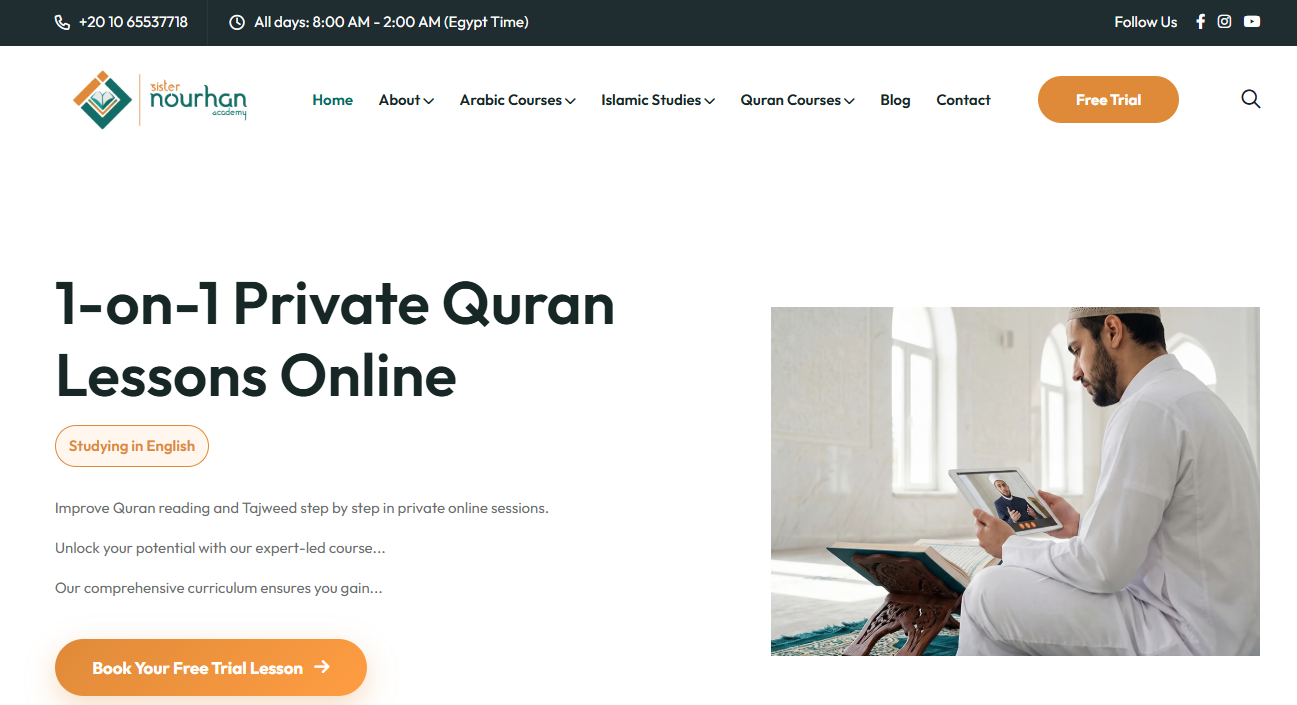
Women who prefer individual guidance can join 1-on-1 Private Quran Lessons Online to study Quran with personalized support from a dedicated female teacher.
How Should Serious Marital Conflict Be Resolved in Islam?
Islam encourages serious marital conflict to be addressed through reconciliation, communication, and mediation rather than allowing the conflict to develop into harm or abuse.
The Quran specifically introduces arbitration when disagreement between spouses becomes serious. Allah says:
وَإِنْ خِفْتُمْ شِقَاقَ بَيْنِهِمَا فَابْعَثُوا حَكَمًا مِّنْ أَهْلِهِ وَحَكَمًا مِّنْ أَهْلِهَا إِنْ يُرِيدَا إِصْلَاحًا يُوَفِّقِ اللَّهُ بَيْنَهُمَا
“If you fear a breach between them, appoint an arbitrator from his family and an arbitrator from her family. If they desire reconciliation, Allah will bring harmony between them.” Surah An-Nisa (4:35)
This shows that the Quran does not reduce serious marital problems to physical discipline. Its broader approach includes communication, attempts at reconciliation, mediation, and arbitration when the spouses cannot resolve the conflict themselves.
If reconciliation ultimately cannot be achieved, Islam also recognizes separation rather than requiring a couple to remain indefinitely in a harmful or unworkable marriage.
Does the Quran Address Abuse or Misconduct by Husbands?
Yes. The Quran also addresses misconduct and harmful behavior from husbands, not only problems arising from wives.
Allah says:
وَإِنِ امْرَأَةٌ خَافَتْ مِن بَعْلِهَا نُشُوزًا أَوْ إِعْرَاضًا فَلَا جُنَاحَ عَلَيْهِمَا أَنْ يُصْلِحَا بَيْنَهُمَا صُلْحًا
“If a woman fears from her husband ill-treatment or desertion, there is no blame upon them if they seek a settlement between themselves.” Surah An-Nisa (4:128)
This verse is significant because the Quran uses nushuz in relation to a husband as well as in the discussion concerning a wife. Serious marital misconduct is therefore not presented as something that can arise from only one side of a marriage.
A husband is also accountable for how he treats his wife, and the Quran directs spouses toward fair settlement and reconciliation when his conduct threatens the marriage.
What Should a Woman Do If Her Husband Is Violent or Abusive?
A woman experiencing serious violence or abuse should seek safety and support rather than being told that Islam requires her to accept the harm. The Quran should not be used to justify repeated assault, threats, intimidation, or humiliation.
An abusive husband cannot make harmful behavior Islamically acceptable simply by referring to Surah An-Nisa 4:34.
As discussed above, even the traditional interpretation of the verse was surrounded by restrictions and cannot be separated from the Quran’s broader commands concerning good treatment and the prevention of harm.
Islam also provides ways to address serious marital breakdown, including reconciliation, family arbitration, and separation when necessary. If a woman is in danger, protecting herself and seeking appropriate help should take priority.
Religious language should therefore never be used to silence a woman experiencing serious abuse, pressure her to remain in danger, or prevent her from seeking protection and support.
See our teaching methods
Experience the quality of our instruction firsthand by watching a live lesson snippet below.
Enrich Your Islamic Knowledge
Deepen your understanding of Fiqh, Aqeedah, and Hadith with dedicated female scholars at Sister Nourhan Academy.
Start Your Free Trial NowLearn the Quran With Context at Sister Nourhan Academy
Questions about women, marriage, and Quranic interpretation show why Islamic texts should be studied with knowledge of their language, context, Prophetic guidance, and wider Islamic teachings rather than through isolated verses alone.
At Sister Nourhan Academy, female students can study Quran and Islamic subjects in a structured learning environment with qualified female teachers.
Whether you want to understand the Quran more deeply, strengthen your Arabic, improve your recitation, or build a stronger foundation in Islamic knowledge, guided study can help you approach difficult questions with greater clarity and confidence.

Discover our Islamic Studies Courses
Conclusion
The Quran does not give men a general right to beat, abuse, or terrorize women. Surah An-Nisa 4:34 contains a disputed passage concerning a specific case of serious marital discord.
Many classical scholars understood its wording as permitting a highly restricted physical measure, while other interpretations and scholarly positions have emphasized avoiding it or understood the wording differently.
That verse must also be read alongside the Quran’s broader teachings on kindness, mercy, avoidance of harm, reconciliation, and accountability within marriage. The Prophet Muhammad ﷺ did not strike his wives and made good treatment of one’s family a measure of good character.
Understanding this issue therefore requires more than isolating a single word or verse. The Quranic discussion of marriage as a whole emphasizes responsibility, reconciliation, and good treatment, and its teachings should never be used as blanket justification for domestic abuse or serious physical harm.
Frequently Asked Questions About Hitting Women in the Quran
Does the Quran Allow Men to Hit Women?
The Quran does not give men a general right to hit women. The disputed Quranic passage concerns a specific case of serious marital discord, and classical scholars who interpreted it physically imposed substantial restrictions on its application.
Does the Quran Talk About Beating Women?
Yes. A Quranic passage concerning serious marital conflict has historically been interpreted by many classical scholars as permitting a restricted physical measure. However, it is not a general command for men to beat women.
Where Does the Quran Talk About Hitting a Woman?
The main passage discussed in this context appears in Surah An-Nisa. It addresses serious marital discord and contains the disputed Arabic expression wa-idribuhunna.
Does the Quran Say Men Can Beat Women When They Are Angry?
No. The Quran does not give men permission to physically attack women simply because they are angry, frustrated, or involved in an ordinary disagreement.
Does the Quran Support Violence Against Women?
The Quran does not establish violence against women as a general male right. Its broader teachings include kindness toward wives, avoidance of deliberate harm, reconciliation, affection, mercy, and accountability for marital misconduct.
Does Islam Allow Domestic Violence?
No. Severe assault, injury, terror, threats, humiliation, and repeated physical abuse cannot be justified by treating the restricted classical discussion as unlimited permission for domestic violence.
Did Prophet Muhammad ﷺ Hit His Wives?
No. Aishah reported that the Prophet ﷺ did not strike women or servants. The report is recorded in Sahih Muslim 2328a.