Have you ever listened to a reciter and felt the verses settle straight into your heart, then opened the Mushaf yourself and felt something was missing? That gap is almost always about tajweed rules — the science that teaches every letter exactly how to leave your mouth.
Here is the comforting part: tajweed is not a talent you are born with. It is a small, finite set of rules that any learner can master with the right order and the right teacher.
At Sister Nourhan Academy, we meet students every week who read Arabic well yet freeze the moment a noon sakinah meets a baa. It is never a lack of ability — it is simply a missing map.
This guide is that map. By the end, you will know what each rule does, which ones are obligatory, and the exact order to learn them in.
What You Will Learn In This Article:
The precise meaning of tajweed and why scholars preserved it as a science.
The scholarly ruling on applying tajweed — obligatory versus recommended.
The core Quran tajweed rules: noon sakinah, meem sakinah, madd, qalqalah, tafkheem and makharij.
A realistic, step-by-step learning plan that works for adults and children.
The most common beginner mistakes and how to correct them early.
What Are Tajweed Rules?
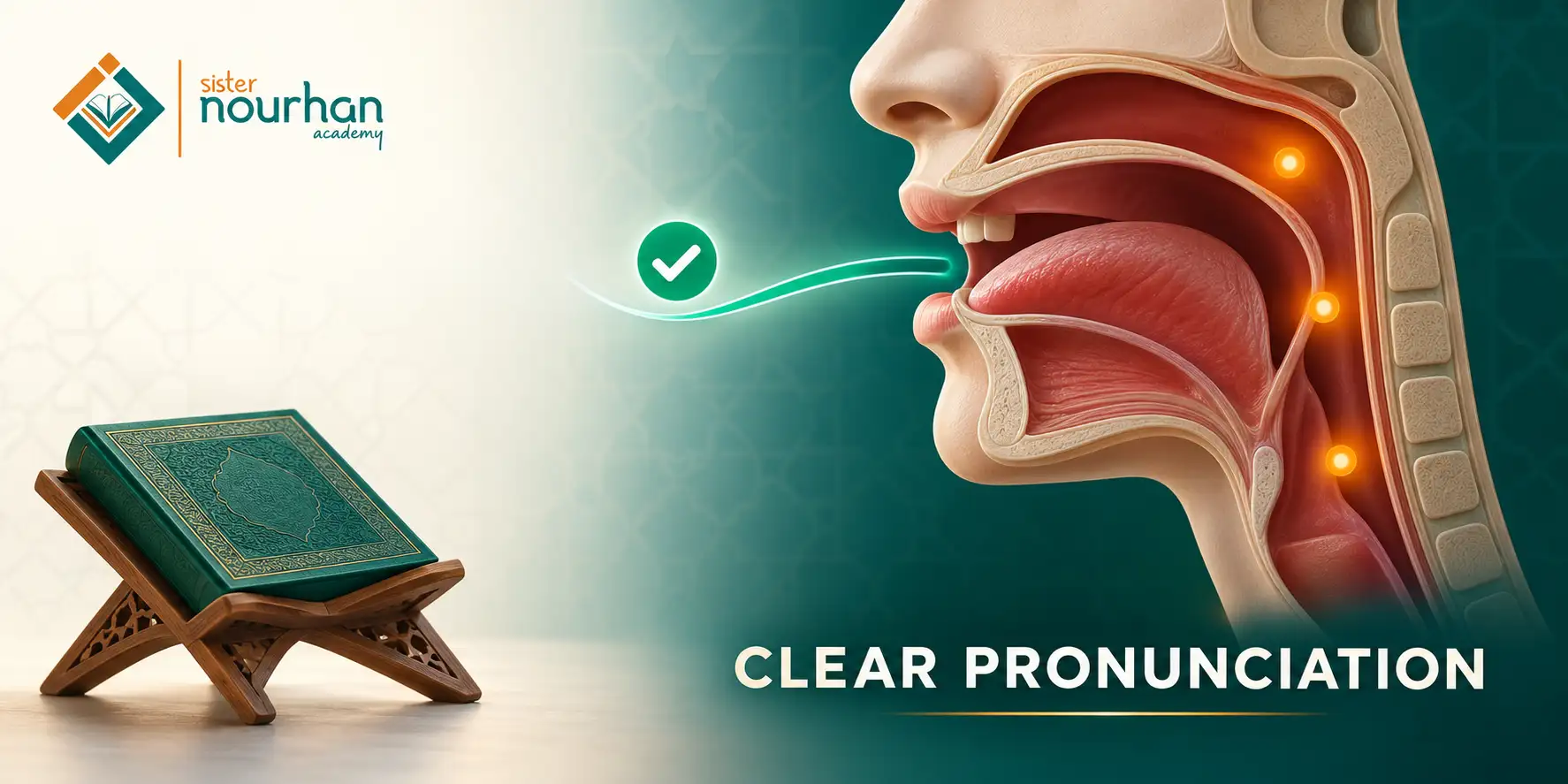
Tajweed rules are the set of pronunciation laws that govern how each Arabic letter is articulated during Quranic recitation — giving every letter its rightful makhraj (exit point) and sifat (characteristics). They protect the recitation from distortion and give it its recognisable beauty.
So what is tajweed Quran recitation in practice? It is reading the Book exactly as it was revealed, protected from distortion and delivered with its recognisable beauty.
These rules were not invented; they were documented. They describe exactly how the Prophet ﷺ recited, transmitted through unbroken chains of teachers.
Tajweed Meaning & Definition
Linguistically, tajweed means to improve, beautify, or perfect something. Technically, it means pronouncing every letter correctly and consistently, whether you recite aloud or silently.
So the goal is not a beautiful voice. The goal is accuracy — beauty follows accuracy naturally.
How Tajweed Was Preserved As A Science
Early reciters (qurra') memorised not only the text but the exact manner of its delivery, and their work later shaped Arabic grammar itself. As the reference entry on Quranic recitation at Encyclopaedia Britannica explains, this oral discipline is what allowed huge congregations to follow the text uniformly across centuries.
That is why tajweed is still taught mouth-to-mouth today. A book can explain ikhfa; only a teacher can tell you whether yours is correct.
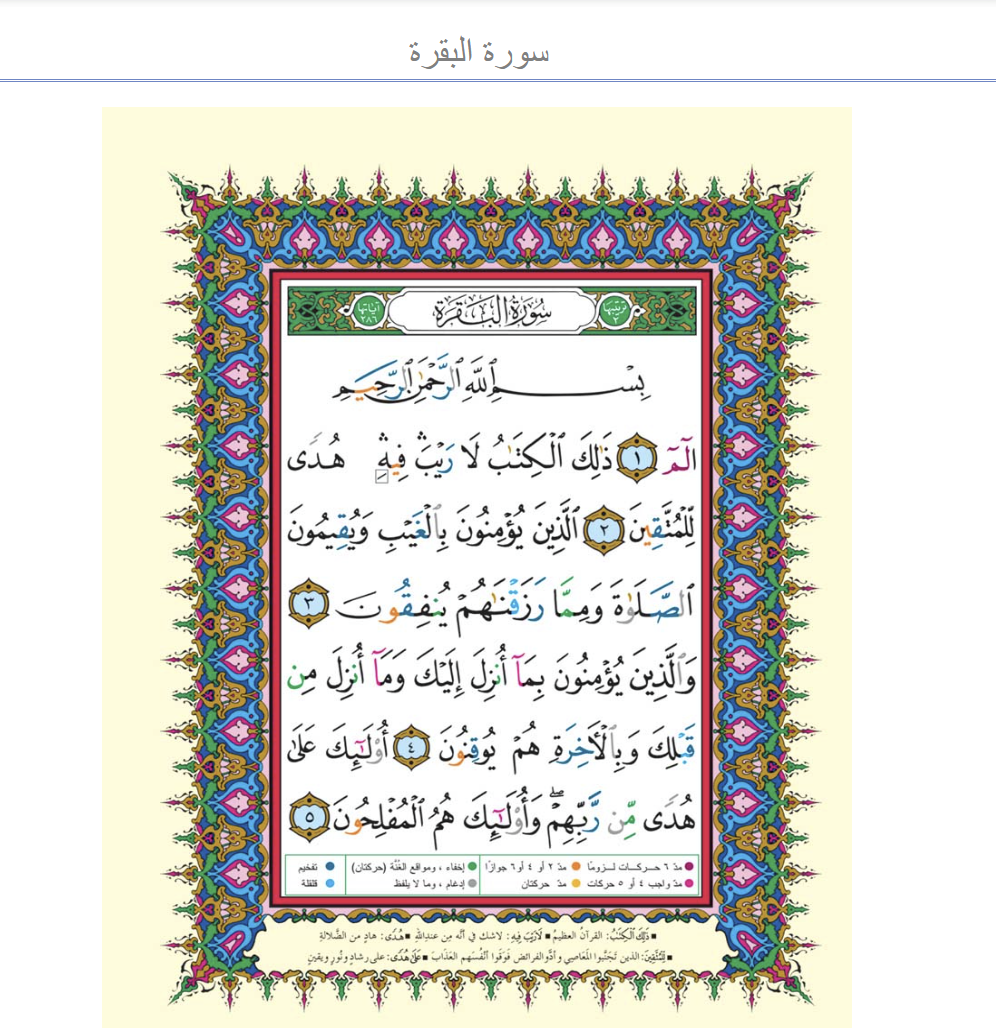
Free to open, free to practise — every rule colour-marked on the page.
Use this colour-coded Mushaf reader for daily drills.
One note: colours show where a rule applies, not whether your sound is right, so let a certified Sister Nourhan Academy teacher confirm your pronunciation is truly correct.
Why Tajweed Matters And The Reward Of Learning It
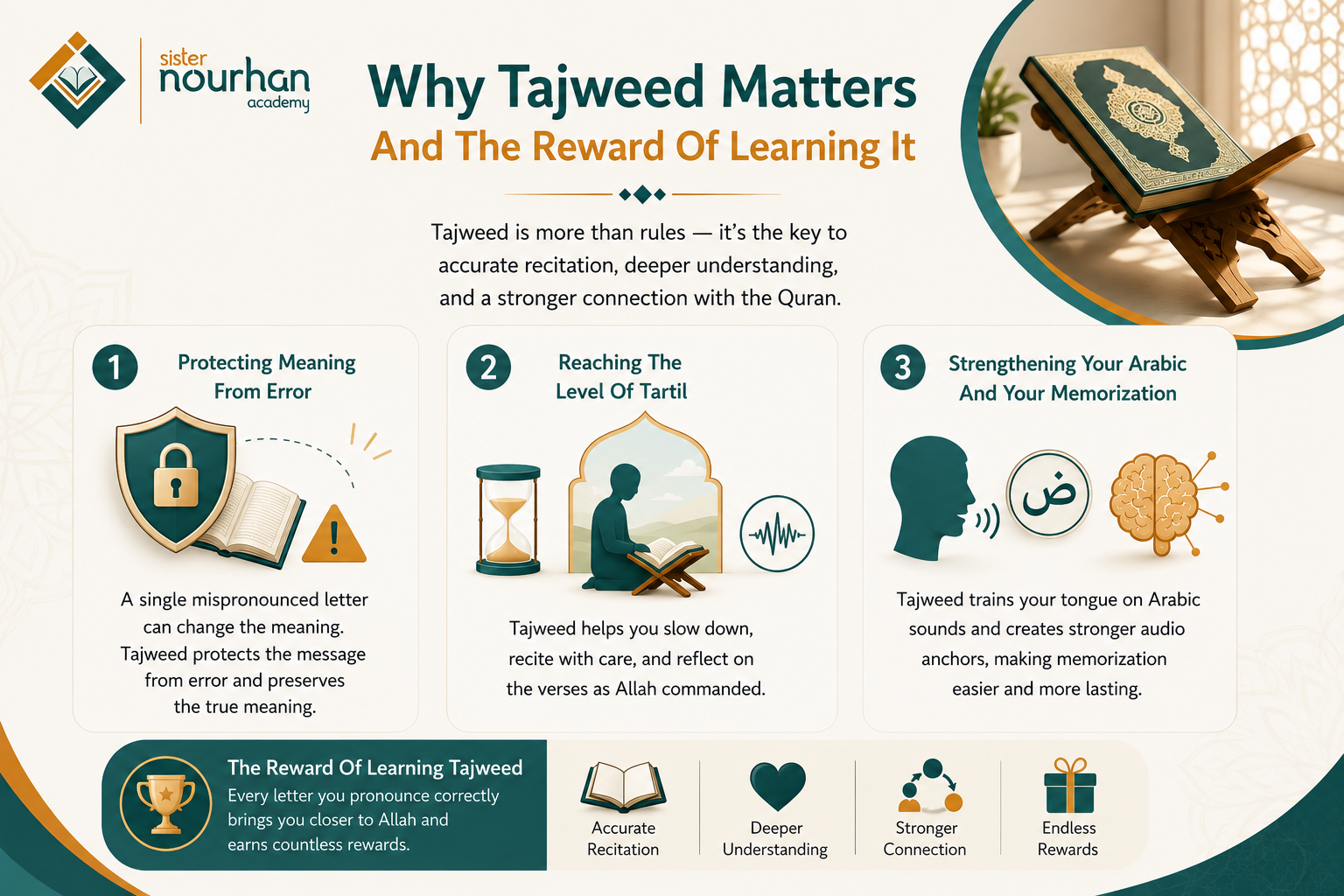
Learning tajweed changes three things at once: your accuracy, your understanding, and your connection to the verses. Below are the benefits students notice fastest.
1. Protecting Meaning From Error
Scholars divide recitation errors into lahn jali (clear errors that change meaning or invalidate prayer) and lahn khafi (subtle errors that spoil the quality of recitation). Tajweed exists primarily to shield your tongue from both.
A single mispronounced letter can shift a word's meaning entirely. Correct articulation is therefore an act of protecting the message, not just polishing it.
2. Reaching The Level Of Tartil
Allah commanded, "And recite the Quran with measured recitation" (Al-Muzzammil: 4). Tartil is unhurried, deliberate reading — and tajweed is the practical toolkit that makes it possible.
Slowing down does more than sound better. It gives your mind the space to actually reflect on what you are reading.
3. Strengthening Your Arabic And Your Memorization
Tajweed trains your tongue on classical Arabic sounds that most non-native speakers never practise, which directly improves your general pronunciation. Many students pair it with our Arabic for Beginners course for exactly this reason.
It also makes memorisation noticeably easier. Clear, rhythmic pronunciation gives the brain stronger audio anchors to retrieve later.
Recommended reading: How to Teach Tajweed for Kids? 7 Practical Steps That Actually Work
The Ruling On Tajweed In Islam
Applying tajweed is not an all-or-nothing obligation; scholars separate the essential from the refined. Understanding this distinction removes a lot of unnecessary anxiety for new learners.
Fard Kifayah And Fard Ayn
Studying the theory of tajweed is considered fard kifayah — a communal obligation. If a sufficient number of Muslims preserve this knowledge, the obligation is lifted from the rest.
Applying the essential rules while reciting, however, is treated by most reciters as fard ayn — an individual duty on every accountable Muslim.
The Obligatory Minimum Vs. The Recommended Refinement
The obligatory minimum is pronouncing letters from their correct articulation points without substituting one letter for another or committing an error that alters the meaning.
Everything beyond that — precise madd counts, ghunnah timing, idgham — is classified by later scholars as a technical perfection rather than a sin to omit.
In short: no one is sinful for imperfect recitation while learning. But no one should stay a beginner forever either.
Your recitation is already good — Advanced Tajweed Course is what makes it precise. Refine every letter with live oral correction in our Course, and book your free trial lesson today.
Shots from Our Classes
Take a moment to view the video below to see how our teachers provide clear, supportive corrections during a session.
Begin Your Quranic Journey
Connect with the words of Allah through personalized sessions at Sister Nourhan Academy.
Book Your Free TrialThe Core Quran tajweed rules Every Reciter Must Master
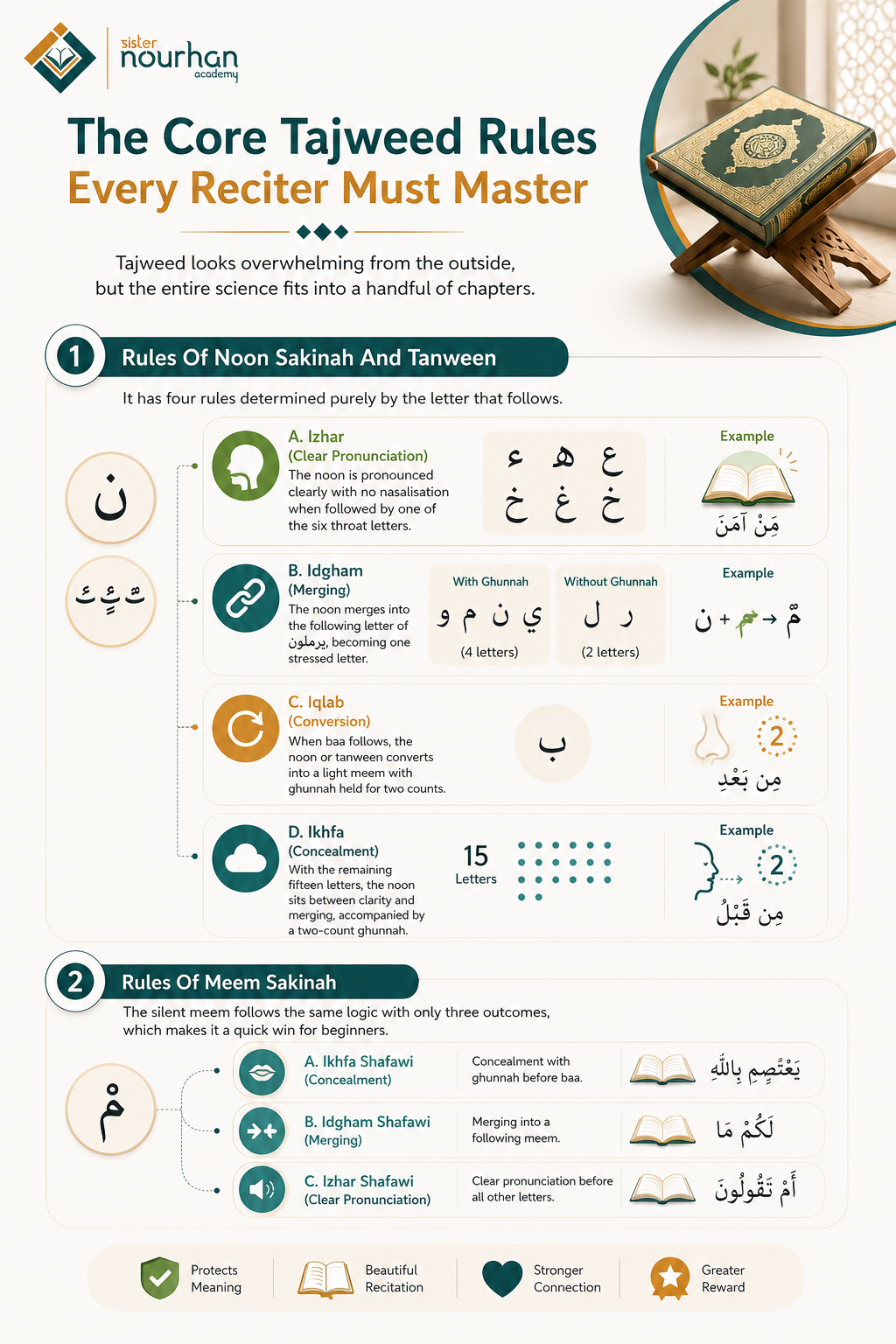
Tajweed looks overwhelming from the outside, but the entire science fits into a handful of chapters. Here they are in the order we teach them.
1. Rules Of Noon Sakinah And Tanween
This is the first chapter in almost every curriculum, and it has four rules determined purely by the letter that follows.
A. Izhar (Clear Pronunciation)
The noon is pronounced clearly with no nasalisation when followed by one of the six throat letters: ء، ه، ع، ح، غ، خ. Example: مَنْ آمَنَ.
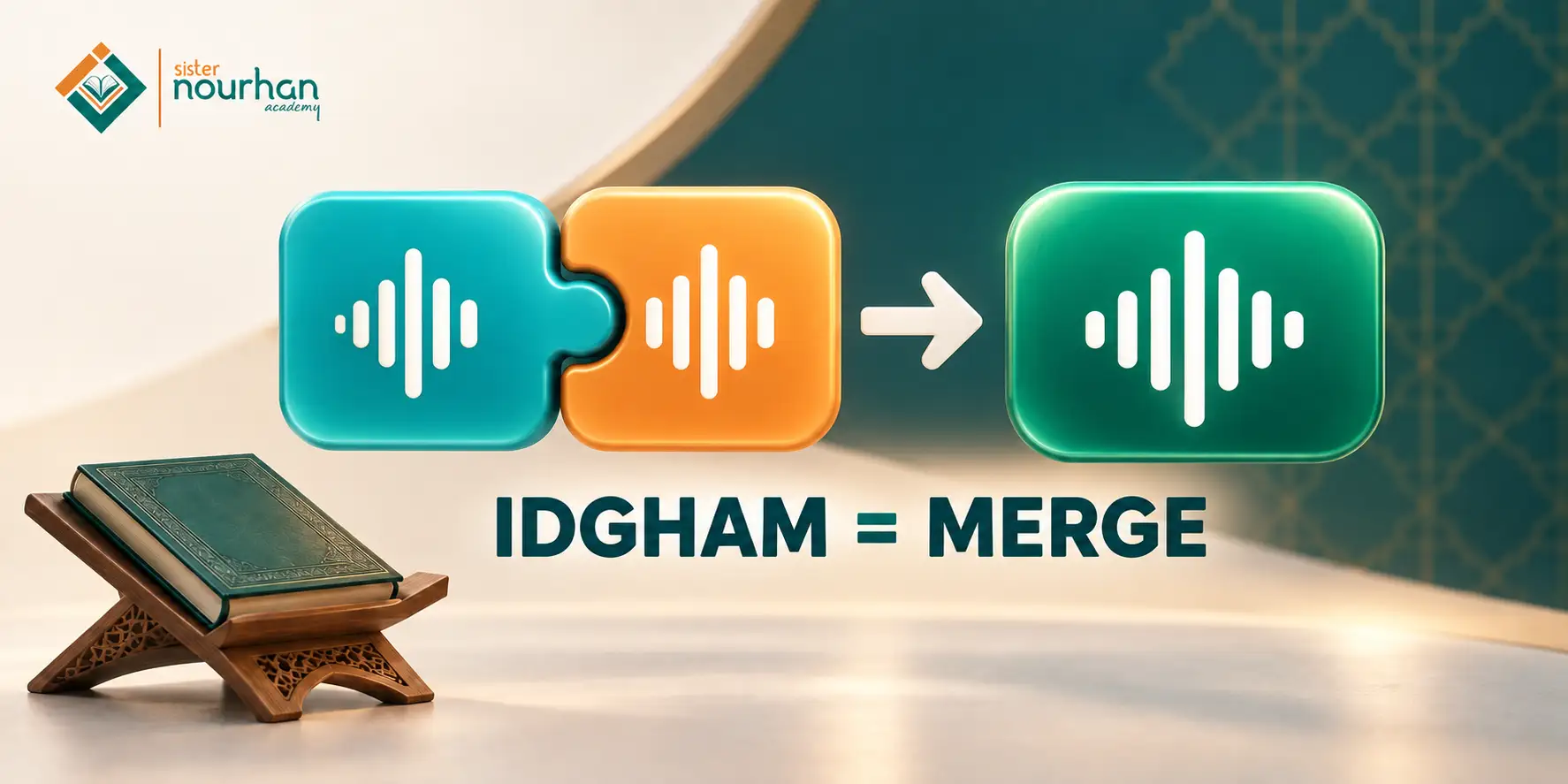
B. Idgham (Merging)
The noon merges into the following letter of يرملون, becoming one stressed letter. Four of them (ي، ن، م، و) carry ghunnah; two (ل، ر) do not.
C. Iqlab (Conversion)
When baa follows, the noon or tanween converts into a light meem with ghunnah held for two counts. Example: مِن بَعْدِ.
D. Ikhfa (Concealment)
With the remaining fifteen letters, the noon sits between clarity and merging, accompanied by a two-count ghunnah. Example: مِن قَبْلُ.
2. Rules Of Meem Sakinah
The silent meem follows the same logic with only three outcomes, which makes it a quick win for beginners.
Ikhfa Shafawi: concealment with ghunnah before baa — يَعْتَصِم بِاللهِ.
Idgham Shafawi: merging into a following meem — لَكُم مَّا.
Izhar Shafawi: clear pronunciation before all other letters — أَمْ تَقُولُونَ.\
3. The Rules Of Madd (Elongation)
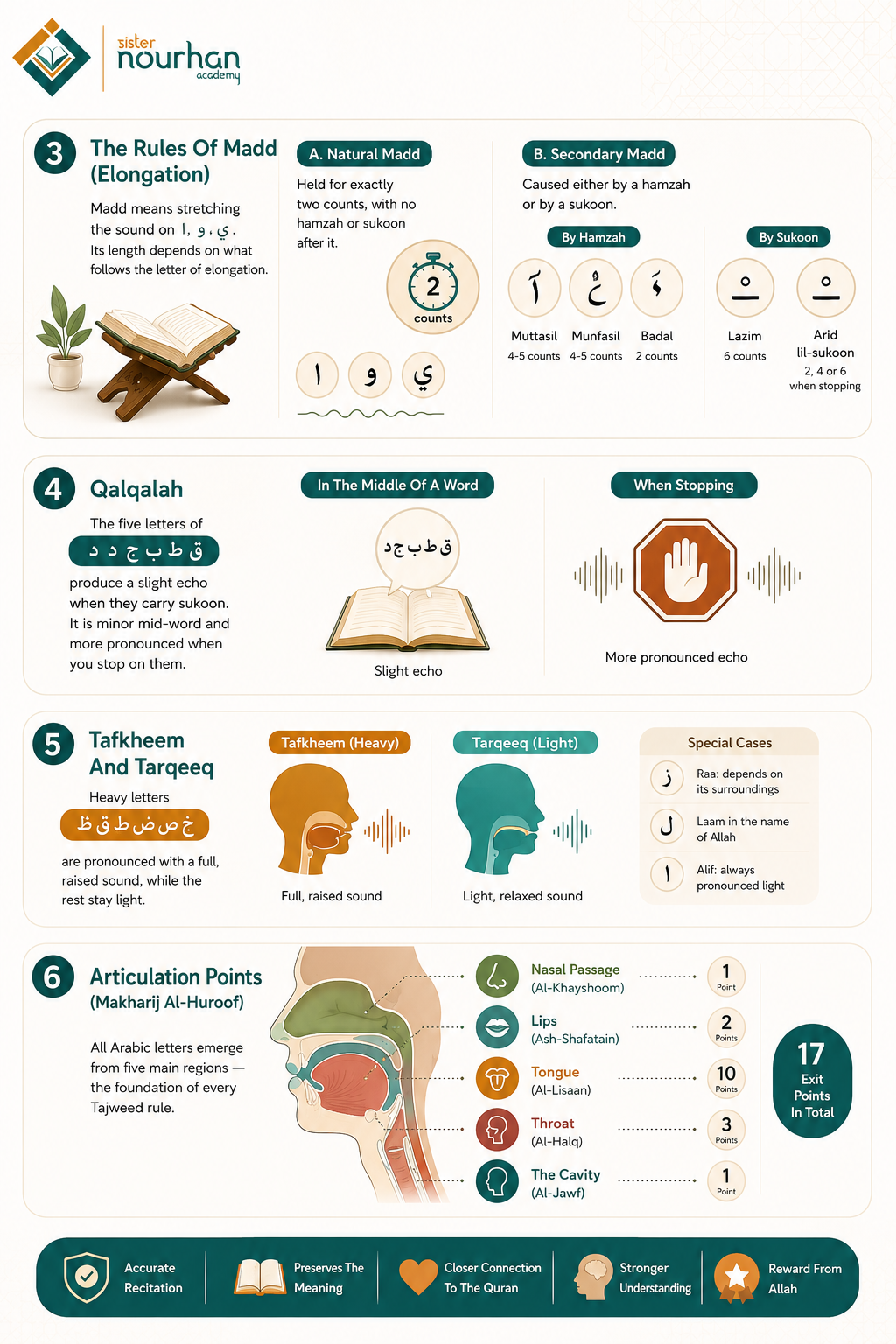
Madd means stretching the sound on ا، و، ي. Its length depends on what follows the letter of elongation.
A. Natural Madd
Held for exactly two counts, with no hamzah or sukoon after it. This is the default and the one most learners rush through.
B. Secondary Madd
Caused either by a hamzah — muttasil (obligatory, 4–5 counts), munfasil (permissible, 4–5), badal (2) — or by a sukoon: lazim (6 counts) and arid lil-sukoon (2, 4 or 6 when stopping).
4. Qalqalah
The five letters of قطب جد produce a slight echo when they carry sukoon. It is minor mid-word and more pronounced when you stop on them.
5. Tafkheem And Tarqeeq
Heavy letters (خص ضغط قظ) are pronounced with a full, raised sound, while the rest stay light. Special cases apply to raa, laam in the name of Allah, and alif.
6. Articulation Points (Makharij Al-Huroof)
All Arabic letters emerge from five main regions: the cavity, throat, tongue, lips and nasal passage — distributed across seventeen precise exit points. Every other rule depends on getting these right first.
How To Learn Tajweed Rules Step By Step
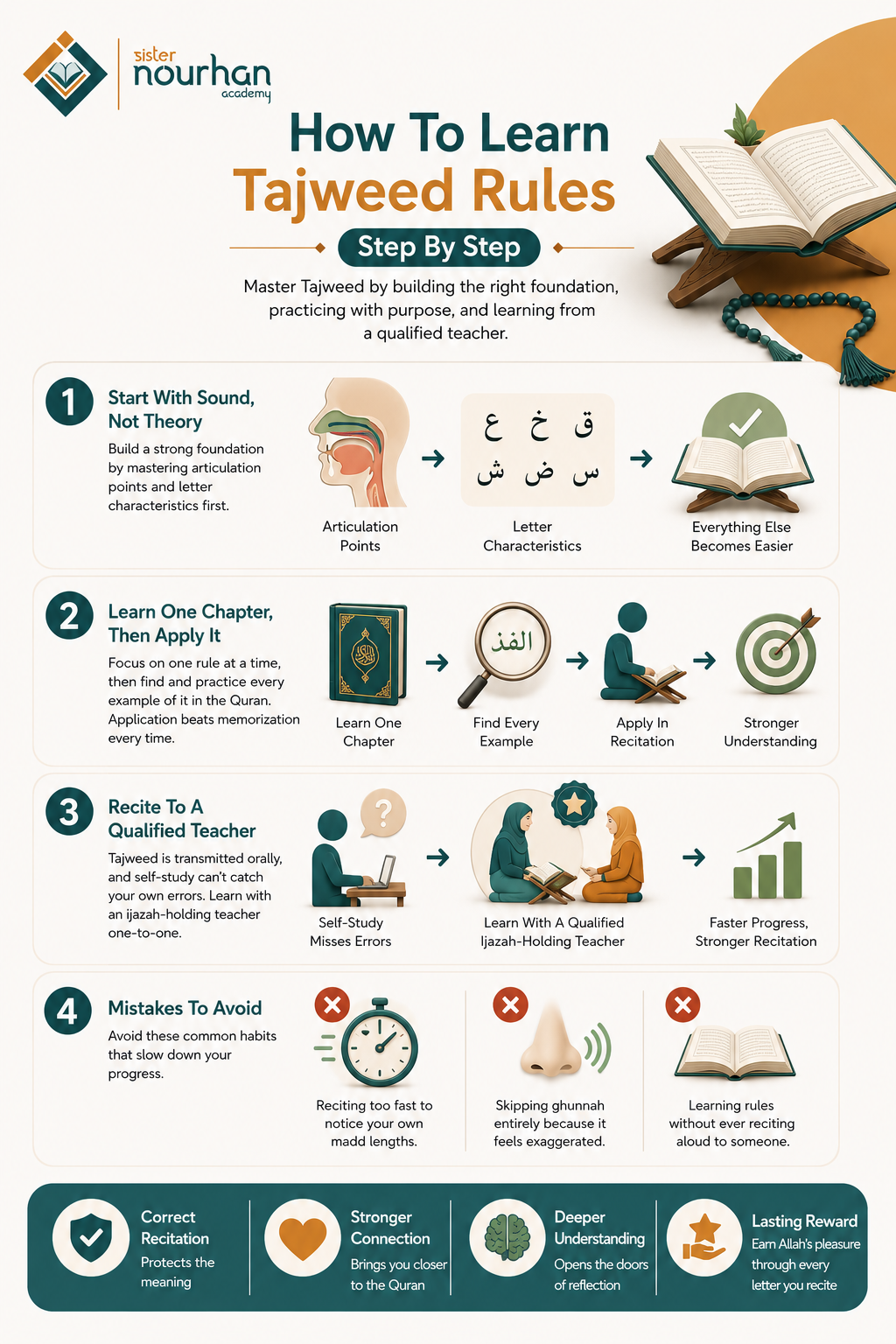
Most people fail at tajweed for one reason: they study it like a textbook instead of a skill. Here is the sequence that actually works.
1. Start With Sound, Not Theory
Spend your first weeks on the articulation points and letter characteristics before touching a single chapter of tajweed rules. Everything else becomes far easier afterwards.
2. Learn One Chapter, Then Apply It
Take noon sakinah alone, then hunt for every example of it in Surah Al-Fatiha and the short surahs. Application beats memorisation of definitions every time.
3. Recite To A Qualified Teacher
Tajweed is transmitted orally, and self-study cannot catch your own errors. Working one-to-one with an ijazah-holding instructor — as in our 1-on-1 Private Quran Lessons Online — shortens the journey dramatically.

4. Mistakes To Avoid
Most beginners repeat the same three habits, and each one is easy to fix the moment someone points it out. Watch for these as you practise:
Reciting too fast to notice your own madd lengths.
Skipping ghunnah entirely because it feels exaggerated.
Learning rules without ever reciting aloud to someone.
Further reading: How To Learn To Read The Quran In Arabic? A Complete Beginner's Guide
See our teaching methods
Experience the quality of our instruction firsthand by watching a live lesson snippet below.
Experience the quality of our instruction firsthand by watching a live lesson snippet below.
Begin Your Quranic Journey
Connect with the words of Allah through personalized sessions at Sister Nourhan Academy.
Book Your Free TrialWhy Learn Tajweed With Sister Nourhan Academy
Choosing where to learn matters as much as deciding to learn. Tajweed is transmitted from a qualified mouth to a listening ear, so the quality of your teacher determines the quality of your recitation for years to come. Here is exactly what studying with us gives you.
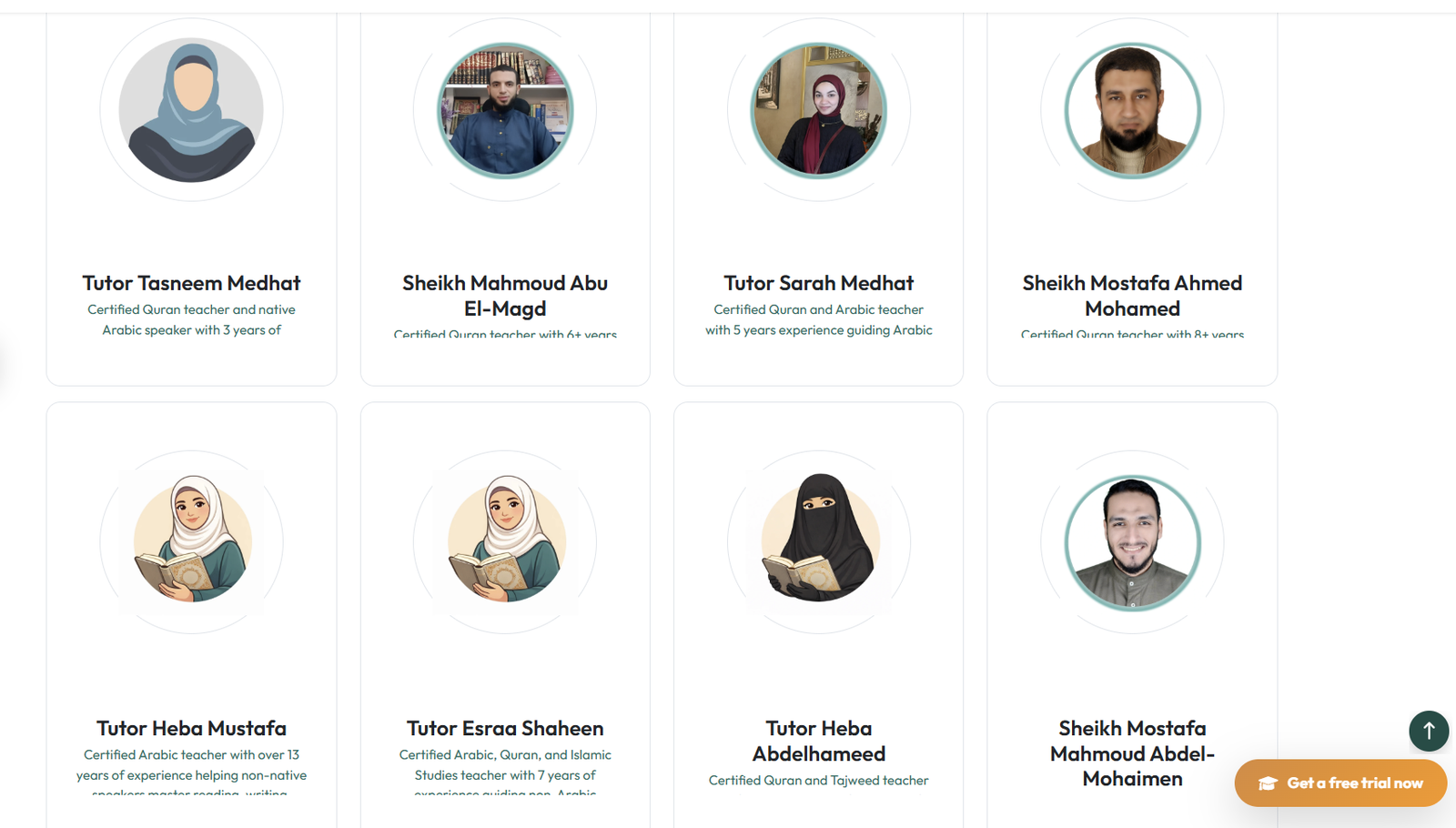
1. Certified Teachers With Connected Chains Of Transmission
Our instructors are certified graduates holding ijazah with unbroken chains back to the Prophet ﷺ. That means you are not learning tajweed second-hand — you are receiving it the way it has always been passed down.
Every lesson is delivered live and one-to-one. Never pre-recorded, never in a crowded group where your mistakes go unheard.
2. A Programme Built Around Your Level
Your plan is shaped by where you actually are, not by a fixed syllabus. Complete beginners start with articulation points and the short surahs, while intermediate students work steadily through the full rule set.
Advanced learners go further still, refining their recitation in our Al-Azhar Quran course and preparing for formal ijazah certification.

3. Courses For Every Member Of The Family
Children learn through age-appropriate, engaging lessons and our Hifz for Kids programme, so correct pronunciation becomes second nature early.
Sisters can study in a fully female-taught environment through Hifz for Females, and adults balancing work or study choose flexible slots across every time zone.

4. Tajweed That Connects To The Bigger Picture
Tajweed rarely stands alone, and it works best when paired with memorisation and understanding. Many students combine it with our Quran Memorization Program to lock in accuracy while they memorise.
Others add Islamic Studies so that correct recitation grows alongside genuine comprehension of what they are reading.
5. Structure, Tracking And Real Accountability
You get progress reports, revision plans, and a teacher who remembers exactly which rule you slipped on last week. That continuity is what turns scattered practice into measurable improvement.

Don't miss: How to Learn to Read Quran for Beginners: A 10-Step Guide
Conclusion
Tajweed begins with the articulation points, moves through noon sakinah and meem sakinah, expands into the madd family, and finishes with qalqalah, tafkheem and the rules of stopping.
The essential level — correct letters, no meaning-changing errors — is a duty on every reciter, while the finer refinements are the mark of excellence.
The ultimate takeaway is simple: tajweed rules are not a barrier between you and the Quran. They are the bridge that lets you read the Book the way it was revealed, and reflect on it the way it was meant to be understood.
Start Your Tajweed Journey Today!
You have the map of tajweed rules now. What you need next is a voice on the other end of the call telling you, kindly and precisely, exactly what to fix.
See how our classes work in practice:
Learn Quranic Arabic: Student Revises Spelling & Word Recognition in 3 Minutes
Book your free trial lesson with Sister Nourhan Academy and get a live assessment of your current recitation, plus a personalised plan built around your level, your goals and your schedule. There is no payment required to start and no obligation to continue.
Browse our available Quran and Tajweed programs:
If you would rather ask a few questions first, our team is one message away on the contact page. Choose your slot this week — your recitation a year from now depends on the lesson you book today.
Frequently Asked Questions
How Many Rules Of Tajweed Are There?
There is no single fixed number — most curricula cover around 15 to 20 chapters, from makharij and sifat to waqf and ibtida'. Sister Nourhan Academy sequences them so you master one chapter fully before moving to the next, instead of memorising a list.
Is Tajweed Haram?
Not at all — tajweed is the opposite of haram. It is the recommended, and in its essentials obligatory, way to recite the Quran correctly. What scholars warn against is excessive melodic exaggeration that distorts letters, which is exactly what proper supervision prevents.
What Are The 7 Types Of Quran Recitation?
They are the seven authentic qira'at transmitted through the imams Nafi', Ibn Kathir, Abu Amr, Ibn Amir, Asim, Hamzah and Al-Kisa'i. Most of the Muslim world recites Hafs 'an Asim, which is the narration taught throughout Sister Nourhan Academy's Quran courses.
How Do You Read A Colour-Coded Tajweed Quran?
Each colour marks a specific rule — for example one shade for ghunnah, another for ikhfa, another for obligatory madd — with a key printed at the back. A colour-coded Mushaf shows you what is tajweed Quran reading visually, but only a qualified teacher can confirm the sound you produce is correct.
What Is Tajweed Called In English?
Tajweed is usually translated as "Quranic recitation rules" or "the science of correct Quranic pronunciation." Our lessons at Sister Nourhan Academy are taught fully in English, so every rule and term is explained clearly before you apply it in Arabic.