

When reciting the Quran, the way you pronounce Noon Sakinah (نْ) and Tanween (ـً ـٍ ـٌ) changes according to the letter that comes next. One of the clearest and most important of these rules is Izhar Halqi.
Izhar Halqi requires the Noon Sakinah or Tanween to remain clear before six specific throat letters. Instead of merging, concealing, or changing the sound, the reciter gives the Noon its proper articulation before moving smoothly to the following letter.
In this guide, you will learn what Izhar Halqi means, its six letters, how the rule works, Quranic examples for every letter, and the most common mistakes learners should avoid.
What Is Izhar Halqi?
Izhar Halqi is one of the four rules of noon saakin (نْ) and tanween (ـً ـٍ ـٌ) in Tajweed. It applies when a noon saakin or tanween is immediately followed by one of six specific letters, requiring the noon sound to be pronounced clearly and distinctly — with no nasalization (ghunnah), no merging, and no transformation.
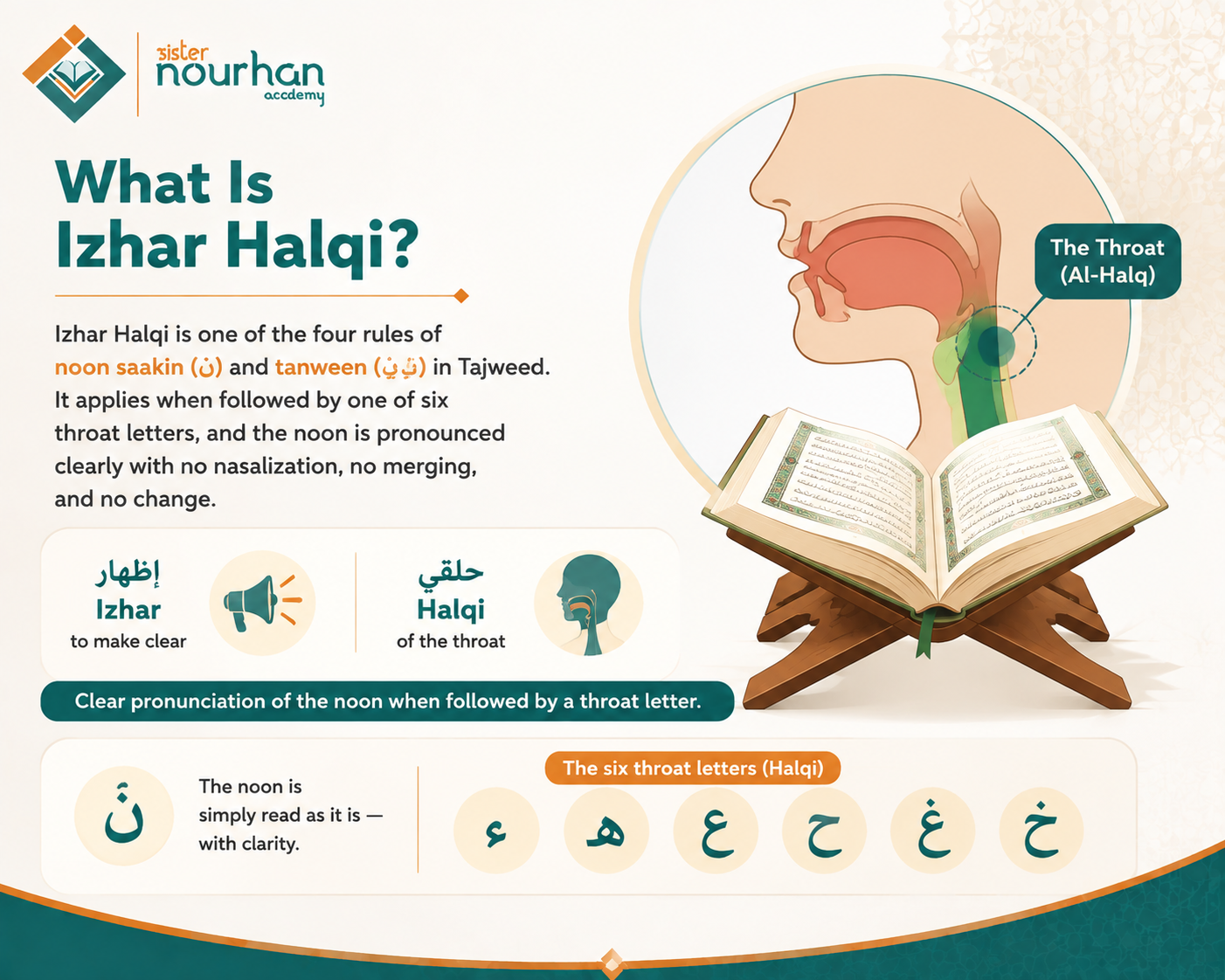
The word Izhar (إظهار) means "to make clear" or "to manifest." The word Halqi (حلقي) means "of the throat" — because all six trigger letters are articulated from the throat (the halq). Together, Izhar Halqi means: clear pronunciation of the noon when followed by a throat letter.
This is the default, most natural application of noon saakin and tanween. The noon is simply read as it is — no special modification required, only clarity.
Read also: What is general Izhar in Tajweed?
The Six Letters of Izhar Halqi
There are six Izhar Halqi letters:
ء هـ ع ح غ خ
They come from three general areas of the throat.
Because Noon and the six Izhar letters are produced from distinct articulation areas, the Noon remains clear rather than merging into the following throat letter.
A traditional phrase sometimes used to help students remember the letters is:
أخي هاك علماً حازه غير خاسر
The six Izhar letters appear as the initial letters of its words.
Why Does Izhar Halqi Occur?
The reason behind Izhar Halqi is closely connected to Makharij Al-Huruf, the articulation points of Arabic letters.
Noon is articulated using the tongue near the upper front teeth, while the six Izhar letters originate from the throat. Because the articulation points are relatively distant from one another, there is no strong reason for the Noon to merge into the following letter.
The reciter therefore completes the Noon clearly before moving to the throat letter This distinguishes Izhar from rules such as Idgham, where sounds merge, and Ikhfa, where the Noon sound is partially concealed.
See our teaching methods
Experience the quality of our instruction firsthand by watching a live lesson snippet below.
Begin Your Quranic Journey
Connect with the words of Allah through personalized sessions at Sister Nourhan Academy.
Book Your Free TrialIzhar Halqi Examples in the Quran
The easiest way to understand Izhar Halqi is to see how each of its six letters appears after Noon Sakinah or Tanween in actual Quranic verses. The following examples show all six Izhar Halqi letters and how the rule is applied during recitation.
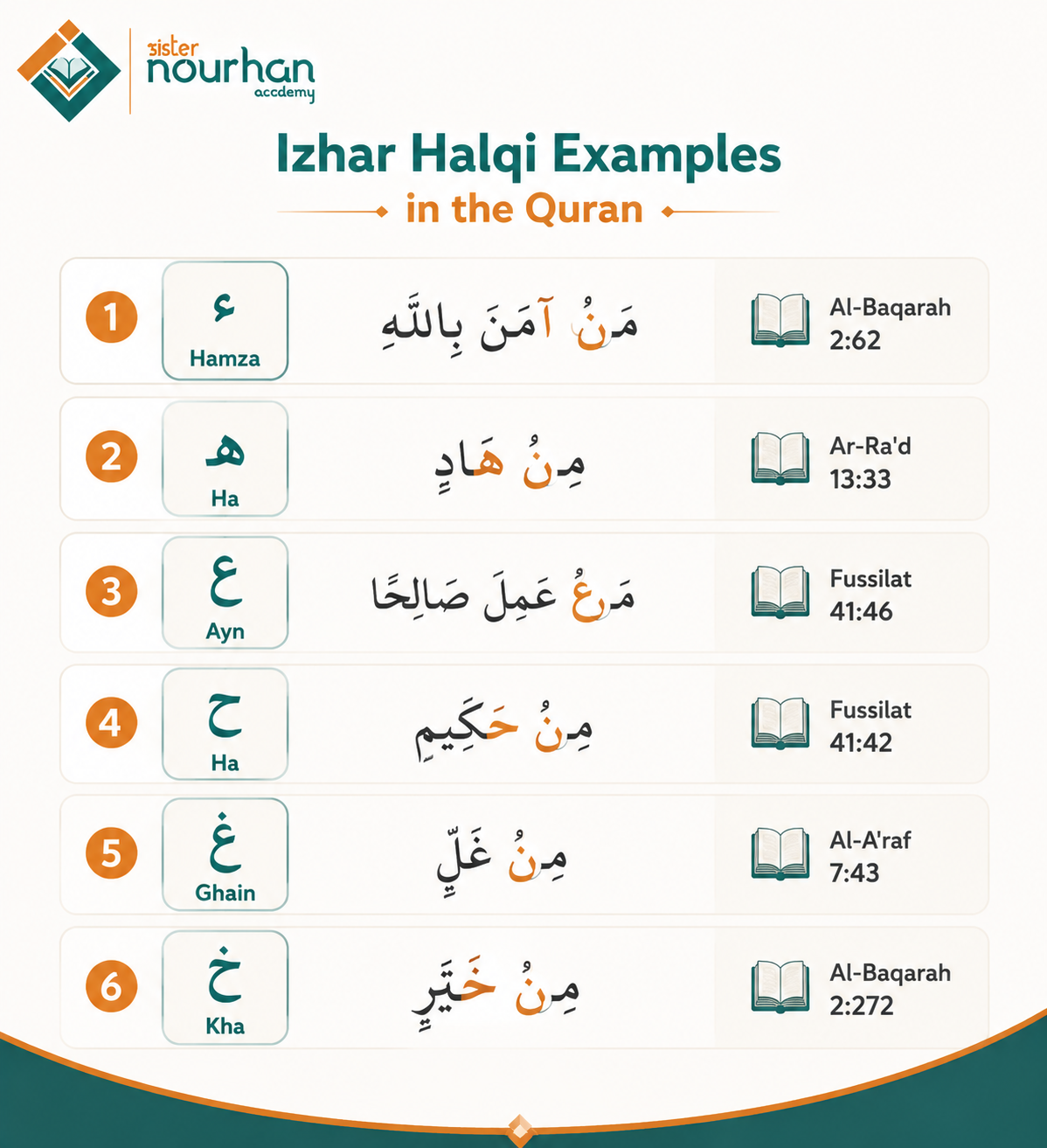
1. Izhar with Hamza (ء)
A clear example of Izhar with Hamza appears in Surah Al-Baqarah:
﴿مَنْ آمَنَ بِاللَّهِ وَالْيَوْمِ الْآخِرِ وَعَمِلَ صَالِحًا﴾
“Whoever believes in Allah and the Last Day and does good…” Surah Al-Baqarah, 2:62
In مَنْ آمَنَ, the Noon Sakinah in مَنْ is immediately followed by the Hamza (ء) in آمَنَ. Since Hamza is one of the six throat letters, Izhar Halqi applies. The Noon should be pronounced clearly before moving to the Hamza, without merging or concealing it.
2. Izhar with Ha (هـ)
An example of Izhar with هـ appears in Surah Ar-Ra'd:
﴿وَمَنْ يُضْلِلِ اللَّهُ فَمَا لَهُ مِنْ هَادٍ﴾
“And whoever Allah leaves to stray will have no guide.” Surah Ar-Ra'd, 13:33
The Izhar occurs in مِنْ هَادٍ, where the Noon Sakinah in مِنْ is followed by هـ in هَادٍ. The Noon should remain clear and distinct before the reciter moves to the throat articulation of هـ.
3. Izhar with Ayn (ع)
Allah says in Surah Fussilat:
﴿مَنْ عَمِلَ صَالِحًا فَلِنَفْسِهِ وَمَنْ أَسَاءَ فَعَلَيْهَا﴾
“Whoever does righteousness, it is for his own benefit; and whoever does evil, it is against it.” Surah Fussilat, 41:46
In مَنْ عَمِلَ, the Noon Sakinah is followed by ع, one of the middle-throat letters. The Noon is therefore pronounced clearly before transitioning to the articulation point of Ayn.
4. Izhar with Ha (ح)
Another example appears in Surah Fussilat:
﴿لَا يَأْتِيهِ الْبَاطِلُ مِنْ بَيْنِ يَدَيْهِ وَلَا مِنْ خَلْفِهِ تَنْزِيلٌ مِنْ حَكِيمٍ حَمِيدٍ﴾
“Falsehood cannot approach it from before it or from behind it; it is a revelation from One Who is All-Wise, Praiseworthy.” Surah Fussilat, 41:42
The Izhar occurs in مِنْ حَكِيمٍ. The Noon Sakinah is followed by ح, so it must remain clearly articulated before moving to the middle-throat sound of ح. The two sounds should remain distinct without an artificial pause between them.
5. Izhar with Ghain (غ)
Allah says in Surah Al-A'raf:
﴿وَنَزَعْنَا مَا فِي صُدُورِهِمْ مِنْ غِلٍّ﴾
“We will remove whatever bitterness they had in their hearts.” Surah Al-A'raf, 7:43
In مِنْ غِلٍّ, the Noon Sakinah is followed by غ. Because Ghain is one of the six Izhar Halqi letters, the Noon should be pronounced distinctly before moving to the articulation of غ.
6. Izhar with Kha (خ)
A clear example with خ appears in Surah Al-Baqarah:
﴿وَمَا تُنْفِقُوا مِنْ خَيْرٍ فَلِأَنْفُسِكُمْ﴾
“Whatever good you spend is for your own benefit.” Surah Al-Baqarah, 2:272
The Izhar occurs in مِنْ خَيْرٍ, where Noon Sakinah is followed by خ. The Noon remains clear before transitioning to Kha and should not be concealed or merged into the following letter.
How to Apply Izhar Halqi Correctly to Noon Saakin and Tanween
Applying Izhar Halqi is straightforward once you recognize the trigger.
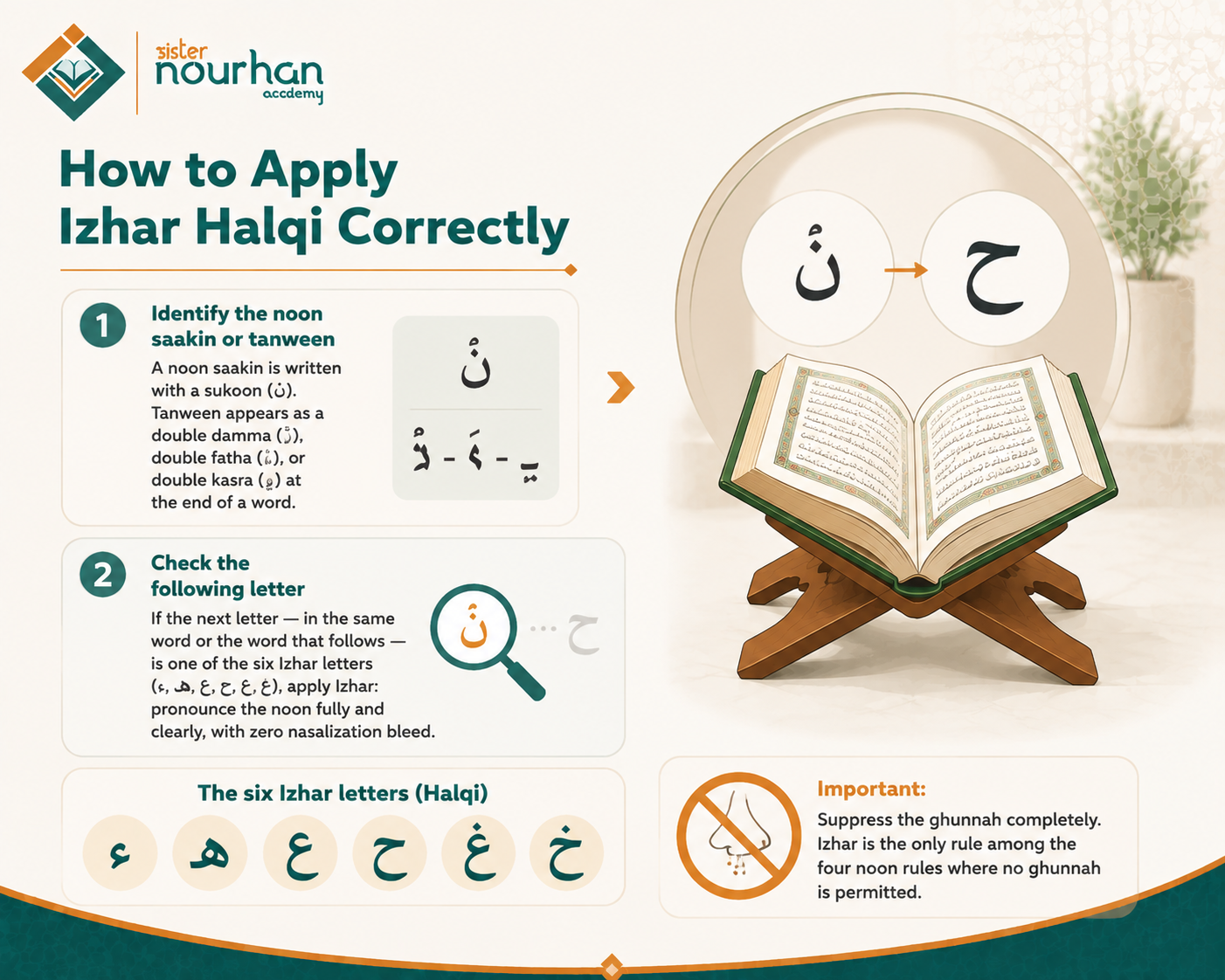
Follow this two-step process:
Step 1: Identify the Noon Saakin or Tanween in the Quranic Text
A noon saakin is written with a sukoon (نْ). Tanween appears as a double damma (ـٌ), double fatha (ـً), or double kasra (ـٍ) at the end of a word.
Step 2: Check Whether the Next Letter Is One of the Six Izhar Halqi Letters
If the next letter — whether in the same word or the word that follows — is one of the six Izhar letters (ء, هـ, ع, ح, غ, خ), apply Izhar: pronounce the noon fully and clearly, with zero nasalization bleed.
The most important technical point: suppress the ghunnah completely. Izhar is the only rule among the four noon rules where no ghunnah is permitted. Even a slight nasal extension of the noon before an Izhar letter is an error.
If you are studying with a qualified teacher, this is typically one of the first rules corrected — because learners who have developed a habit of ghunnah in other rules sometimes carry it into Izhar positions without noticing.
If you are also working on memorization alongside your Tajweed, the Hifz program for females at Sister Nourhan Academy integrates proper recitation with structured memorization — so what you memorize is accurate from the start.

Common Mistakes When Applying Izhar Halqi
Even students who can memorize the six letters may still make pronunciation errors while reciting.
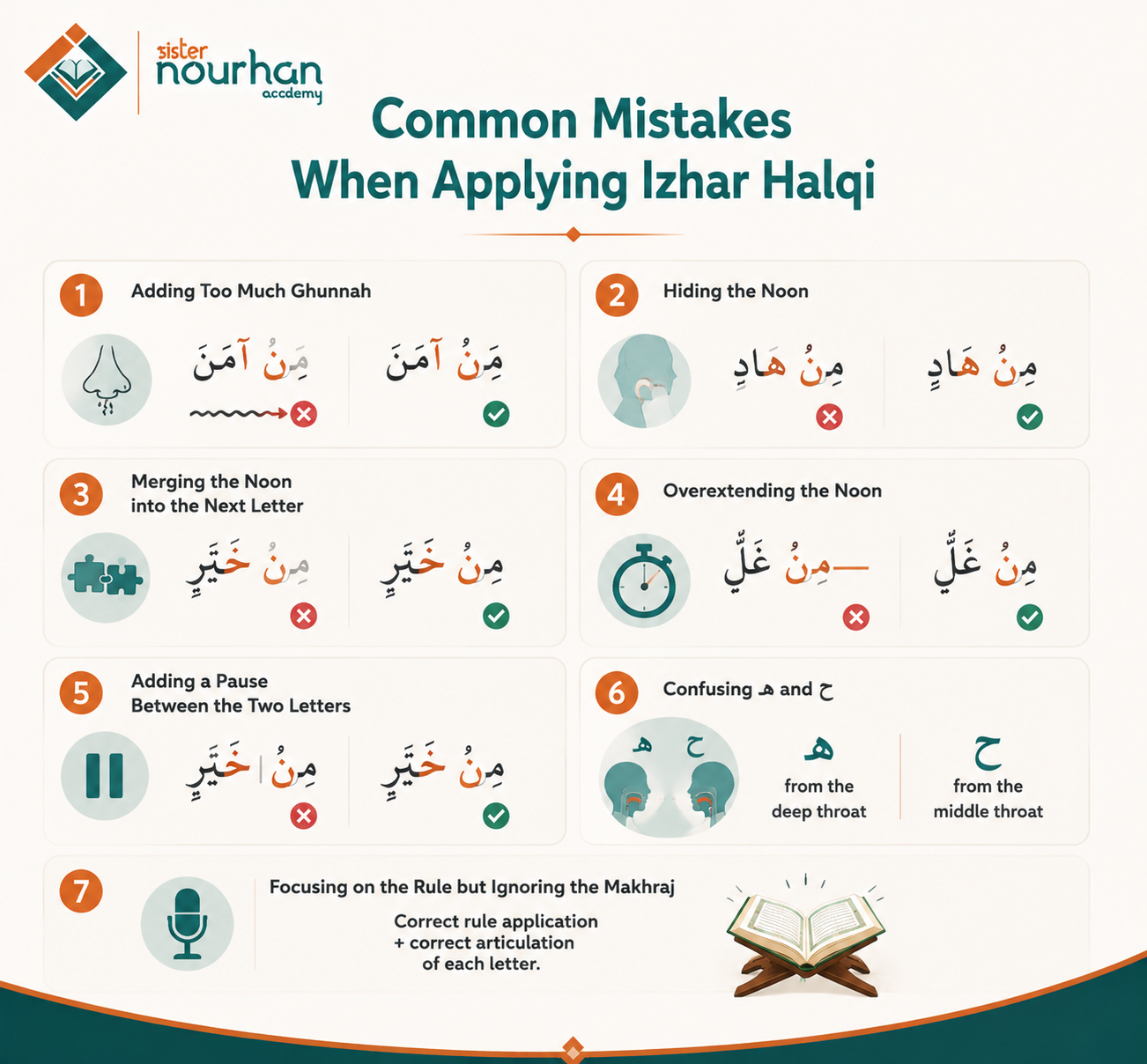
1. Adding Too Much Ghunnah
One of the most common mistakes is carrying the prolonged nasal sound of Ikhfa or Idgham into an Izhar position.
For example, in:
مَنْ آمَنَ
the Noon should remain clear rather than being held with an extended nasal sound.
2. Hiding the Noon
Some learners begin preparing for the throat letter too early and weaken the Noon.
This can happen especially before letters such as هـ and ح.
Complete the Noon before moving to the throat.
3. Merging the Noon into the Next Letter
Izhar is the opposite of merging If the Noon loses its independent clarity and blends into the following letter, the rule has not been applied correctly.
4. Overextending the Noon
Making the Noon clear does not mean holding it for an unnecessarily long time Give the letter its normal duration and move naturally into the next sound.
5. Adding a Pause Between the Two Letters
Izhar means clear pronunciation, not separation through silence.
For example:
مِنْ خَيْرٍ
should remain one continuous phrase. The Noon is clear, but no artificial pause should be inserted before خ.
6. Confusing هـ and ح
English transliteration often represents both letters using forms of “h,” but they have different articulation points and qualities.
هـ comes from the deepest throat region.
ح comes from the middle throat.
Both cause Izhar, but they must still be pronounced as distinct Arabic letters.
7. Focusing on the Rule but Ignoring the Makhraj
A learner may successfully identify an Izhar position but still pronounce the throat letter incorrectly.
Tajweed requires both:
correct rule application + correct articulation of each letter.
For learners who already understand the basics and want to refine their recitation, the Advanced Tajweed for Adults course provides guided instruction designed to turn rules such as Izhar Halqi from theoretical knowledge into consistent recitation skills.

How to Practice Izhar Halqi?
A structured practice routine makes the rule much easier to apply automatically.
Step 1 — Memorize the Six Letters
Start with:
ء هـ ع ح غ خ
Say them aloud until you can recognize them immediately.
Step 2 — Group Them by Throat Area
Practice them as three pairs:
ء هـ
ع ح
غ خ
This connects the rule with the Makharij instead of treating the letters as an unrelated list.
Step 3 — Practice Noon Sakinah Before Each Letter
Use examples such as:
مَنْ آمَنَ
مِنْ هَادٍ
مَنْ عَمِلَ
مِنْ حَكِيمٍ
مِنْ غِلٍّ
مِنْ خَيْرٍ
Read each slowly and focus on completing the Noon before beginning the throat letter.
Step 4 — Practice Tanween Examples
Once Noon Sakinah feels comfortable, look for Quranic passages where Tanween is followed by one of the six Izhar letters.
The same principle applies: the nunation remains clear before the throat letter.
Step 5 — Compare Izhar with Ikhfa
Read one Izhar example and one Ikhfa example consecutively.
Listen for the difference:
Izhar: Noon remains clear.
Ikhfa: Noon becomes concealed and is accompanied by Ghunnah.
This contrast is one of the fastest ways to train the ear.
Step 6 — Record Your Recitation
Record yourself reciting several Izhar examples.
Listen for three things:
Is the Noon clearly audible?
Are you avoiding unnecessary nasal prolongation?
Are you moving smoothly into the throat letter?
Recording often reveals habits that are difficult to notice while reciting.
Step 7 — Recite to a Qualified Tajweed Teacher
Some Tajweed mistakes cannot be corrected through written explanations alone.
A qualified teacher can hear whether you are:
extending the nasal sound,
weakening the Noon,
using the wrong Makhraj,
or blending the letters unintentionally.
Real-time correction helps prevent these habits from becoming permanent.
Shots from Our Classes
Take a moment to view the video below to see how our teachers provide clear, supportive corrections during a session.
Begin Your Quranic Journey
Connect with the words of Allah through personalized sessions at Sister Nourhan Academy.
Book Your Free TrialLearn Izhar Halqi with Sister Nourhan Academy
Understanding Izhar Halqi and memorizing its six letters is only the first step. Applying the rule correctly during Quran recitation requires practice, careful listening, and feedback from a qualified teacher who can identify pronunciation mistakes as they happen.
At Sister Nourhan Academy, students receive structured online Tajweed instruction focused on both understanding the rules and applying them in real recitation. Teachers provide direct correction in areas such as Makharij, Ghunnah, Noon Sakinah and Tanween rules, Meem rules, and other essential Tajweed principles.
Discover our Tajweed Courses

Conclusion
Izhar Halqi is the clearest of the four noon rules: when a noon saakin or tanween meets one of the six throat letters — ء, هـ, ع, ح, غ, خ — the noon is pronounced with full clarity and zero nasalization. The rule is named after the throat (halq) because every one of its trigger letters originates there, making clear separation of the noon both the grammatical requirement and the phonetically natural outcome.
The key to mastering it is not memorizing the six letters once — it is building the habit of scanning ahead while reciting, recognizing the trigger letter before you arrive at it, and then producing a clean, un-nasalized noon without hesitation. That automaticity comes from consistent practice with examples drawn directly from the Quran.
Frequently Asked Questions
What is Izhar Halqi in simple terms?
Izhar Halqi means pronouncing the noon saakin or tanween clearly when it is followed by one of six throat letters: ء, هـ, ع, ح, غ, خ. The noon is read as it is — fully and without any nasal extension.
What are the six letters of Izhar Halqi?
The six letters are Hamza (ء), Ha (هـ), Ayn (ع), Ha (ح), Ghain (غ), and Kha (خ). They are grouped together because they are all articulated from different zones within the throat.
Is there ghunnah in Izhar Halqi?
No. Izhar Halqi is the one noon rule where ghunnah is completely absent. The noon is pronounced cleanly with no nasal extension whatsoever. Adding ghunnah in an Izhar position is a recitation error.
How is Izhar Halqi different from Ikhfa?
In Izhar, the noon is pronounced fully and clearly. In Ikhfa, the noon is partially concealed with ghunnah when followed by one of fifteen other letters. Izhar produces a sharp, complete noon; Ikhfa produces a nasal, merged sound somewhere between a noon and the following letter.
Where does Izhar Halqi appear most often in the Quran?
The combination مِنْ followed by a throat letter is one of the most frequent. Phrases like مِنْ خَيْرٍ, مِنْ هَادٍ, and مِنْ عَمِلَ appear dozens of times across the Quran, making them ideal for building recognition speed.
Can Izhar Halqi appear within a single word?
Yes, though it is rare. The noon saakin can appear inside a word followed immediately by an Izhar letter in the same word — a phenomenon classical scholars call Izhar mutlaq in some cases. The more common occurrence is across two adjacent words.