Every time you open a Mushaf and recite, small symbols appear within the text — letters like م, ج, and لا, or paired dots like ∴. These are waqf signs in the Quran, and they are not decorative. Each one is a precise instruction about what to do with your voice and your breath at that exact point in the verse.
Most reciters learn these symbols at some point. Far fewer learn how to apply them correctly under the pressure of live recitation — or understand what goes wrong when they're ignored. This guide covers all six waqf signs, what each one means, and how to actually use them when you recite.
What Are Waqf Signs in the Quran?
Waqf signs in the Quran are a set of symbols printed within the Mushaf to guide the reciter on where to stop (waqf), where to continue (wasl), and where both options are permitted.
The word waqf (وقف) means cessation or pause in Arabic, and the science built around it — Al-Waqf wal-Ibtida' — governs not just where you stop but where you restart after stopping.
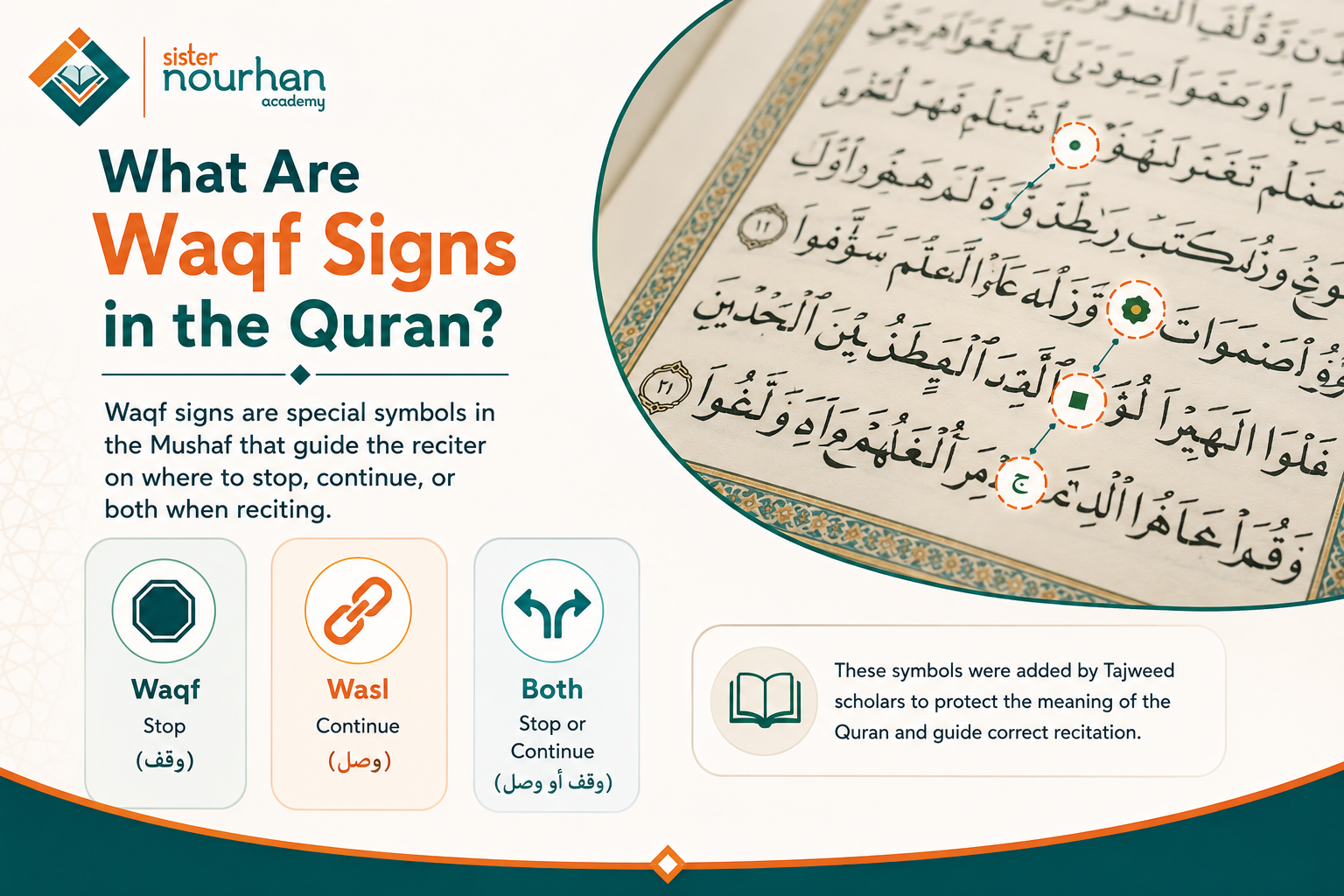
These symbols were not part of the original revelation. Tajweed scholars introduced them later, as Islam spread to non-Arab communities and the risk of misreading the Quran's meaning grew.
Their purpose is straightforward: to protect the meaning of the Quran during recitation by telling the reader exactly when a pause serves the text and when it harms it.
Read also: What are the rules of Waqf in the Quran?
Why Are Waqf Signs Important When Reading the Quran?
The Quran is not punctuated the way a modern text is. There are no commas or full stops — the meaning flows continuously through verses that can be grammatically and semantically interlinked across several words or even across verse boundaries.
A stop in the wrong place does not just break the flow. It can actively change what a listener hears and understands.
An incorrect pause can make a positive statement sound negative, sever a condition from its outcome, or separate a noun from its description — producing a different meaning entirely from what the verse intends.
Tajweed scholars classified a wrongly placed stop as lahn khafiy — a subtle recitation error that does not mispronounce a letter but does compromise the integrity of what is being recited.
Knowing stop signs in Quran recitation is therefore not an advanced concern for memorization students. It belongs in the core of any serious tajweed education.
The Advanced Tajweed for Adults course at Sister Nourhan Academy covers Al-Waqf wal-Ibtida' as part of a full, structured tajweed curriculum taught by ijazah-certified instructors.
Shots from Our Classes
Take a moment to view the video below to see how our teachers provide clear, supportive corrections during a session.
Begin Your Quranic Journey
Connect with the words of Allah through personalized sessions at Sister Nourhan Academy.
Book Your Free TrialThe 6 Waqf Signs in the Quran
The standard Mushaf uses several Waqf signs to guide readers on where to stop, where to continue, and which option is preferred. The six primary signs below help preserve both the meaning of the verses and the correct flow of Quran recitation.
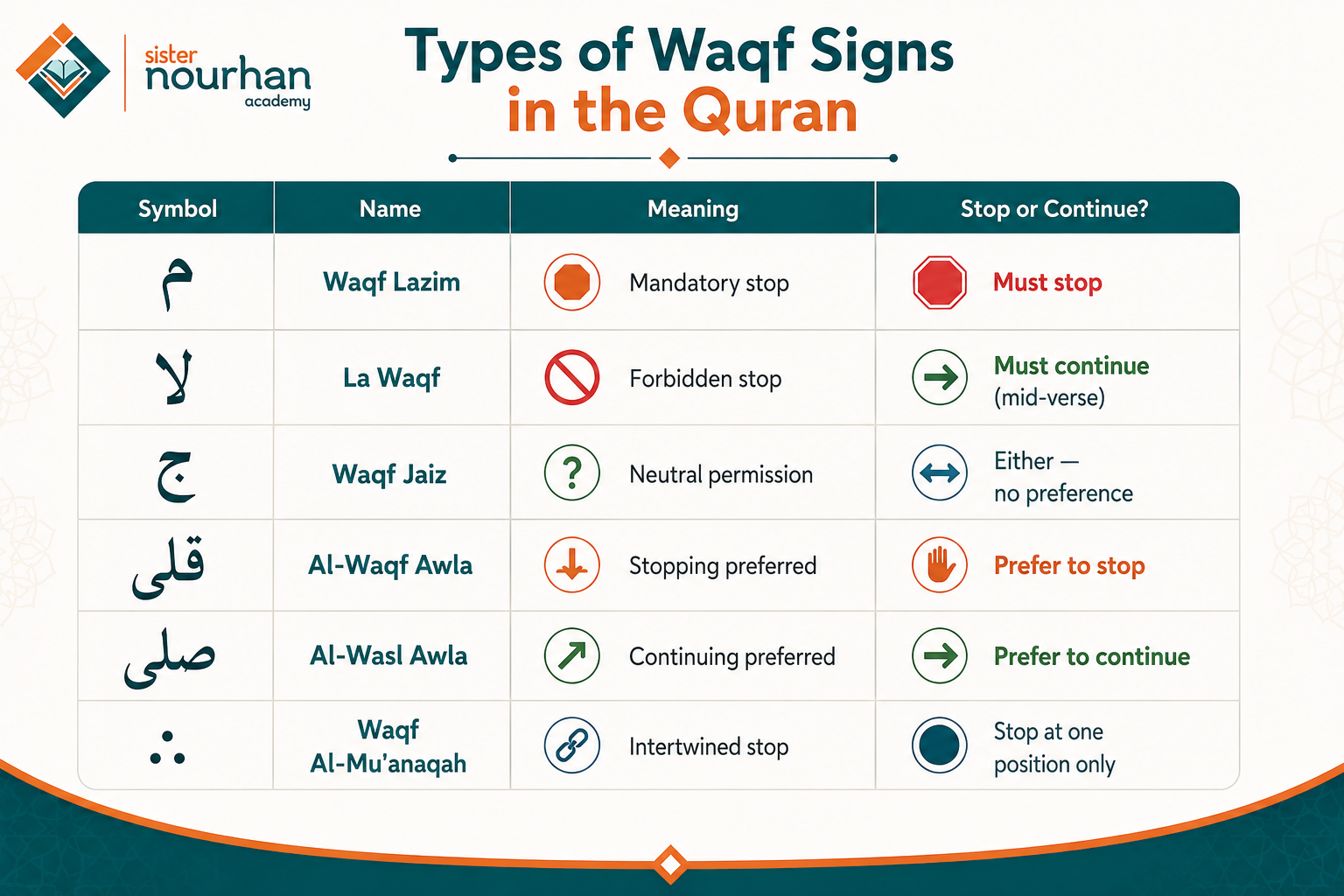
1. م — Waqf Lazim (Mandatory Stop)
The sign م indicates Waqf Lazim, a point where stopping is necessary to preserve the intended meaning. Continuing may create ambiguity or connect meanings that should remain separate.
Ruling: Stopping is required.
2. لا — La Waqf (Do Not Stop)
The sign لا indicates that the reader should not stop because the meaning remains closely connected to what follows. Stopping mid-verse at this point may interrupt the grammatical or semantic structure.
When لا appears at the end of a verse, however, stopping at the verse ending remains permissible.
Ruling: Do not stop mid-verse; stopping at the end of a verse is permitted.
3. ج — Waqf Jaiz (Permissible Stop)
ج stands for Waqf Jaiz — a stop that is simply permitted, with no preference given to stopping or continuing. Both options are equally valid at this point. The reader may choose based on breath, pace, or recitation context.
This is the most flexible of the quran waqf symbols and the most frequently appearing sign across the Mushaf.
Ruling: Stopping and continuing are both equally permitted.
4. قلى — Al-Waqf Awla (Stopping Is Preferred)
قلى marks a position where continuing is technically allowed, but stopping is the stronger choice. The meaning at this point benefits from a pause, and the verse reads more correctly when the reader stops here.
The practical rule with قلى: stop unless you have a specific reason to continue — such as managing a long passage in a single breath for a particular recitation style.
Ruling: Continuing is permitted; stopping is preferred.
5. صلى — Al-Wasl Awla (Continuing Is Preferred)
صلى comes from sila — connection. It marks a position where stopping is technically allowed, but continuing without stopping is the better choice. The connection between this word and what follows is strong enough that maintaining flow serves the verse more than pausing.
Think of صلى as a yellow light: you can stop, but the recitation is smoother and more correct if you carry on.
Ruling: Stopping is permitted; continuing is preferred.
6. ∴ — Waqf Al-Mu'anaqah (Intertwined Stop)
This is the most visually distinctive of all the stop signs in Quran recitation. Three dots — appearing like a small triangle — mark two separate positions within a verse. The rule is:
You may stop at the first position — but then you must continue through the second.
Or you may continue past the first position and stop at the second.
You may also continue through both positions without stopping at either.
The one thing you cannot do is stop at both positions.
Stopping at both dots fragments the verse into disconnected pieces, breaking the meaning entirely.
The most frequently cited example comes from Surah Al-Baqarah (2:2):
﴿ذَلِكَ الْكِتَابُ لاَ رَيْبَ ∴ فِيهِ ∴ هُدًى لِّلْمُتَّقِينَ﴾
Stopping after لاَ رَيْبَ gives: "There is no doubt" — a complete, meaningful statement. Stopping after فِيهِ gives: "There is no doubt in it" — also complete. But stopping at both leaves the listener with two separate fragments that together lose the verse's full sense.
Ruling: Stop at one of the two marked positions only — or continue through both. Never stop at both.
Applying Waqf Signs While Reciting the Quran
Recognizing Waqf signs is only the first step; the real skill is knowing how to respond to them naturally while reciting. The following practical guidelines can help beginners and intermediate learners apply each sign correctly.
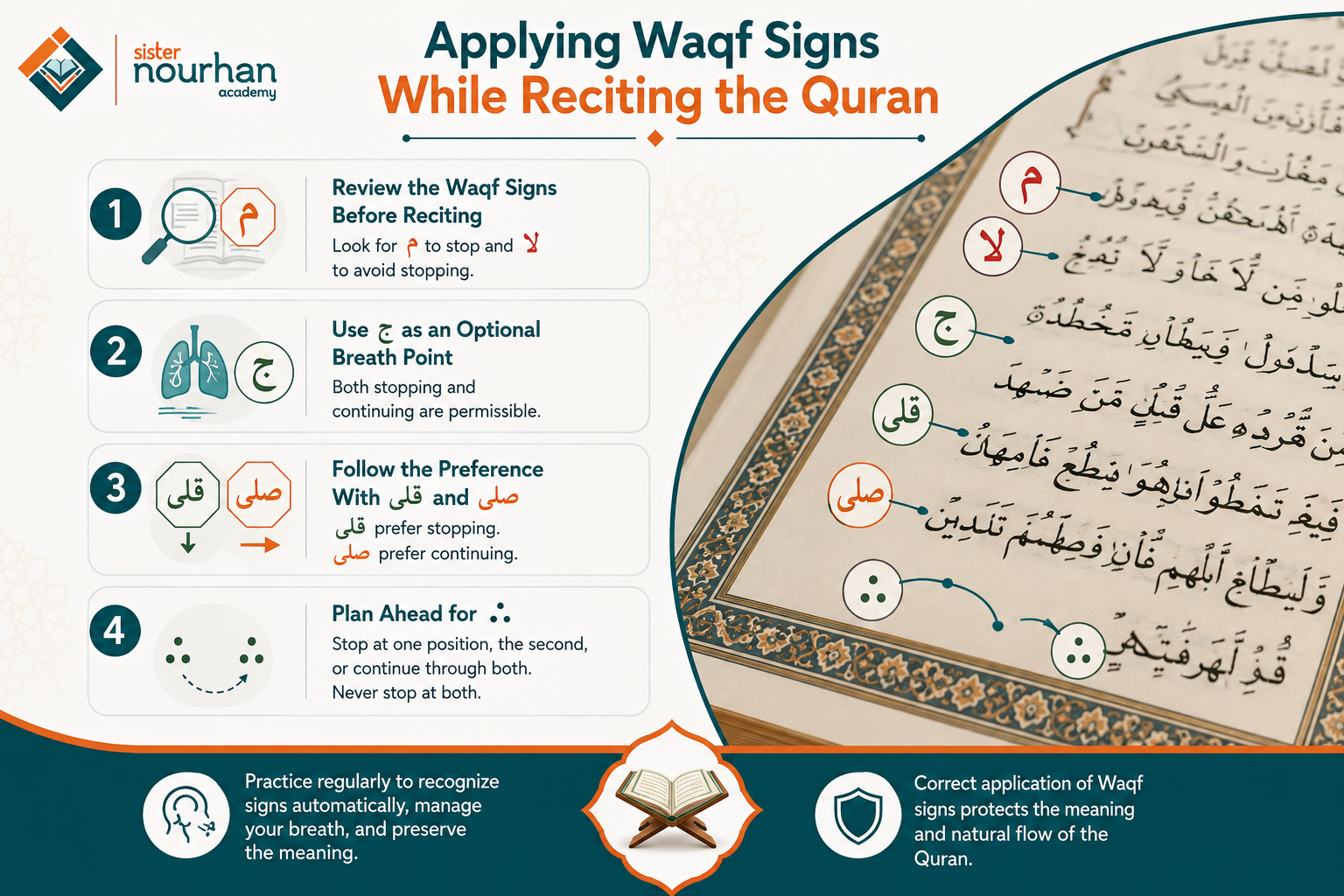
1. Review the Waqf Signs Before Reciting
Before starting a passage, quickly scan for the main stopping signs. Pay particular attention to م, where you should plan to stop, and لا, where you should avoid stopping mid-verse. This helps you manage your breath before reaching these points.
2. Use ج as an Optional Breath Point
The sign ج does not require you to stop. It indicates that both stopping and continuing are permissible, making it a useful place to pause when you need to take a breath.
3. Follow the Preference With قلى and صلى
When you see قلى, stopping is preferable, while صلى indicates that continuing is preferable. Follow these recommendations whenever your breath allows while remembering that both options remain permissible.
4. Plan Ahead for ∴
When you encounter paired ∴ signs, decide before reaching the first one whether you will stop there, stop at the second, or continue through both. Avoid stopping at both positions, as this can disrupt the intended connection of meaning.
With regular practice, these signs become easier to recognize automatically, allowing you to manage your breath while preserving the meaning and natural flow of Quran recitation.
If you want structured practice applying these signs under expert supervision, the 1-on-1 Private Quran Lessons Online at Sister Nourhan Academy offer individual sessions where your recitation is heard, assessed, and corrected verse by verse.

What Happens If You Stop at the Wrong Place in the Quran?
A misplaced stop in the Quran is not simply a stylistic error — it is a meaning error. Tajweed scholars classify it as lahn khafiy: a subtle fault that does not affect the pronunciation of individual letters but does damage the coherence of what is recited.
The consequences range from mild to significant depending on where the wrong stop falls. In some cases, stopping mid-sentence separates a condition from its result, making the verse appear to make a statement it does not actually make.
In others, a pause after a negation removes the object of that negation — turning "there is no doubt in it" into a fragmented "there is no doubt" followed by an orphaned "in it."
This is precisely why the م sign exists: to mark the spots where the risk of meaning-damage is highest, and where a stop is not optional but required to preserve what the verse communicates.
Common Mistakes When Following Quran Waqf Signs
Knowing the Waqf symbols does not always mean applying them correctly during recitation. The following mistakes are especially common among learners and can affect both the flow and meaning of a passage.
1. Stopping at لا Mid-Verse
The sign لا indicates that the reader should not stop at that point within a verse. Running out of breath is a common reason for this mistake, so reviewing the stopping signs beforehand can help with better breath management.
2. Treating ج as a Mandatory Stop
The sign ج means that stopping is permitted, not required. Pausing at every ج unnecessarily can interrupt the natural flow of recitation.
3. Confusing قلى and صلى
Although both signs allow stopping, they indicate different preferences:
قلى: Stopping is preferred.
صلى: Continuing is preferred.
Recognizing this distinction helps the reader choose the more appropriate option.
4. Stopping at Both ∴ Positions
With Waqf Al-Mu'anaqah, the reader may stop at either one of the paired positions or continue through both. Stopping at both should be avoided, as it can fragment the intended meaning.
5. Ignoring Waqf Signs
Stopping only when breath runs out can lead to pauses in inappropriate places. Instead, readers should use the Waqf signs to guide their pauses while planning their breath around the meaning and structure of the verses.
Learning to recognize these mistakes during practice makes it easier to develop more accurate and meaningful Quran recitation.
How to Learn Waqf and Ibtida' Correctly?
The 6 waqf signs in the Quran are a tool — an important one, but a tool nonetheless. They exist within a larger science called Al-Waqf wal-Ibtida' (The Science of Stopping and Starting), which governs not just where you stop but where and how you restart.
Ibtida' — the starting point after a stop — is the half of this science that most students never formally learn.
Where you restart after a pause must make grammatical and semantic sense on its own. Starting from the middle of a connected phrase, even after a correct stop, can produce a misleading partial statement.
The waqf symbols in the Mushaf guide the stop. The science of ibtida' guides what comes next. Together, they form a complete system for meaning-preserving recitation — and both require study under a qualified teacher, not just self-reading.
See our teaching methods
Experience the quality of our instruction firsthand by watching a live lesson snippet below.
Begin Your Quranic Journey
Connect with the words of Allah through personalized sessions at Sister Nourhan Academy.
Book Your Free TrialMaster Quran Waqf Rules with Sister Nourhan Academy
Understanding Waqf signs is an important step toward accurate Quran recitation, but mastering them requires guided practice.
A qualified teacher can help you recognize the correct stopping points, preserve the intended meaning of the verses, and apply Waqf and Ibtida’ rules naturally while reciting.
At Sister Nourhan Academy, students learn Tajweed through structured online lessons with qualified instructors. Whether you are strengthening basic recitation skills or progressing to advanced Waqf and Ibtida’, lessons are adapted to your current level, learning goals, and schedule.
Start your free trial class with Sister Nourhan Academy and take the next step toward more accurate, confident, and meaningful Quran recitation.
Discover our Tajweed Courses
Conclusion
The 6 waqf signs in the Quran — م (mandatory stop), لا (forbidden stop mid-verse), ج (equal permission), قلى (stopping preferred), صلى (continuing preferred), and ∴ (intertwined stop) — form a complete system for protecting meaning during recitation.
Each symbol carries a specific ruling, and each ruling exists because an incorrect stop does not just interrupt fluency — it changes what the verse communicates to anyone listening.
Learn the symbols, understand their rulings, apply them deliberately during practice, and get your recitation checked by someone qualified to hear the difference. That is the full path to using quran waqf symbols correctly — not just knowing what they are, but knowing what to do when you meet them mid-verse.
FAQs About Waqf Signs in the Quran
How many waqf signs are in the Quran?
There are 6 primary waqf signs used across the standard Mushaf: م (Waqf Lazim), لا (La Waqf), ج (Waqf Jaiz), قلى (Al-Waqf Awla), صلى (Al-Wasl Awla), and ∴ (Waqf Al-Mu'anaqah). Some editions of the Mushaf include additional or variant symbols, but these 6 are the core set recognized across tajweed scholarship.
What does م mean in Quran recitation?
The م symbol marks Waqf Lazim — a mandatory stop. The meaning of the verse at that point is only fully clear when the reader pauses there. Continuing without stopping can create ambiguity or produce a misleading reading for the listener.
What does لا mean as a waqf sign?
The لا symbol means stopping is forbidden at that position mid-verse, because pausing there would break the grammatical or semantic connection in a misleading way. If لا appears at the end of a verse, stopping is still permitted — pausing at verse endings is a Sunnah of the Prophet ﷺ.
Can I stop at ج?
Yes. The ج symbol marks Waqf Jaiz — equal permission. Both stopping and continuing are valid at that point. It is not a command to stop; it is simply confirmation that stopping there is acceptable if needed.
What is the difference between قلى and صلى?
Both symbols indicate a permitted stop, but with opposite preferences. قلى means stopping is the better choice — continuing is allowed but not ideal. صلى means continuing is the better choice — stopping is allowed but not ideal. Neither is obligatory; both are guidance on which option serves the verse more correctly at that point.
What is the ∴ symbol in the Quran?
The ∴ symbol marks Waqf Al-Mu'anaqah — the intertwined stop. It appears at two positions within a verse, and the rule is that you may stop at one position but not both. Stopping at both fragments the verse and breaks the meaning. You may also choose to continue through both positions without stopping at either.