
The Waqf rules in Quran explain where a reciter should stop, where stopping is permitted, and where a pause may damage or leave the meaning incomplete.
Waqf (الوقف) is the act of cutting the voice at a Quranic word for enough time to breathe, with the intention of continuing the recitation afterward. It is an important part of Tajweed because a technically correct pronunciation can still communicate an incomplete or misleading meaning when the reader stops in the wrong place.
For that reason, learning Waqf in Tajweed is not simply about recognizing symbols in the Mushaf. The reader must understand what each stopping sign asks them to do and, more importantly, whether the meaning is complete at the point where they stop.
This guide focuses specifically on Waqf (stopping): its main types, the four categories of voluntary Waqf, common Quran stopping signs, what happens to a word when you stop on it, and mistakes to avoid.
What Are the Waqf Rules in Quran?
The Waqf rules in Quran are Tajweed principles that determine appropriate and inappropriate places to stop during recitation so that the Quranic meaning remains complete and accurate.
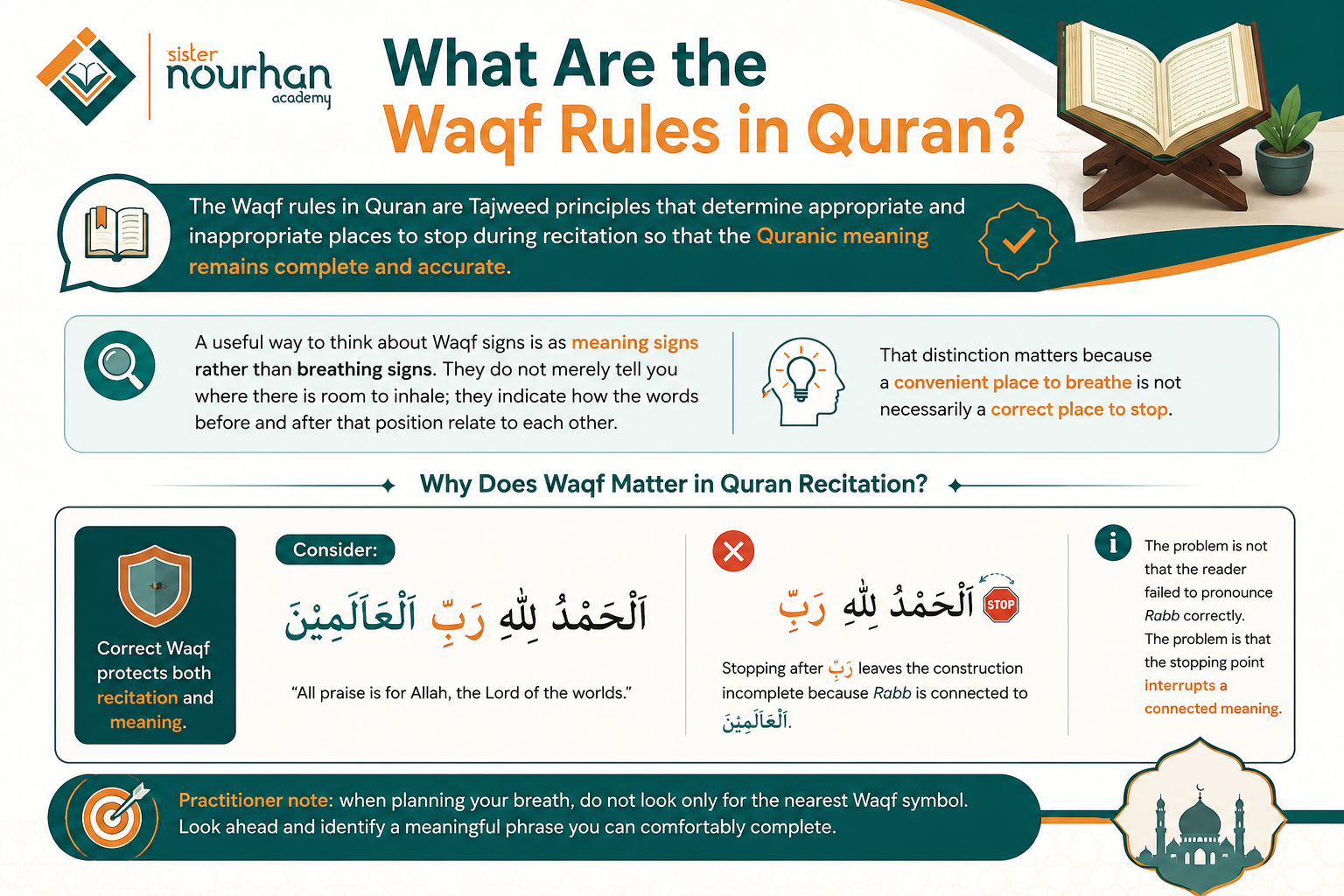
A useful way to think about Waqf signs is as meaning signs rather than breathing signs. They do not merely tell you where there is room to inhale; they indicate how the words before and after that position relate to each other.
That distinction matters because a convenient place to breathe is not necessarily a correct place to stop.
Why Does Waqf Matter in Quran Recitation?
Correct Waqf protects both recitation and meaning.
Consider:
الْحَمْدُ لِلَّهِ رَبِّ الْعَالَمِينَ
Stopping after رَبِّ leaves the construction incomplete because Rabb is connected to الْعَالَمِينَ.
The problem is not that the reader failed to pronounce Rabb correctly. The problem is that the stopping point interrupts a connected meaning.
Practitioner note: when planning your breath, do not look only for the nearest Waqf symbol. Look ahead and identify a meaningful phrase you can comfortably complete.
If recognizing the signs is easy but applying them during continuous recitation is difficult, guided practice with Sister Nourhan Academy can help you learn to combine breath control, Tajweed, and meaning rather than treating each skill separately.
Through the Hifz for Females Course, female learners can also strengthen memorization while practicing accurate stopping and starting points, improving Tajweed, and developing greater confidence in continuous Quran recitation.

How to Practice Idgham Correctly in Quran Recitation
Knowing the Idgham letters is only the beginning. To apply the rule correctly, you need to recognize Noon Sakinah and Tanween quickly, identify the following letter, distinguish between the two types of Idgham, and practice merging the sounds smoothly.
These categories should not be confused with Mushaf symbols such as م or ج. One classification describes why you stopped; the symbols guide you about where stopping is appropriate.
1. Identify Noon Sakinah or Tanween Before Applying Idgham
Waqf Idtirari (الوقف الاضطراري) is a stop forced by circumstances rather than deliberately chosen by the reciter.
A reader may run out of breath, cough, sneeze, forget the continuation, or face another unavoidable interruption.
Because the stop was necessary, it is treated differently from deliberately choosing an unsuitable stopping point.
The important practical question becomes: where should you resume from?
If stopping has left the meaning incomplete, do not automatically continue from the following word. Return to a suitable earlier point so that the connected phrase can be recited correctly.
2. Check the First Letter of the Following Word
Waqf Ikhtibari (الوقف الاختباري) is a deliberate stop made for examination or instruction rather than ordinary recitation.
A teacher may ask a student to stop on a particular word to demonstrate how it is written or pronounced when stopping. This category therefore serves an educational purpose.
3. Merge the Noon or Tanween Into the Idgham Letter
Waqf Intizari (الوقف الانتظاري) is a technical stop used when a qualified reader is collecting or demonstrating different recognized recitation variants.
It is primarily relevant to advanced students studying the Qira'at rather than beginners learning everyday Quran recitation.
4. Distinguish Idgham With Ghunnah From Idgham Without Ghunnah
Divide the six Idgham letters into two groups:
ي ن م و (ينمو): Apply Idgham with Ghunnah, maintaining the nasal sound for approximately two counts.
ل ر: Apply Idgham without Ghunnah, merging directly into the following letter without extending a Ghunnah.
Practice the two groups separately so you do not automatically add Ghunnah to every Idgham position
5. Practice Each Idgham Letter With Quranic Examples
Choose Quranic examples containing each of the six letters and recite them slowly. Focus first on the quality of the merge rather than your recitation speed.
Once you can apply the rule consistently at a slow pace, gradually return to your normal Quran recitation speed.
6. Recite to a Qualified Tajweed Teacher and Correct Subtle Mistakes
Some Idgham mistakes are difficult to detect independently. You may leave part of the Noon sound audible, make the Ghunnah too short or too long, or fail to merge the two sounds completely.
Reciting to a qualified Quran or Tajweed teacher allows these subtle errors to be identified and corrected before they become habits.
Regularly listening to proficient Quran reciters can also strengthen your ability to recognize and reproduce correct Idgham during your own recitation.
Shots from Our Classes
Take a moment to view the video below to see how our teachers provide clear, supportive corrections during a session.
Begin Your Quranic Journey
Connect with the words of Allah through personalized sessions at Sister Nourhan Academy.
Book Your Free TrialWhat Are the Four Types of Voluntary Waqf?
The four types of voluntary Waqf describe how complete the meaning is at the stopping point and how strongly it remains connected to what follows.
This gives students a better decision framework than memorizing isolated names.
What Is Waqf Taam?
Waqf Taam (الوقف التام) is a complete stop where the preceding statement has completed its meaning and is not dependent on what follows in wording or meaning. It represents one of the strongest natural places to stop.
However, learners should avoid assuming that every end of an ayah automatically represents Waqf Taam. Verse endings deserve particular attention in recitation, but the semantic relationship between passages still needs to be understood.
What Is Waqf Kafi?
Waqf Kafi (الوقف الكافي) occurs where the statement is complete in itself but remains connected to what follows in meaning rather than grammatical construction.
The word Kafi means “sufficient.” The reader has reached a meaningful stopping point, even though the next passage continues the broader subject.
The easiest distinction is:
Taam: the thought is complete and independent.
Kafi: the sentence is complete, but the topic continues.
What Is Waqf Hasan?
Waqf Hasan (الوقف الحسن) is a good stop on words that provide an understandable meaning but remain connected to what follows in wording and meaning.
Stopping can therefore be acceptable, but the reader must be careful about simply beginning from the next word if doing so produces an incomplete construction.
This is where beginners often focus too much on “Can I stop?” and overlook the equally practical question: “If I stop here, can I continue naturally from the next word?”
What Is Waqf Qabih?
Waqf Qabih (الوقف القبيح) is an inappropriate deliberate stop made before the intended meaning or grammatical construction has been completed.
Examples include separating a verb from something necessary to complete its meaning or stopping where the resulting phrase communicates an incomplete or misleading idea.
A useful test is:
Would the listener understand a complete and correct meaning if my recitation ended here?
If not, look for a better stopping point.
Understanding the difference between Waqf Taam, Kafi, Hasan, and Qabih becomes much easier when you practice these stopping points during real Quran recitation rather than memorizing definitions alone.
With Sister Nourhan Academy, you can receive personalized guidance from qualified teachers who help you recognize appropriate stopping and starting points, preserve the intended meaning of the verses, and apply Waqf rules naturally while reciting.
For learners ready to refine these skills further, the Advanced Tajweed Course provides structured practice in advanced recitation rules, including Waqf and Ibtida, pronunciation accuracy, and practical correction.
What Do the Main Waqf Signs in the Quran Mean?
Waqf signs in the Mushaf help reciters understand where they may stop, where continuing is preferable, and where stopping could affect the intended connection between words and meanings.
These symbols are especially useful when your breath is limited because a grammatically or semantically connected phrase should not be divided carelessly.
The exact symbols and their interpretation can vary slightly between Mushaf notation systems. For this reason, learn the convention used in the Mushaf you regularly recite from rather than assuming every printed copy uses exactly the same set of signs.
م — Waqf Lazim: Stop to Preserve the Intended Meaning
The symbol م marks Waqf Lazim, a position where the Mushaf notation strongly directs the reciter to stop because continuing may create an incorrect or misleading connection with what follows.
When you encounter م, complete the phrase, stop, take a breath if necessary, and then begin from the following appropriate phrase.
A useful distinction is:
Waqf Lazim (م) = a Mushaf instruction about stopping.
Waqf Taam = a classification based on the completeness and relationship of meaning.
They are related to the science of Waqf but should not be treated as interchangeable terms.
لا — Avoid Stopping Because the Meaning Remains Connected
The symbol لا generally indicates that you should not deliberately stop at that position because what comes before and after it remains closely connected.
Stopping there without necessity may leave the phrase incomplete or temporarily create an unintended meaning.
However, running out of breath, coughing, sneezing, or another unavoidable interruption can force you to stop. This becomes Waqf Idtirari, an unavoidable stop.
In that situation, do not automatically resume from the next word. Check the meaning and, when necessary, return to an earlier suitable word or phrase so that the intended connection is restored.
ج — Waqf Jaiz: Both Stopping and Continuing Are Permissible
The symbol ج represents Waqf Jaiz, meaning that both stopping and continuing are permissible.
This gives the reciter flexibility. You may choose to stop because you need a breath or because it produces a natural recitation break, or you may continue when your breath and the flow of recitation allow it.
For beginners, ج can be understood simply as:
You may stop, and you may continue.
As your understanding of Arabic and Waqf develops, you can make these choices with greater awareness of the surrounding meaning.
قلى — Stopping Is Preferred, Although Continuing Is Allowed
The symbol قلى indicates a position where both stopping and continuing are permissible, but stopping is considered preferable according to the Mushaf notation.
When you see قلى, stopping can provide a clearer or more appropriate break before moving to the next phrase.
This does not mean that continuing is automatically an error. It means that, between the two permissible options, the notation gives preference to stopping.
صلى — Continuing Is Preferred, Although Stopping Is Allowed
The symbol صلى gives the opposite preference. Both stopping and continuing are generally permissible, but continuing is preferable because the connection with what follows is stronger.
If your breath allows, continue through the sign and complete the connected phrase.
Remember:
صلى → Continue is better.
If you need to stop because of limited breath, however, the permissibility of stopping remains. The sign expresses a preference rather than an absolute prohibition.
∴ ∴ — Mu'anaqah: Stop at One Paired Position, but Not Both
Mu'anaqah (تعانق الوقف) is represented by two corresponding sets of three dots placed at related positions in a passage.
Unlike ordinary Waqf signs, the two symbols must be read together.
You may:
Stop at the first position and continue through the second.
or Continue through the first and stop at the second.
You should not deliberately stop at both paired positions, because the two stopping points function as alternatives.
This makes Mu'anaqah an important exception to remember: when you see three dots, look ahead for the matching set before deciding where to stop.
A Simple Way to Remember the Main Waqf Signs
Use this quick pattern while practicing:
م → Stop
لا → Do not deliberately stop
ج → Either option is allowed
قلى → Stopping is better
صلى → Continuing is better
∴ ∴ → Choose one of the two stops
Practice recognizing these signs while following a skilled reciter in the Mushaf. Over time, you should aim not only to recognize the symbol but also to understand how the stopping point affects the meaning and flow of the verse.
How Should You Choose Where to Stop When Your Breath Is Short?
A practical Waqf strategy begins before your breath is nearly gone.
Use this sequence:
Look ahead before beginning a long phrase.
Identify the next suitable stopping point.
Estimate whether your breath can reach it comfortably.
Do not accelerate your recitation simply to reach the sign.
If your breath unexpectedly fails, stop where necessary.
Check whether the meaning became incomplete.
Repeat from an earlier suitable point when necessary.
The original insight here is simple: good Waqf begins with breath planning, not emergency stopping.
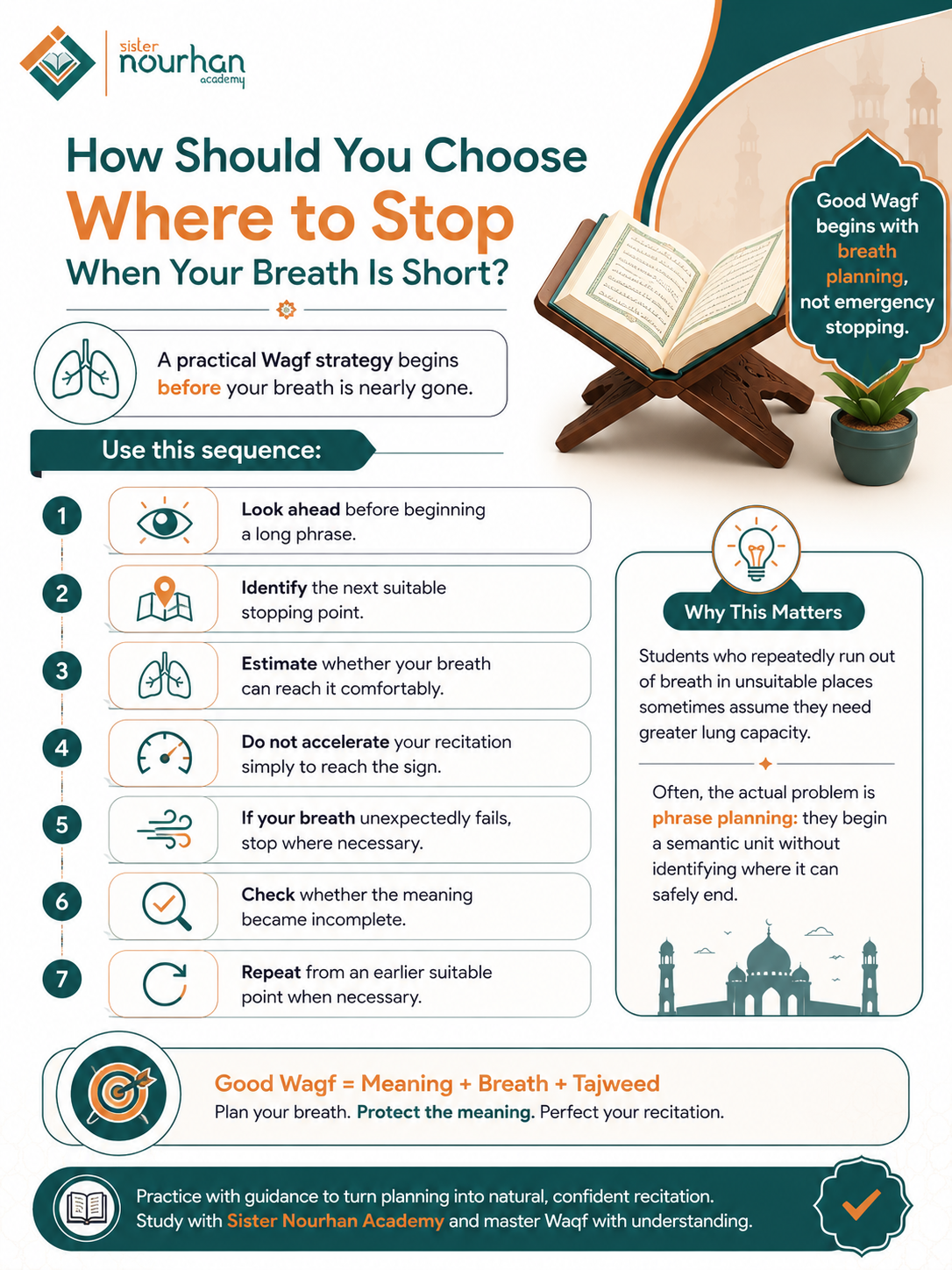
Students who repeatedly run out of breath in unsuitable places sometimes assume they need greater lung capacity. Often, the actual problem is phrase planning: they begin a semantic unit without identifying where it can safely end.
Common Mistakes When Applying Waqf Rules in Tajweed
One of the biggest mistakes is treating every printed Waqf sign as an absolute command. Signs such as ج, قلى, and صلى express different degrees of preference rather than one identical instruction.
Another mistake is stopping simply because the reader needs air without considering the meaning. Breath is necessary, but experienced recitation involves planning breaths around meaningful units.
Students may also confuse م with the academic category Waqf Taam, or interpret لا as though Unavoidable/Compulsory Stop there were sinful. These classifications need to be understood within the science of recitation rather than reduced to “allowed versus forbidden.”
Finally, do not learn Waqf entirely by sight. A student can memorize every symbol yet still struggle when reciting passages continuously. The skill becomes reliable only when visual recognition, meaning, breath control, and correct stopping pronunciation operate together.
See our teaching methods
Experience the quality of our instruction firsthand by watching a live lesson snippet below.
Begin Your Quranic Journey
Connect with the words of Allah through personalized sessions at Sister Nourhan Academy.
Book Your Free TrialStart Applying Waqf Rules Correctly With Sister Nourhan Academy
Reading about Waqf rules in Quran teaches you what the signs mean. Hearing whether your pauses preserve the meaning while maintaining correct Tajweed requires guided recitation practice.
Study with Sister Nourhan Academy and receive direct correction on stopping positions, final-word pronunciation, breath planning, and Tajweed application within real Quran passages.
Discover our Tajweed Courses

Conclusion
The rules of Waqf in Quran protect meaning by guiding the reciter toward appropriate stopping positions. The four general types are Idtirari, Ikhtibari, Intizari, and Ikhtiyari, while voluntary Waqf is further evaluated as Taam, Kafi, Hasan, or Qabih.
For everyday recitation, learn the major Mushaf signs first: م, لا, ج, قلى, صلى, paired stopping dots, and Saktah. Then move beyond symbol recognition and practice what happens to the final word when you actually stop.
The most reliable habit is simple: read for meaning, plan your breath before it becomes urgent, and never choose a stopping point solely because it is convenient.
FAQs About Waqf Rules in Quran
What is Waqf in Tajweed?
Waqf in Tajweed is cutting the voice on a Quranic word for enough time to breathe, with the intention of continuing the recitation. Its rules help the reader stop without damaging or leaving the intended meaning incomplete.
What are the four general types of Waqf in the Quran?
The four general types are Waqf Idtirari, Ikhtibari, Intizari, and Ikhtiyari. They describe stopping because of necessity, testing, Qira'at study, or deliberate choice respectively.
What are the four types of Waqf Ikhtiyari?
The four types of voluntary Waqf are Taam, Kafi, Hasan, and Qabih. They are distinguished primarily by whether the meaning is complete and how the passage relates to what follows.
What does م mean in the Quran?
The symbol م marks Waqf Lazim, indicating a position where stopping is strongly required by the Mushaf notation to prevent an incorrect connection in meaning.
What does لا mean in Quran recitation?
The symbol لا tells the reader not to deliberately stop at that location because the meaning remains connected. If breath forces a stop, return to an appropriate earlier point when necessary.
What is the difference between Waqf and Saktah?
Waqf is a stop in which the reader may take a breath, while Saktah is a brief pause without breathing. Therefore, a Saktah sign should not be treated like an ordinary stopping point.