
Idgham with ghunnah & without ghunnah are two essential Tajweed rules that explain what happens when a Noon Sakinah (نْ) or Tanween (ــًــٍــٌ) is followed by one of the six Idgham letters.
Instead of pronouncing the Noon Sakinah or Tanween separately, the sound merges into the following letter. The key difference is simple: Idgham with Ghunnah keeps a nasal sound, while Idgham without Ghunnah does not.
Learning the letters alone is not enough. You also need to recognize the rule inside a Quranic phrase and train your tongue to move directly into the following letter without accidentally adding or removing Ghunnah.
This guide explains both types, their letters, Quranic examples, pronunciation, important exceptions, and the easiest way to tell them apart while reciting.
Introduction To Idgham With Ghunnah & Without Ghunnah
Idgham is the merging of a sakin letter into the moving letter that follows it so that the two are pronounced as one intensified sound.
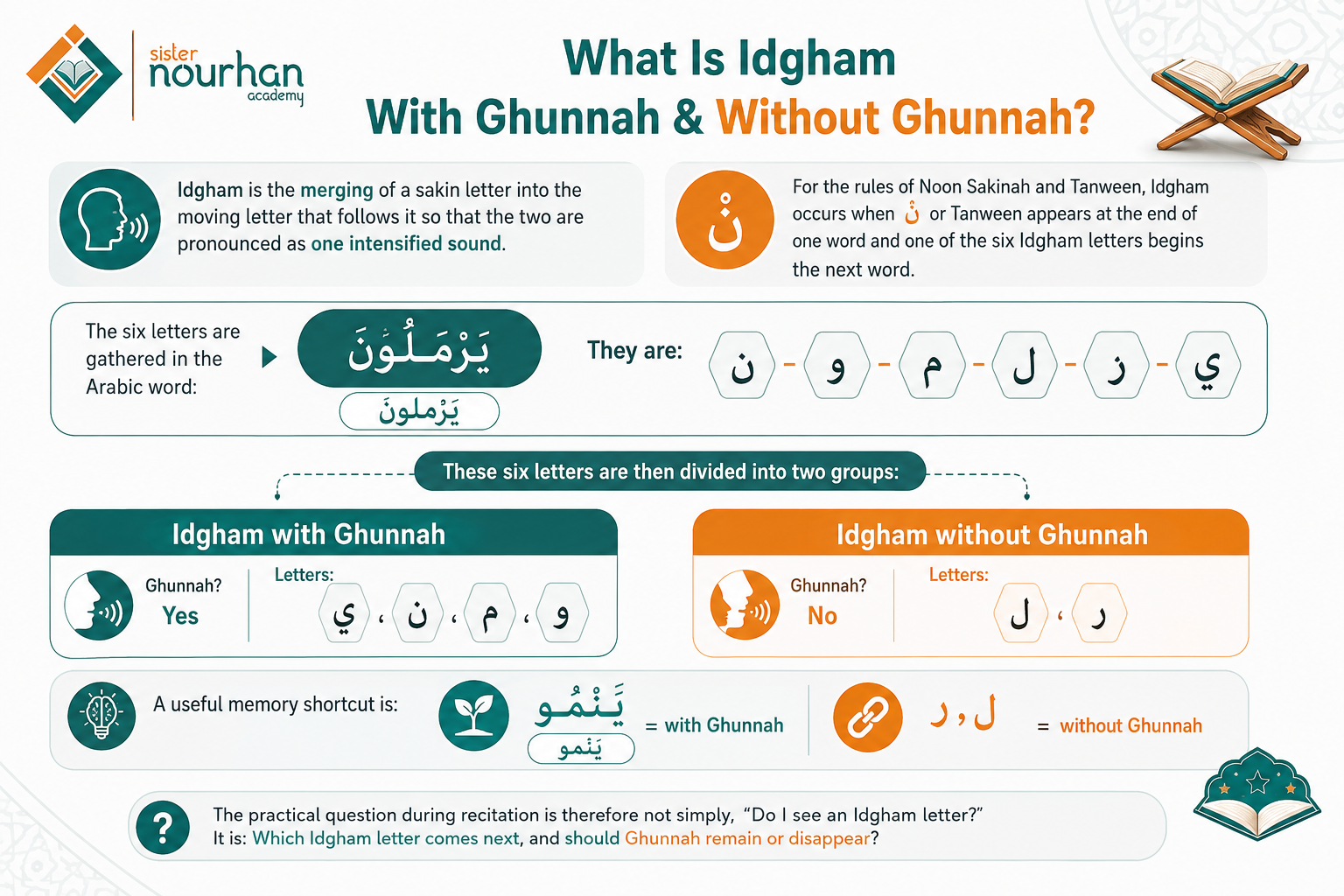
For the rules of Noon Sakinah and Tanween, Idgham occurs when نْ or Tanween appears at the end of one word and one of the six Idgham letters begins the next word.
The six letters are gathered in the Arabic word:
يَرْمَلُون — يرملون
They are:
ي – ر – م – ل – و – ن
These six letters are then divided into two groups:
A useful memory shortcut is:
يَنْمُو — ينمو = with Ghunnah
ل، ر = without Ghunnah
The practical question during recitation is therefore not simply, “Do I see an Idgham letter?” It is: Which Idgham letter comes next, and should Ghunnah remain or disappear?
What Is Ghunnah in Tajweed?
Ghunnah is a nasal sound associated particularly with the letters Noon (ن) and Meem (م) and produced through the nasal passage.
In Idgham with Ghunnah, this nasal quality is maintained during the merging and is held for approximately two counts (harakat).
You should not create Ghunnah simply by holding the vowel longer. The sound needs to resonate through the nasal passage while the mouth prepares to articulate the following letter.
A useful self-check is to recite the example slowly. If blocking the nose noticeably interrupts the Ghunnah sound, you are producing nasal resonance rather than merely stretching the vowel.
What Is Idgham Bighunnah?
Idgham Bighunnah is the merging of Noon Sakinah or Tanween into one of the letters ي، ن، م، و while maintaining Ghunnah for two counts.
“Bi Ghunnah” literally means “with Ghunnah.”
What Are the Idgham With Ghunnah Letters?
The Idgham with Ghunnah letters are:
ي — Yaa
ن — Noon
م — Meem
و — Waw
They are conveniently collected in the word:
يَنْمُو — Yanmu
When Noon Sakinah or Tanween is followed by any of these four letters in the following word, the Noon or Tanween merges into that letter with Ghunnah.
Idgham Maal Ghunnah Examples
Here are clear Idgham with Ghunnah examples from the Quran:
Consider:
مَنْ يَعْمَلْ
The Noon Sakinah at the end of مَنْ is followed by Yaa at the beginning of يَعْمَلْ. You should not pronounce a separate, clear “n” before the Yaa.
Instead, merge smoothly into the Yaa while keeping the Ghunnah.
This is an area where written explanations can only take you so far. Tajweed becomes much easier when a teacher can hear whether your Ghunnah is too short, exaggerated, or coming from the wrong place.
Sister Nourhan Academy offers live Quran instruction with direct recitation correction and personalized Tajweed practice.
Shots from Our Classes
Take a moment to view the video below to see how our teachers provide clear, supportive corrections during a session.
Begin Your Quranic Journey
Connect with the words of Allah through personalized sessions at Sister Nourhan Academy.
Book Your Free TrialWhat Is the Difference Between Complete and Incomplete Idgham With Ghunnah?
Idgham Bighunnah can be understood more precisely by looking at what happens to the original Noon sound.
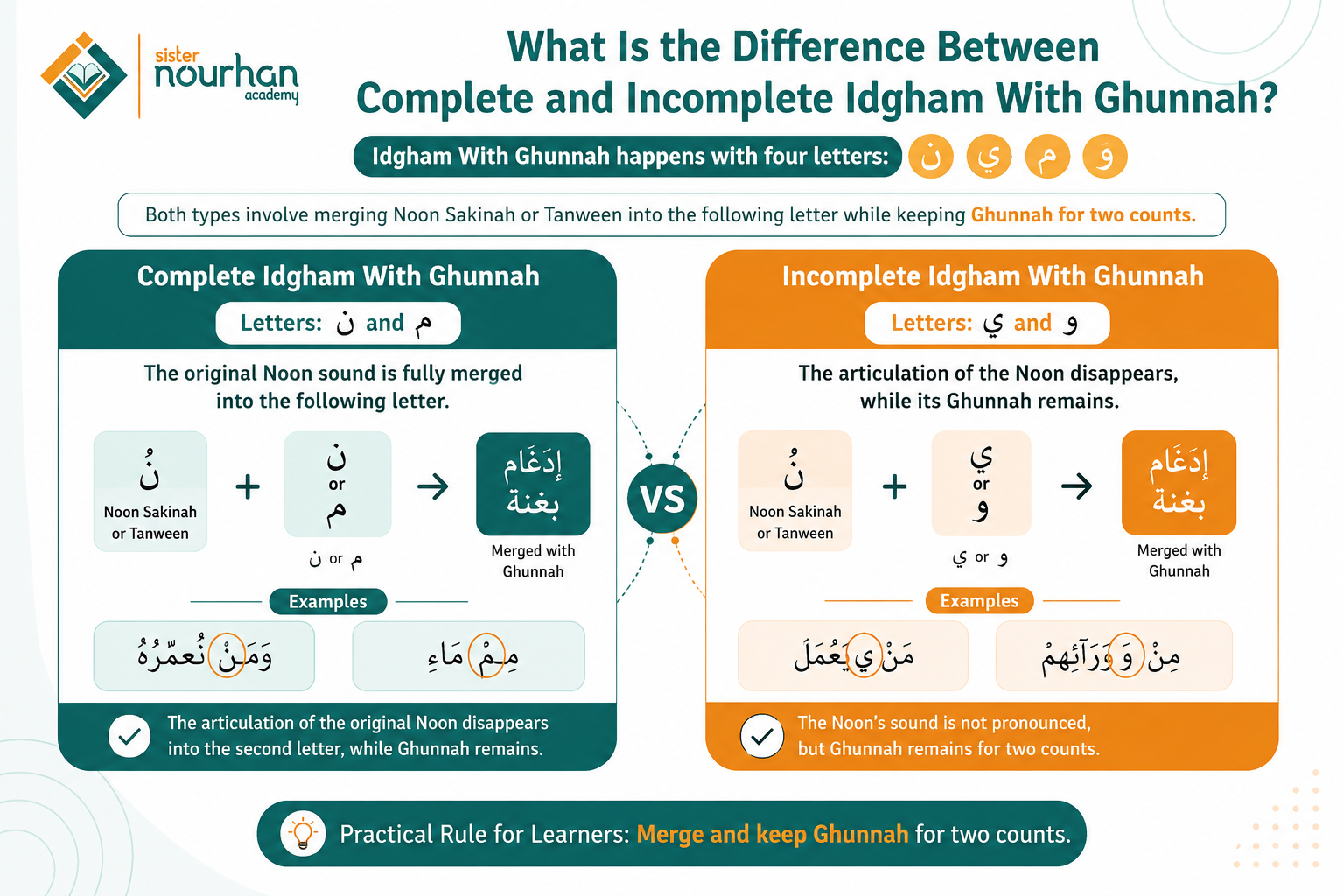
Complete Idgham With Ghunnah: ن and م
When Noon Sakinah or Tanween is followed by ن or م, the first sound is fully merged into the following letter.
Examples include:
وَمَنْ نُعَمِّرْهُ
مِنْ مَاءٍ
The articulation of the original Noon disappears into the second letter, while Ghunnah remains as part of the merged pronunciation.
Incomplete Idgham With Ghunnah: ي and و
When Noon Sakinah or Tanween is followed by ي or و, it is traditionally described as incomplete Idgham because the articulation of the Noon disappears while its characteristic Ghunnah remains.
Examples include:
مَنْ يَعْمَلْ
مِنْ وَرَائِهِمْ
For learners, the most practical rule is unchanged: merge and keep Ghunnah for two counts.
What Is Idgham Without Ghunnah?
Idgham without Ghunnah is the complete merging of Noon Sakinah or Tanween into Laam or Raa without retaining the nasal Ghunnah sound.
It is also known as:
Idgham Bila Ghunnah — إدغام بلا غنة
The word بلا means “without,” so the name itself tells you exactly how to recite the rule.
What Are the Idgham Without Ghunnah Letters?
The Idgham without Ghunnah letters are only:
ل — Laam
ر — Raa
If either letter follows Noon Sakinah or Tanween across two words, the Noon sound merges completely into the Laam or Raa.
No Ghunnah should remain.
Idgham Without Ghunnah Examples
For example:
مِنْ رَبِّهِمْ
Do not pronounce it as a clear min rabbihim with an audible Noon between the words.
The Noon merges into the Raa, so the recitation transitions directly into the intensified Raa without Ghunnah.
Likewise:
غَفُورٌ رَحِيمٌ
The Tanween before Raa disappears into the following Raa rather than being pronounced as a separate “n” sound.
Students sometimes remember that Idgham means “merge” but forget to distinguish nasal merging from non-nasal merging. Live correction is especially useful here because an unwanted Ghunnah can be subtle to the person producing it.
Sister Nourhan Academy's Tajweed lessons emphasize practical application through live recitation rather than memorizing terminology in isolation.
Read also: 7 Practical Steps to Teach Tajweed Successfully to Children
Idgham With Ghunnah vs Idgham Without Ghunnah
The simplest way to remember the rule is to compare both forms directly.
A quick decision process during recitation is:
Find Noon Sakinah or Tanween.
Look at the first letter of the following word.
If it is ي ن م و, merge with Ghunnah.
If it is ل ر, merge without Ghunnah.
If it is another letter, a different Noon Sakinah or Tanween rule applies.
Idgham Normally Occurs Between Two Words
One of the most important details beginners miss is that the Idgham of Noon Sakinah normally occurs across two separate words.
For example:
مِنْ + مَاءٍ
The Noon Sakinah appears at the end of the first word, while Meem starts the second word.
However, if Noon Sakinah and Yaa or Waw occur inside the same word, this Noon is pronounced clearly rather than merged. This is known as Izhar Mutlaq.
The commonly taught Quranic words are:
الدُّنْيَا
بُنْيَان
صِنْوَان
قِنْوَان
This exception prevents a common beginner mistake: seeing نْ + ي or نْ + و and applying Idgham automatically without first checking the word boundary.
What Is the Exception in “Man Raq” (مَنْ رَاقٍ)?
The phrase:
مَنْ ۜ رَاقٍ
in Surah Al-Qiyamah is an important exception in the recitation of Hafs.
Ordinarily, Noon Sakinah followed by Raa would produce Idgham without Ghunnah. Here, however, a prescribed Saktah—a brief pause without taking a breath—separates the sounds.
Therefore, the Noon is heard distinctly rather than merged into the Raa.
This example teaches a broader Tajweed principle: do not apply a rule from letter recognition alone. Quranic recitation signs and the specific narration being read also matter.
How to Practice Idgham With and Without Ghunnah
Reading the definition once will not train the mouth. Practice should move from recognition to controlled repetition and finally to natural recitation.
Identify the Noon Sakinah or Tanween. Do not start by searching randomly for Idgham letters.
Check the next letter. Decide whether it belongs to ينمو or ل، ر.
Say the two words slowly together. Avoid inserting a pause between them.
For ينمو, maintain Ghunnah for two counts. Keep it controlled rather than exaggerated.
For ل and ر, remove the nasal sound. Move directly into the following letter.
Repeat the complete Quranic phrase. Tajweed must eventually work naturally inside continuous recitation.
Compare yourself with a qualified reciter or teacher. Many Ghunnah errors are easier to hear from another person than from yourself.
Practitioner note: do not practice the wrong pronunciation dozens of times hoping it will eventually improve. Repetition strengthens whatever sound you repeat—including mistakes.
See our teaching methods
Experience the quality of our instruction firsthand by watching a live lesson snippet below.
Begin Your Quranic Journey
Connect with the words of Allah through personalized sessions at Sister Nourhan Academy.
Book Your Free TrialStart Practicing Tajweed With Live Correction
Understanding Idgham with Ghunnah & without Ghunnah on paper is only the first step. The real goal is to recognize each rule instantly and produce it correctly while reciting without interrupting your flow.
At Sister Nourhan Academy, students can practice Tajweed through live online Quran lessons with direct correction, structured learning, and personalized guidance suited to their current level.
Discover our Tajweed Courses

Conclusion
Idgham with Ghunnah and Idgham without Ghunnah differ primarily in whether the nasal Ghunnah sound remains after Noon Sakinah or Tanween merges into the following letter.
Remember ينمو for Idgham with Ghunnah and ل، ر for Idgham without Ghunnah.
Then train yourself to check three things every time: the Noon or Tanween, the following letter, and whether the two sounds occur across separate words. Once that recognition becomes automatic, Idgham begins to sound natural rather than like a rule you are consciously trying to remember.
FAQs
What are the Idgham with Ghunnah letters?
The Idgham with Ghunnah letters are ي، ن، م، و, collected in the word ينمو. When one follows Noon Sakinah or Tanween across two words, the sounds merge while Ghunnah is maintained for two counts.
What are the Idgham without Ghunnah letters?
The Idgham without Ghunnah letters are Laam (ل) and Raa (ر). Noon Sakinah or Tanween merges completely into them without retaining a nasal Ghunnah sound.
What is an Idgham with Ghunnah example?
مَنْ يَعْمَلْ is an Idgham with Ghunnah example. Noon Sakinah is followed by Yaa, so the Noon merges into the Yaa while Ghunnah is maintained.
What is an Idgham without Ghunnah example?
مِنْ رَبِّهِمْ is an Idgham without Ghunnah example. Noon Sakinah is followed by Raa, so the Noon merges completely into the Raa without Ghunnah.
How many letters of Idgham are there?
There are six Idgham letters for Noon Sakinah and Tanween: ي، ر، م، ل، و، ن, gathered in the word يرملون. Four require Ghunnah and two do not.
Does Idgham happen inside the same word?
Normally, the Idgham of Noon Sakinah and Tanween discussed here occurs between two words. In words such as الدنيا، بنيان، صنوان، قنوان, the Noon is pronounced clearly instead; this is known as Izhar Mutlaq.