

Every time you recite the Quran, idgham shapes the way dozens of words sound — yet most beginners never learn to recognise it until they start formal Tajweed study.
Idgham is one of the four core rules governing Noon Sakinah and Tanween, and it is the one responsible for that smooth, flowing merge you hear when skilled reciters move between certain words without any break.
Get idgham right, and your recitation gains a natural, connected quality. Apply it inconsistently — or confuse it with ikhfa or izhar — and the flow breaks down.
This guide covers the full picture: idgham meaning, all six letters, both types, real Quran examples for every letter, the important exception, and the common mistakes to avoid.
What Is Idgham in Tajweed?
Idgham (إدغام) literally means “merging,” “assimilation,” or “integration.” The Arabic word comes from the root د-غ-م, which carries the meaning of inserting one thing into another or combining two things until they become one.
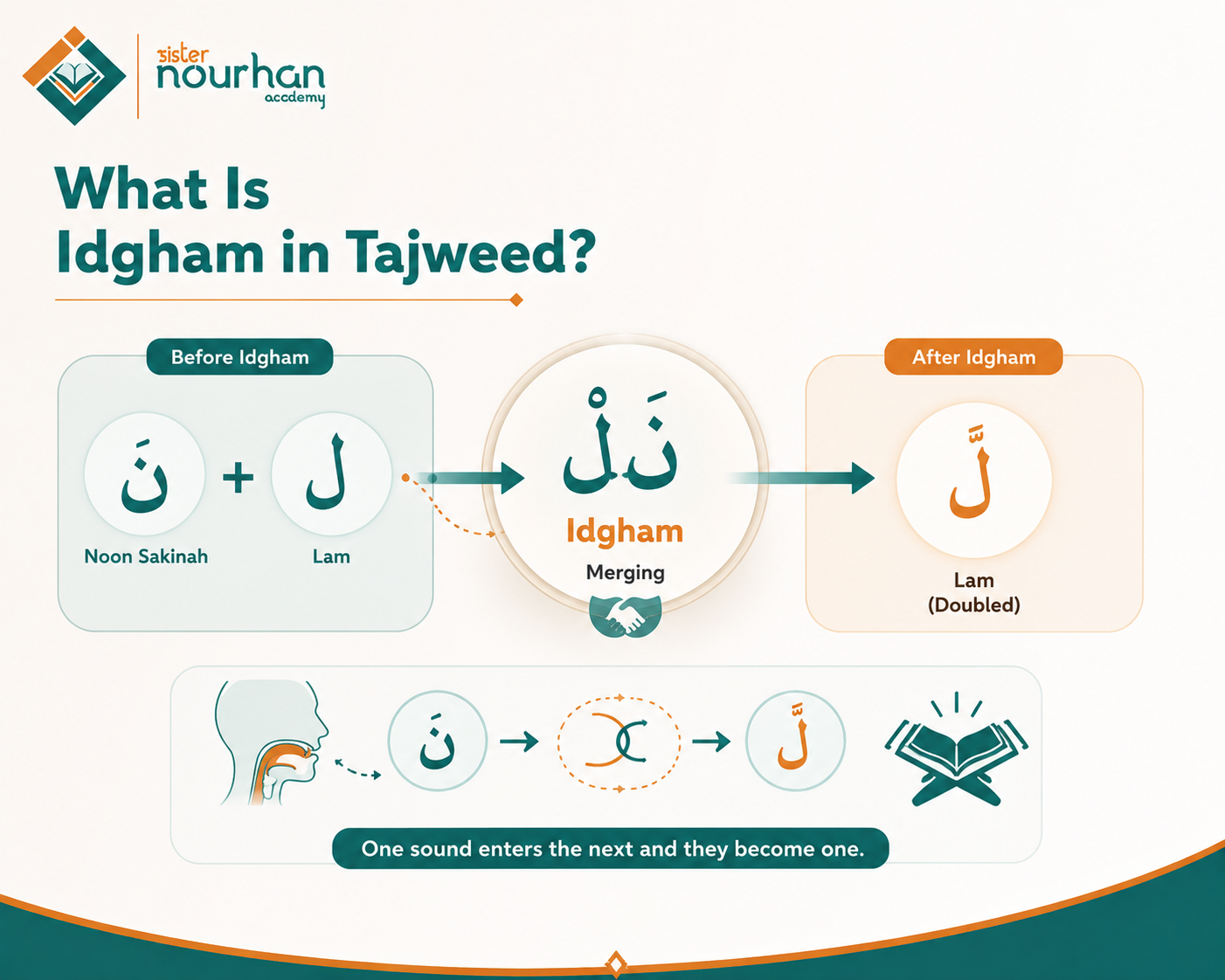
In Tajweed, Idgham is the complete merging of a Noon Sakinah (نْ) or Tanween (ً ٍ ٌ) into the letter that immediately follows it. The first sound is absorbed into the second, causing the following letter to be pronounced as a doubled (mushaddad) letter.
In practical terms, instead of pronouncing the Noon Sakinah or Tanween separately, its sound merges smoothly into the next letter. This removes phonetic difficulty between the two sounds and creates a more natural, continuous flow in Quranic recitation.
So, the simplest way to understand Idgham is: one sound enters the next until they are pronounced together as a single reinforced sound.
What Is the Idgham Rule in Tajweed?
The Idgham rule applies when a Noon Sakinah (نْ) or Tanween (ً ٍ ٌ) at the end of a word is immediately followed by one of the six Idgham letters at the beginning of the next word:
ي ر م ل و ن — يَرْمَلُون
When these two conditions occur, the Noon Sakinah or Tanween merges into the following letter instead of being pronounced separately. The following letter is therefore treated as a doubled (mushaddad) sound.
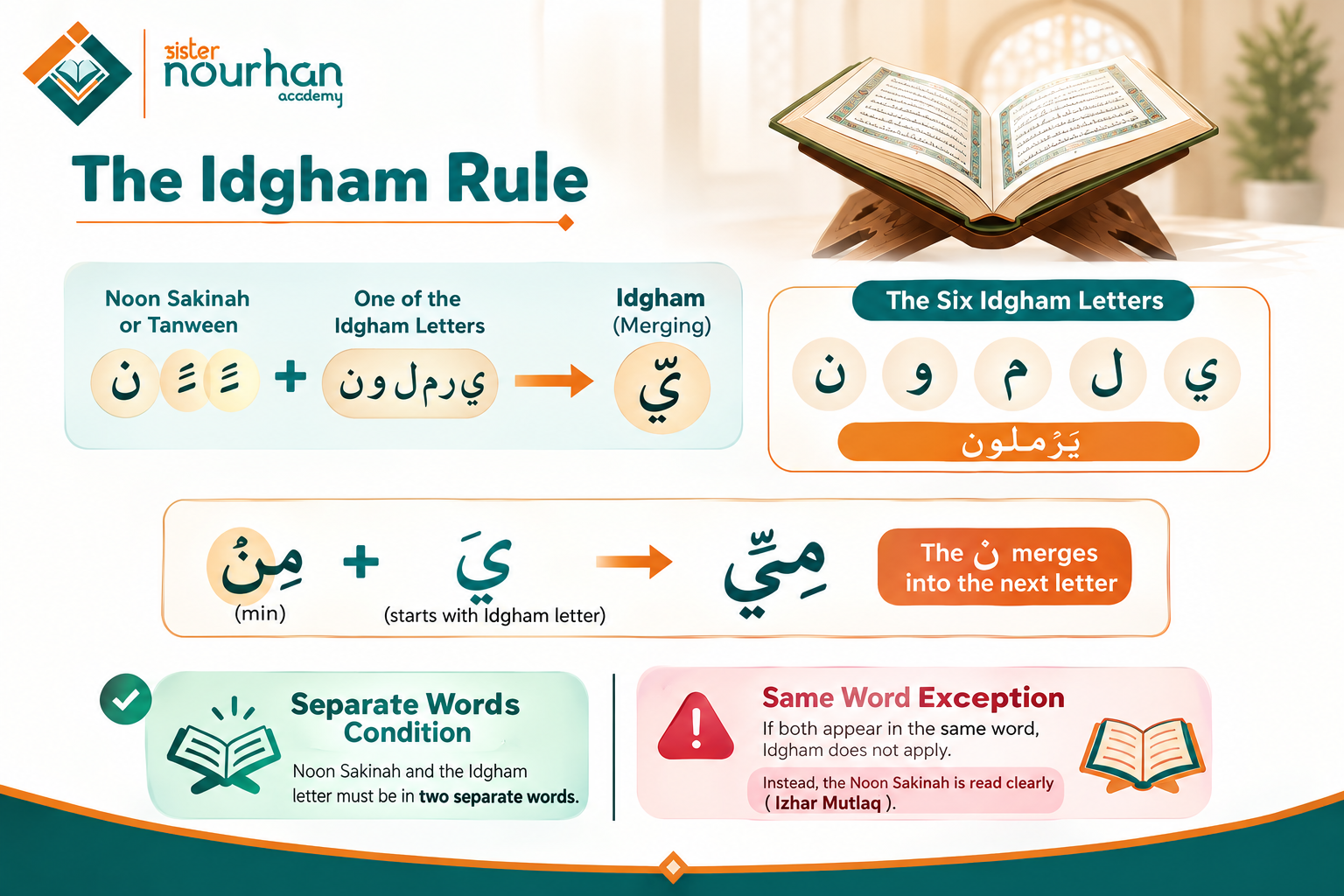
For example, when مِنْ is followed by a word beginning with an Idgham letter, the final نْ may merge into that letter according to the applicable type of Idgham.
A key condition of Idgham is that the Noon Sakinah and the Idgham letter must occur in two separate words. If both appear within the same word, Idgham does not apply. Instead, the Noon Sakinah is pronounced clearly according to Izhar Mutlaq (إظهار مطلق).
This exception occurs in specific Quranic words and is important for distinguishing true Idgham from letter combinations that may appear similar.
What Are the 6 Letters of Idgham?
There are exactly six idgham letters in tajweed. Classical scholars arranged them into the mnemonic word يَرْمَلُونَ (Yarmaloon) so that students could memorise them as a single unit.
Four of the six letters require a nasal hum (ghunnah) during the merge. Two require an instant, silent absorption with no nasal sound. This distinction defines the two types of idgham.
Sister Nourhan Academy's Al-Azhar Tajweed programme trains students to recognise all six combinations automatically during live recitation — not just in isolated drills — through structured practice with ijazah-certified instructors.

What Are the Types of Idgham?
Idgham is divided into two types depending on whether Ghunnah (غنّة) is maintained during the merge. Idgham With Ghunnah uses four letters, while Idgham Without Ghunnah uses two.
1. Idgham With Ghunnah (إدغام بغنة)
Idgham Bi Ghunnah occurs when Noon Sakinah (نْ) or Tanween (ً ٍ ٌ) is followed by one of four letters:
ي ن م و — يَنْمُو (Yanmoo)
In this type, the Noon Sakinah or Tanween merges into the following letter while a Ghunnah is maintained for two counts. The nasal resonance comes from the nasal passage (Al-Khayshum) and should be clearly heard during the merge.
Correct Application: Merge smoothly into the following letter while holding the Ghunnah for two counts. Omitting the Ghunnah is a Tajweed error.
2. Idgham Without Ghunnah (إدغام بغير غنة)
Idgham Bila Ghunnah occurs when Noon Sakinah or Tanween is followed by:
ل (Laam) or ر (Ra)
Here, the Noon Sakinah or Tanween is completely absorbed into the Laam or Ra without any nasal sound.
Correct Application: Move directly from the Noon Sakinah or Tanween into a reinforced Laam or Ra, with no Ghunnah or pause between the two sounds.
The key distinction is simple: ي ن م و merge with Ghunnah, while ل ر merge without Ghunnah.
Begin Your Quranic Journey
Connect with the words of Allah through personalized sessions at Sister Nourhan Academy.
Book Your Free TrialIdgham Letters and Examples in the Quran
The six Idgham letters are ي، ن، م، و، ل، ر. The first four (يَنْمُو) are pronounced with Ghunnah, while ل and ر are pronounced without Ghunnah. The following examples show how each letter works with Noon Sakinah and Tanween.
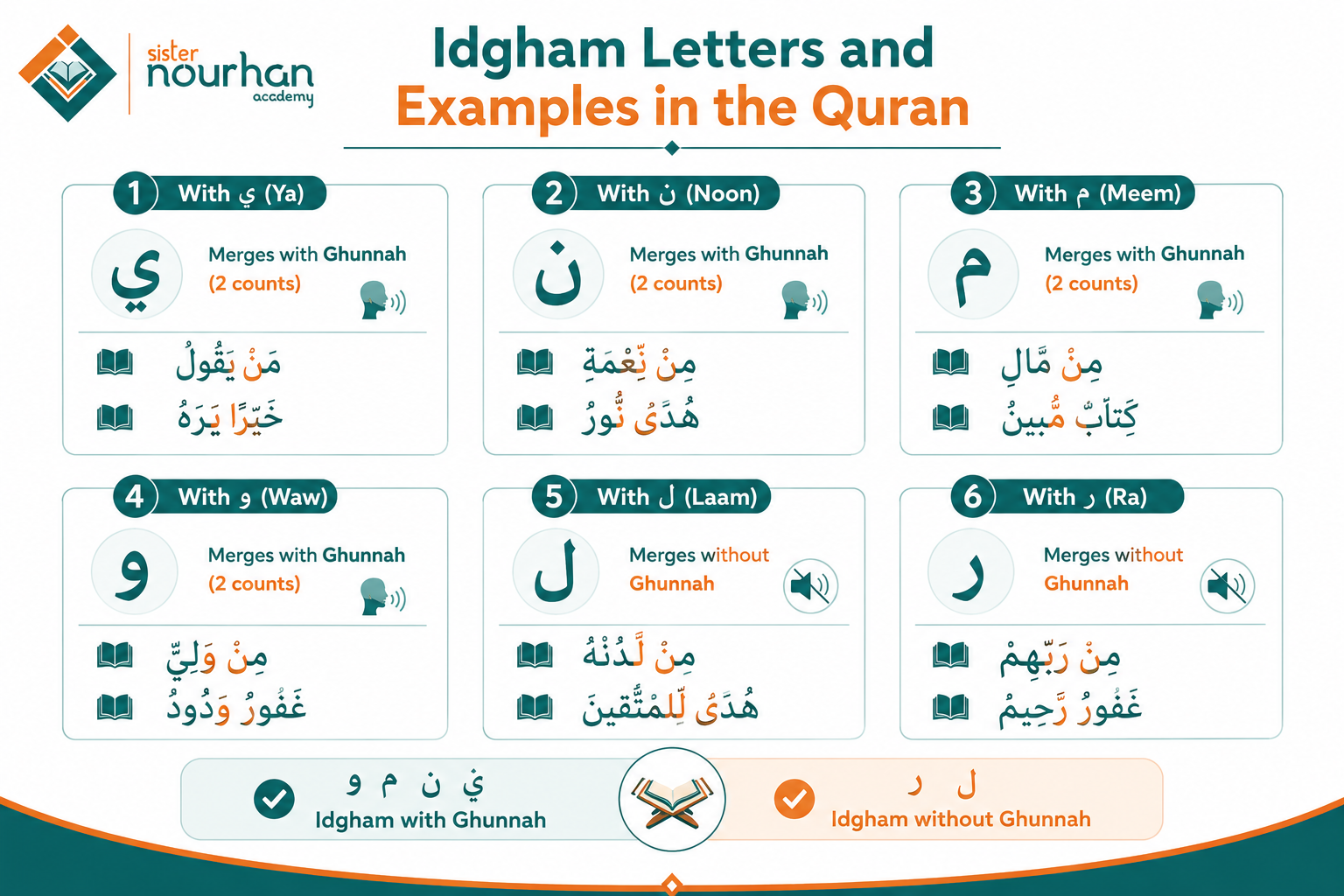
Idgham With ي (Ya)
When Noon Sakinah or Tanween is followed by ي, it merges into the Ya with a Ghunnah held for two counts.
مَن يَقُولُ — the Noon Sakinah merges into ي with Ghunnah.
خَيْرًا يَرَهُ — Surah Az-Zalzalah (99:7): the Tanween merges into ي with Ghunnah.
Idgham With ن (Noon)
When followed by ن, the Noon Sakinah or Tanween merges into the following Noon, producing a doubled Noon with two counts of Ghunnah.
مِن نِّعْمَةٍ — the first Noon merges into the following Noon.
هُدًى نُّورٌ — the Tanween merges into ن with Ghunnah.
Idgham With م (Meem)
When followed by م, the Noon Sakinah or Tanween merges into the Meem with two counts of Ghunnah.
مِن مَّالٍ — the Noon merges completely into م.
كِتَابٌ مُّبِينٌ — the Tanween merges into م with Ghunnah.
Idgham With و (Waw)
When followed by و, the Noon Sakinah or Tanween merges into the Waw while maintaining Ghunnah for two counts.
مِن وَّلِيٍّ — the Noon merges into و with Ghunnah.
غَفُورٌ وَدُودٌ — the Tanween merges into و with Ghunnah.
Idgham With ل (Laam)
When followed by ل, the Noon Sakinah or Tanween merges completely into the Laam without Ghunnah.
مِن لَّدُنْهُ — the Noon merges into ل without a nasal sound.
هُدًى لِّلْمُتَّقِينَ — Surah Al-Baqarah (2:2): the Tanween merges into ل without Ghunnah.
Idgham With ر (Ra)
When followed by ر, the Noon Sakinah or Tanween merges completely into the Ra without Ghunnah.
مِن رَّبِّهِمْ — the Noon merges into ر without Ghunnah.
غَفُورٌ رَّحِيمٌ — the Tanween merges into ر without Ghunnah.
A simple way to remember the distinction is:
ي ن م و = Idgham with Ghunnah
ل ر = Idgham without Ghunnah
Read also: What is Idgham Shafawi in Tajweed?
When Does Idgham Not Apply?
The most important exception in the idgham rule: if the Noon Sakinah and the idgham letter appear inside the same word, idgham does not apply. Instead, you pronounce the noon clearly — this is Izhar.
There are four specific words in the Quran where this exception occurs, and they appear repeatedly:
Why no idgham here? Merging the noon into the following letter within a single word would alter the word's established pronunciation and potentially distort its meaning.
The idgham rule was designed to operate across word boundaries. Within one word, the letters have a fixed, preserved pronunciation.
A reliable working rule: if it is written as one word in the mushaf, treat the noon as izhar. If the noon ends one word and the idgham letter begins the next, apply idgham.
Read also: What Is Izhar Halqi?
Complete and Incomplete Idgham
Idgham can also be classified as complete (Kamil) or incomplete (Naqis) according to whether both the letter and its characteristics are fully absorbed into the following letter.
Complete Idgham (Idgham Kamil)
Complete Idgham occurs with ن (Noon), م (Meem), ل (Laam), and ر (Ra). In this type, the Noon Sakinah or Tanween is completely absorbed into the following letter.
With ن and م, the merger is accompanied by Ghunnah for two counts, while with ل and ر, the merger occurs without Ghunnah.
Incomplete Idgham (Idgham Naqis)
Incomplete Idgham occurs with ي (Ya) and و (Waw). The Noon Sakinah or Tanween merges into the following letter, but the Ghunnah remains as a characteristic of the original Noon sound.
The reciter does not pronounce a separate Noon; instead, the merge is accompanied by a clear Ghunnah held for two counts.
This distinction is particularly useful in advanced Tajweed study. For practical recitation, remember:
ن، م → Complete Idgham with Ghunnah
ل، ر → Complete Idgham without Ghunnah
ي، و → Incomplete Idgham with Ghunnah
For students working at this level of detail, Sister Nourhan Academy's Advanced Tajweed Course addresses these precise distinctions under qualified teacher supervision.

Idgham vs. Izhar, Ikhfa, and Iqlab
Idgham is one of four rules that govern Noon Sakinah and Tanween. Knowing where idgham ends and another rule begins prevents the most common misapplication errors.
The key distinction between idgham and ikhfa: ikhfa is not a weak or partial idgham. It is a distinct rule applied to fifteen different letters, and the noon is concealed — not merged.
In ikhfa, the noon's articulation point is released but the sound is not fully absorbed into the next letter. Treating ikhfa as "almost idgham" is one of the most persistent errors at the intermediate level.
Read also: What are the rules of Ikhfaa Shafawi?
Common Mistakes When Applying Idgham
Understanding the most common Idgham mistakes helps learners apply the rule correctly and avoid pronunciation habits that can affect the accuracy of Quran recitation.
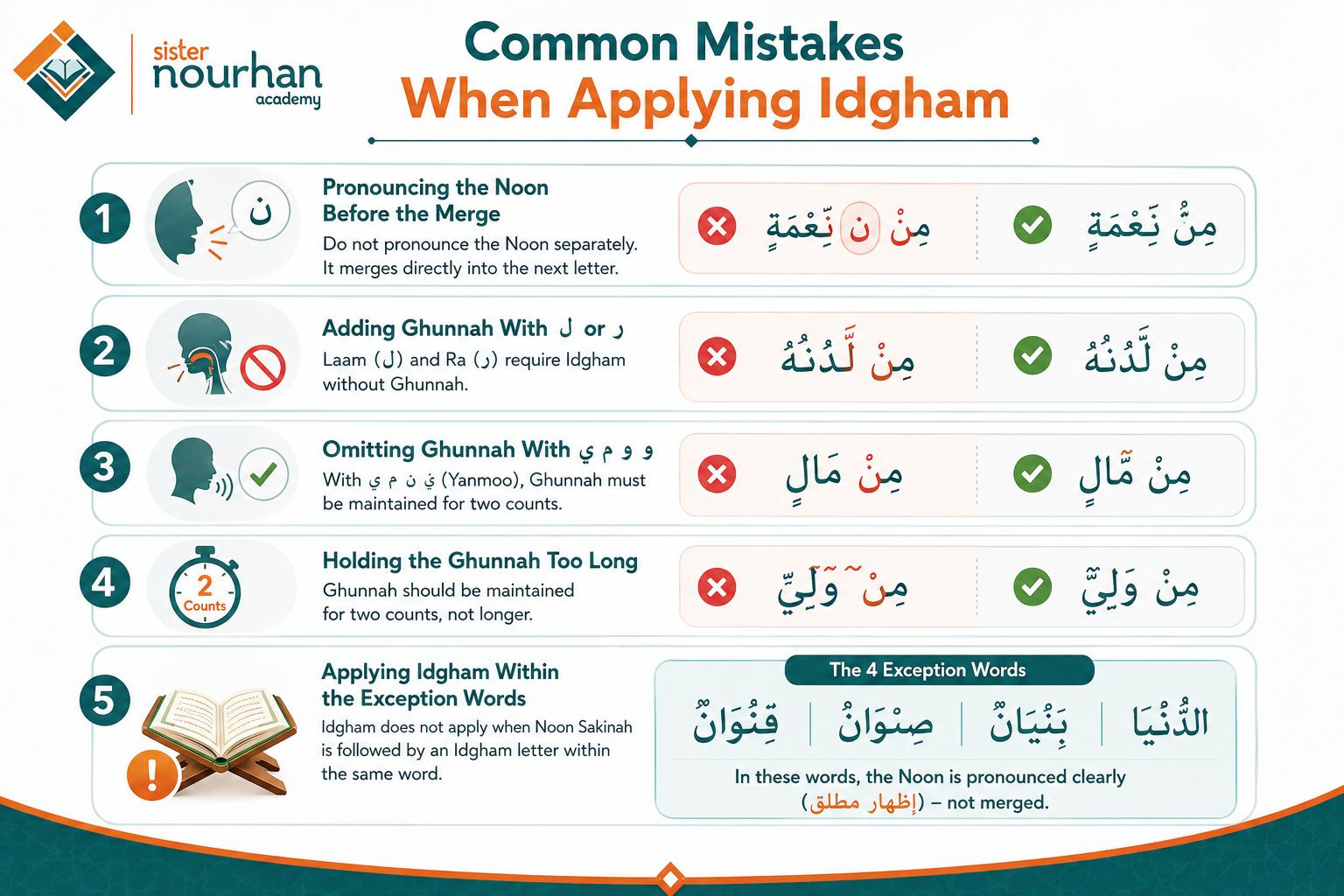
1. Pronouncing the Noon Before the Merge
A common mistake is pronouncing part of the Noon Sakinah before merging into the next letter. In Idgham, the Noon should not be pronounced separately; it merges directly into the following letter.
2. Adding Ghunnah With ل or ر
Laam (ل) and Ra (ر) require Idgham without Ghunnah. Adding nasal resonance when merging into either letter is incorrect.
3. Omitting Ghunnah With ي ن م و
With the letters ي ن م و (Yanmoo), Ghunnah must accompany the merge. It should be maintained for two counts rather than disappearing with the Noon sound.
4. Holding the Ghunnah Too Long
Ghunnah should be maintained for two counts. Extending it beyond the required duration can disrupt the correct timing and flow of recitation.
5. Applying Idgham Within the Exception Words
Idgham does not apply when Noon Sakinah is followed by an Idgham letter within the same word. The four well-known Quranic exceptions are:
الدُّنْيَا — بُنْيَانٌ — صِنْوَانٌ — قِنْوَانٌ
In these words, the Noon is pronounced clearly according to Izhar Mutlaq (إظهار مطلق) rather than being merged.
How to Practice Idgham Correctly in Quran Recitation
Knowing the Idgham letters is only the beginning. To apply the rule correctly, you need to recognize Noon Sakinah and Tanween quickly, identify the following letter, distinguish between the two types of Idgham, and practice merging the sounds smoothly.
1. Identify Noon Sakinah or Tanween Before Applying Idgham
While reading, first look for Noon Sakinah (نْ) or one of the three Tanween signs (ً ٍ ٌ). Idgham occurs when one of these is followed by an Idgham letter in the next word.
At first, practice identifying these signs without reciting. This helps train your eyes to recognize potential Idgham positions before focusing on pronunciation.
2. Check the First Letter of the Following Word
Once you find Noon Sakinah or Tanween, immediately check the first letter of the next word.
If that letter is one of the six Idgham letters ي ر م ل و ن, remembered through the word يرملون, Idgham applies. If it is not, another Noon Sakinah or Tanween rule may apply, such as Izhar, Iqlab, or Ikhfa.
3. Merge the Noon or Tanween Into the Idgham Letter
Do not pronounce the Noon Sakinah or Tanween as a completely separate sound. Instead, allow it to merge into the following Idgham letter so the transition between the two words sounds connected and natural.
A common beginner mistake is to pronounce too much of the original ن before beginning the next letter. Practice slowly until the merge becomes smooth.
4. Distinguish Idgham With Ghunnah From Idgham Without Ghunnah
Divide the six Idgham letters into two groups:
ي ن م و (ينمو): Apply Idgham with Ghunnah, maintaining the nasal sound for approximately two counts.
ل ر: Apply Idgham without Ghunnah, merging directly into the following letter without extending a Ghunnah.
Practice the two groups separately so you do not automatically add Ghunnah to every Idgham position.
5. Practice Each Idgham Letter With Quranic Examples
Choose Quranic examples containing each of the six letters and recite them slowly. Focus first on the quality of the merge rather than your recitation speed.
Once you can apply the rule consistently at a slow pace, gradually return to your normal Quran recitation speed.
6. Recite to a Qualified Tajweed Teacher and Correct Subtle Mistakes
Some Idgham mistakes are difficult to detect independently. You may leave part of the Noon sound audible, make the Ghunnah too short or too long, or fail to merge the two sounds completely.
Reciting to a qualified Quran or Tajweed teacher allows these subtle errors to be identified and corrected before they become habits.
Regularly listening to proficient Quran reciters can also strengthen your ability to recognize and reproduce correct Idgham during your own recitation.
See our teaching methods
Experience the quality of our instruction firsthand by watching a live lesson snippet below.
Begin Your Quranic Journey
Connect with the words of Allah through personalized sessions at Sister Nourhan Academy.
Book Your Free TrialLearn Idgham and Tajweed With a Qualified Quran Teacher
Idgham appears throughout the Quran, and applying it correctly requires more than memorizing its letters and types. Consistent practice with a qualified teacher helps you master the correct merging, Ghunnah timing, and pronunciation while correcting mistakes before they become habits.
At Sister Nourhan Academy, students learn Tajweed through structured, teacher-guided lessons with qualified Al-Azhar-affiliated instructors who hold Ijazah certification and have experience teaching non-Arabic speakers at different levels.
Book your class today and start reciting the Quran with greater accuracy and confidence.
Discover our Tajweed Courses

Conclusion
Idgham in Tajweed is the rule that governs the merging of Noon Sakinah or Tanween into one of six specific letters when they appear across a word boundary. The six letters — memorised through يَرْمَلُونَ — split into two groups: four that require a ghunnah (ya, noon, meem, waw) and two that require an instant, silent merge (laam, ra).
The single-word exception is non-negotiable: الدُّنْيَا, بُنْيَانٌ, صِنْوَانٌ, and قِنْوَانٌ are pronounced with a clear noon every time, regardless of the idgham letter that follows.
Mastering both types — holding the ghunnah precisely with yanmoo letters and releasing the noon silently with laam and ra — is what separates hesitant recitation from connected, flowing recitation. It is also what allows every prayer you read to reflect the way the Quran was revealed.
Frequently Asked Questions About Idgham
What is idgham in Tajweed?
Idgham is a Tajweed rule in which a Noon Sakinah or Tanween is completely absorbed into the next letter when that letter is one of six specific Arabic letters. The noon sound disappears and the following letter is pronounced with a doubled, reinforced articulation.
What does idgham mean in English?
Idgham means "merging" or "assimilation" in English. In Tajweed, it describes the process by which one letter is fully inserted into the letter that follows it, creating a single doubled sound.
What is the idgham rule?
The idgham rule states that when a Noon Sakinah or Tanween at the end of a word is followed by one of the letters يرملون at the start of the next word, the noon is fully merged into that letter. The rule does not apply when both letters are inside the same word.
How many letters of idgham are there?
There are six idgham letters: ي (Ya), ر (Ra), م (Meem), ل (Laam), و (Waw), and ن (Noon). They are memorised through the mnemonic word يَرْمَلُونَ (Yarmaloon).
What are the 6 letters of idgham?
The six letters are Ya (ي), Ra (ر), Meem (م), Laam (ل), Waw (و), and Noon (ن) — arranged in the mnemonic يَرْمَلُونَ.
What are the letters of idgham with ghunnah?
The four letters of idgham with ghunnah are Ya (ي), Noon (ن), Meem (م), and Waw (و), grouped under the mnemonic يَنْمُو (Yanmoo). When noon sakinah or tanween precedes any of these, a nasal hum is held for two vowel counts.