

Ikhfa Shafawi is a Tajweed rule that occurs when a Meem Sakinah (مْ) at the end of a word is followed by the letter Baa (ب) at the beginning of the next word. The Meem is concealed rather than pronounced completely clearly or merged, while a full Ghunnah is maintained.
The rule is easy to identify because Baa (ب) is the only Ikhfa Shafawi letter.
However, recognizing مْ + ب is only the first step. Correct application depends on controlling the Ghunnah, coordinating the lips properly, and avoiding the common mistake of turning the concealed Meem into either clear Izhar or complete Idgham.
This guide explains the Ikhfa Shafawi rule, its letter, correct pronunciation, Mushaf sign, Quranic examples, and practical exercises for mastering it.
What Is Ikhfa Shafawi?
Ikhfa Shafawi is the concealment of a Meem Sakinah (مْ) when it is followed by Baa (ب), while retaining a complete Ghunnah and without placing a Shaddah on the Baa.
The basic Ikhfa Shafawi rule can therefore be memorized as:
مْ + ب = إخفاء شفوي
The word Ikhfa (إخفاء) means concealment or hiding. Technically, it describes pronunciation between clear articulation (Izhar) and complete merging (Idgham), without Shaddah and with Ghunnah.
Shafawi (شفوي) means “related to the lips.” It is called Shafawi because the articulation involves the lips: both Meem and Baa are labial letters.
What Are the Ikhfa Shafawi Letters?
There is only one Ikhfa Shafawi letter:
ب — Baa
Whenever you are continuing your recitation and see a Meem Sakinah at the end of one word followed immediately by Baa at the beginning of the next, apply Ikhfa Shafawi.
A useful memory formula is:
Meem Sakinah + Baa = Ikhfa Shafawi
Unlike the well-known Ikhfa rule for Noon Sakinah and Tanween, you do not need to memorize a long list of letters here.
Does Ikhfa Shafawi Occur in One Word?
No. Ikhfa Shafawi occurs across two words: the first word ends with Meem Sakinah and the following word begins with Baa.
For example:
هُم بِـ
The first word ends in Meem Sakinah, while the next begins with Baa.
This two-word test is a useful safeguard because not every visually similar Meem-Baa sequence should automatically be classified as Ikhfa Shafawi.
Why Does Baa Cause Ikhfa Shafawi?
Baa causes Ikhfa Shafawi because Meem and Baa are closely related in articulation: both involve the two lips.
This closeness makes completely separating the two sounds less natural, while they are not identical letters that would merge completely like two Meems.
The result is an intermediate pronunciation: the Meem is concealed with Ghunnah before transitioning into Baa.
Learning Tajweed rules such as Ikhfa Shafawi gives children a stronger foundation for accurate Quran recitation—and that accuracy becomes especially important when they begin memorizing.
With the Hifz for Kids Course at Sister Nourhan Academy, your child can memorize the Quran with structured guidance while strengthening correct pronunciation, Tajweed application, and long-term retention under qualified teachers.
Shots from Our Classes
Take a moment to view the video below to see how our teachers provide clear, supportive corrections during a session.
Begin Your Quranic Journey
Connect with the words of Allah through personalized sessions at Sister Nourhan Academy.
Book Your Free TrialHow Do You Pronounce Ikhfa Shafawi Correctly?
Correct Ikhfaa Shafawi requires more than simply making a nasal sound. The lips, Ghunnah, and transition into Baa must work together.
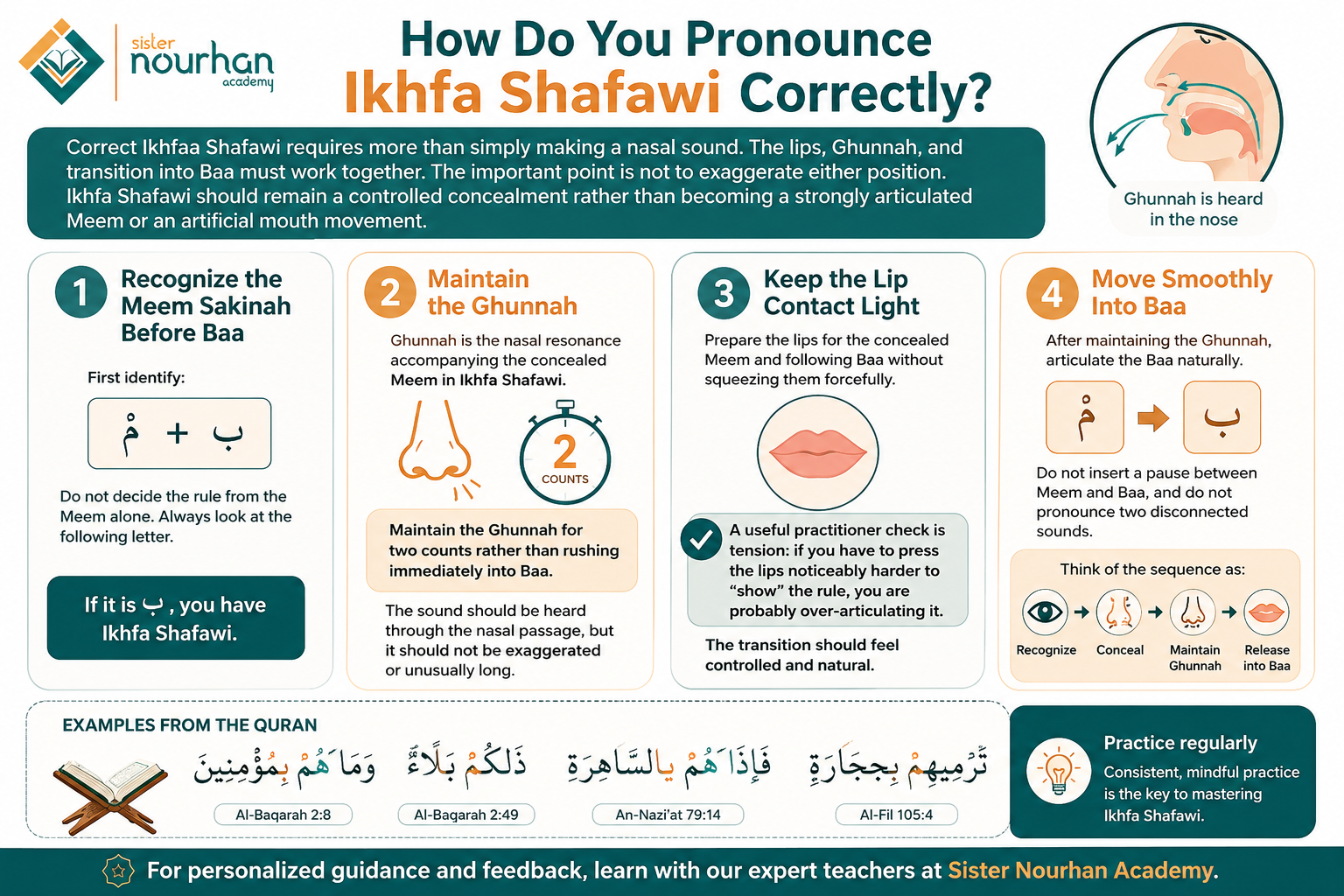
Classical descriptions differ slightly over the precise lip position. One approach describes a very small gap between the lips, while another—and a widely preferred practical approach—uses gentle contact between the lips without excessive pressure.
The important point is not to exaggerate either position. Ikhfa Shafawi should remain a controlled concealment rather than becoming a strongly articulated Meem or an artificial mouth movement.
1. Identify Meem Sakinah Followed by Baa
First identify:
مْ + ب
Do not decide the rule from the Meem alone. Always look at the following letter.
If it is ب, you have Ikhfa Shafawi.
2. Maintain the Ghunnah for Two Counts
Ghunnah is the nasal resonance accompanying the concealed Meem in Ikhfa Shafawi. Maintain the Ghunnah for two counts rather than rushing immediately into Baa.
The sound should be heard through the nasal passage, but it should not become exaggerated or unusually long.
3. Keep the Lip Contact Light and Controlled
Prepare the lips for the concealed Meem and following Baa without squeezing them forcefully.
A useful practitioner check is tension: if you have to press the lips noticeably harder to “show” the rule, you are probably over-articulating it. The transition should feel controlled and natural.
4. Transition Smoothly From the Concealed Meem Into Baa
After maintaining the Ghunnah, articulate the Baa naturally. Do not insert a pause between Meem and Baa, and do not pronounce two disconnected sounds.
Think of the sequence as:
recognize → conceal → maintain Ghunnah → release into Baa
If you want direct feedback on subtle details such as Ghunnah timing and lip position, Sister Nourhan Academy can help you practice Tajweed rules with guided correction rather than relying on written explanations alone.
What Are Some Ikhfa Shafawi Examples in the Quran?
Ikhfa Shafawi examples in Quran occur whenever a word ending in Meem Sakinah is immediately followed by a word beginning with Baa.
The following examples give you several patterns to practice:
When practicing these phrases, isolate only the boundary first—for example, هُم بِ—before returning to the complete Ayah.
This prevents the surrounding words from distracting you while you learn the articulation.
How Can You Recognize Ikhfa Shafawi in the Mushaf?
In common Mushaf notation, a Meem Sakinah undergoing Ikhfa Shafawi may appear without the usual Sukoon sign, while the following Baa remains without a Shaddah.
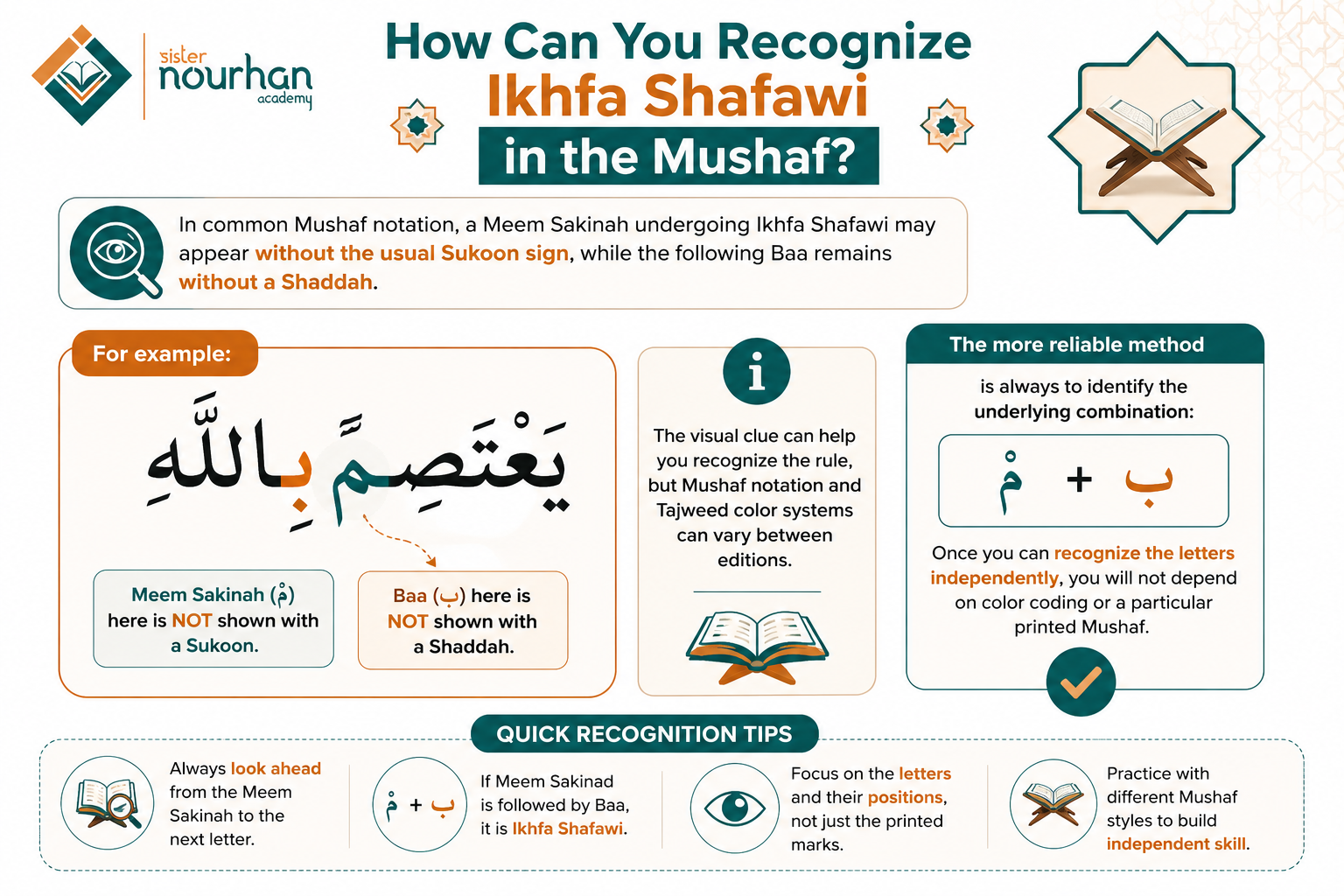
For example:
يَعْتَصِم بِاللَّهِ
The visual clue can help you recognize the rule, but Mushaf notation and Tajweed color systems can vary between editions.
The more reliable method is always to identify the underlying combination:
مْ + ب
Once you can recognize the letters independently, you will not depend on color coding or a particular printed Mushaf.
Read also: What are the rules of Qalqalah?
What Is the Difference Between Ikhfa Shafawi, Idgham Shafawi, and Izhar Shafawi?
The three rules of Meem Sakinah are distinguished primarily by the letter that comes immediately after the Meem.
The fastest decision method is therefore to look one letter ahead.
If you see Baa, conceal. If you see Meem, merge. Otherwise, pronounce the Meem clearly according to Izhar Shafawi.
1- Ikhfa Shafawi vs Idgham Shafawi
Ikhfa Shafawi conceals Meem Sakinah before Baa, while Idgham Shafawi merges Meem Sakinah into another Meem.
Compare:
مْ + ب → Ikhfa Shafawi
مْ + م → Idgham Shafawi
Both involve Ghunnah, which is why beginners sometimes confuse them.
The crucial difference is that Ikhfa preserves a transition into a different letter—Baa. Idgham combines two identical Meems into one intensified Meem.
2- Ikhfa Shafawi vs Izhar Shafawi
Ikhfa Shafawi conceals the Meem before Baa, whereas Izhar Shafawi requires the Meem to be articulated clearly before the other Izhar letters.
A learner who pronounces a strong, completely distinct “m” immediately before Baa may accidentally turn Ikhfa into Izhar.
This distinction is easier to hear with a teacher than to learn from transliteration alone.
Understanding the difference between Ikhfa Shafawi, Idgham Shafawi, and Izhar Shafawi is only the first step. Applying each rule correctly while reciting from memory requires consistent practice and correction.
With Sister Nourhan Academy’s Hifz for Females Course, female students can work toward stronger Quran memorization while refining Tajweed, pronunciation, and recitation accuracy with guided instruction.
Rad also: What is Ikhfa Haqiqi in Tajweed?
What Are the Most Common Ikhfa Shafawi Mistakes?
Most errors happen not because students forget that Baa is the trigger, but because they cannot yet coordinate the Ghunnah, lips, and transition.
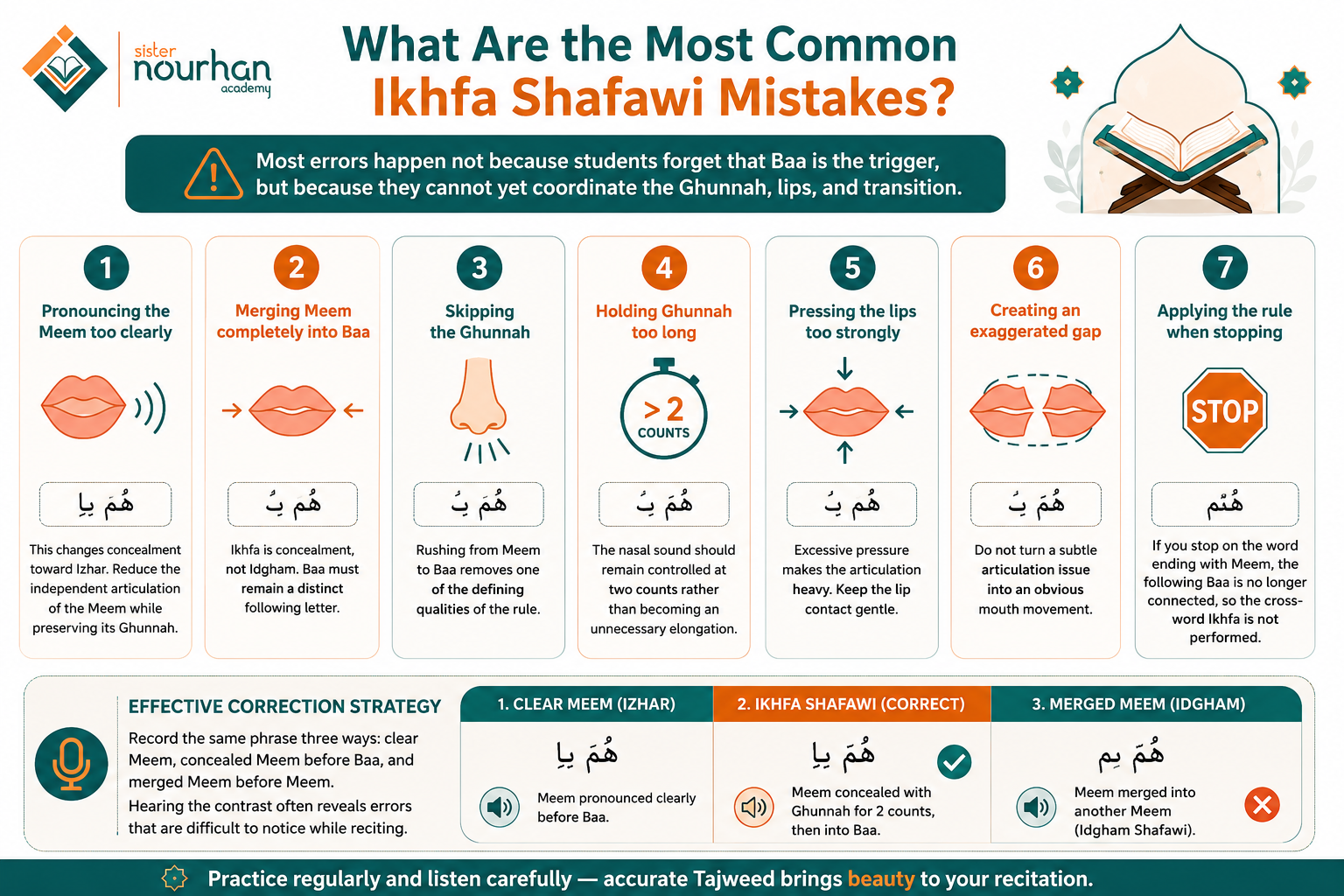
Pronouncing the Meem too clearly: this changes concealment toward Izhar. Reduce the independent articulation of the Meem while preserving its Ghunnah.
Merging Meem completely into Baa: Ikhfa is concealment, not Idgham. Baa must remain a distinct following letter.
Skipping the Ghunnah: rushing from Meem to Baa removes one of the defining qualities of the rule.
Holding Ghunnah too long: the nasal sound should remain controlled at two counts rather than becoming an unnecessary elongation.
Pressing the lips too strongly: excessive pressure makes the articulation heavy. Keep the lip contact gentle.
Creating an exaggerated gap: do not turn a subtle articulation issue into an obvious mouth movement.
Applying the rule when stopping: if you stop on the word ending with Meem, the following Baa is no longer being connected in recitation, so the cross-word Ikhfa is not performed.
A particularly useful correction strategy is to record the same phrase three ways: clear Meem, concealed Meem before Baa, and merged Meem before Meem. Hearing the contrast often reveals errors that are difficult to notice while reciting.
See our teaching methods
Experience the quality of our instruction firsthand by watching a live lesson snippet below.
Begin Your Quranic Journey
Connect with the words of Allah through personalized sessions at Sister Nourhan Academy.
Book Your Free TrialStart Practicing Ikhfa Shafawi With Sister Nourhan Academy
Knowing مْ + ب is easy. Producing the correct Ghunnah, lip contact, and transition consistently during real Quran recitation requires guided practice.
Study with Sister Nourhan Academy to receive structured Tajweed instruction and direct correction as you apply Ikhfa Shafawi and other recitation rules.
[Book Your Advanced Tajweed Course]
Discover our Tajweed Courses

Conclusion
Ikhfa Shafawi occurs when Meem Sakinah (مْ) is followed by Baa (ب) across two connected words. Baa is the only one of the Ikhfa Shafawi letters, making the rule simple to identify.
Correct recitation requires more than recognition: conceal the Meem, preserve the two-count Ghunnah, avoid excessive lip pressure, and transition naturally into Baa.
Practice Quranic examples slowly before returning them to normal recitation speed. Most importantly, compare Ikhfa with Idgham and Izhar Shafawi so that your ear learns the difference as clearly as your mind knows the definitions.
FAQs
What is Ikhfa Shafawi?
Ikhfa Shafawi is the concealment of Meem Sakinah before Baa with Ghunnah. It is pronounced between complete Izhar and complete Idgham, without merging the Meem into the Baa.
What are the Ikhfa Shafawi letters?
Baa (ب) is the only Ikhfa Shafawi letter. The rule occurs when Meem Sakinah (مْ) is followed immediately by Baa while continuing the recitation.
What is the Ikhfa Shafawi rule?
The rule is مْ + ب = Ikhfa Shafawi. Conceal the Meem with a full Ghunnah for two counts, then transition smoothly into the Baa without merging the two letters.
How many counts is the Ghunnah in Ikhfa Shafawi?
The Ghunnah in Ikhfa Shafawi is held for two counts. It should be clearly nasal but controlled, without shortening it through rushing or exaggerating its duration.
Does Ikhfa Shafawi occur in one word?
No, Ikhfa Shafawi occurs between two words. The first word ends with Meem Sakinah and the next begins with Baa, such as وَمَا هُم بِمُؤْمِنِينَ.
What is the difference between Ikhfa Shafawi and Idgham Shafawi?
Ikhfa Shafawi occurs before Baa (ب), while Idgham Shafawi occurs before Meem (م). In Ikhfa, the Meem is concealed with Ghunnah; in Idgham, the first Meem merges into the second Meem.