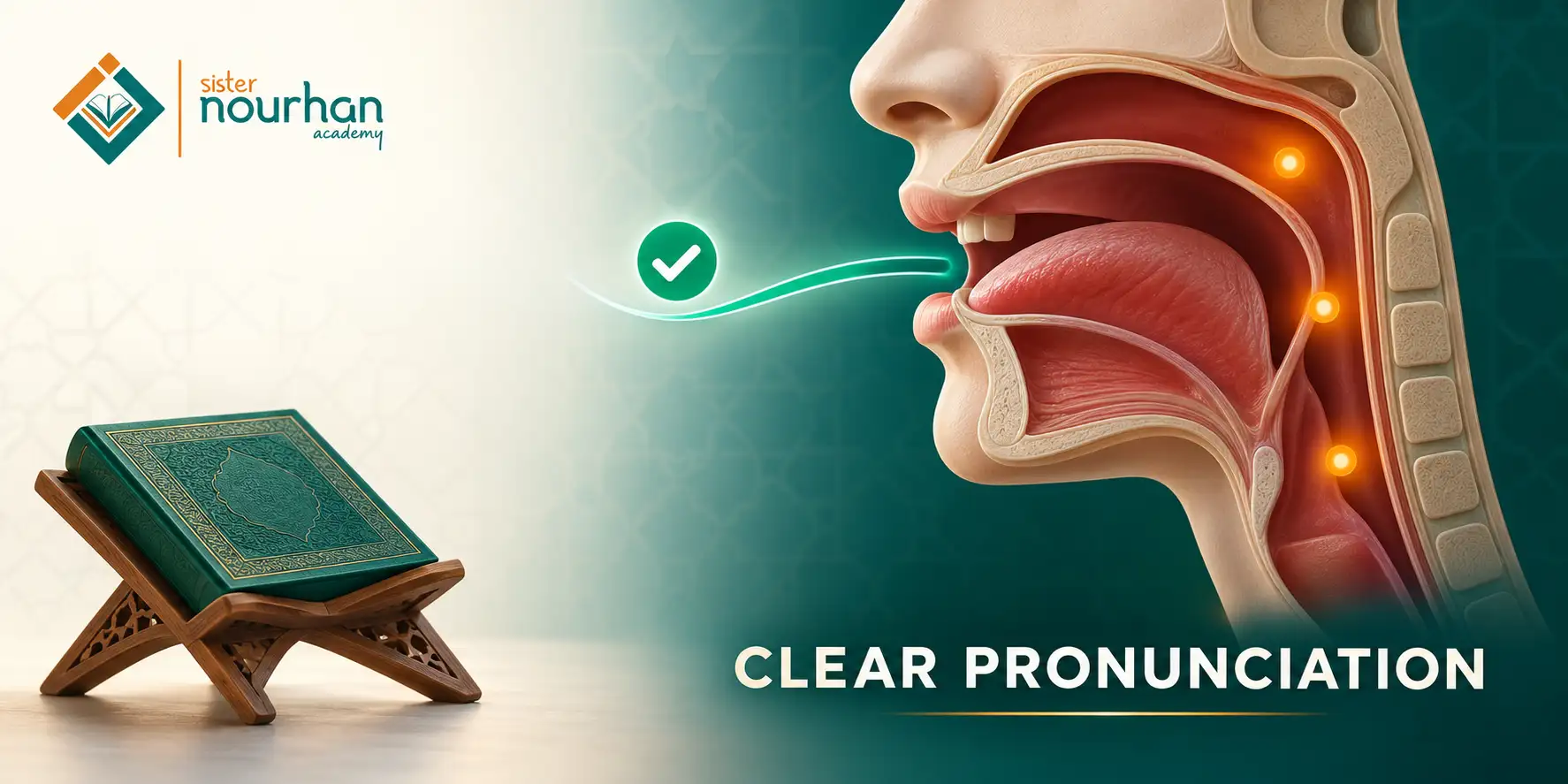
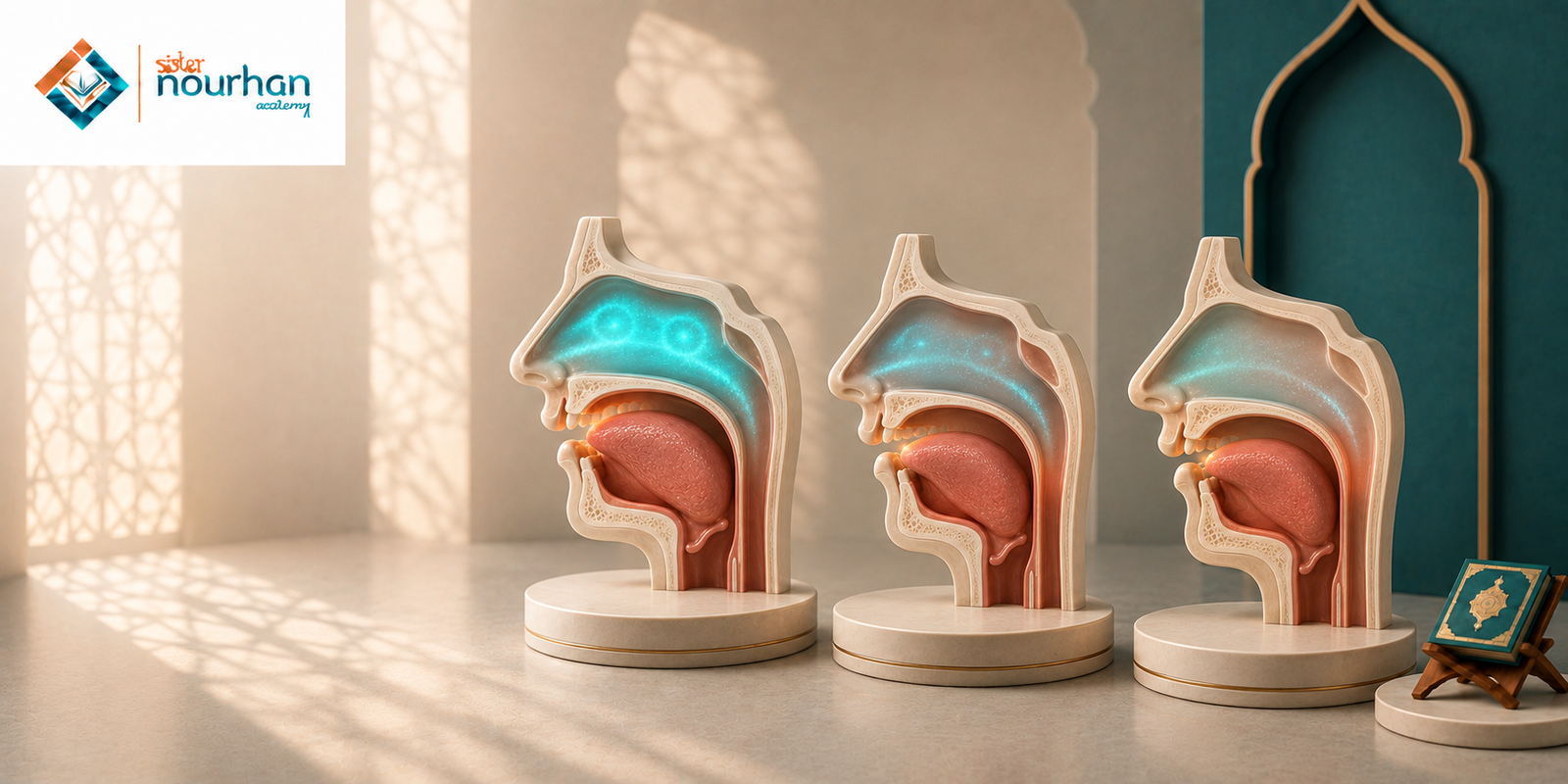
Ikhfa Haqiqi is one of the essential Tajweed rules for Noon Sakinah and Tanween. It occurs when نْ (Noon Sakinah) or Tanween (ــًــٍــٌ) comes before one of the 15 Ikhfa Haqiqi letters.
Instead of pronouncing the Noon clearly or merging it completely into the next letter, the reciter conceals its sound while maintaining Ghunnah for two counts.
Learning this distinction is important because Tajweed depends not only on recognizing a rule but also on producing the correct transition between sounds. The same principle appears in foundational Quran-reading instruction, where Sukoon activates important rules such as Ikhfa.
What Is Ikhfa Haqiqi in Tajweed?
Ikhfa Haqiqi is the concealment of Noon Sakinah or Tanween when followed by one of 15 specific letters, producing a pronunciation between Izhar and Idgham without Shaddah while maintaining Ghunnah for two counts.
The Arabic word Ikhfa (الإخفاء) means hiding or concealment, while Haqiqi (الحقيقي) means real or true. The term can therefore be understood as “true concealment.”
This rule applies to:
Noon Sakinah: نْ
Tanween: ــً / ــٍ / ــٌ
The practical trigger is simple: identify Noon Sakinah or Tanween, then look immediately at the next letter. If that letter belongs to the 15 Ikhfa letters, apply Ikhfa Haqiqi.
Why Is It Called “Haqiqi” Ikhfa?
It is called Ikhfa Haqiqi to distinguish it from Ikhfa Shafawi, another Tajweed rule that involves Meem Sakinah rather than Noon Sakinah or Tanween.
“Haqiqi” therefore helps identify which concealment rule the reciter is applying.
Where Can Ikhfa Haqiqi Occur- One Word or Two?
With Noon Sakinah, Ikhfa can occur either within one word or across two words.
For example:
يَنْصُرُكُمْ
The Noon Sakinah and the following ص occur within the same word.
It can also occur across a word boundary, such as:
مِنْ قَبْلُ
Tanween, however, appears at the end of a word, so its Ikhfa relationship necessarily involves the beginning of the next word.
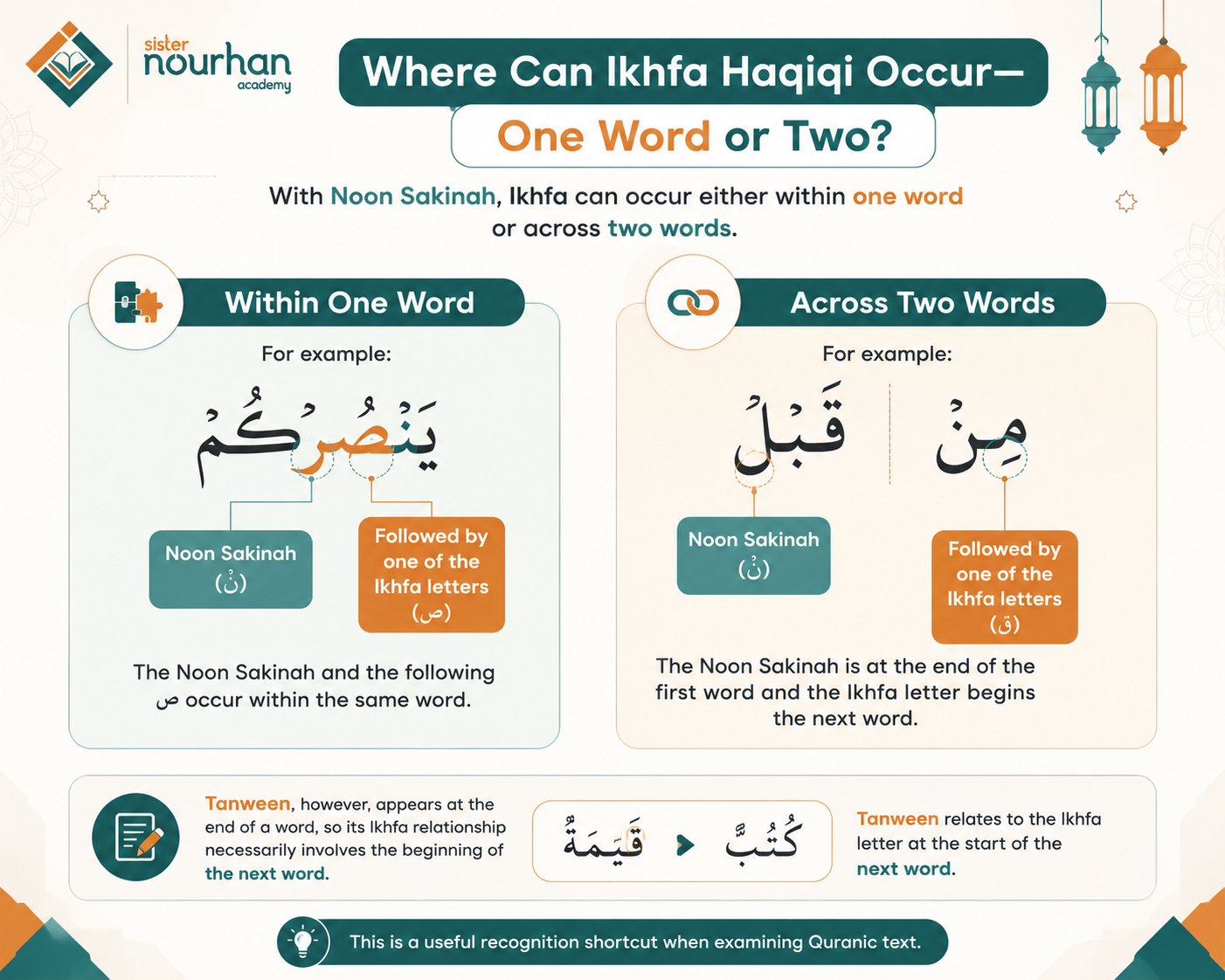
This is a useful recognition shortcut when examining Quranic text.
What Are the 15 Ikhfa Haqiqi Letters?
There are 15 Ikhfa Haqiqi letters:
ت، ث، ج، د، ذ، ز، س، ش، ص، ض، ط، ظ، ف، ق، ك
A traditional mnemonic gathers them into the opening letters of this line:
صِفْ ذَا ثَنَا كَمْ جَادَ شَخْصٌ قَدْ سَمَا
دُمْ طَيِّبًا زِدْ فِي تُقًى ضَعْ ظَالِمَا
A practical learning method is to memorize the letters as a set, but train them through real Quran phrases. Recognizing a list and producing Ikhfa correctly during continuous recitation are different skills.
If identifying the rule is easy but applying it naturally is difficult, guided Tajweed correction at Sister Nourhan Academy can help turn rule knowledge into accurate recitation.
For younger learners combining correct Tajweed with Quran memorization, the Hifz for Kids Course provides structured guidance to help children memorize the Quran while developing accurate recitation habits.

Shots from Our Classes
Take a moment to view the video below to see how our teachers provide clear, supportive corrections during a session.
Begin Your Quranic Journey
Connect with the words of Allah through personalized sessions at Sister Nourhan Academy.
Book Your Free TrialWhat Are Some Ikhfa Haqiqi Examples?
Ikhfa Haqiqi examples can involve either Noon Sakinah or Tanween, but the deciding factor is always the letter immediately following them.
Studying both categories prevents learners from associating Ikhfa only with the written letter ن.
Ikhfa Haqiqi Examples With Noon Sakinah
مَنْ جَاءَ
Here, نْ is followed by ج, one of the Ikhfa letters. The Noon is concealed with Ghunnah rather than pronounced as a complete “n.”
مِنْ قَبْلُ
Here, Noon Sakinah is followed by ق, so Ikhfa Haqiqi applies.
يَنْصُرُكُمْ
Here, نْ is followed by ص within the same word. This demonstrates that Noon Sakinah Ikhfa does not require two separate words.
Ikhfa Haqiqi Examples With Tanween
شَيْءٍ قَدِيرٌ
The Kasratain in شَيْءٍ is followed by ق, triggering Ikhfa.
مَاءً ثَجَّاجًا
The Fathatain is followed by ث, so the Tanween is concealed with Ghunnah.
رِزْقًا كَرِيمًا
The Tanween is followed by ك, another Ikhfa letter.
The key is to listen for the concealed nasal quality rather than trying to pronounce a distinct Noon between the two words.
How Do You Pronounce Ikhfa Haqiqi Correctly?
Correct Ikhfa Haqiqi pronunciation depends on three things working together: concealing the Noon, maintaining Ghunnah, and preparing the mouth for the following letter.
1. Conceal the Noon Instead of Pronouncing It Clearly
A normal Noon involves the tongue contacting the area behind the upper front teeth.
During Ikhfa, avoid completing this normal Noon articulation. If you hear a strong independent “n” before the following letter, you are moving toward Izhar rather than Ikhfa.
2. Maintain the Ghunnah for Two Counts
Ghunnah is the nasal resonance associated with letters such as Noon and Meem in specific Tajweed contexts.
During Ikhfa Haqiqi, maintain the nasal sound for two counts before moving into the next letter.
The goal is controlled timing, not making the nasal sound as long or loud as possible.
3. Prepare the Tongue for the Following Ikhfa Letter
Your tongue should be ready for the articulation point of the letter that follows. This detail explains why Ikhfa does not sound exactly identical before all 15 letters. The following letter influences both the degree of concealment and the quality of the Ghunnah.
A common mistake is spending too much attention on the two-count Ghunnah while neglecting the transition into the next letter. In practice, the transition is often where a teacher can hear whether the Ikhfa is genuinely correct.
Correct Ikhfa Haqiqi becomes easier when children practice the rule repeatedly in real Quran recitation rather than memorizing it only as theory.
With Sister Nourhan Academy’s Hifz for Kids Course, children can work on Quran memorization while developing accurate Tajweed, pronunciation, and recitation habits through guided practice and correction.

What Are the Levels of Ikhfa Haqiqi?
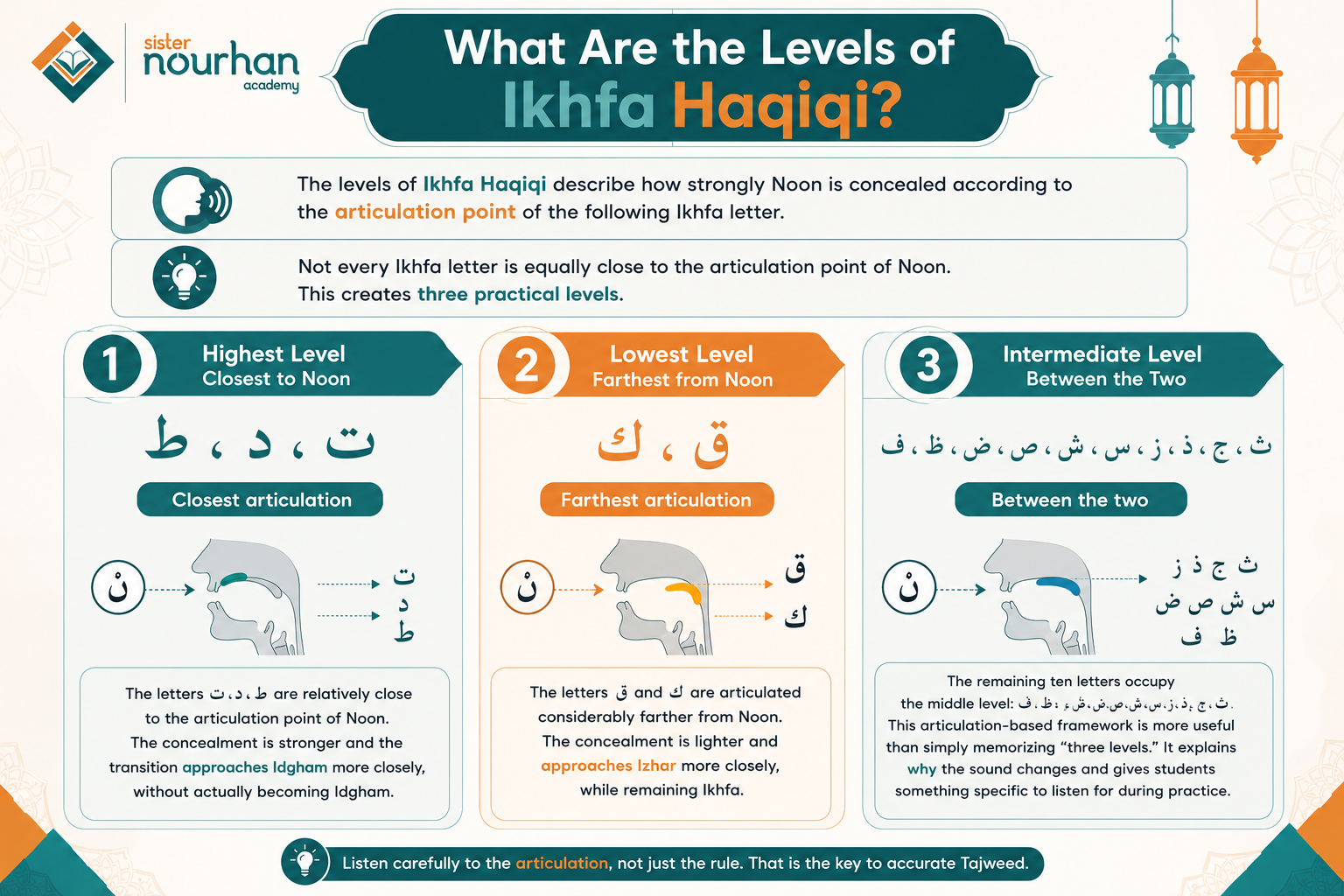
The levels of Ikhfa Haqiqi describe how strongly Noon is concealed according to the articulation point of the following Ikhfa letter.
Not every Ikhfa letter is equally close to the articulation point of Noon. This creates three practical levels.
1- Highest Level of Ikhfa: ت، د، ط
The letters ت، د، ط are relatively close to the articulation point of Noon. As a result, the concealment is stronger and the transition approaches Idgham more closely, without actually becoming Idgham.
2- Lowest Level of Ikhfa: ق، ك
The letters ق and ك are articulated considerably farther from Noon. The concealment is therefore lighter and approaches Izhar more closely, while remaining Ikhfa.
3- Intermediate Level of Ikhfa
The remaining ten letters occupy the middle level:
ث، ج، ذ، ز، س، ش، ص، ض، ظ، ف
This articulation-based framework is more useful than simply memorizing “three levels.” It explains why the sound changes and gives students something specific to listen for during practice.
See our teaching methods
Experience the quality of our instruction firsthand by watching a live lesson snippet below.
Begin Your Quranic Journey
Connect with the words of Allah through personalized sessions at Sister Nourhan Academy.
Book Your Free TrialIs Ghunnah Heavy or Light in Ikhfa Haqiqi?
The Ghunnah in Ikhfa Haqiqi takes its heavy or light quality from the letter that follows it.
When the following Ikhfa letter is a heavy letter, the Ghunnah takes on a heavier quality. When the following letter is light, the Ghunnah remains light.
Heavy Ghunnah in Ikhfa Haqiqi
The heavy Ikhfa letters are:
ص، ض، ط، ظ، ق
For example:
مِنْ قَبْلُ
Because ق is heavy, the Ghunnah prepares for that heavy articulation.
Light Ghunnah in Ikhfa Haqiqi
With the remaining Ikhfa letters, the Ghunnah is light.
For example:
مَاءً ثَجَّاجًا
Because ث is light, the Ghunnah remains light.
A frequent mistake is deliberately making every Ikhfa Ghunnah sound identical. Instead, think of the nasal sound as preparing for the next letter.
What Is the Difference Between Ikhfa Haqiqi and Ikhfa Shafawi?
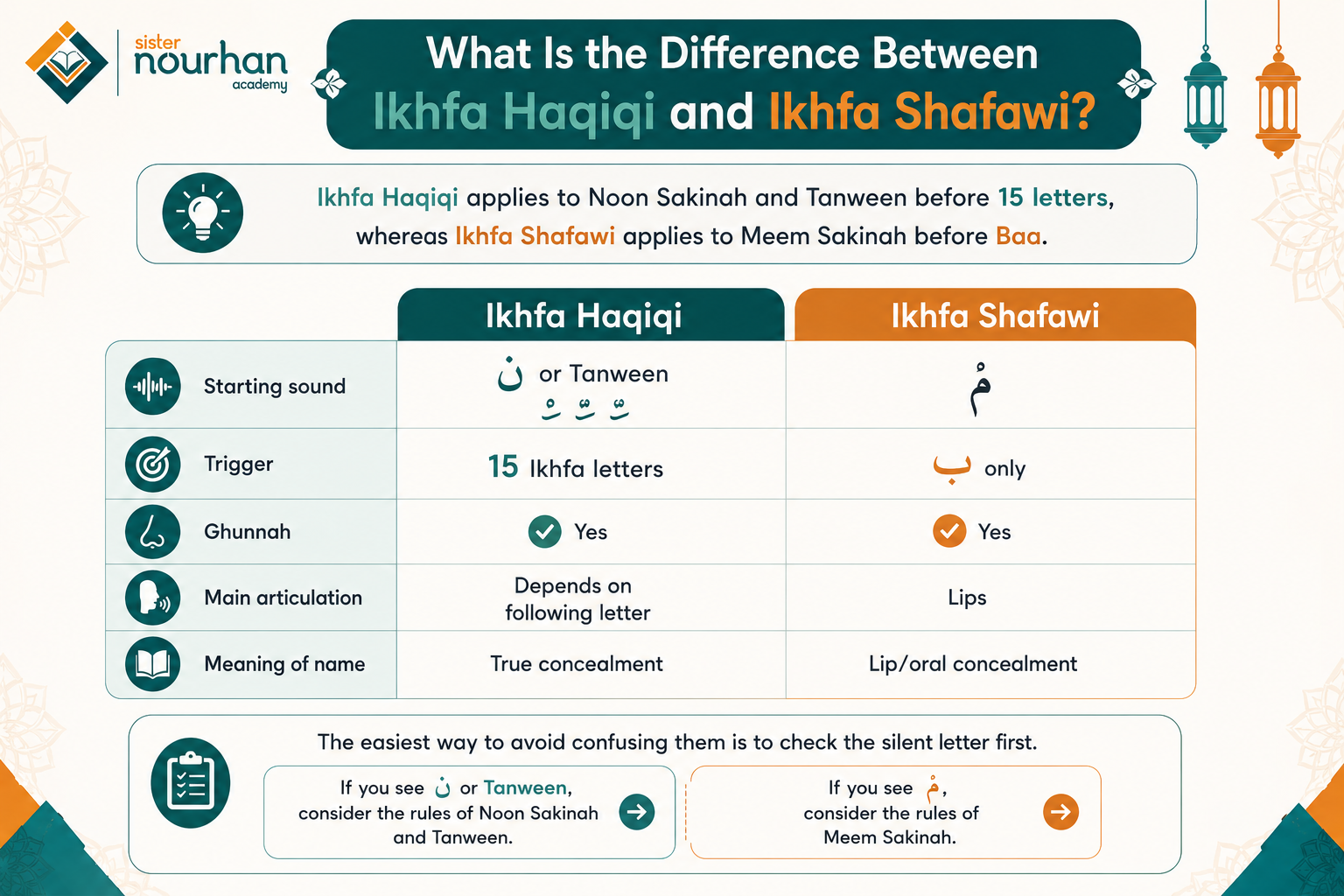
Ikhfa Haqiqi applies to Noon Sakinah and Tanween before 15 letters, whereas Ikhfa Shafawi applies to Meem Sakinah before Baa.
The easiest way to avoid confusing them is to check the silent letter first.
If you see نْ or Tanween, consider the rules of Noon Sakinah and Tanween. If you see مْ, consider the rules of Meem Sakinah.
Common Ikhfa Haqiqi Mistakes to Avoid
Most Ikhfaa Haqiqi errors come from pronunciation rather than failure to memorize the 15 letters.
Pronouncing a clear Noon: this turns the sound toward Izhar.
Merging completely: Ikhfa is not full Idgham.
Touching the normal Noon articulation point: this can make the hidden Noon too explicit.
Dropping the Ghunnah: Ikhfa Haqiqi requires the nasal quality.
Holding Ghunnah too long: the standard duration here is two counts.
Giving every Ghunnah the same quality: the following letter affects whether it is heavy or light.
Memorizing the letters without practicing transitions: correct Tajweed must remain accurate during continuous Quran recitation.
A useful self-test is to record one phrase with Ikhfa and listen specifically for the Noon. If you hear a crisp independent “n,” you may be over-pronouncing it. If the following letter seems swallowed into the nasal sound, you may be concealing too much.
Start Mastering Ikhfa Haqiqi With Sister Nourhan Academy
Knowing the Ikhfa Haqiqi letters is only the first step. Train your ear, Ghunnah timing, tongue position, and transitions with guided correction from Sister Nourhan Academy.
Build Tajweed skills that you can apply naturally while reciting the Quran—not only rules you can recognize on a page.
[Start Learning Advanced Tajweed Course]

Discover our Tajweed Courses
Conclusion
Ikhfa Haqiqi occurs when Noon Sakinah or Tanween is followed by one of 15 specific letters. The Noon sound is concealed without complete merging, while Ghunnah is maintained for two counts.
To master the rule, go beyond memorizing its letters. Practice the three levels of concealment, distinguish heavy from light Ghunnah, and focus carefully on the transition into the following letter.
FAQs
What is Ikhfa Haqiqi?
Ikhfa Haqiqi is concealing Noon Sakinah or Tanween before one of 15 Ikhfa letters while maintaining Ghunnah for two counts. Its pronunciation falls between clear Izhar and complete Idgham.
How many Ikhfa Haqiqi letters are there?
There are 15 Ikhfa Haqiqi letters: ت، ث، ج، د، ذ، ز، س، ش، ص، ض، ط، ظ، ف، ق، ك.
What are the levels of Ikhfa Haqiqi?
Ikhfa Haqiqi has three levels based on the following letter's articulation point. ت، د، ط produce the closest or highest level; ق and ك produce the farthest or lowest level; the remaining ten letters form the intermediate level.
How long is Ghunnah in Ikhfa Haqiqi?
Ghunnah in Ikhfa Haqiqi is held for two counts. The reciter should maintain the nasal resonance without clearly articulating an independent Noon.
Can Ikhfa Haqiqi occur within one word?
Yes, Noon Sakinah Ikhfa can occur within one word or between two words. Tanween occurs at a word ending, so its Ikhfa relationship is with the first letter of the following word.
What is the difference between Ikhfa Haqiqi and Ikhfa Shafawi?
Ikhfa Haqiqi concerns Noon Sakinah or Tanween before 15 letters, while Ikhfa Shafawi concerns Meem Sakinah before Baa. Both involve concealment and Ghunnah, but they apply to different letters and articulation mechanisms.