

Izhar Shafawi with examples becomes easy to understand once you know one simple decision rule: when Meem Sakinah (مْ) is followed by any Arabic letter except Baa (ب) or Meem (م), pronounce the Meem clearly from the lips.
The word Izhar (إظهار) means “to make clear,” while Shafawi (شفوي) means “related to the lips.” The name therefore describes exactly what happens: the Meem Sakinah is made clear through complete lip articulation.
Izhar Shafawi is one of the three rules of Meem Sakinah, alongside Ikhfa Shafawi and Idgham Shafawi. The easiest way to distinguish them is not to memorize 26 Izhar letters individually, but to remember the two exceptions: Baa means conceal; Meem means merge; everything else means clarify.
This guide explains the letters, pronunciation technique, Izhar Shafawi examples in Quran, common mistakes, and a practical method for identifying the rule during recitation.
What Is Izhar Shafawi?
Izhar Shafawi is the Tajweed rule that requires Meem Sakinah (مْ) to be pronounced clearly from the lips when it is followed by any Arabic letter except Baa (ب) or Meem (م).
The term has two parts:
Izhar (إظهار): clarity or making something apparent
Shafawi (شفوي): labial or related to the lips
It is called Shafawi because Meem is articulated by bringing the two lips together.
For example:
أَلَمْ يَجْعَلْ
The Meem Sakinah in أَلَمْ is followed by Yaa (ي). Since Yaa is neither Baa nor Meem, the Meem is pronounced clearly.
Another example is:
هُمْ فِي
Here, the Meem Sakinah in هُمْ is followed by Faa (ف), so Izhar Shafawi applies.
What Is Meem Sakinah?
Meem Sakinah is the Arabic letter Meem (م) carrying Sukoon (مْ), meaning it has no vowel of its own. Its pronunciation depends on the letter immediately following it.
Every Meem Sakinah falls under one of three rules:
This gives students a faster decision method than trying to memorize a long list: look one letter ahead.
What Are the Izhar Shafawi Letters?
There are 26 Izhar Shafawi letters: all Arabic letters except Baa (ب) and Meem (م).
They are:
ء ت ث ج ح خ د ذ ر ز س ش ص ض ط ظ ع غ ف ق ك ل ن هـ و ي
Rather than memorizing all 26 letters separately, remember:
مْ + ب → Ikhfa Shafawi
مْ + م → Idgham Shafawi
مْ + everything else → Izhar Shafawi
This “two-exception method” is especially useful while reading because it reduces the decision to checking whether the next letter is Baa or Meem.
Shots from Our Classes
Take a moment to view the video below to see how our teachers provide clear, supportive corrections during a session.
Begin Your Quranic Journey
Connect with the words of Allah through personalized sessions at Sister Nourhan Academy.
Book Your Free TrialWhy Do Faa(ف) and Waw (و) Need Extra Attention in Izhar Shafawi?
Faa (ف) and Waw (و) require extra clarity because their articulation points are close to the lip articulation used for Meem.
Meem is formed by closing both lips. Waw also involves the lips, while Faa is produced where the upper teeth meet the inner lower lip.
Because these articulation points are close, students may accidentally weaken, conceal, or blur the Meem before moving into Faa or Waw.
Compare:
هُمْ فِي
and:
لَكُمْ وَلِيَ
In both cases, fully establish the Meem first. Only then move to Faa or Waw.
Practitioner note: do not solve this problem by holding the Meem longer. The objective is clean articulation, not extra duration.
If you find yourself repeatedly concealing Meem before Faa or Waw, personalized correction in Sister Nourhan Academy's Tajweed lessons can help identify whether the problem comes from lip closure, timing, or an incorrect habit carried over from Ikhfa Shafawi.
With Sister Nourhan Academy, children can develop clearer pronunciation and stronger Tajweed habits under the guidance of qualified Quran teachers who listen carefully, correct subtle articulation mistakes, and help prevent errors from becoming part of memorized recitation.
For children working toward consistent Quran memorization, the Hifz for Kids Course combines structured Hifz practice with teacher-guided recitation, helping them memorize with greater accuracy and confidence.

How Do You Pronounce Izhar Shafawi Correctly?
Correct Izhar Shafawi pronunciation depends on completing the Meem before beginning the following letter.
Use this four-step process:
Identify Meem Sakinah (مْ).
Look immediately at the next letter. Confirm that it is neither Baa nor Meem.
Close both lips completely for the Meem. Give the letter its clear articulation without extending an added Ghunnah for the rule.
Release naturally into the next letter. Do not merge, hide, or unnecessarily prolong the Meem.
The key physical checkpoint is simple: did your two lips actually meet for the Meem before you started the next letter?
That question is especially useful when practicing Meem before Faa and Waw.
Is There Ghunnah in Izhar Shafawi?
Izhar Shafawi does not require the extended Ghunnah used in Ikhfa Shafawi or Idgham Shafawi.
Meem naturally has a nasal quality as one of its inherent characteristics, but the reciter should not deliberately extend it into the pronounced Ghunnah associated with concealment or merging.
This distinction matters because saying that Meem has absolutely no nasal quality can be misleading. The practical rule is: pronounce the Meem naturally and clearly without adding an extended Ghunnah.
Master subtle distinctions like natural nasal quality and extended Ghunnah through focused practice and personalized correction.
Explore the Advanced Tajweed Course to strengthen your pronunciation and apply Tajweed rules with greater accuracy.

Izhar Shafawi Examples in Quran
The following examples of Izhar Shafawi demonstrate how the same rule appears before different Arabic letters.
Izhar Shafawi Before Yaa
أَلَمْ يَجْعَلْ كَيْدَهُمْ فِي تَضْلِيلٍ
Alam yaj'al kaydahum fī taḍlīl.
Surah Al-Fil, 105:2
There are useful practice points in this verse.
In أَلَمْ يَجْعَلْ, Meem Sakinah is followed by Yaa (ي).
Later, in كَيْدَهُمْ فِي, Meem Sakinah is followed by Faa (ف). Both positions require Izhar Shafawi, but the second deserves extra attention because Faa is articulated close to the lips.
Izhar Shafawi Before Waw
لَكُمْ دِينُكُمْ وَلِيَ دِينِ
Lakum dīnukum wa liya dīn.
Surah Al-Kafirun, 109:6
In دِينُكُمْ وَلِيَ, the final Meem Sakinah is followed by Waw (و).
Pronounce the Meem completely before rounding the lips for Waw. Do not let the two sounds blend together.
Izhar Shafawi Before Dal
الْحَمْدُ لِلَّهِ رَبِّ الْعَالَمِينَ
Al-ḥamdu lillāhi rabbil-'ālamīn.
Surah Al-Fatiha, 1:2
In الْحَمْدُ, the Meem Sakinah is followed by Dal (د).
The lips close completely for Meem before the tongue moves to produce Dal.
Izhar Shafawi Before Lam
إِنَّمَا نُطْعِمُكُمْ لِوَجْهِ اللَّهِ
Innamā nuṭ'imukum liwajhi Allāh.
Surah Al-Insan, 76:9
The Meem Sakinah in نُطْعِمُكُمْ is followed by Lam (ل) at the beginning of the following word.
The Meem remains distinct and is not merged into Lam.
Izhar Shafawi Before Jeem
From the same verse:
مِنْكُمْ جَزَاءً
Minkum jazā'an.
Surah Al-Insan, 76:9
The Meem Sakinah at the end of مِنْكُمْ comes before Jeem (ج).
Close the lips for Meem, release them, and then articulate Jeem separately.
Izhar Shafawi Before Sheen
وَسَقَاهُمْ رَبُّهُمْ شَرَابًا طَهُورًا
Wa saqāhum rabbuhum sharāban ṭahūrā.
Surah Al-Insan, 76:21
The Meem in رَبُّهُمْ is followed by Sheen (ش).
The Meem must remain fully distinct before the Sheen begins.
More Izhar Shafawi Examples for Practice
The examples below show Izhar Shafawi with Meem Sakinah (مْ) followed by different Arabic letters.
Practice each example slowly, making sure the Meem is pronounced clearly before moving to the next letter.
Pay particular attention when مْ is followed by ف or و, as the closeness of their articulation to the lips can make the Meem less distinct if the transition is rushed.
Read also: Izhar: Definition, Letters, Types, Rules, and Examples
Where Can Izhar Shafawi Occur— Within One Word or Between Two Words?
Izhar Shafawi can occur either inside one word or across the boundary between two words.
This is important because some students learn the rule only through examples such as هُمْ فِي and assume the Meem must appear at the end of a word.
It does not.
Izhar Shafawi Within One Word
Consider:
الْحَمْدُ
The sequence مْ + د occurs inside the same word, so Izhar Shafawi applies.
Izhar Shafawi Between Two Words
Consider:
هُمْ فِي
The first word ends with Meem Sakinah and the next begins with Faa.
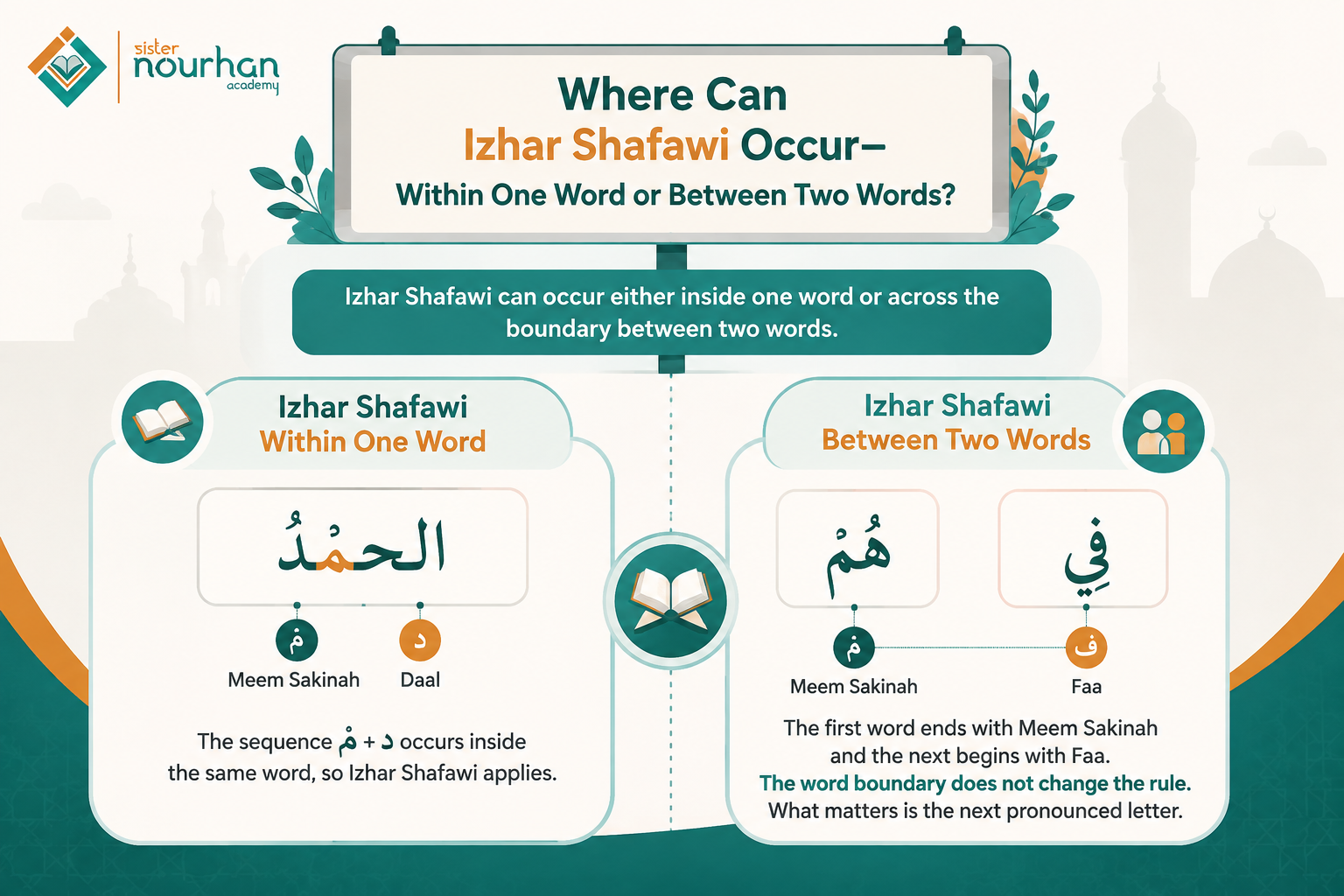
The word boundary does not change the rule. What matters is the next pronounced letter.
What Is the Difference Between Izhar Shafawi, Ikhfa Shafawi, and Idgham Shafawi?
The three rules are determined entirely by the letter immediately after Meem Sakinah.
So when you see Meem Sakinah, ask only one question:
What comes next?
If it is Baa, conceal.
If it is Meem, merge.
If it is anything else, clarify.
Read more about : What is Ikhfa Shafawi in Tajweed?
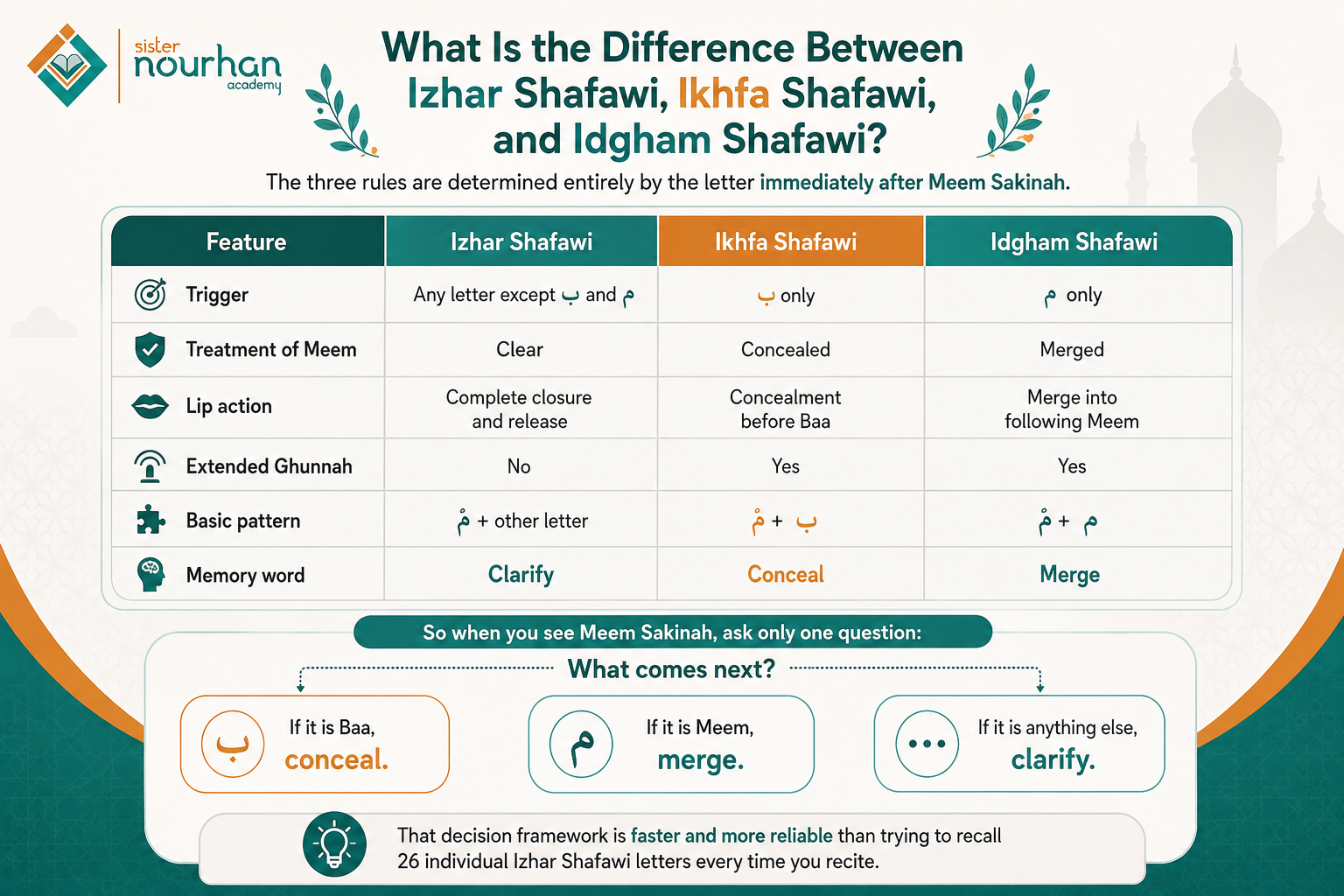
That decision framework is faster and more reliable than trying to recall 26 individual Izhar Shafawi letters every time you recite.
What Common Izhar Shafawi Mistakes Should You Avoid?
Most errors are not caused by forgetting the definition. They happen during the physical transition between Meem and the following letter.
1. Adding an Unnecessary Ghunnah
A student may understand that Meem is a nasal letter and then exaggerate that nasal quality.
This can make Izhar sound closer to Ikhfa or Idgham.
Fix: pronounce the Meem naturally without deliberately extending its nasal resonance.
2. Concealing Meem Before Faa or Waw
This is one of the most important Izhar Shafawi pronunciation errors.
Because Faa and Waw involve nearby lip articulation, students may move toward the next letter before completing the Meem.
Fix: make sure both lips meet completely before beginning Faa or Waw.
3. Rushing Over the Meem
At faster recitation speeds, students sometimes technically touch the Meem but fail to give it a distinct sound.
Fix: practice the phrase slowly until the closure and release become automatic. Then gradually increase speed without losing clarity.
4. Over-Articulating the Meem
Clarity does not mean striking or prolonging the Meem unnaturally. Overcorrecting can interrupt the flow of recitation.
Fix: aim for complete but natural lip closure rather than extra force or duration.
5. Confusing Izhar Shafawi With Izhar Halqi
Both rules use the word Izhar, but they apply to different letters. Izhar Shafawi governs Meem Sakinah before all letters except Baa and Meem.
Izhar Halqi governs Noon Sakinah and Tanween before the six throat letters. The shared principle is clarity; the trigger system is completely different.
If these distinctions still disappear when you move from exercises to actual Quran recitation, guided Tajweed practice at Sister Nourhan Academy can help turn rule recognition into automatic pronunciation.

See our teaching methods
Experience the quality of our instruction firsthand by watching a live lesson snippet below.
Begin Your Quranic Journey
Connect with the words of Allah through personalized sessions at Sister Nourhan Academy.
Book Your Free TrialStart Mastering Izhar Shafawi With Sister Nourhan Academy
Knowing that Meem should be clear is different from hearing whether your own Meem is actually clear.
Study Tajweed with Sister Nourhan Academy and develop accurate Meem Sakinah pronunciation through guided listening, practical recitation, and direct correction.
Discover our Tajweed Courses

Conclusion
Izhar Shafawi with examples is easiest to master through one simple principle: when Meem Sakinah (مْ) is followed by any letter except Baa (ب) or Meem (م), pronounce the Meem clearly from the lips without adding an extended Ghunnah.
There are 26 Izhar Shafawi letters, but memorizing all 26 is unnecessary. Remember the two exceptions instead: Baa causes Ikhfa, Meem causes Idgham, and everything else causes Izhar.
Give extra attention to Faa and Waw, because their proximity to the lip articulation of Meem makes accidental concealment more likely. Clear lip closure followed by a natural release is the practical key to accurate Izhar Shafawi.
Frequently Asked Questions About Izhar Shafawi
What is Izhar Shafawi in simple terms?
Izhar Shafawi means pronouncing Meem Sakinah clearly when the next letter is anything except Baa or Meem. The lips close completely for Meem before moving naturally to the following letter.
How many Izhar Shafawi letters are there?
There are 26 Izhar Shafawi letters. They are all Arabic letters except Baa (ب), which causes Ikhfa Shafawi, and Meem (م), which causes Idgham Shafawi.
What are some Izhar Shafawi examples in the Quran?
Examples include أَلَمْ يَجْعَلْ (Al-Fil 105:2), كَيْدَهُمْ فِي (Al-Fil 105:2), لَكُمْ دِينُكُمْ وَلِيَ دِينِ (Al-Kafirun 109:6), and رَبُّهُمْ شَرَابًا (Al-Insan 76:21).
Is there Ghunnah in Izhar Shafawi?
There is no added or extended Ghunnah as part of the Izhar Shafawi rule. Pronounce the Meem with its natural characteristics but do not prolong nasal resonance as you would in Ikhfa Shafawi or Idgham Shafawi.
Why are Faa and Waw important in Izhar Shafawi?
Faa and Waw require extra attention because their articulation points are close to that of Meem. Complete the Meem with full lip closure before moving to Faa or Waw so that the Meem does not become concealed or blurred.
Can Izhar Shafawi occur in one word?
Yes. Izhar Shafawi can occur within one word or between two words. The location does not determine the rule; the decisive factor is whether the letter following Meem Sakinah is neither Baa nor Meem.