

Qalqalah Letters & Rules explain how five specific Arabic letters produce a controlled bouncing or echoing sound when they become Sakin (ْ) during Quran recitation.
The five Qalqalah letters are ق ط ب ج د, commonly memorized through the Arabic phrase قُطْبُ جَدٍّ (Qutb Jad).
Qalqalah may sound simple, but correct pronunciation requires balance. The letter must be released clearly without adding a Fathah, Kasrah, Dammah, Hamzah, or an exaggerated extra syllable.
The strength of the Qalqalah also changes according to whether the letter is Sakin within continuous recitation, paused upon at the end of a word, or Mushaddad at the point of Waqf.
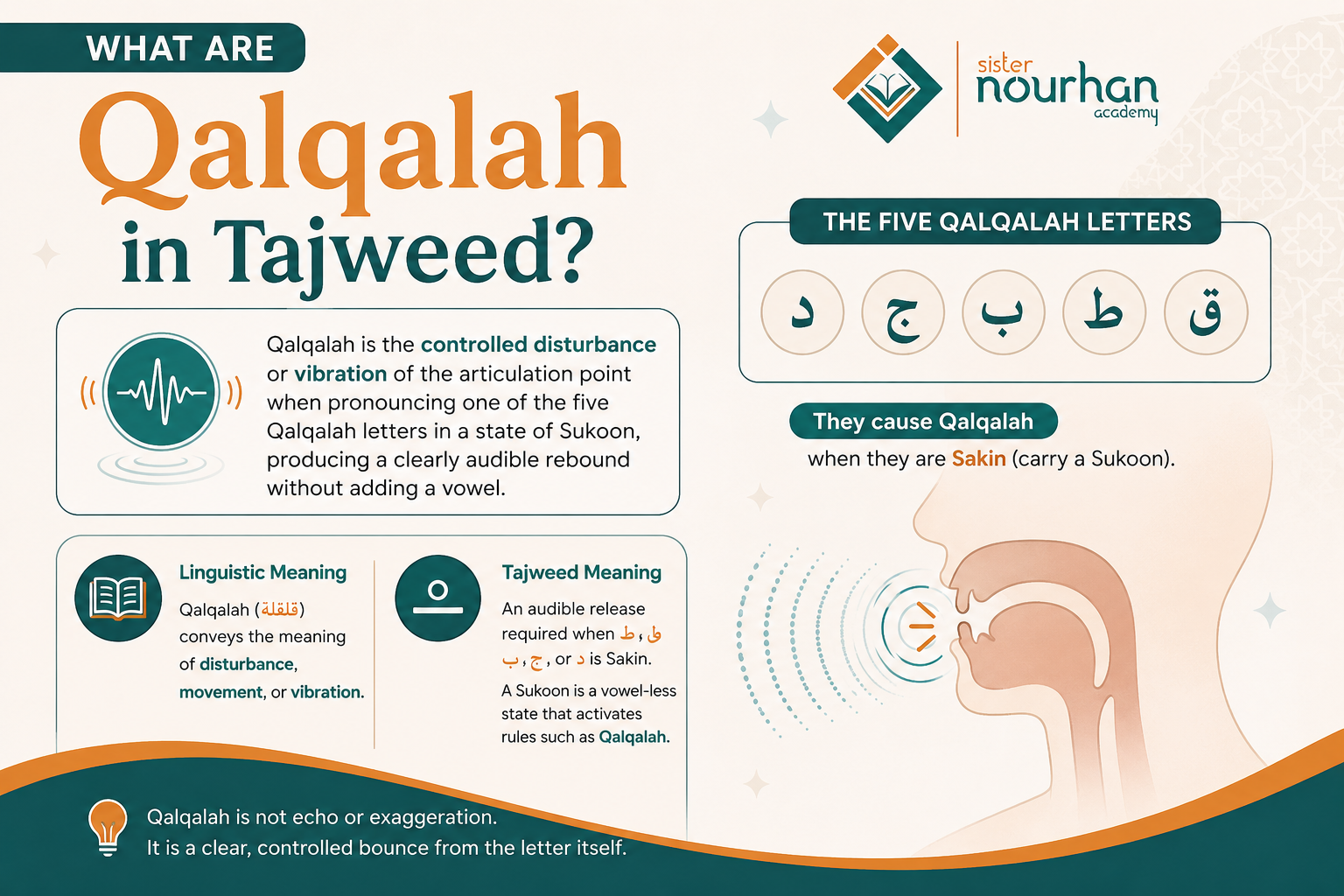
What Are Qalqalah in Tajweed?
Qalqalah is the controlled disturbance or vibration of the articulation point when pronouncing one of the five Qalqalah letters in a state of Sukoon, producing a clearly audible rebound without adding a vowel.
Linguistically, Qalqalah (قلقلة) conveys the meaning of disturbance, movement, or vibration.
In Tajweed terminology, the concept describes the audible release required when ق، ط، ب، ج, or د is Sakin. A Sukoon is a vowel-less state, and it is one of the Quranic reading markers that activates rules such as Qalqalah.
What Are the Five Qalqalah Letters?
The letters of Qalqalah (Huruf Qalqalah) are:
The easiest mnemonic is:
قُطْبُ جَدٍّ — Qutb Jad
If you identify one of these five letters, your next question should be: is the letter Sakin?
That two-step check prevents one of the most common beginner mistakes: applying Qalqalah simply because a Qalqalah letter appears in the word.
Why Do the Qalqalah Letters Produce a Bouncing Sound?
The five letters share two important characteristics: Shiddah (الشدة) and Jahr (الجهر).
Shiddah means that the sound is strongly obstructed at the letter's Makhraj, while Jahr involves the withholding of breath associated with these voiced letters.
When the letter is Sakin, this strong closure would make the consonant difficult to hear distinctly if it were simply stopped. The articulation therefore releases with the characteristic Qalqalah vibration.
Practitioner note: do not deliberately shake the jaw, tongue, or lips. The “bounce” describes the sound produced by the release, not a physical bouncing movement that should be exaggerated.
When Does Qalqalah Occur During Quran Recitation?
Qalqalah occurs when one of the five letters ق ط ب ج د is Sakin, either because it carries an original Sukoon or because stopping on the word creates Sukoon.
This distinction is important because the visible Mushaf does not always show you every Qalqalah that will occur.
Qalqalah With an Original Sukoon
An original Sukoon is already part of the word.
Examples include:
يَقْطَعُونَ
The قْ is Sakin, so Qalqalah is applied.
يَجْعَلُونَ
The جْ is Sakin, so it receives Qalqalah.
أَبْصَارِهِمْ
The بْ receives Qalqalah.
The rule applies while continuing the recitation because the letter itself is originally Sakin.
Qalqalah With an Acquired Sukoon During Waqf
A letter may be vowelled while you continue reading but become Sakin when you stop (Waqf) on the word.
For example:
أَحَدٌ
When continuing, the final د carries its ending and does not receive the end-of-word Qalqalah associated with Waqf.
When stopping:
أَحَدْ
The final د becomes Sakin, so Qalqalah appears clearly.
This creates a useful reading rule:
Do not decide Qalqalah from the written letter alone. Decide from how the letter is actually pronounced in that moment.
If recognizing these changes during continuous recitation is difficult, guided Tajweed practice with Sister Nourhan Academy can help you move from identifying rules on a page to applying them naturally while reading.
For adults who want to strengthen their recitation further, the Advanced Tajweed Course For Adults provides focused practice, personalized correction, and deeper guidance in applying Qalqalah and other Tajweed rules accurately.

Shots from Our Classes
Take a moment to view the video below to see how our teachers provide clear, supportive corrections during a session.
Begin Your Quranic Journey
Connect with the words of Allah through personalized sessions at Sister Nourhan Academy.
Book Your Free TrialWhat Are the Three Grades of Qalqalah?
Qalqalah can be taught in three degrees of strength according to the condition of the Sakin letter.
This three-level framework is useful because it prevents students from producing every Qalqalah with exactly the same force.
What Is Qalqalah Sughra?
Qalqalah Sughra (القلقلة الصغرى) is the lighter Qalqalah produced when a Qalqalah letter has an original Sukoon during continuous recitation.
Examples include:
يَقْطَعُونَ — Qalqalah on قْ
يَجْعَلُونَ — Qalqalah on جْ
أَبْصَارِهِمْ — Qalqalah on بْ
يَدْعُونَ — Qalqalah on دْ
The rebound should remain recognizable but restrained.
A common error is making Sughra almost disappear because the reader is concentrating on reaching the following letter quickly. The opposite error is making it as dramatic as an end-of-ayah stop.
What Is Qalqalah Kubra?
Qalqalah Kubra (القلقلة الكبرى) is the stronger Qalqalah heard when a Qalqalah letter occurs at the end of a word and becomes Sakin because the reciter stops on it.
Examples include stopping on:
الْفَلَقْ
The final ق becomes Sakin through Waqf.
أَحَدْ
The final د becomes Sakin through Waqf.
مُحِيطْ
The final ط becomes Sakin when stopping.
Because the Qalqalah letter now closes the recited word, its rebound is more apparent than the lighter Qalqalah within connected speech.
Our Verified Student Feedback reflects the positive experiences of learners who have studied with Sister Nourhan Academy. Students consistently value the patient guidance, attentive correction, and supportive teaching approach that help them improve their Tajweed and recite the Quran with greater accuracy and confidence.
Explore their reviews to see how personalized instruction has supported their Quran learning journey.

What Is the Strongest Degree of Qalqalah?
The strongest Qalqalah occurs when a Mushaddad Qalqalah letter appears at the end of a word and the reciter stops on it.
A clear example is stopping on:
الْحَقّ
Here the قّ is Mushaddad. A Shaddah represents a doubled consonant and affects the application of Tajweed rules.
Another important example occurs in Surah Al-Masad:
وَتَبَّ
When stopping on تَبَّ, the Mushaddad بّ produces a particularly strong Qalqalah.
Do not interpret “strongest” as permission to add a long echo. The difference is clarity and strength of release, not an arbitrary extension of duration.
Read also: Signs of waqf pauses in the quran
How Should You Pronounce Qalqalah Correctly?
Correct Qalqalah comes from maintaining the letter's Makhraj and characteristics while allowing a brief, controlled release.
Use this sequence:
Find the letter — look for ق، ط، ب، ج, or د.
Check its state — determine whether it is actually Sakin.
Establish its Makhraj — form the consonant correctly before releasing it.
Release the trapped sound — allow the characteristic Qalqalah to become audible.
Keep it vowel-free — do not turn the rebound into a, i, or u.
Adjust the strength — lighter during Sughra and clearer at Waqf.
For example, a Sakin بْ should remain Baa. It should not become بَ (ba) simply because the reader wants to make the Qalqalah audible.
That distinction between release and vowel addition is one of the most useful self-correction tests in Qalqalah.
For students who understand the theory but cannot hear whether their own release is accurate, personalized correction through an Advanced Tajweed Course with experienced teachers at Sister Nourhan Academy can help identify subtle articulation errors before they become automatic habits.

When Should You Not Apply Qalqalah?
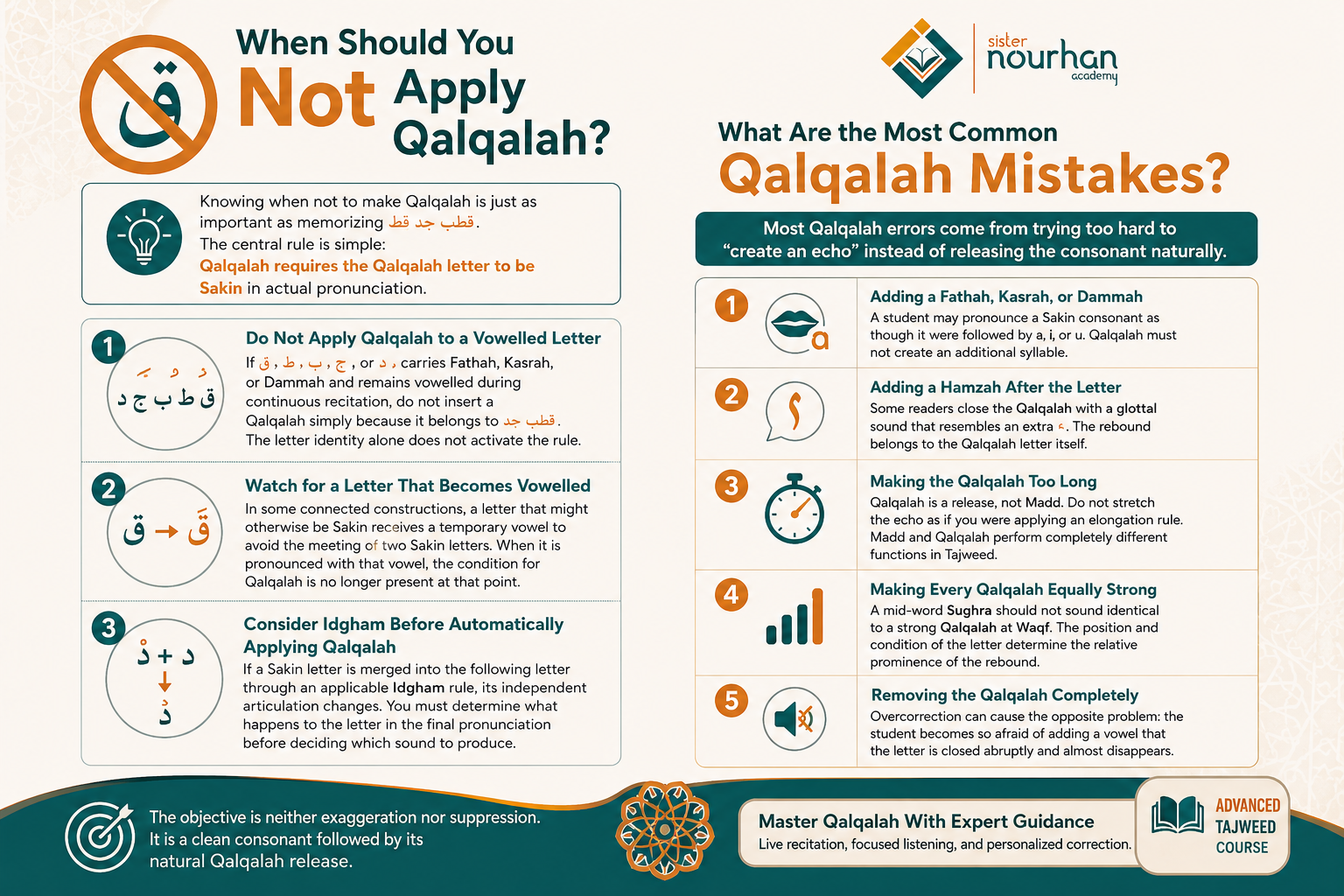
Knowing when not to make Qalqalah is just as important as memorizing قطب جد. The central rule is simple: Qalqalah requires the Qalqalah letter to be Sakin in actual pronunciation.
a. Do Not Apply Qalqalah to a Vowelled Letter
If ق، ط، ب، ج, or د carries Fathah, Kasrah, or Dammah and remains vowelled during continuous recitation, do not insert a Qalqalah simply because it belongs to قطب جد.
The letter identity alone does not activate the rule.
b. Watch for a Letter That Becomes Vowelled to Avoid Two Sakin Letters
In some connected constructions, a letter that might otherwise be Sakin receives a temporary vowel to avoid the meeting of two Sakin letters.
When it is pronounced with that vowel, the condition for Qalqalah is no longer present at that point.
c. Consider Idgham Before Automatically Applying Qalqalah
If a Sakin letter is merged into the following letter through an applicable Idgham rule, its independent articulation changes.
This is an important advanced principle: Tajweed rules are not isolated labels. You must determine what happens to the letter in the final pronunciation before deciding which sound to produce.
Read more about: Idgham With Ghunnah & Without Ghunnah
How Can You Practice Qalqalah Effectively and Improve Its Pronunciation?
The most effective Qalqalah practice follows a gradual progression:
Recognize → Listen → Pronounce → Compare → Apply → Correct
Instead of beginning with fast Quran recitation, train the sound separately first. This makes it easier to produce a clear Qalqalah without accidentally adding a vowel after the letter.
1. Memorize the Five Qalqalah Letters Until Recognition Becomes Automatic
Begin by memorizing the five Qalqalah letters through the phrase:
قُطْبُ جَدٍّ
The letters are:
ق ط ب ج د
Your goal is instant recognition. When one of these letters appears with Sukoon, you should recognize the possibility of Qalqalah without stopping to reconstruct the mnemonic in your mind.
2. Listen Carefully to How Skilled Reciters Release Qalqalah Letters
Choose a clear, measured Quran recitation and focus specifically on Qalqalah letters carrying Sukoon.
During this exercise, temporarily ignore other Tajweed rules and listen for how the consonant is released. Notice that the letter remains recognizable without becoming a full Fathah, Kasrah, or Dammah sound.
Training your ear first makes it easier to recognize the difference between a controlled Qalqalah and an exaggerated bounce.
3. Practice Each Sakin Qalqalah Letter in Isolation
Before practicing complete Quranic words, train the five letters individually:
أَقْ — أَطْ — أَبْ — أَجْ — أَدْ
Pronounce each combination slowly and focus on releasing the Sakin consonant clearly.
The goal is not to add a new vowel. For example, أَدْ should not turn into an extra da, di, or du sound after the Daal.
Repeat each letter several times until you can produce the release consistently.
4. Compare Qalqalah Sughra With a Stronger Qalqalah When Stopping
Next, compare Qalqalah in different positions.
Practice a word containing a Sakin Qalqalah letter within connected recitation, such as:
يَجْعَلُونَ
Then compare it with stopping on a word such as:
أَحَدْ
Listen to how the Qalqalah becomes more prominent when stopping, while still avoiding an added vowel.
Do not try to measure Qalqalah using a fixed number of counts. Instead, focus on producing a clear, controlled release appropriate to the position of the letter.
5. Apply Qalqalah Gradually in Quranic Words and Verses
Once isolated pronunciation becomes comfortable, move through increasingly realistic practice:
Isolated letter → Quranic word → Short phrase → Complete Ayah
Start slowly and identify every Qalqalah position before reciting. Then gradually increase your speed while keeping the same controlled pronunciation.
This progression helps prevent the rule from disappearing when you move from exercises into normal Quran recitation.
6. Record Your Recitation and Listen for Added Vowels
Record yourself practicing several Qalqalah examples and listen back carefully.
Pay particular attention to whether you accidentally add a vowel after the Sakin letter. If أَحَدْ sounds as though an additional da, di, or du has appeared after the Daal, the release needs further correction.
Recording is useful because mistakes that feel natural while reciting can become much easier to notice when you hear them played back.
7. Recite to a Qualified Tajweed Teacher for Final Correction
Visual recognition can teach you where Qalqalah occurs, but listening and feedback determine whether you are actually producing it correctly.
A qualified Tajweed teacher can identify subtle problems such as weak Qalqalah, exaggerated bouncing, added vowels, or an incorrect Makhraj that may be difficult to detect independently.
See our teaching methods
Experience the quality of our instruction firsthand by watching a live lesson snippet below.
Begin Your Quranic Journey
Connect with the words of Allah through personalized sessions at Sister Nourhan Academy.
Book Your Free TrialWhat Are the Most Common Qalqalah Mistakes?
Most Qalqalah errors come from trying too hard to “create an echo” instead of releasing the consonant naturally.
1. Adding a Fathah, Kasrah, or Dammah
This is perhaps the most recognizable mistake. A student may pronounce a Sakin consonant as though it were followed by a, i, or u. Qalqalah must not create an additional syllable.
2. Adding a Hamzah After the Letter
Some readers close the Qalqalah with a glottal sound that resembles an extra ء. The rebound belongs to the Qalqalah letter itself. It should not sound as though another letter has been attached to it.
3. Making the Qalqalah Too Long
Qalqalah is a release, not Madd. Do not stretch the echo as if you were applying an elongation rule. Madd and Qalqalah perform completely different functions in Tajweed.
4. Making Every Qalqalah Equally Strong
A mid-word Sughra should not sound identical to a strong Qalqalah at Waqf. The position and condition of the letter determine the relative prominence of the rebound.
5. Removing the Qalqalah Completely
Overcorrection can cause the opposite problem: the student becomes so afraid of adding a vowel that the letter is closed abruptly and almost disappears.
The objective is neither exaggeration nor suppression. It is a clean consonant followed by its natural Qalqalah release.
Start Mastering Qalqalah With Sister Nourhan Academy
Reading about Qalqalah rules teaches you when the sound should occur. Accurate recitation requires someone to hear whether your bounce is too weak, exaggerated, vowelled, or produced from an incorrect Makhraj.
Study with Sister Nourhan Academy and develop practical Tajweed through live recitation, focused listening, and personalized teacher correction. The Advanced Tajweed Course can help you refine Qalqalah alongside the articulation and pronunciation rules that interact with it during real Quran recitation.
Discover our Tajweed Courses

Conclusion
The Qalqalah letters are ق، ط، ب، ج, and د, remembered through قُطْبُ جَدٍّ. Qalqalah appears when one of these letters is Sakin, whether the Sukoon is original or created when stopping.
The most important skill is not producing the loudest “bounce.” It is producing a controlled release that preserves the letter without adding a vowel.
Learn to identify the letter, check whether it is Sakin, distinguish the strength required by its position, and then listen critically to your pronunciation. Those four habits turn Qalqalah from a memorized Tajweed definition into an applied recitation skill.
Frequently Asked Questions About Qalqalah
What is Qalqalah in Tajweed?
Qalqalah is a controlled bouncing or echoing sound produced when one of the five Qalqalah letters is pronounced in a state of Sukoon. The sound comes from releasing the letter's articulation clearly without adding a vowel.
What are the five letters of Qalqalah?
The five Qalqalah letters are ق، ط، ب، ج, and د. They are traditionally memorized using the phrase قُطْبُ جَدٍّ (Qutb Jad).
When does Qalqalah occur?
Qalqalah occurs whenever one of ق ط ب ج د is actually Sakin in pronunciation. The Sukoon may be original within the word or acquired because the reciter stops on a final Qalqalah letter.
What is the difference between Qalqalah Sughra and Kubra?
Qalqalah Sughra is the lighter Qalqalah on an originally Sakin letter during connected recitation, while Qalqalah Kubra is stronger when stopping makes a final Qalqalah letter Sakin. A final Mushaddad Qalqalah letter at Waqf produces the strongest degree.
Does Qalqalah add a vowel to the letter?
No. Qalqalah must not add Fathah, Kasrah, or Dammah to the consonant. If the bounce turns بْ into something resembling ba, bi, or bu, the Qalqalah has been over-vowelled.
Is Qalqalah applied every time ق ط ب ج د appears?
No. The letter must be Sakin in the actual pronunciation for Qalqalah to apply. A normally vowelled Qalqalah letter does not receive the Qalqalah sound merely because it belongs to قطب جد.