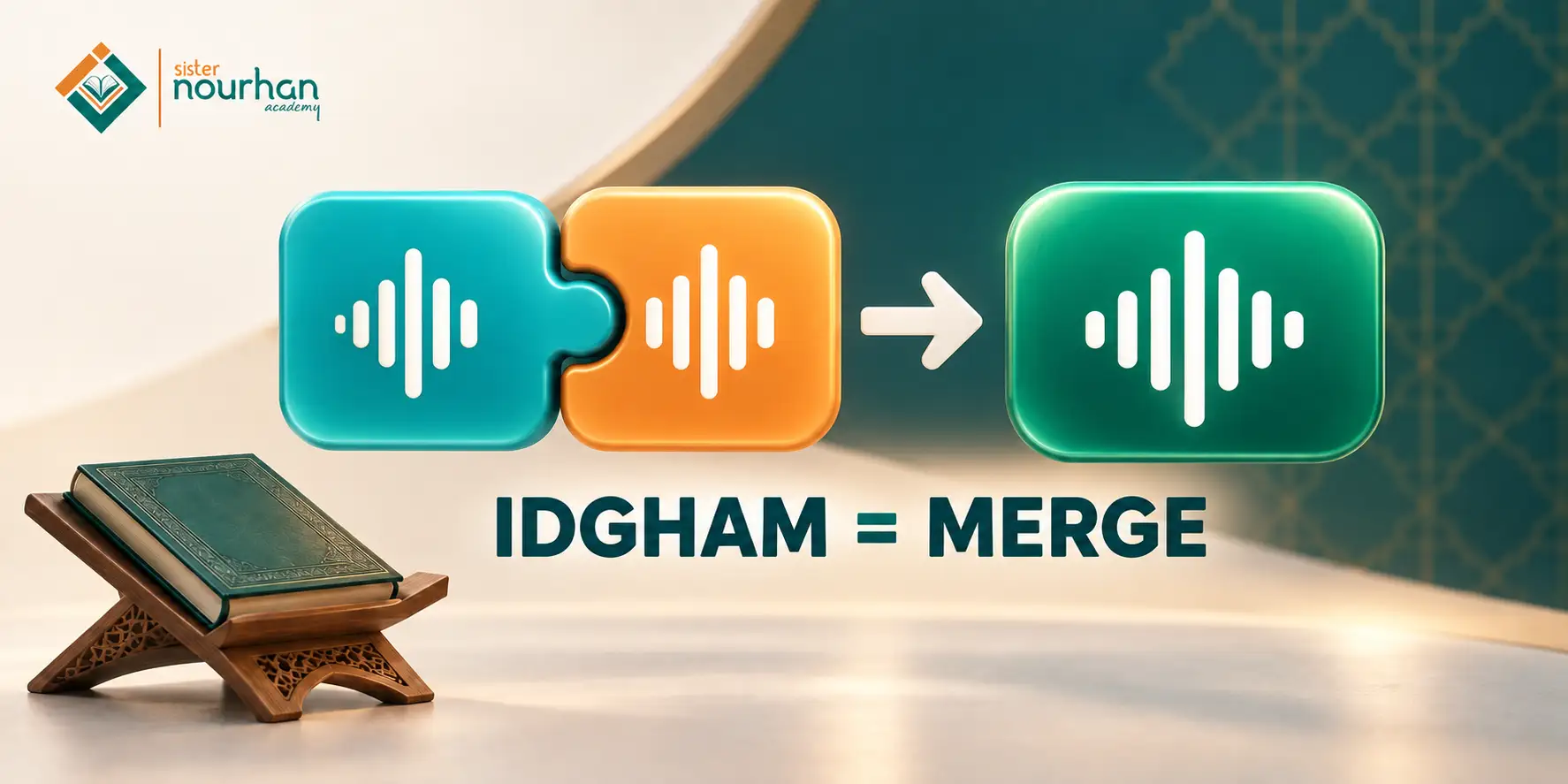
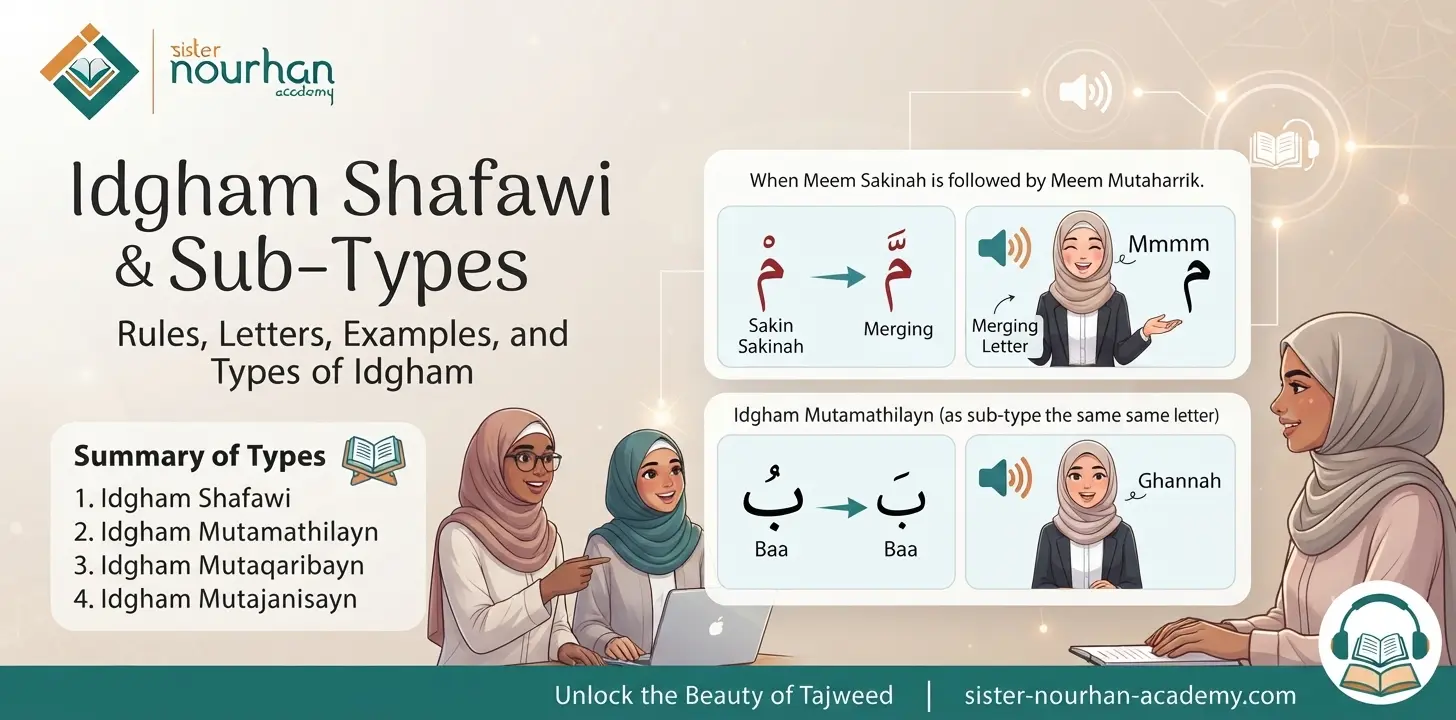
Idgham Shafawi & Sub-Types are part of the Tajweed system that teaches a reciter when sounds should merge rather than be pronounced separately. Idgham Shafawi specifically occurs when a Meem Sakinah (مْ) is followed by another Meem (م).
The two Meems merge into one emphasized Meem with Ghunnah, creating a smooth transition without separating the first Meem from the second.
Understanding this rule becomes easier when you distinguish Idgham Shafawi from broader types of Idgham, including Idgham Mutamasilain, Mutajanisain, Mutaqaribain, Kamil, and Naqis.
Tajweed itself is the system governing accurate Quranic pronunciation, including letter articulation, elongation, merging, and related recitation rules.
What Is Idgham Shafawi?
Idgham Shafawi is the merging of a silent Meem (مْ) into a following Meem (م), producing one strengthened Meem accompanied by Ghunnah.
The word Idgham (إدغام) means merging or assimilation, while Shafawi (شفوي) comes from shafah, meaning “lip.” The name reflects the fact that the Meem is articulated through the lips.
What Are the Idgham Shafawi Letters?
There is only one Idgham Shafawi trigger letter: م (Meem)
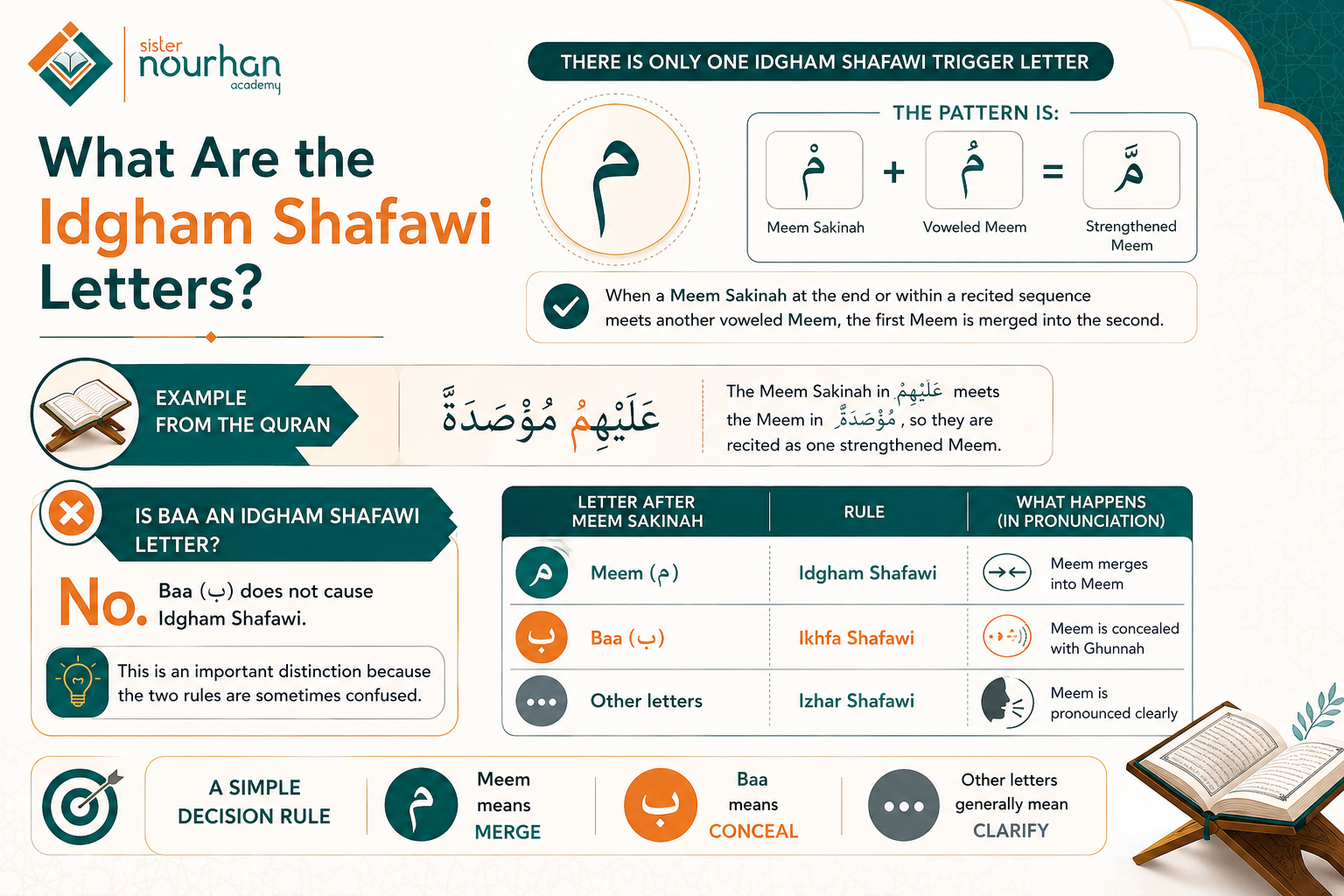
The pattern is:
مْ + م = مّ
When a Meem Sakinah at the end or within a recited sequence meets another voweled Meem, the first Meem is merged into the second.
For example:
عَلَيْهِم مُّؤْصَدَةٌ
The Meem Sakinah in عَلَيْهِمْ meets the Meem in مُّؤْصَدَةٌ, so they are recited as one strengthened Meem.
Is Baa an Idgham Shafawi Letter?
No. Baa (ب) does not cause Idgham Shafawi.
This is an important distinction because the two rules are sometimes confused:
A useful decision rule is therefore simple: Meem means merge, Baa means conceal, and the other letters generally mean clarify.
How Is Idgham Shafawi Pronounced?
Close the lips for the merged Meem without separating the two letters into two independent sounds.
The resulting Meem carries a Ghunnah, or nasal resonance, commonly practiced for two counts. The sound should remain controlled rather than exaggerated.
A common student mistake is to pronounce:
هُمْ | مِّن
as two disconnected Meems.
The correct application treats the transition as a single intensified Meem:
هُم مِّن
The lips meet once for the merged sound while the Ghunnah is maintained.
Idgham Shafawi Examples in the Quran
Studying Idgham Shafawi examples trains the eye to recognize the pattern before the tongue attempts to pronounce it.
The key is always to find مْ at the end of the first sound followed immediately by م at the beginning of the next.
How Do You Spot Idgham Shafawi Quickly?
Use a three-check method:
Find a Meem with Sukoon (مْ).
Look immediately at the next letter.
If that letter is Meem, merge them and apply Ghunnah.
Do not decide from the appearance of a Shaddah alone. Identify the underlying letter relationship first; the Mushaf notation helps show pronunciation, but understanding the rule lets you recognize it independently.
Practitioner note: students often learn the definition correctly but miss the rule while reading because they look only at individual words. Train yourself to scan the boundary between two words, where many Idgham Shafawi cases occur.
Shots from Our Classes
Take a moment to view the video below to see how our teachers provide clear, supportive corrections during a session.
Begin Your Quranic Journey
Connect with the words of Allah through personalized sessions at Sister Nourhan Academy.
Book Your Free TrialWhat Are the Main Types of Idgham Beyond Idgham Shafawi?
The broader types of Idgham can also be classified according to the relationship between the two letters that meet.
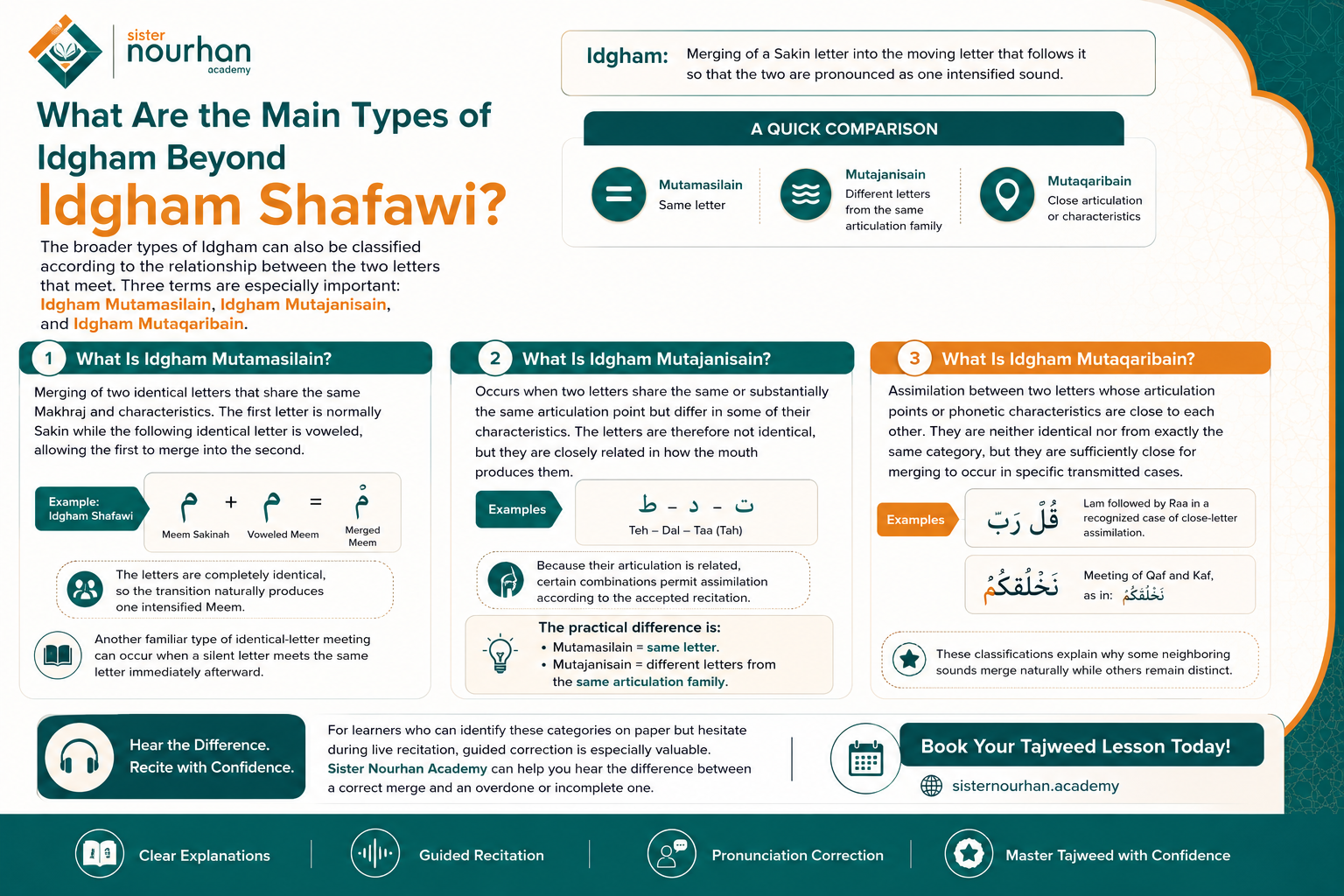
Three terms are especially important: Idgham Mutamasilain, Idgham Mutajanisain, and Idgham Mutaqaribain.
1- What Is Idgham Mutamasilain?
Idgham Mutamasilain is the merging of two identical letters that share the same Makhraj and characteristics.
The first letter is normally Sakin while the following identical letter is voweled, allowing the first to merge into the second.
Idgham Shafawi is a clear example:
مْ + م
The letters are completely identical, so the transition naturally produces one intensified Meem.
Another familiar type of identical-letter meeting can occur when a silent letter meets the same letter immediately afterward.
2- What Is Idgham Mutajanisain?
Idgham Mutajanisain occurs when two letters share the same or substantially the same articulation point but differ in some of their characteristics.
The letters are therefore not identical, but they are closely related in how the mouth produces them.
Examples discussed in Tajweed include meetings among letters from closely connected articulation groups, such as:
ت – د – ط
Example:"قَد تَّبَيَّنَ
Because their articulation is related, certain combinations permit assimilation according to the accepted recitation.
The practical difference is:Mutamasilain = same letter.
Mutajanisain = different letters from the same articulation family.
3- What Is Idgham Mutaqaribain?
Idgham Mutaqaribain is assimilation between two letters whose articulation points or phonetic characteristics are close to each other.
They are neither identical nor from exactly the same category, but they are sufficiently close for merging to occur in specific transmitted cases.
A well-known example is:
قُل رَّبِّ
Here, the Lam is followed by Raa in a recognized case of close-letter assimilation.
Another commonly studied example involves Qaf and Kaf, as in:
نَخْلُقكُّم
The value of these classifications is not merely memorizing Arabic terminology. They explain why some neighboring sounds merge naturally while others remain distinct.
For learners who can identify these categories on paper but hesitate during live recitation, guided correction is especially valuable. Sister Nourhan Academy can help you hear the difference between a correct merge and an overdone or incomplete one.

Why Is Idgham Shafawi Also Called Idgham Mutamasilain?
Idgham Shafawi is an example of Idgham Mutamasilain because the two letters involved are identical: Meem followed by Meem.
Mutamasilain means “two identical letters.” They share both the same articulation point and the same characteristics.
This gives students an important classification shortcut:
Every Meem-Sakinah-to-Meem Idgham Shafawi is a meeting of identical letters.
If identifying Tajweed rules from the Mushaf still feels difficult, Sister Nourhan Academy can help you move from memorizing definitions to recognizing and applying the rules during real Quran recitation.
What Is the Difference Between Idgham Kamil and Naqis?
Idgham Kamil and Naqis classify Idgham according to how completely the characteristics of the first letter disappear during assimilation.
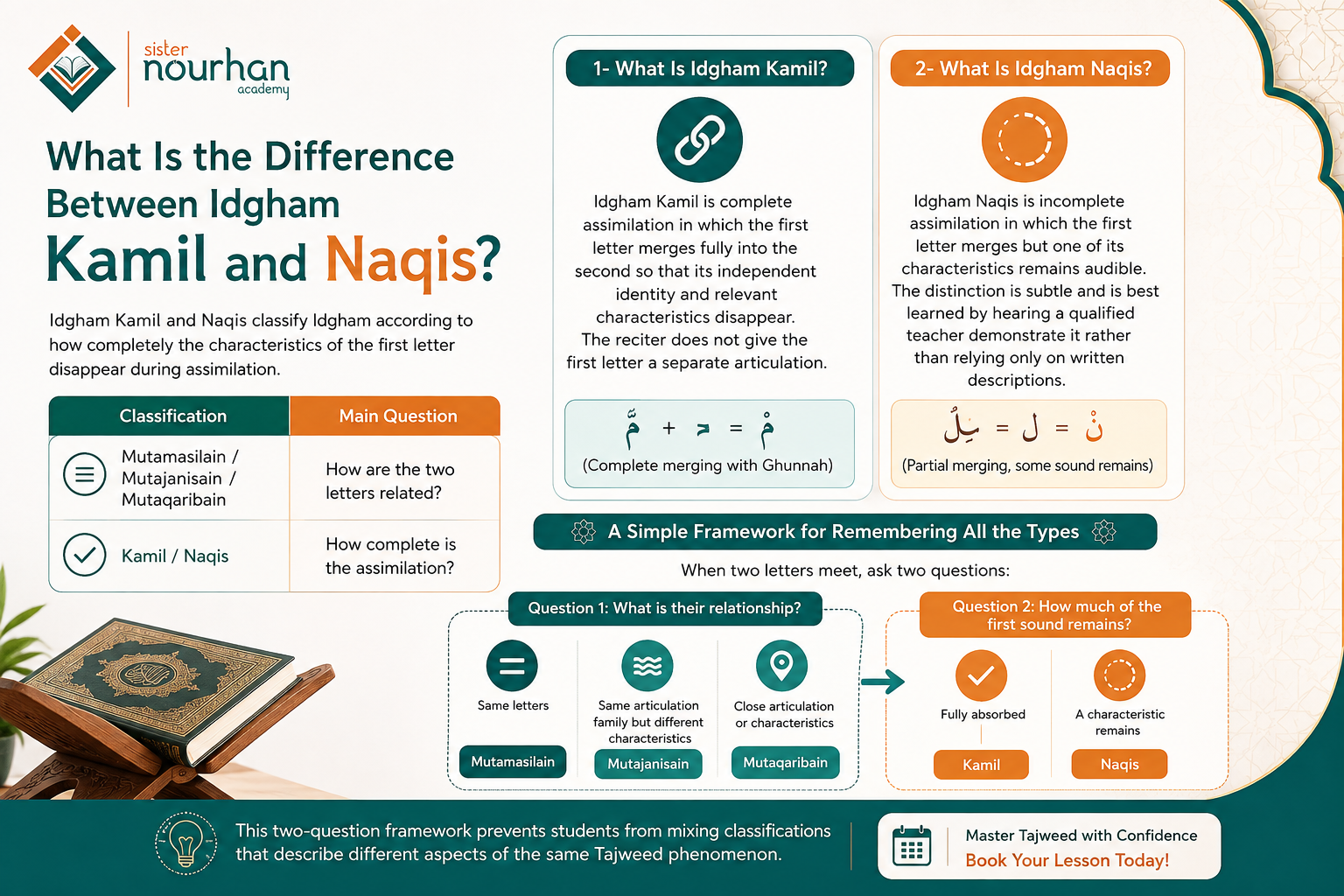
This classification answers a different question from Mutamasilain, Mutajanisain, and Mutaqaribain.
1- What Is Idgham Kamil?
Idgham Kamil is complete assimilation in which the first letter merges fully into the second so that its independent identity and relevant characteristics disappear.
The reciter does not give the first letter a separate articulation.
This is why complete Idgham should sound like one strengthened second letter rather than two letters pronounced rapidly beside one another.
Read also: Teaching Tajweed for Children Made Easy: 7 Practical Steps
2- What Is Idgham Naqis?
Idgham Naqis is incomplete assimilation in which the first letter merges but one of its characteristics remains audible.
The distinction is subtle and is best learned by hearing a qualified teacher demonstrate it rather than relying only on written descriptions.
A frequent source of confusion is treating Kamil and Naqis as separate “Idgham Shafawi sub-types.” They are better understood as broader analytical classifications of assimilation.
A Simple Framework for Remembering All the Types
When two letters meet, ask two questions:
Question 1: What is their relationship?
Same letters → Mutamasilain
Same articulation family but different characteristics → Mutajanisain
Close articulation or characteristics → Mutaqaribain
Question 2: How much of the first sound remains?
Fully absorbed → Kamil
A characteristic remains → Naqis
This two-question framework prevents students from mixing classifications that describe different aspects of the same Tajweed phenomenon.
Common Idgham Shafawi Mistakes to Avoid
Knowing the rule does not automatically produce correct recitation. Most errors happen during the transition between the two letters.
Confusing Baa with Meem: Baa after Meem Sakinah produces Ikhfa Shafawi, not Idgham Shafawi.
Pronouncing two separate Meems: the first Meem should merge rather than receive its own independent beat.
Dropping the Ghunnah: the merged Meem requires the nasal quality associated with the strengthened Meem.
Overholding the Ghunnah: more nasal sound is not necessarily better; keep the timing controlled.
Closing the lips twice: this often reveals that the student is still treating the Meems as separate letters.
Memorizing labels without listening: Tajweed is ultimately an applied recitation discipline, so accurate listening and teacher correction matter.
The best practice drill is to isolate the word boundary first, repeat it slowly until the merging feels natural, and then place the phrase back into the full Ayah.
See our teaching methods
Experience the quality of our instruction firsthand by watching a live lesson snippet below.
Begin Your Quranic Journey
Connect with the words of Allah through personalized sessions at Sister Nourhan Academy.
Book Your Free TrialStart Mastering Idgham Shafawi with Sister Nourhan Academy
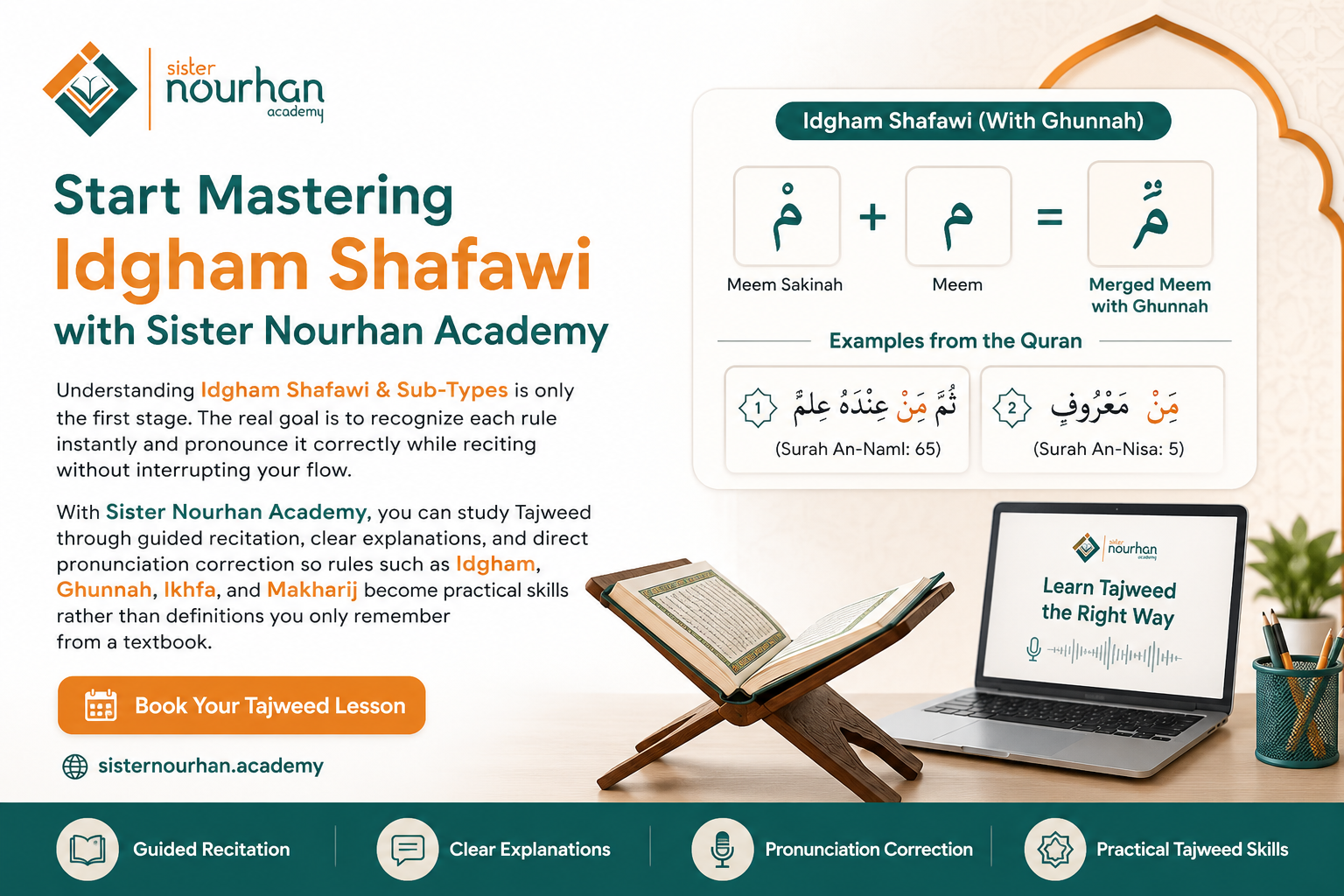
Understanding Idgham Shafawi & Sub-Types is only the first stage. The real goal is to recognize each rule instantly and pronounce it correctly while reciting without interrupting your flow.
With Sister Nourhan Academy, you can study Tajweed through guided recitation, clear explanations, and direct pronunciation correction so rules such as Idgham, Ghunnah, Ikhfa, and Makharij become practical skills rather than definitions you only remember from a textbook.
Discover our Tajweed Courses
Conclusion
Idgham Shafawi occurs when Meem Sakinah (مْ) meets another Meem (م), causing the first Meem to merge into the second with Ghunnah. Its single trigger letter makes the rule easy to identify once the correct pattern is understood.
The broader types of Idgham explain different relationships between letters. Mutamasilain concerns identical letters, Mutajanisain concerns related articulation points, and Mutaqaribain concerns letters that are close phonetically. Kamil and Naqis, meanwhile, describe whether assimilation is complete or whether part of the first letter's characteristics remains.
Learning these distinctions helps transform Tajweed from a collection of names into a logical system you can hear and apply during Quran recitation.
Frequently Asked Questions
What is Idgham Shafawi?
Idgham Shafawi is the Tajweed rule in which a Meem Sakinah (مْ) merges into a following Meem (م). The two Meems are pronounced as one strengthened Meem with Ghunnah.
What are the Idgham Shafawi letters?
There is only one Idgham Shafawi letter: Meem (م). When Meem Sakinah is followed by Meem, Idgham Shafawi applies.
Is Meem Sakinah followed by Baa Idgham Shafawi?
No. Meem Sakinah followed by Baa (ب) is Ikhfa Shafawi, not Idgham Shafawi. Meem followed by Meem is Idgham Shafawi.
What is the difference between Idgham Mutamasilain and Mutajanisain?
Mutamasilain involves two identical letters, while Mutajanisain involves different letters that share the same or closely related articulation point but have different characteristics.
What is Idgham Mutaqaribain?
Idgham Mutaqaribain is assimilation between two letters that are close in articulation point or phonetic characteristics, such as particular Lam-Raa and Qaf-Kaf combinations transmitted in Tajweed.
What is the difference between Idgham Kamil and Naqis?
Idgham Kamil is complete assimilation, where the first letter loses its independent identity and relevant characteristics. Idgham Naqis is incomplete assimilation, where the first letter merges but one of its characteristics remains audible.