

Izhar Mutlaq with examples becomes easy to understand once you remember one distinction: when Noon Sakinah (نْ) is followed by Waw (و) or Ya (ي) inside the same word, the Noon remains clear instead of merging into the next letter.
This rule is unusual because Waw and Ya normally trigger Idgham with Ghunnah when they follow Noon Sakinah across two separate words. Izhar Mutlaq is the important exception to that pattern.
Even better, you do not need to memorize dozens of examples. The rule occurs in only four Quranic words: الدُّنْيَا، بُنْيَان، قِنْوَان، صِنْوَان.
Understanding why these four words behave differently helps you recognize the rule instantly instead of relying on memorization alone.
What Is Izhar Mutlaq in Tajweed?
Izhar Mutlaq is a Tajweed rule in which Noon Sakinah (نْ) is pronounced clearly when followed by Waw (و) or Ya (ي) within the same word, instead of being merged into the following letter as it normally would when the same combination occurs across two separate words.
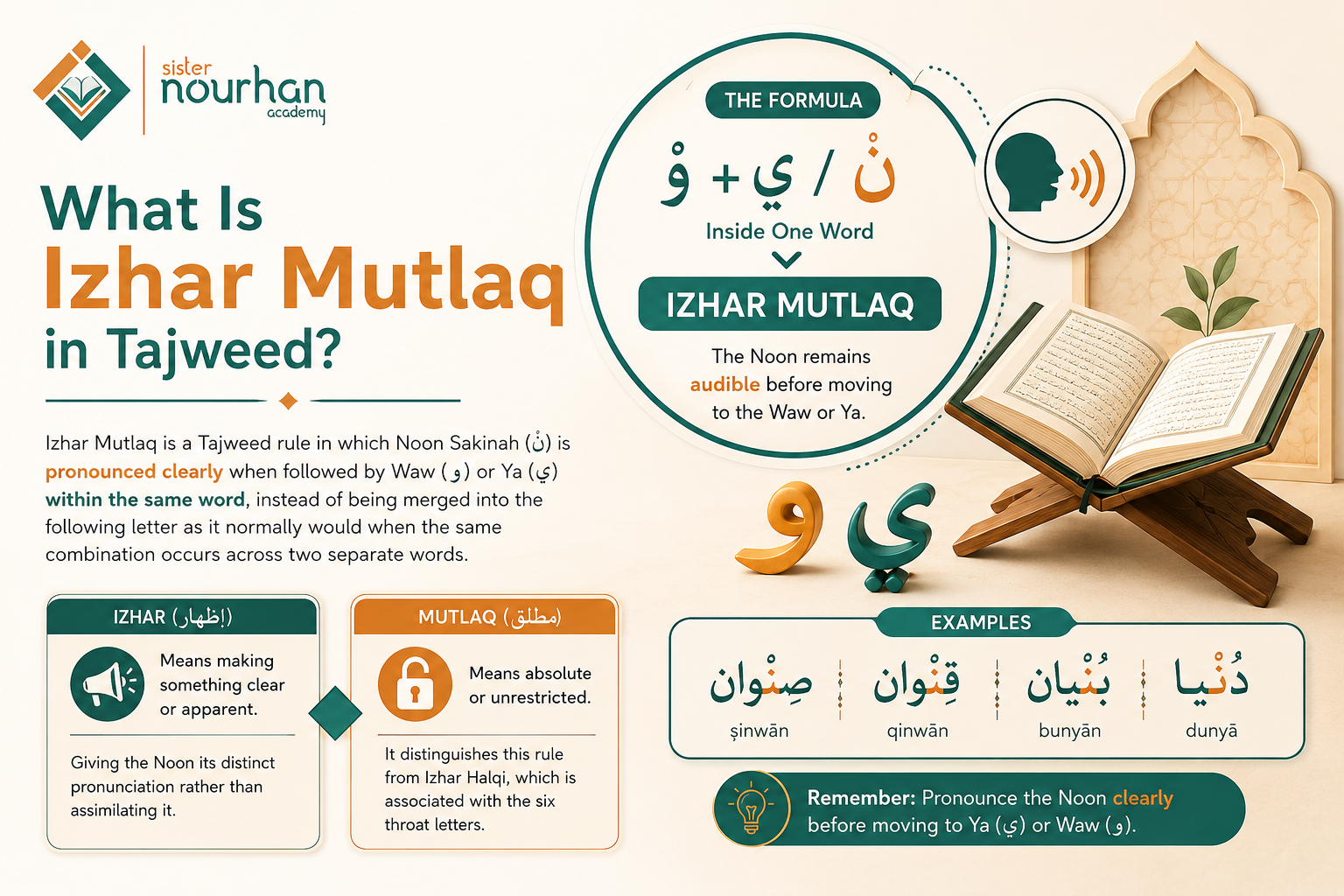
The Arabic word Izhar (إظهار) means making something clear or apparent. In Tajweed, it refers to giving the Noon its distinct pronunciation rather than assimilating it into the next letter.
Mutlaq (مطلق) means absolute or unrestricted. The term distinguishes this rule from Izhar Halqi, which is associated specifically with the six throat letters.
A useful formula is:
نْ + ي or و inside one word = Izhar Mutlaq
The Noon remains audible before moving to the Waw or Ya.
What Are the Izhar Mutlaq Letters?
There are only two letters associated with Izhar Mutlaq:
ي — Ya
و — Waw
However, seeing one of these letters after Noon Sakinah is not enough by itself. You must also check the word boundary.
This creates one of the most useful decision rules in this topic:
Same word = show the Noon. Two words = merge the Noon.
For learners who repeatedly confuse these patterns, hearing them demonstrated by a teacher can make the distinction much easier to reproduce during continuous recitation.
See our teaching methods
Experience the quality of our instruction firsthand by watching a live lesson snippet below.
Begin Your Quranic Journey
Connect with the words of Allah through personalized sessions at Sister Nourhan Academy.
Book Your Free TrialWhy Does Izhar Mutlaq Apply Instead of Idgham?
Izhar Mutlaq exists because Idgham of Noon Sakinah into Waw or Ya applies between two words rather than within one word.
Merging the Noon inside words such as الدُّنْيَا or بُنْيَان would remove the distinct Noon sound and change the established pronunciation of the word.
The rule therefore preserves the word's phonetic structure and follows the transmitted method of Quranic recitation.
This is why memorizing only the phrase “Ya and Waw are Idgham letters” can cause mistakes. That rule needs an additional condition:
Ya or Waw triggers Idgham after Noon Sakinah when the two occur in separate words.
When Noon Sakinah and either letter appear together in the same word in the four established Quranic words, Izhar Mutlaq applies instead.
At Sister Nourhan Academy, students receive focused teacher support, real-time correction, and personalized practice designed around their individual recitation needs.
Build stronger pronunciation and apply rules like Izhar Mutlaq confidently through our 1-on-1 Private Quran Lessons Online, where every lesson gives you dedicated time to improve your Quran recitation.

What Are the Izhar Mutlaq Examples in the Quran?
There are four words associated with Izhar Mutlaq in the Quran: بُنْيَان، قِنْوَان، صِنْوَان، and الدُّنْيَا. In each word, the Noon Sakinah is followed by either Ya or Waw but remains clearly pronounced rather than being merged.
Learning these four words as a single set is often faster than trying to identify the rule from scratch every time you encounter one.
1. بُنْيَانٌ — Bunyan
بُنْيَانٌ
In بُنْيَان, the Noon Sakinah نْ is immediately followed by Ya (ي) inside the same word.
Therefore:
نْ + ي in one word → Izhar Mutlaq
An example appears in Surah As-Saff:
كَأَنَّهُم بُنْيَانٌ مَّرْصُوصٌ
The Noon must remain clearly audible before transitioning to the Ya.
The practical mistake to avoid is allowing نْي to collapse into a merged Ya sound.
2. قِنْوَانٌ — Qinwan
قِنْوَانٌ
Here, Noon Sakinah is followed by Waw (و) inside one word:
نْ + و in one word → Izhar Mutlaq
The word appears in Surah Al-An'am:
قِنْوَانٌ دَانِيَةٌ
Pronounce the Noon distinctly, then move directly to the Waw without assimilating the two letters.
3. صِنْوَانٌ — Sinwan
صِنْوَانٌ
The same pattern occurs in صِنْوَان:
نْ + و → Izhar Mutlaq
It appears in Surah Ar-Ra'd:
صِنْوَانٌ وَغَيْرُ صِنْوَانٍ
The word appears twice in this passage, making the verse particularly useful for practicing the Noon-to-Waw transition.
A good drill is to isolate صِنْوَان first, establish the Noon clearly, and only then recite the complete phrase.
4. الدُّنْيَا — Ad-Dunya
الدُّنْيَا
This is often the most recognizable Izhar Mutlaq example because the word appears repeatedly throughout Quranic recitation.
The relevant sequence is:
نْ + ي
Since both occur inside الدُّنْيَا, the Noon is pronounced clearly.
One Quranic example is:
أُولَٰئِكَ الَّذِينَ اشْتَرَوُا الْحَيَاةَ الدُّنْيَا بِالْآخِرَةِ
The mistake to watch for is allowing the Noon to disappear into the Ya. Keep دُنْـ distinct before continuing into ـيَا.
If you can pronounce الدُّنْيَا correctly and immediately recognize why it uses Izhar rather than Idgham, you have understood the central logic of the entire rule.
Read also: What is Qalqalah in Tajweed?
How Is Izhar Mutlaq Different from Idgham?
Izhar Mutlaq keeps Noon Sakinah clearly pronounced before Waw or Ya inside one word, while Idgham merges Noon Sakinah into Waw or Ya when the letters occur across two separate words.
The letters may be identical. The location changes the ruling.
This produces a very practical Tajweed decision framework:
Find the Noon Sakinah.
Look at the letter immediately after it.
If it is Waw or Ya, check whether both letters belong to one word.
If they are in one word and the word is one of the four established cases, apply Izhar Mutlaq.
If they occur across two words, apply the relevant Idgham with Ghunnah rule.
This word-boundary check is more reliable than memorizing “Waw and Ya equal Idgham” without understanding the condition behind it.
Students who want to turn rules like these into automatic recitation can use structured Tajweed practice with Sister Nourhan Academy to hear the contrast and receive correction while reading real Quranic passages.
How Should You Pronounce Izhar Mutlaq Correctly?
Correct Izhar Mutlaq requires a recognizable Noon sound followed by a clean transition into Waw or Ya.
The Noon Sakinah should not disappear through Idgham, but it should not be exaggerated or artificially prolonged either.
Pronounce the Noon from Its Correct Makhraj
The Noon is articulated with the tip of the tongue contacting the area behind the upper front teeth.
Establish the Noon clearly before leaving its articulation point and moving toward the following Waw or Ya. The attached source specifically emphasizes full articulation of the Noon rather than allowing it to merge into the next letter.
Do Not Add an Idgham Ghunnah
The most important practical distinction is that you should not treat the combination as Idgham with Ghunnah.
Izhar means clarity. The goal is therefore to preserve the identity of the Noon rather than blend it into Waw or Ya.
This does not mean producing an unnatural, stretched Noon. Pronounce it normally and clearly, then continue.
Memorize the Four Words as Visual Triggers
Because the rule is restricted to only four words, one of the fastest practice methods is to memorize them together:
الدُّنْيَا — بُنْيَان — قِنْوَان — صِنْوَان
Then divide them by the following letter:
Before Ya (ي):
الدُّنْيَا
بُنْيَان
Before Waw (و):
قِنْوَان
صِنْوَان
This two-by-two grouping reduces the amount of information you need to process while reciting.
Turn Tajweed rules into confident, accurate recitation with Sister Nourhan Academy’s Advanced Tajweed Course for Adults. Learn with experienced teachers who provide practical pronunciation correction, personalized guidance, and focused practice on advanced rules such as Izhar Mutlaq.
Our students’ positive feedback and satisfaction with the learning experience reflect the quality of instruction, teacher support, and personalized attention provided throughout their Tajweed journey.

Avoid These Common Izhar Mutlaq Mistakes
A learner can understand the definition yet still apply the rule incorrectly in live recitation.
Common mistakes include:
Applying Idgham simply because the following letter is Waw or Ya
Allowing the Noon in الدُّنْيَا to disappear
Adding an exaggerated nasal sound
Stretching the Noon longer than necessary
Memorizing the four words without understanding the same-word condition
Looking only at the next letter without checking the word boundary
The most useful correction question is therefore:
“Are Noon Sakinah and Waw or Ya inside the same word?”
That single check resolves most confusion.
How Is Izhar Mutlaq Different from Other Types of Izhar?
Izhar rules all involve clear pronunciation, but they do not govern the same letters or conditions.
The distinctive feature of Izhar Mutlaq is therefore structural: the word boundary determines the ruling.
Izhar Halqi is identified mainly by the following throat letter, while Izhar Shafawi concerns Meem Sakinah. Izhar Mutlaq is the special same-word exception students need when learning the relationship between Noon Sakinah and the Idgham letters Waw and Ya.
If rules begin to feel similar on paper, practicing them side by side in Sister Nourhan Academy's Tajweed lessons can help turn technical distinctions into sounds you can recognize naturally while reciting.
Shots from Our Classes
Take a moment to view the video below to see how our teachers provide clear, supportive corrections during a session.
Begin Your Quranic Journey
Connect with the words of Allah through personalized sessions at Sister Nourhan Academy.
Book Your Free TrialStart Mastering Izhar Mutlaq with Sister Nourhan Academy
Reading about Izhar Mutlaq helps you recognize the rule. Hearing your own pronunciation corrected helps you apply it consistently.
Study Tajweed with Sister Nourhan Academy and practice Noon Sakinah rules through guided recitation, direct examples, and teacher feedback so that Izhar, Idgham, Ikhfa, and Iqlab become practical skills rather than definitions you only memorize.
Our Courses

Conclusion
Izhar Mutlaq is the clear pronunciation of Noon Sakinah when Waw (و) or Ya (ي) follows it within the same word.
The four key Quranic words are:
الدُّنْيَا — بُنْيَان — قِنْوَان — صِنْوَان
The most important principle is not simply memorizing these examples. Understand the boundary rule: Waw or Ya after Noon Sakinah inside these words requires Izhar, while the corresponding combination across two words normally leads to Idgham with Ghunnah.
Once that distinction becomes automatic, Izhar Mutlaq is one of the simplest Noon Sakinah rules to identify during Quran recitation.
Frequently Asked Questions
What is Izhar Mutlaq?
Izhar Mutlaq is the clear pronunciation of Noon Sakinah before Waw or Ya when both letters occur within the same word. The Noon is not merged into the following letter.
How many Izhar Mutlaq letters are there?
There are two Izhar Mutlaq letters: Waw (و) and Ya (ي). They create this ruling only when they follow Noon Sakinah within the specific same-word pattern.
What are the four examples of Izhar Mutlaq?
The four Izhar Mutlaq words are الدُّنْيَا, بُنْيَان, قِنْوَان, and صِنْوَان. The first two contain Noon Sakinah before Ya, while the last two contain Noon Sakinah before Waw.
What is the difference between Izhar Mutlaq and Idgham?
Izhar Mutlaq occurs inside one word, while Idgham with Waw or Ya occurs across two words. In Izhar Mutlaq the Noon remains clear; in Idgham the Noon merges into the following letter.
Does Izhar Mutlaq have Ghunnah?
Izhar Mutlaq does not use the added Ghunnah associated with Idgham with Ghunnah. Pronounce the Noon naturally and distinctly without blending or unnecessarily prolonging it.
Why is it called Izhar Mutlaq?
It is called Izhar because the Noon is pronounced clearly, and Mutlaq because this form of Izhar is distinguished from rules tied to categories such as the throat letters in Izhar Halqi.