

You have probably recited Surah Al-Fatihah hundreds of times — but did you notice that the letter noon almost never sounds the same twice? That single letter changes shape, softens, hides, and sometimes disappears completely.
That is exactly what the Noon Sakinah & Tanween Rules govern: four precise ways your tongue is meant to behave when a silent noon meets the letter after it. Get them right, and your recitation instantly sounds settled and correct.
At Sister Nourhan Academy, this is one of the first chapters our students master with a qualified female tutor, because it fixes more recitation mistakes than any other single lesson in Tajweed.
In the next few minutes, you will learn all four rules, their letters, and real Quranic examples — explained in plain English, with no confusing terminology left unexplained.
What You Will Learn in This Article:
What Noon Sakinah & Tanween rules actually are, and how they differ.
The four rules — Izhar, Idgham, Iqlab, and Ikhfa — with their letters.
Clear tanween examples from the Quran for every single rule.
The most common pronunciation mistakes and how to correct them fast.
A simple daily practice plan you can start tonight.
Noon Sakinah & Tanween Rules: What They Actually Mean
Before the four rules make sense, you need to be able to spot the two sounds they apply to. They look different on the page but behave almost identically on the tongue.
What Is Noon Sakin?
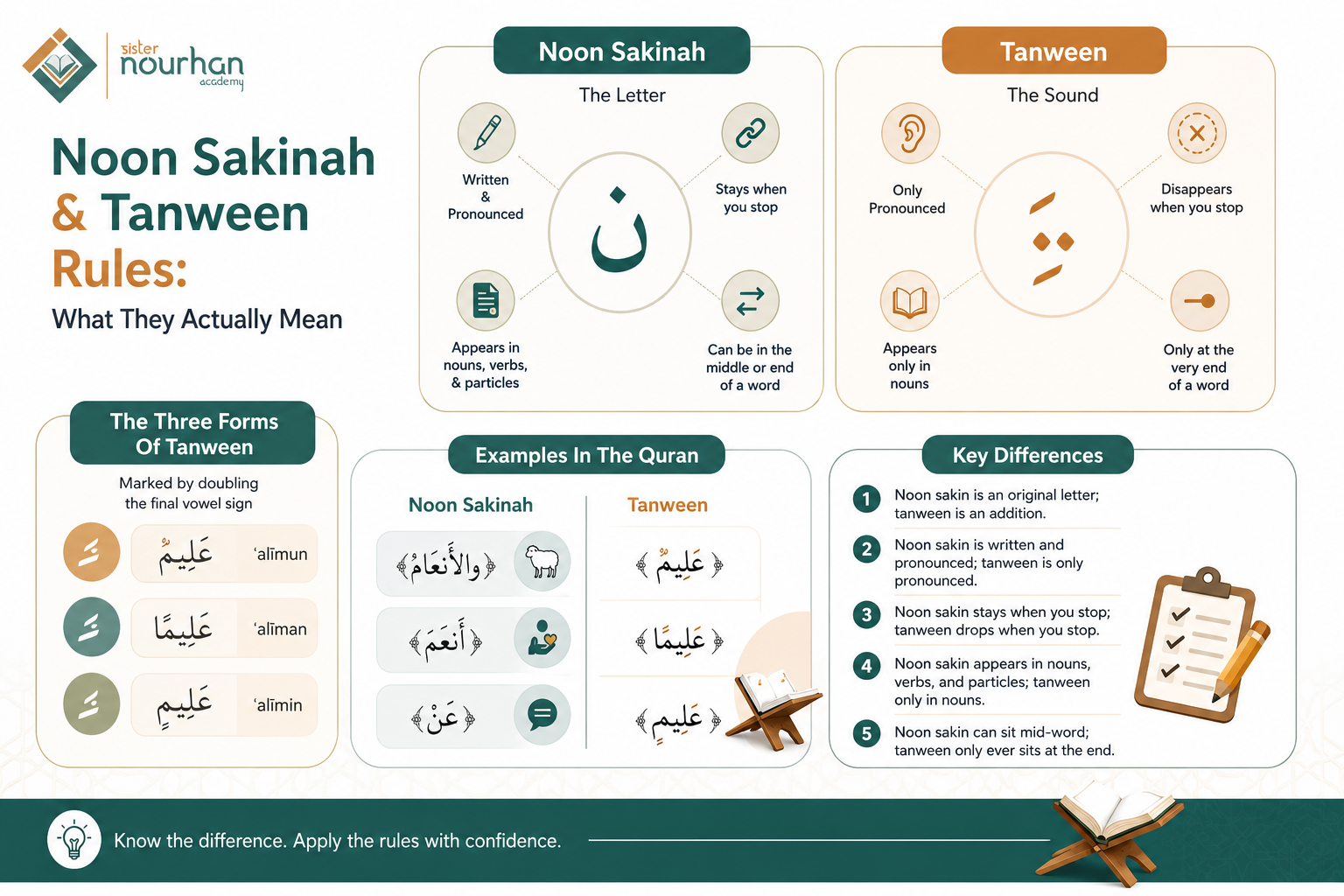
Noon sakin is the letter ن carrying no vowel — no fathah, dammah, or kasrah. It is written, pronounced, and stays fixed whether you continue reading or stop.
It can appear in nouns, verbs, and particles, and it can sit either in the middle of a word or at its end. Examples: ﴿وَالْأَنْعَامُ﴾, ﴿أَنْعَمَ﴾, and ﴿عَنْ﴾.
What Is Tanween?
Tanween is an extra silent noon sound added to the end of a noun — pronounced but never written as a letter. It appears only when you continue reciting, and it disappears the moment you stop.
The tanween meaning in Arabic grammar comes from tanwīn, "to make a sound." That is the whole idea: a sound with no written letter of its own.
The Three Forms Of Tanween In Arabic
Tanween is marked by doubling the final vowel sign, which gives you three forms:
Two dammahs: ﴿عَلِيمٌ﴾ — pronounced ʿalīmun.
Two fathahs: ﴿عَلِيمًا﴾ — pronounced ʿalīman.
Two kasrahs: ﴿عَلِيمٍ﴾ — pronounced ʿalīmin.
The Difference Between Noon Saakin And Tanween
Understanding the noon saakin and tanween rules is easier once you see where the two part ways. Scholars list five clear differences:
Noon sakin is an original letter; tanween is an addition.
Noon sakin is written and pronounced; tanween is only pronounced.
Noon sakin stays when you stop; tanween drops when you stop.
Noon sakin appears in nouns, verbs, and particles; tanween only in nouns.
Noon sakin can sit mid-word; tanween only ever sits at the very end.
Related read: How To Learn To Read The Quran In Arabic? A Complete Beginner's Guide
Shots from Our Classes
Take a moment to view the video below to see how our teachers provide clear, supportive corrections during a session.
Begin Your Quranic Journey
Connect with the words of Allah through personalized sessions at Sister Nourhan Academy.
Book Your Free TrialUnderstanding the 4 Noon Sakinah & Tanween Rules with Examples
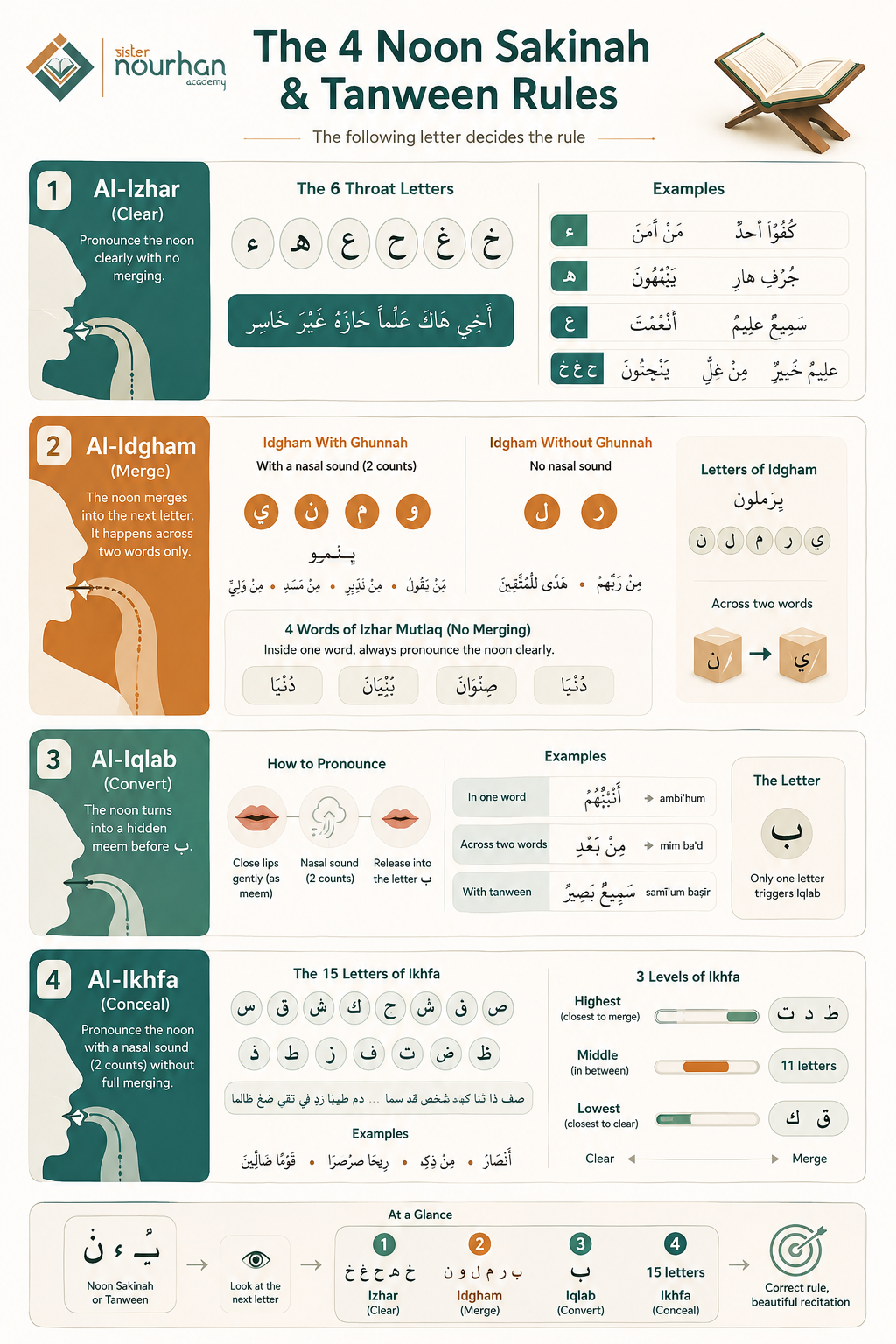
Whatever letter follows the silent noon decides which of four rules applies. There are no exceptions to memorise beyond four small words, which we will cover shortly.
The four rules are Izhar (clear), Idgham (merged), Iqlab (converted), and Ikhfa (concealed). For the classical framing of this chapter, the Egyptian Ministry of Endowments' Tajweed reference section presents them with full evidences.
Rule 1 – Al-Izhar (Clear Pronunciation)
Izhar means clarity. You pronounce the noon sakin or tanween plainly from its exit point, with no extra nasal sound stretched onto it.
The Six Throat Letters
Izhar happens when the noon is followed by one of six letters that all come from the throat: ء، هـ، ع، ح، غ، خ. They are collected in the phrase "أخي هاك علماً حازه غير خاسر."
The reason is distance: the noon exits from the tip of the tongue, while these six exit from the throat. Two far-apart exits cannot merge, so the noon simply stays clear.
Izhar Examples
Here is how the rule looks in the Quran, with both noon sakin and tanween:
With ء: ﴿مَنْ آمَنَ﴾ and ﴿كُفُوًا أَحَدٌ﴾.
With هـ: ﴿يَنْهَوْنَ﴾ and ﴿جُرُفٍ هَارٍ﴾.
With ع: ﴿أَنْعَمْتَ﴾ and ﴿سَمِيعٌ عَلِيمٌ﴾.
With ح، غ، خ: ﴿يَنْحِتُونَ﴾, ﴿مِنْ غِلٍّ﴾, ﴿عَلِيمٌ خَبِيرٌ﴾.
Rule 2 – Al-Idgham (Merging)
Idgham means inserting one thing into another. The noon dissolves into the following letter, and the two become a single stressed letter.
Its six letters are gathered in the word يرملون (ي، ر، م، ل، و، ن), and it only ever occurs across two words — never inside one. It then splits into two types.
Idgham With Ghunnah
This applies to four letters collected in ينمو (ي، ن، م، و). The noon merges into them while a nasal hum, or ghunnah, is held for the length of two counts.
Examples: ﴿مَنْ يَقُولُ﴾, ﴿مِنْ نَذِيرٍ﴾, ﴿مِنْ مَسَدٍ﴾, and ﴿مِنْ وَلِيٍّ﴾. Scholars call the merge into و and ي incomplete, because the letter goes but its nasal quality stays.
Read also: What Are the Types of Idgham?
Idgham Without Ghunnah
This applies to only two letters: ل and ر. Here the noon vanishes completely with no nasal hum at all, which is why it is called complete idgham.
Examples: ﴿مِنْ رَبِّهِمْ﴾ is read mir-rabbihim, and ﴿هُدًى لِلْمُتَّقِينَ﴾ is read hudal-lilmuttaqīn.
The Four Words Where Idgham Does Not Apply
When one of these six letters follows a noon sakin inside a single word, you must pronounce the noon clearly instead. This is called Izhar Mutlaq.
It occurs in exactly four Quranic words: دُنْيَا، بُنْيَان، صِنْوَان، قِنْوَان. Merging them would blur the word's original root and change its meaning.
Stop guessing which noon merges and which one stays. Our Learn Quran with Tajweed for Sisters course at Sister Nourhan Academy drills every rule until it becomes automatic.

Explore more on this topic: Idgham With Ghunnah & Without Ghunnah - Letters, Rules, and Quran Examples
Rule 3 – Al-Iqlab (Conversion Into Meem)
Iqlab means turning something from its original form. The noon sakin or tanween is converted into a hidden م whenever the letter ب follows it — and it has that one letter only.
How To Pronounce Iqlab
Bring your lips gently together as if saying meem, hold a two-count ghunnah, then release into the ba. The lips should touch lightly, never press hard.
The reason is practical: holding a clear noon and then closing the lips for ba is physically awkward, so the meem acts as a comfortable bridge between the two exits.
Iqlab Examples
The rule shows up in three positions, and each one is read the same way:
In one word: ﴿أَنْبِئْهُمْ﴾ is read ambi'hum.
Across two words: ﴿مِنْ بَعْدِ﴾ is read mim baʿd.
With tanween: ﴿سَمِيعٌ بَصِيرٌ﴾ is read samīʿum baṣīr.
Rule 4 – Al-Ikhfa (Concealment)
Ikhfa means to conceal. You pronounce the noon somewhere between clear and merged — no full contact of the tongue, but the ghunnah is held for two counts.
It is the most frequent of the four rules in the Quran, simply because it covers the largest group of letters.
The Fifteen Letters Of Ikhfa
The letters are ص، ذ، ث، ك، ج، ش، ق، س، د، ط، ز، ف، ت، ض، ظ — everything left over after the letters of the other three rules. They are memorised through the couplet "صف ذا ثنا كم جاد شخص قد سما … دم طيبًا زد في تقى ضع ظالمًا."
Examples: ﴿أَنْصَارَ﴾, ﴿مِنْ ذَكَرٍ﴾, ﴿رِيحًا صَرْصَرًا﴾, and ﴿قَوْمًا ضَالِّينَ﴾.
A concise Arabic breakdown of these categories is also available in the encyclopedia entry on إخفاء.
The Three Levels Of Ikhfa
Not every ikhfa sounds identical, and knowing the levels sharpens your recitation immediately:
Highest: with ط، د، ت — closest to merging.
Lowest: with ق، ك — closest to clear pronunciation.
Middle: with the remaining eleven letters.
Dive deeper with this resource.
How To Practise Noon Sakinah & Tanween Rules In 15 Minutes A Day
Tajweed is a physical skill, not an information problem, so short daily repetition beats a long weekly session every time. Fifteen focused minutes are enough to move a rule from your notes into your tongue.
The routine below breaks that quarter hour into three simple stages, and it works with any surah you are already comfortable reading.
Minutes 1–5: Mark the Rules Before You Recite
Pick one short surah, such as Surah An-Naba, and work on only the first five verses. Take a pencil and circle every noon sakin and every tanween you can find on the page.
Beside each one, write a single letter for the rule that applies: Z for izhar, D for idgham, Q for iqlab, and K for ikhfa. Marking before reciting forces your eyes to plan ahead instead of reacting mid-verse.
Minutes 6–10: Recite Slowly and Name Each Rule Aloud
Now read those same verses at half your normal speed, pausing before each mark you made. Say the rule out loud first — "Ikhfa, two counts" — and only then recite the word.
Naming the rule builds the link between seeing and doing, which is exactly what recitation under pressure depends on. Speed comes later; accuracy at a slow pace always comes first.
Minutes 11–15: Record, Listen Back, and Fix One Thing
Record the five verses on your phone and listen to them once, focusing only on the nasal sounds. Ask yourself two questions: was every ghunnah held for two counts, and did any hum appear on ل or ر?
Choose one weak spot and repeat just that word ten times before you close the session. One corrected habit per day adds up to the whole chapter within a month.
Fifteen minutes with a tutor beats two hours alone. Explore our Advanced Tajweed Course and get corrected in real time, not months later.

What You Gain When You Study Tajweed With Sister Nourhan Academy
Reading about Tajweed and reciting with Tajweed are two different skills. The gap between them closes only when someone listens to you and corrects you. Here is exactly what our students get.
1. Certified Female Tutors Who Listen Closely
Every session is one-to-one with a qualified female teacher, many of them Ijazah-holders trained in classical recitation. You are never one voice inside a crowded group class.
That means your ghunnah length, your ikhfa, and your makharij are corrected the moment they slip — which is the fastest way any learner improves.
2. A Step-By-Step Tajweed Path
You do not have to guess what to study next. Our Quran courses move you from letter exits, to noon and meem rules, to madd, to full fluent recitation.
Ready to memorise as well as perfect? The Quran Memorization Program applies these rules to every new page you commit to memory.

3. Courses For Every Member Of The Family
Sisters can study in a fully women-only environment, while children learn through the Hifz for Kids program with age-appropriate pacing.
We also offer Arabic for Sisters and Islamic Studies, so your Quran learning sits inside a complete foundation.

4. Flexible Scheduling That Fits Real Life
Choose your own times, reschedule when life happens, and study from anywhere in the world. Our 1-on-1 private lessons are built around your week, not the other way round.
Practical guides like how to memorise the Quran in two years keep you supported between sessions too.

Common Mistakes Learners Make When Applying the Noon Sakinah & Tanween Rules
Most errors in this chapter are not about knowledge — they are about muscle memory. These three slips are the ones our tutors correct most often, and each one has a simple fix.
1. Rushing the Ghunnah
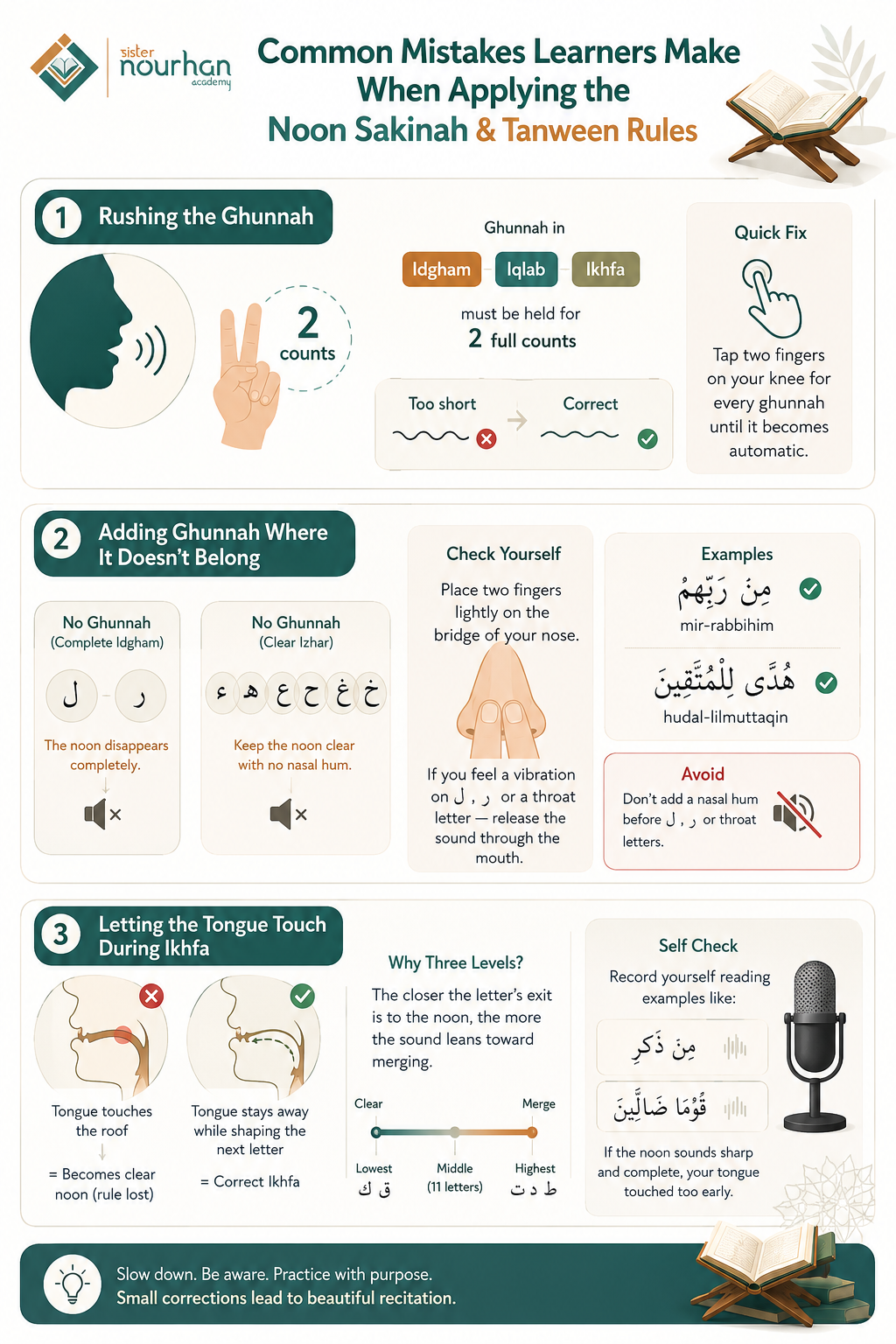
The ghunnah is a nasal hum measured in counts, and in idgham, iqlab, and ikhfa it must be held for two full counts every single time. Most learners give it half a count, because the ear does not notice the shortfall until someone points it out.
The problem is that an inconsistent ghunnah makes the whole verse sound uneven — some words stretched, others clipped. In classical teaching, one count is roughly the time it takes to fold or open one finger, so the two counts should feel measured, not hurried.
The fix is to count physically while you recite: tap two fingers on your knee for every ghunnah until the length becomes automatic. Within a couple of weeks your ear starts catching the short ones on its own, which is the real sign of progress.
2. Adding Ghunnah Where It Doesn't Belong
The opposite mistake is humming through letters that carry no ghunnah at all. The two most common offenders are ل and ر, where idgham is complete: the noon disappears entirely, taking its nasal quality with it.
﴿مِنْ رَبِّهِمْ﴾ should sound like a clean mir-rabbihim with no hum before the raa, and ﴿هُدًى لِلْمُتَّقِينَ﴾ like hudal-lilmuttaqīn. Many readers also stretch a nasal sound before the six throat letters, which turns clear izhar into something closer to ikhfa.
A useful self-check is to place two fingers lightly on the bridge of your nose while reciting. If you feel a vibration on ل, ر, or a throat letter, the sound is leaking into your nose and needs to be released cleanly through the mouth.
3. Letting the Tongue Touch During Ikhfa
Ikhfa sits deliberately between clear and merged, which means the tongue must stay away from the roof of the mouth while the ghunnah runs. The moment the tip touches, the sound snaps back into a full clear noon and the rule is gone.
Instead, the tongue should already be shaping the letter that comes next — sitting near the exit point of the ص, ت, or ق while the nasal sound flows. This is why the fifteen ikhfa letters have three levels: the closer the letter's exit is to the noon, the more the sound leans toward merging.
Recording yourself is the fastest diagnostic here. Read ﴿مِنْ ذَكَرٍ﴾ and ﴿قَوْمًا ضَالِّينَ﴾, then listen back: if the noon arrives sharp and complete rather than veiled, your tongue moved too early.
See our teaching methods
Experience the quality of our instruction firsthand by watching a live lesson snippet below.
Begin Your Quranic Journey
Connect with the words of Allah through personalized sessions at Sister Nourhan Academy.
Book Your Free TrialConclusion
Four rules. That is genuinely all this chapter contains. Izhar keeps the noon clear before six throat letters; Idgham merges it into يرملون; Iqlab turns it into a meem before ب; and Ikhfa conceals it before fifteen letters.
Add the two-count ghunnah, remember the four exception words, and you have covered the entire chapter of tanween rules and silent noon.
Here is the takeaway to carry with you: the Noon Sakinah & Tanween Rules are not academic theory — they are the difference between reading the Quran and reciting it as it was revealed. And they are learned by ear, with a teacher, far faster than by eye.
Start Reciting With Confidence Today!
Your first step costs nothing. Book a free trial session with Sister Nourhan Academy and recite a few verses aloud — your tutor will tell you exactly which of the four rules you are already applying correctly and which need work.
Watch a real session from Sister Nourhan Academy:
Master Tajweed with Nourhan Academy: Online Quran & Tajweed Classes
From there, you will get a personalised study plan: a clear starting level, a weekly schedule that fits your life, and a female tutor matched to your goals, whether that is perfecting Tajweed, memorising Juz Amma, or completing the whole Quran.
Discover our Tajweed Courses
Thousands of sisters and children around the world already study with us from home, at their own pace, in a warm and respectful environment. Book your free trial lesson now — and make your very next recitation your best one yet.

Frequently Asked Questions
What Are The Three Rules Of Meem Sakinah?
Meem sakinah has three rules: Ikhfa Shafawi before ب, Idgham Shafawi before another م, and Izhar Shafawi before every remaining letter. Sister Nourhan Academy teaches this chapter right after noon sakinah, so the two sets of rules never get confused.
How Many Rules Of Tajweed Are There In Total?
Tajweed has no single fixed number, because it is organised into chapters: letter exits, letter qualities, noon and meem rules, madd lengths, and stopping rules. Our structured curriculum at Sister Nourhan Academy walks you through them in the classical order rather than as scattered facts.
How Do You Read Noon Qutni?
Noon Qutni is the small ن printed under a tanween when the next word begins with a silent letter, as in ﴿عَادًا الْأُولَىٰ﴾. You pronounce it as a light noon with a kasrah, which prevents two silent letters from meeting.
What Are The Basic Tajweed Rules For Kids?
Children usually start with letter shapes and exits, short vowels, then the noon sakinah and madd rules through simple repetition. Our Hifz for Kids program at Sister Nourhan Academy teaches these through short, playful sessions built around a child's attention span.
Is Learning Tajweed Obligatory Or Haram?
Tajweed is certainly not haram — it is the manner in which the Quran was revealed and recited by the Prophet ﷺ. Scholars regard avoiding clear pronunciation errors as obligatory, which is why a qualified tutor makes such a difference.