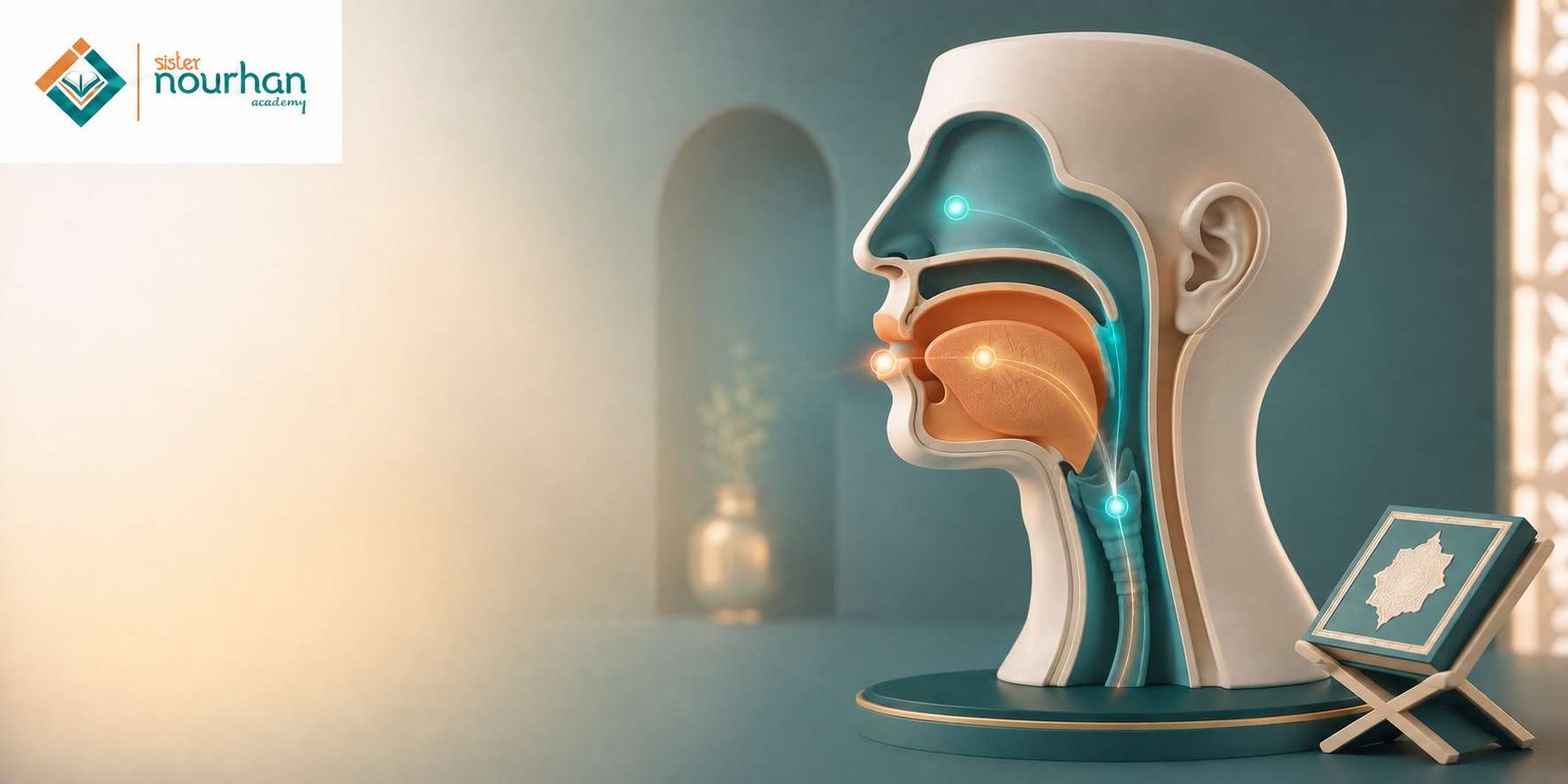
Two students recite the same verse. One sounds clear and settled; the other sounds close, but never quite right. The difference is almost never memorization — it's Makharij Al-Huruf, the precise exit points where each Arabic letter is born inside the mouth and throat.
Arabic is written with 28 consonants, yet those letters produce sounds that simply don't exist in English, Urdu, or Indonesian. Without knowing where a sound is made, learners guess — and guessing is exactly how ع becomes a soft 'a' and ض becomes a heavy 'd'.
At Sister Nourhan Academy, this is the very first thing our teachers fix, because every later Tajweed rule is built on top of it. Correct the exit point, and elongation, ghunnah, and heaviness fall into place almost by themselves.
In the next few minutes you'll learn the complete map of articulation points, how to read a makhraj chart, a self-testing trick you can use tonight, and the mistakes that quietly hold most learners back.
What You Will Learn in This Article:
The exact Makharij Al-Huruf meaning and why 17 articulation points exist.
The five main areas of the mouth and which letters belong to each.
How to read a makhraj chart and a places of articulation diagram.
A simple self-test to locate any letter's exit point on your own.
The real difference between makhraj and tajweed — and why it matters.
What Is Makharij Al-Huruf (Articulation Points)?
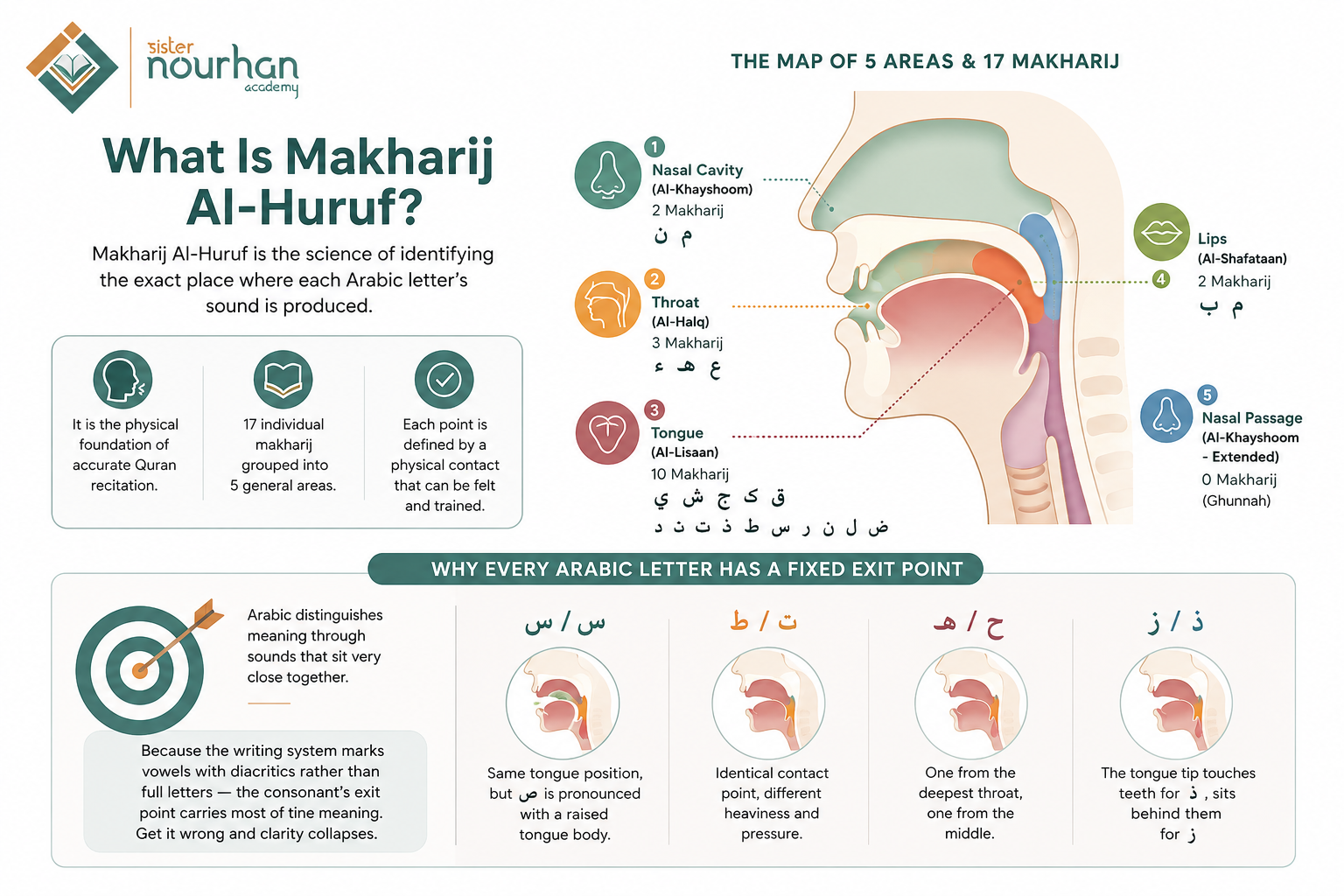
Makharij Al-Huruf is the science of identifying the exact place in the mouth, throat, or nasal passage where each Arabic letter's sound is produced. It is the physical foundation of accurate Quran recitation.
Before we open the map, it helps to understand the word itself and the logic behind it.
THE LITERAL AND TECHNICAL MAKHRAJ MEANING
The word makhraj (plural: makharij) literally means "a place of exit." Technically, it is the point where the airflow is stopped or narrowed to create a distinct letter sound.
Scholars of recitation have described these points for over a thousand years. The classification most widely taught today identifies 17 individual makharij grouped into 5 general areas.
That number isn't arbitrary. Each point is defined by a physical contact — tongue against gum, lip against tooth, air compressed in the throat — that can be felt, corrected, and trained.
WHY EVERY ARABIC LETTER HAS A FIXED EXIT POINT
Arabic distinguishes meaning through sounds that sit very close together. Slide one letter to a neighbouring makhraj and you produce a different word entirely.
Consider these pairs that learners routinely merge:
س / ص — the same tongue position, but ص is pronounced with a raised tongue body.
ت / ط — identical contact point, different heaviness and pressure.
هـ / ح — one from the deepest throat, one from the middle.
ذ / ز — the tongue tip touches teeth for ذ, sits behind them for ز.
Because the writing system marks vowels with diacritics rather than full letters — a feature well documented in Britannica's overview of the Arabic alphabet — the consonant's exit point carries most of the meaning. Get it wrong and clarity collapses.
You may also be interested in: Idgham With Ghunnah & Without Ghunnah - Letters, Rules, and Quran Examples
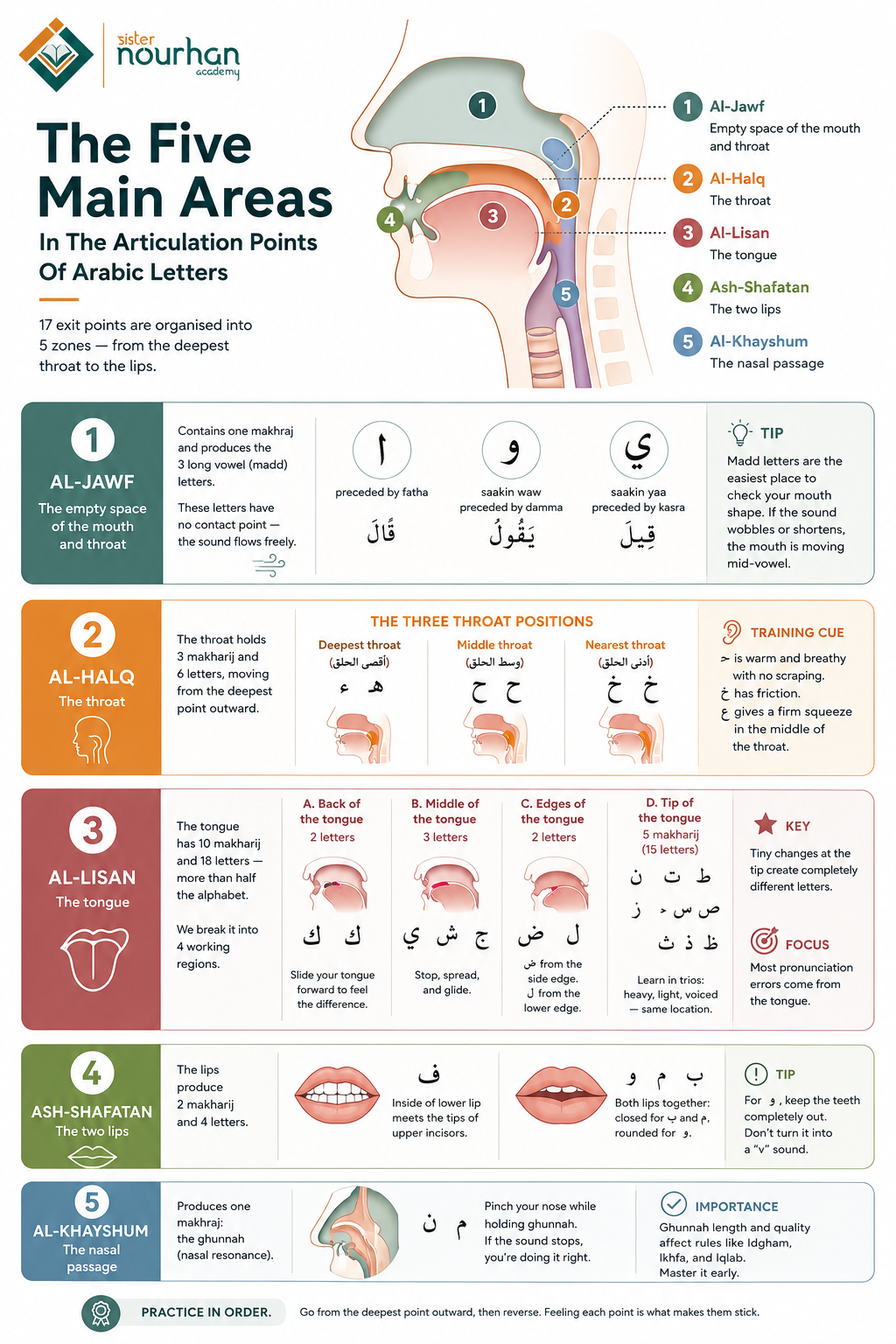
The Five Main Areas In The Articulation Points Of Arabic Letters
The 17 exit points are organised into five zones that run from deep inside the throat all the way out to the lips. Learning them in this order gives you a mental map instead of a memorised list.
Work through them front to back once, then reverse the direction. The physical sensation is what makes them stick.
1. AL-JAWF: THE EMPTY SPACE OF THE MOUTH AND THROAT
Al-Jawf is the hollow air space stretching from the chest cavity up through the mouth. It contains a single makhraj of arabic letters and produces the three long vowel (madd) letters.
These letters have no contact point at all — the sound simply flows and stops when the breath ends. That is why they are called hawa'iyyah, the "airy" letters.
ا — preceded by a fatha, as in قَال.
و — a saakin waw preceded by a damma, as in يَقُول.
ي — a saakin yaa preceded by a kasra, as in قِيل.
A practical note: because there is no obstruction, madd letters are the easiest place to hear whether your mouth shape is correct. If the sound wobbles or shortens, the lips or jaw are moving mid-vowel.
2. AL-HALQ: THE THROAT AND ITS THREE POINTS
The throat holds three distinct makharij and six letters, moving from the deepest point outward. This is the zone non-Arabic speakers find hardest, because English has no equivalent sounds.
The Three Throat Positions
The throat is divided into three levels, and each level carries exactly two letters. Move through them from the deepest point outward:
Deepest Throat (أقصى الحلق): ء and هـ
Middle throat (وسط الحلق): ع and ح
Nearest throat (أدنى الحلق): غ and خ
A useful training cue: ح is a warm, breathy constriction with no scraping, while خ has an audible friction at the back of the tongue. If you feel scraping on ح, you have drifted upward to خ.
For ع, place a finger lightly on your throat mid-way. You should feel a firm squeeze — not a vowel. This single correction transforms how الرَّحْمَـٰنِ and نَعْبُدُ sound.
3. AL-LISAN: THE TONGUE AND ITS TEN POINTS
The tongue is responsible for ten of the seventeen makharij and eighteen letters — more than half the alphabet. Because of this, most pronunciation errors are tongue errors.
We break it into four working regions so you can isolate and drill each one.
A. The Back Of The Tongue
The rearmost part of the tongue rises to meet the roof of the mouth to produce two letters.
ق — the back of the tongue meets the soft palate.
ك — slightly further forward, meeting the hard palate.
Test yourself by alternating قَ – كَ slowly. You should feel the contact point physically slide forward. If it doesn't move, one of the two is wrong.
B. The Middle Of The Tongue
The middle of the tongue presses against the roof of the mouth for three letters: ج، ش، ي (the non-madd yaa).
The distinction here is release. ج stops the air completely then releases; ش lets air spread outward continuously; ي glides.
C. The Edges Of The Tongue
The side edge of the tongue meets the upper molars to produce ض — the single hardest letter in the Arabic language, and the one that gave Arabic its nickname.
It is not an English "d." The tongue's side must make firm contact with the molars while the tongue body stays raised and heavy. Most learners produce د or a heavy ظ instead.
The lower edge of the tongue, closer to the front and touching the gums of the front teeth, produces ل.
D. The Tip Of The Tongue
The tongue tip alone accounts for five makharij and the largest cluster of letters. Precision of a millimetre or two separates them.
ن — tip against the gums above the front incisors.
ر — tip slightly further back, with a light flutter.
ط، د، ت — tip against the roots of the upper front incisors.
ص، س، ز — tip near the meeting point of the upper and lower incisors.
ظ، ذ، ث — tip touching the edges of the upper front incisors.
Notice the pattern: each group of three contains one heavy letter, one light letter, and one voiced letter sharing the same location. Learning them as trios is far faster than learning them one by one.
Struggling with ض, ع, or ط on your own? One live session with a certified teacher fixes in minutes what months of self-study can't. Build the sounds from the ground up with the Arabic Course for Beginners at Sister Nourhan Academy — live pronunciation correction, no credit card required.
4. ASH-SHAFATAN: THE TWO LIPS
The lips produce two makharij and four letters, and they are the most visible — which makes them the easiest to self-correct in a mirror.
ف — the inside of the lower lip meets the tips of the upper incisors.
ب، م، و — both lips together; closed firmly for ب and م, rounded for the non-madd و.
The common error is producing و with the teeth involved, turning it into a "v"-like sound. Keep the teeth completely out of it.
Shots from Our Classes
Take a moment to view the video below to see how our teachers provide clear, supportive corrections during a session.
Begin Your Quranic Journey
Connect with the words of Allah through personalized sessions at Sister Nourhan Academy.
Book Your Free Trial5. AL-KHAYSHUM: THE NASAL PASSAGE
The nasal cavity produces one makhraj: the ghunnah, the nasal resonance that accompanies م and ن in specific states.
You can verify it instantly. Pinch your nose while holding a ghunnah — if the sound is blocked, you're doing it correctly.
Ghunnah length and quality later govern rules like idgham, ikhfa, and iqlab. This one point pays dividends across the entire Tajweed syllabus.
How To Read A Makhraj Chart And Apply It Daily
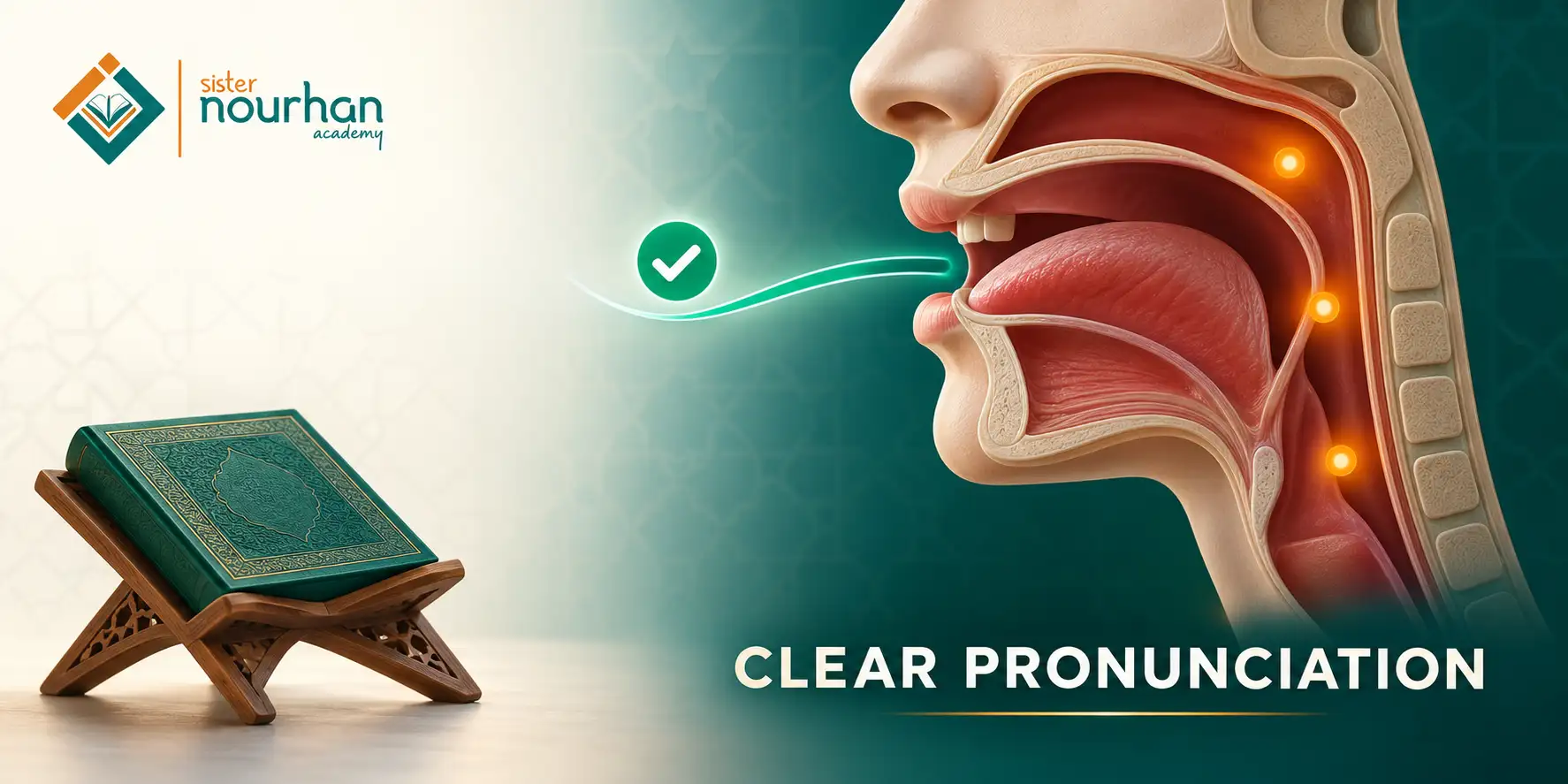
A makhraj chart is a cross-section diagram of the head showing where each letter is produced. Used properly, it turns an abstract list into a physical map you can navigate.
Here's how to get real value from one instead of just looking at it.
HOW TO READ A PLACES OF ARTICULATION DIAGRAM CORRECTLY
Every places of articulation diagram is read from the throat outward, right to left, mirroring the direction Arabic is written. Start at Al-Jawf and Al-Halq, then move forward through the tongue to the lips.
Colour blocks or numbered zones usually group letters that share a location. Focus on the boundaries between zones — that's where confusion lives, not in the middle of a zone.
THE SUKOON TEST: HOW TO LOCATE ANY MAKHRAJ YOURSELF
The classic method is simple: place a hamzah before the letter and give the letter a sukoon, then pronounce it. Where the sound stops is the makhraj.
Try it with ط: say أَطْ. The moment the sound cuts off, your tongue tip is resting exactly on the correct point.
Apply this to any letter you're unsure about:
Say أَعْ to feel the middle throat squeeze.
Say أَضْ to feel the tongue edge press the molars.
Say أَقْ then أَكْ to feel the contact shift forward.
Do this for ten minutes a day with a recording of your voice. Comparing your recording to a certified reciter exposes errors your ear misses in the moment.
Turn theory into a clear, confident recitation. Our 1-on-1 Private Quran Lessons Online give you real-time correction on every single letter, every session.

Explore more on this topic: How To Learn To Read The Quran In Arabic? A Complete Beginner's Guide
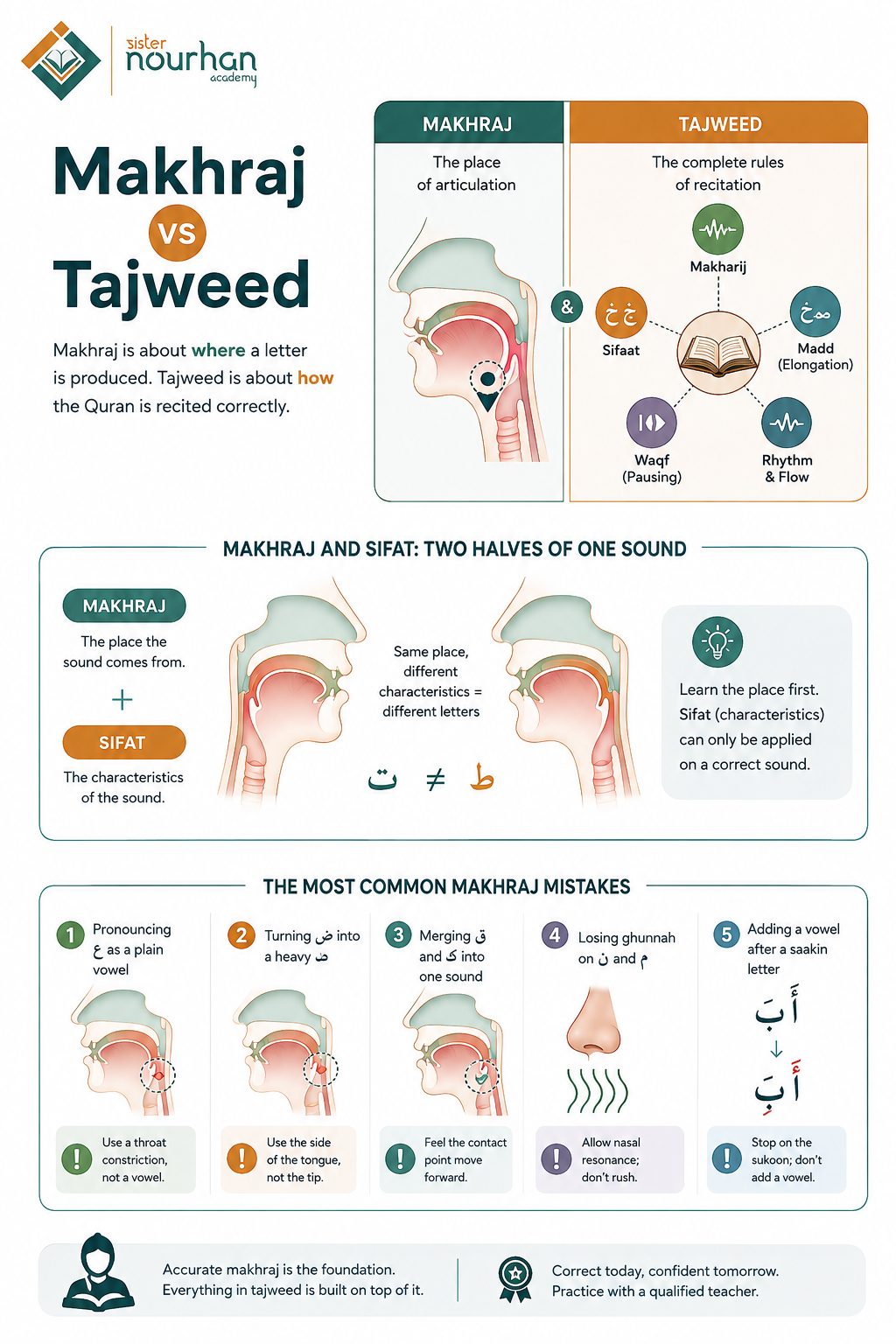
The Difference Between Makhraj And Tajweed
Makhraj is one component of Tajweed, not a synonym for it. Makhraj answers where a letter is produced; Tajweed is the complete science governing how the Quran is recited — including Makharij Al-Huruf, letter characteristics, elongation, pausing, and rhythm.
Understanding the relationship prevents a very common trap: learning rules you cannot physically execute.
MAKHRAJ AND SIFAT: TWO HALVES OF ONE SOUND
Every Arabic letter has two identity markers — its makhraj (place) and its sifat (characteristics such as heaviness, whispering, and strength).
Two letters can share the same exit point and still sound completely different because their characteristics differ. ت and ط are the clearest example: same location, opposite weight.
This is why makhraj must be learned first. Sifat modify a sound; if the base sound is in the wrong place, there is nothing correct to modify.
THE MOST COMMON MAKHRAJ HURUF MISTAKES
These are the errors our teachers correct most often in first sessions:
Pronouncing ع as a plain vowel instead of a throat constriction.
Turning ض into a heavy د by using the tongue tip.
Merging ق and ك into a single back-of-mouth sound.
Losing the ghunnah on ن and م by rushing through them.
Adding a vowel after a saakin letter, e.g. reading أَبْ as أَبَ.
Each of these is fixable in days with the right feedback — and nearly impossible to notice alone, because your brain hears what it intends, not what it produces.
Discover more here: How to Learn Arabic Language in best way?
How Sister Nourhan Academy Helps You Master Makharij Al-Huruf
Reading about articulation points builds understanding; supervised practice builds accuracy. Sister Nourhan Academy was built specifically around that second half — the part self-study cannot replace.
Here's what that looks like in practice.
1. LIVE ONE-ON-ONE CORRECTION WITH CERTIFIED TEACHERS
Every session is private, live, and one-on-one over Zoom or Google Meet — never a recorded video or a crowded group class.
Our instructors are qualified graduates, many holding Ijazah, trained to diagnose articulation errors by ear within the first few minutes. Sisters and children can learn exclusively with our certified female teachers, in a comfortable, respectful environment.
That immediate feedback loop is the difference between practising correctly and practising a mistake a thousand times.

2. A STRUCTURED PATH FROM NOORANI QAIDA TO ADVANCED TAJWEED
You don't have to guess what to study next. The academy's curriculum moves in a deliberate sequence, and Makharij Al-Huruf sits at the very base of it.
Start here: the Noorani Qaida Course covers letter articulation, harakat, madd, sukoon, and shaddah from zero.
Build fluency: the Learn Quran with Tajweed for Sisters programme applies the rules to real recitation.
Refine mastery: the Advanced Tajweed Course polishes Makharij Al-Huruf, sifat, mudood, and waqf to certification standard.
Learners who want to understand what they recite can pair any of these with the Quranic Arabic Course, connecting sound to meaning.

3. PROGRAMS BUILT FOR EVERY AGE, GENDER, AND SCHEDULE
With more than 85 live courses across Quran, Arabic, and Islamic Studies, there is a track for every stage of life.
Children: Arabic for Kids and Hifz for Kids, taught with patience and play.
Adults and reverts: foundational reading through to the Al-Azhar Quran Course.
Busy professionals: flexible slots daily from 8 AM to 2 AM Egypt time.
Memorisation goals: the full Quran course catalogue covers Hifz for every level.

4. WHAT YOU ACTUALLY WALK AWAY WITH
Beyond the lessons themselves, students finish with tangible outcomes rather than a vague sense of progress.
You get a personal makhraj assessment in your first session, a customised practice plan, progress tracking with your teacher, and a digital certificate on completion.
Our 4.9/5 rating from verified students reflects that structure — you can read what learners say on our testimonials page.
Most importantly, you gain the ability to hear your own errors. That skill stays with you long after the course ends.
See our teaching methods
Experience the quality of our instruction firsthand by watching a live lesson snippet below.
Begin Your Quranic Journey
Connect with the words of Allah through personalized sessions at Sister Nourhan Academy.
Book Your Free TrialConclusion
Makharij Al-Huruf is the physical blueprint of Quranic recitation: 17 exit points spread across five zones — the empty space, the throat, the tongue, the lips, and the nasal passage. Map them, feel them, and test them with the sukoon method, and every letter gains its own clear identity.
Remember the core distinction: makhraj tells you where a sound is made, while sifat tell you how it behaves — and Tajweed is the full science that houses both. Fixing the location first is what makes every later rule achievable.
The one takeaway to carry away: you cannot correct what you cannot hear, and almost nobody hears their own articulation accurately. Mastering Makharij Al-Huruf takes a trained ear listening back — that is precisely what live instruction provides.
Book Your Free Trial Class Today!
You've now got the complete map. The next step is putting it under the ear of someone who can tell you, letter by letter, exactly where your tongue is landing — and where it should be instead. That single hour of feedback is worth weeks of solo repetition.
Watch an actual lesson in action:
Practical Application of Quranic Madd (prolongation) Rules
Sister Nourhan Academy offers a completely free trial class, with no credit card required. In it, your teacher will assess your current articulation, identify the specific letters holding your recitation back, and build a personalised plan around your level, your schedule, and your goals — whether you're starting from the alphabet or refining an already-fluent recitation.
Discover our Tajweed Courses
Choose your track and begin today. Book your free trial class now and let us recommend the right starting point for you. Your clearest recitation is one session away.
Frequently Asked Questions
What Is Huroof?
Huroof is the Arabic word for "letters" — the 28 consonants of the Arabic alphabet, each with its own exit point and characteristics. Learning the huroof correctly from day one is the entire focus of the first stage in every Sister Nourhan Academy reading programme.
Which Letter Is هـ?
هـ is haa, the 26th letter of the Arabic alphabet, produced from the deepest part of the throat alongside the hamzah (ء). It is a soft, open breath with no friction — unlike ح, which carries a warm constriction.
What Is The Makhraj Of The Letter "Seen" (س)?
The makhraj of س is the tip of the tongue placed near the meeting point of the upper and lower front incisors, producing a thin, whistling sound. It shares this exact position with ص and ز, which is why our teachers drill the three together in every live session.
Why Do Arabs Use 7 In Words When Typing?
The digit 7 stands in for the letter ح in informal Arabic chat typing, because the numeral visually resembles the letter's shape. It is a typing convention only — it has no place in Quranic reading, where ح must be produced from its true throat makhraj.
What Is The Definition Of Articulation Point?
An articulation point (makhraj) is the precise place where airflow is stopped or narrowed inside the mouth, throat, or nose to create a specific letter sound. Sister Nourhan Academy's teachers identify your exact contact point live in each session, so you feel the position instead of guessing it.