

The Wudu Steps for Women follow the same essential method of purification taught for Muslims before prayer.
A woman begins with the intention, washes her hands, rinses her mouth and nose, washes her face and arms, wipes her head, and finishes by washing her feet.
However, women may have additional practical questions about long hair, hijab, makeup, nail polish, menstruation, and vaginal bleeding.
If you are learning wudu for the first time or simply want to check that you are performing every step correctly, follow the steps below in order.
1. Make the Intention (Niyyah) Before Starting Wudu
The first step of wudu begins before you use any water. Make the intention (niyyah) in your heart that you are performing wudu to purify yourself for worship and to prepare for Salah.
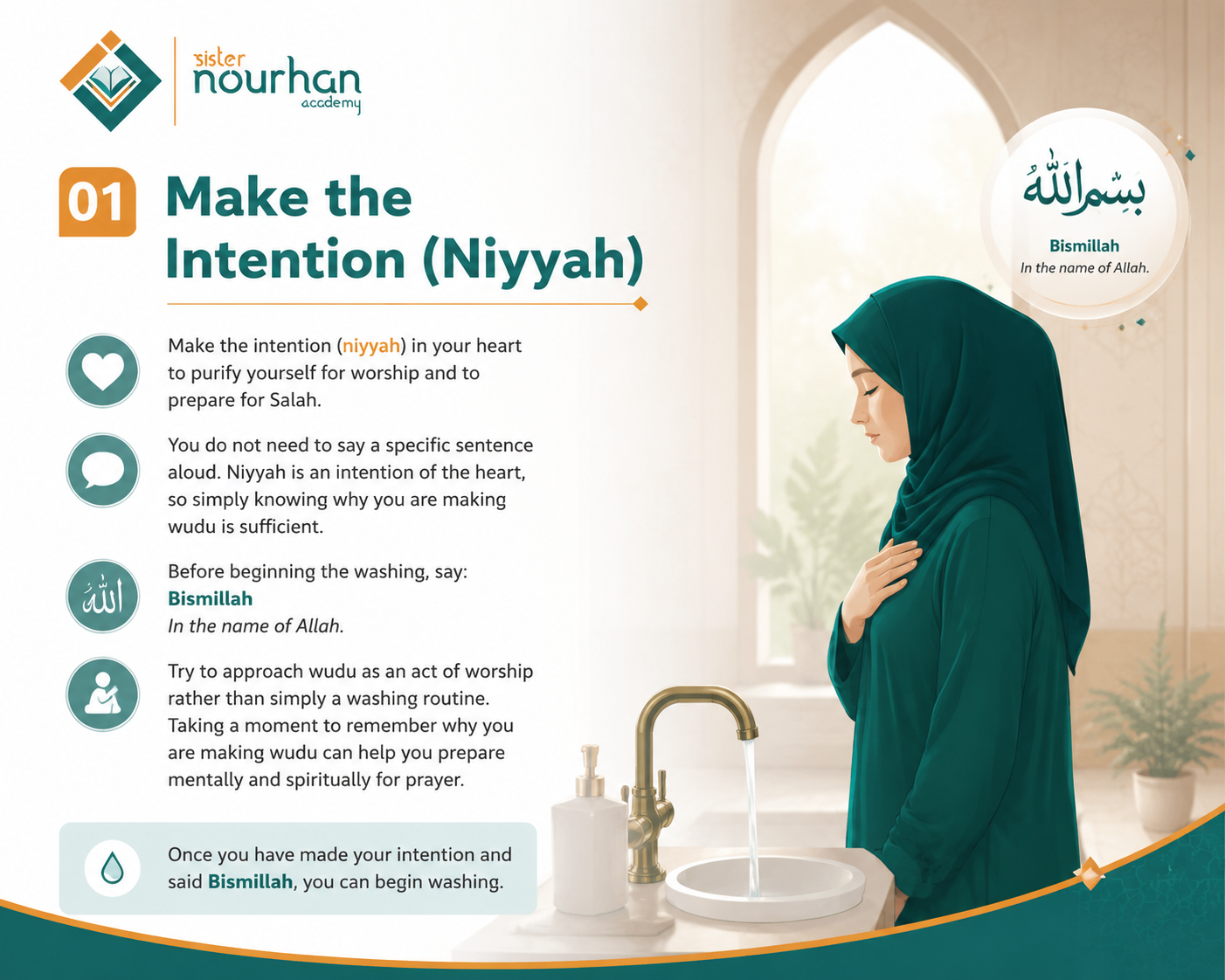
You do not need to say a specific sentence aloud. Niyyah is an intention of the heart, so simply knowing why you are making wudu is sufficient.
Before beginning the washing, say:
Bismillah
In the name of Allah.
Try to approach wudu as an act of worship rather than simply a washing routine. Taking a moment to remember why you are making wudu can help you prepare mentally and spiritually for prayer.
Once you have made your intention and said Bismillah, you can begin washing.
2. Wash Your Hands Three Times and Make Sure Water Reaches Between the Fingers
Start by washing both hands up to the wrists three times Allow the water to flow over the palms, backs of the hands, fingers, and wrists. Rub between your fingers so that water reaches areas that can easily be missed.
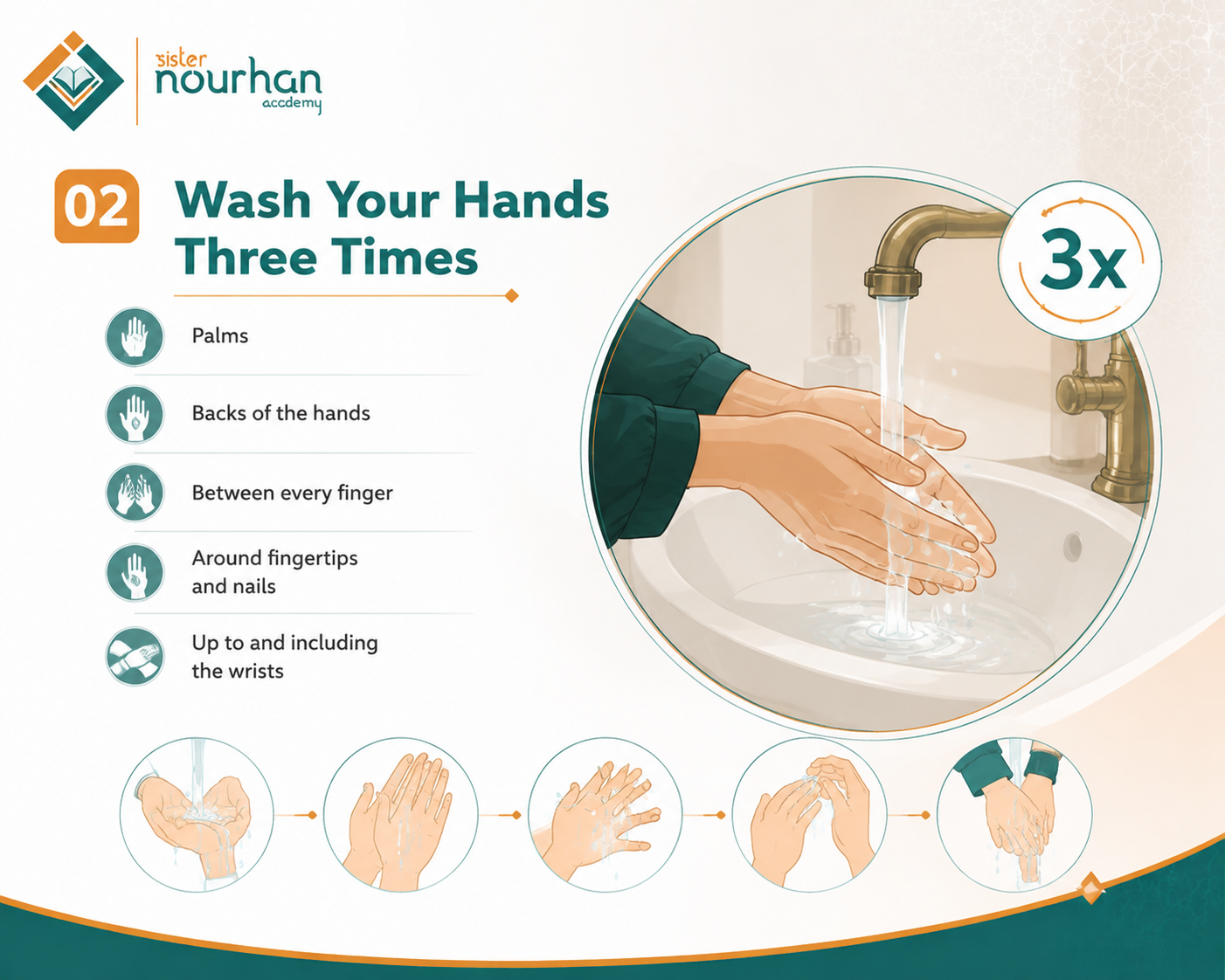
Make sure water reaches:
The palms
The backs of both hands
Between every finger
Around the fingertips and nails
Up to and including the wrists
Pay attention to anything on your hands that may prevent water from reaching the skin.
For women, this is especially important when wearing rings or other hand jewelry. Move a tight ring if necessary so water can reach underneath it.
Nail products should also be checked before beginning wudu. If something forms a barrier that prevents water from reaching the nail, it needs to be addressed before completing wudu.
After washing the hands thoroughly three times, move to the mouth.
3. Rinse Your Mouth Three Times Without Using Excessive Water
Using your right hand, take a small amount of water into your mouth. Move the water around the mouth thoroughly and then spit it out Repeat the process three times.
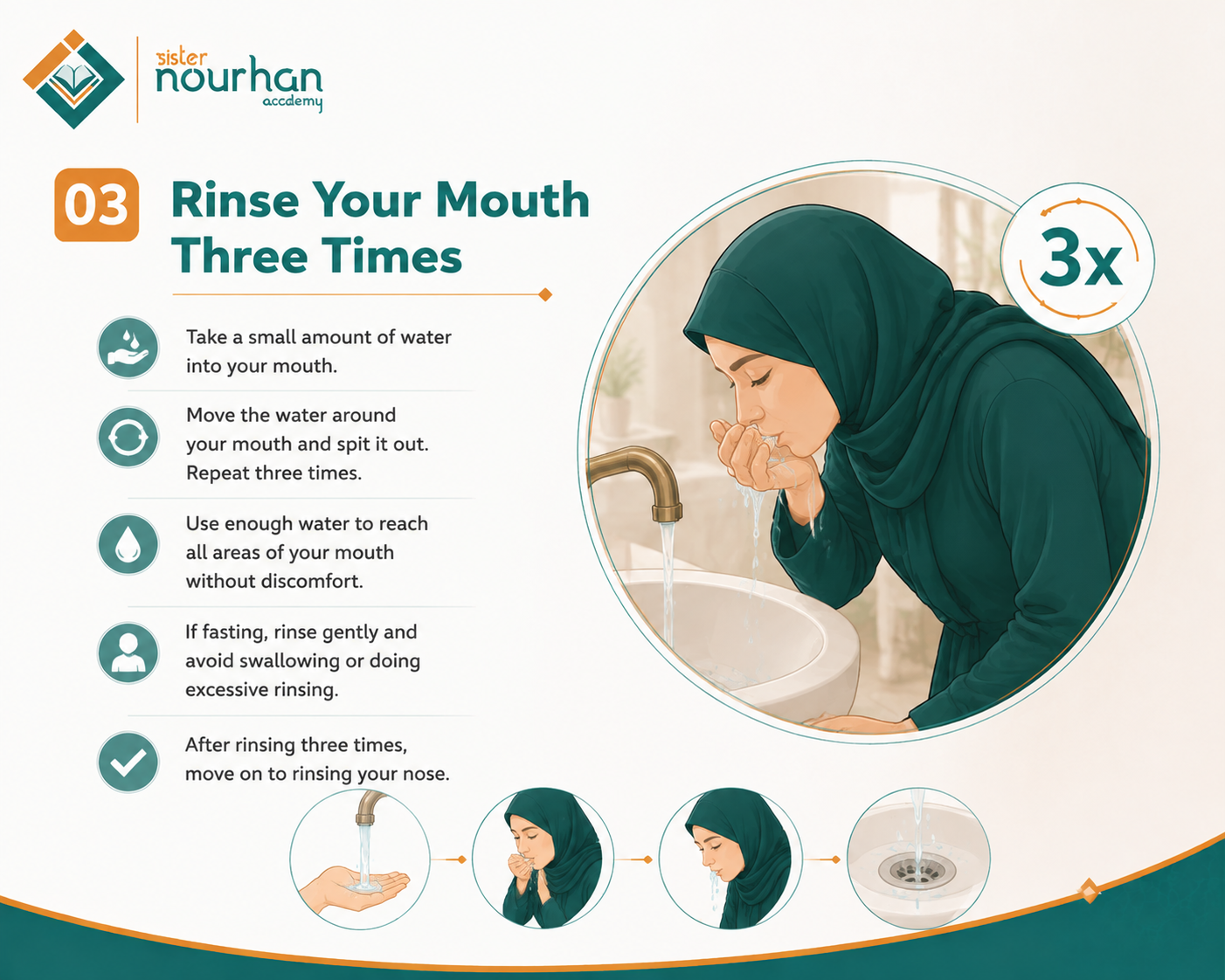
Try to allow the water to reach the different areas of the mouth without making the process uncomfortable. There is no need to use an excessive amount of water.
If you are fasting, rinse the mouth gently and avoid exaggerating the rinsing or drawing water too far toward the throat Once the mouth has been rinsed three times, continue directly to rinsing the nose.
4. Rinse Your Nose Three Times and Take Extra Care When Fasting
Take a small amount of water and gently draw it into the nostrils, then expel it Repeat this three times The water should enter the nostrils sufficiently for them to be rinsed, but you do not need to inhale it forcefully.
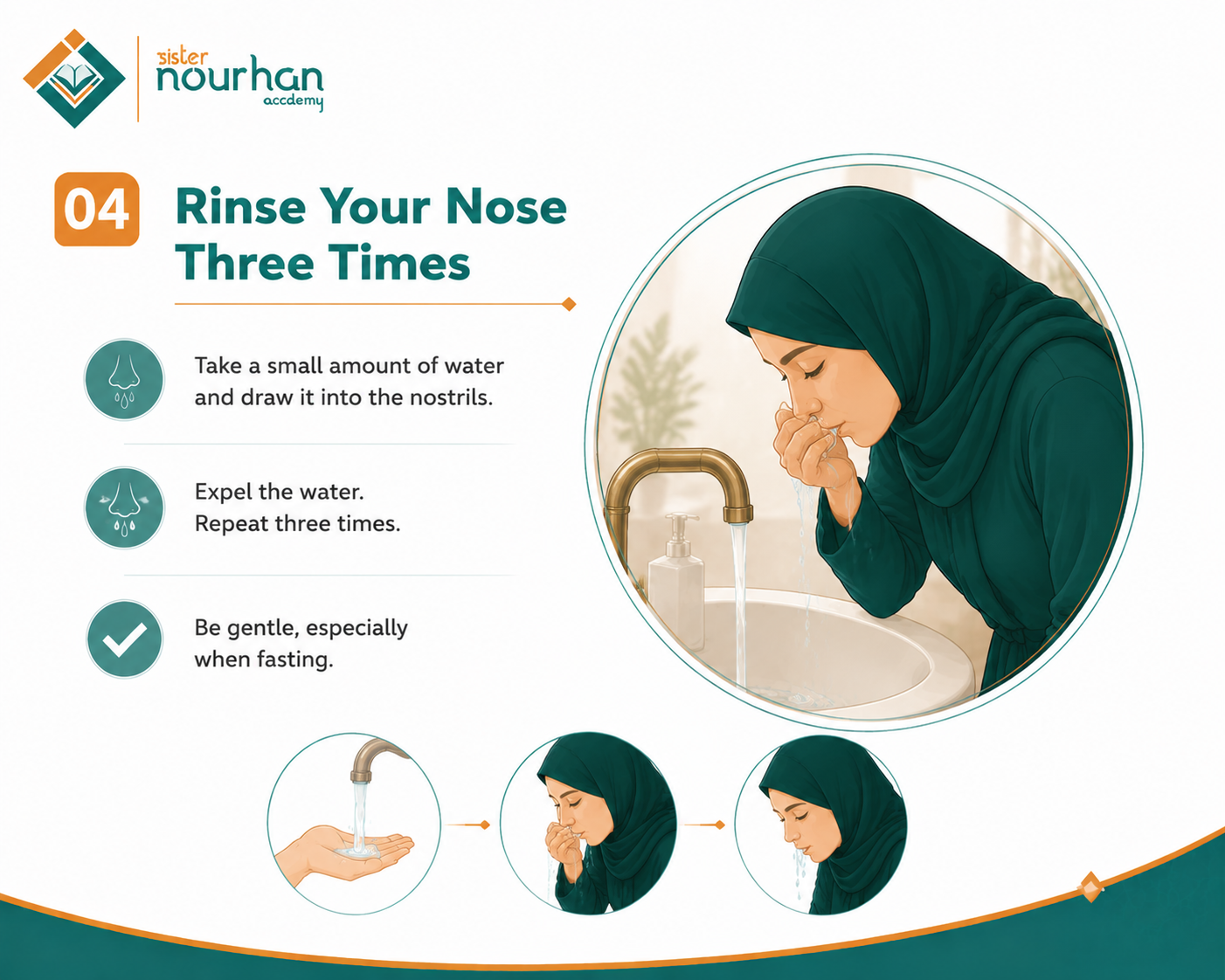
This is particularly important when fasting. The Prophet ﷺ instructed Muslims to be thorough when rinsing the nose except when fasting, so avoid drawing water deeply enough that you risk swallowing it.
Take your time, but do not make the process unnecessarily difficult. After completing the third rinse, move on to washing the face.
Women who want to strengthen their memorization alongside their worship can explore Sister Nourhan Academy's Hifz for Females, which provides a dedicated path for female Quran learners.

5. Wash Your Entire Face Three Times and Check for Water-Blocking Makeup
Wash your entire face three times, making sure water reaches all the required areas The face should be washed from the normal hairline at the top of the forehead down to the chin, covering the full width of the face.
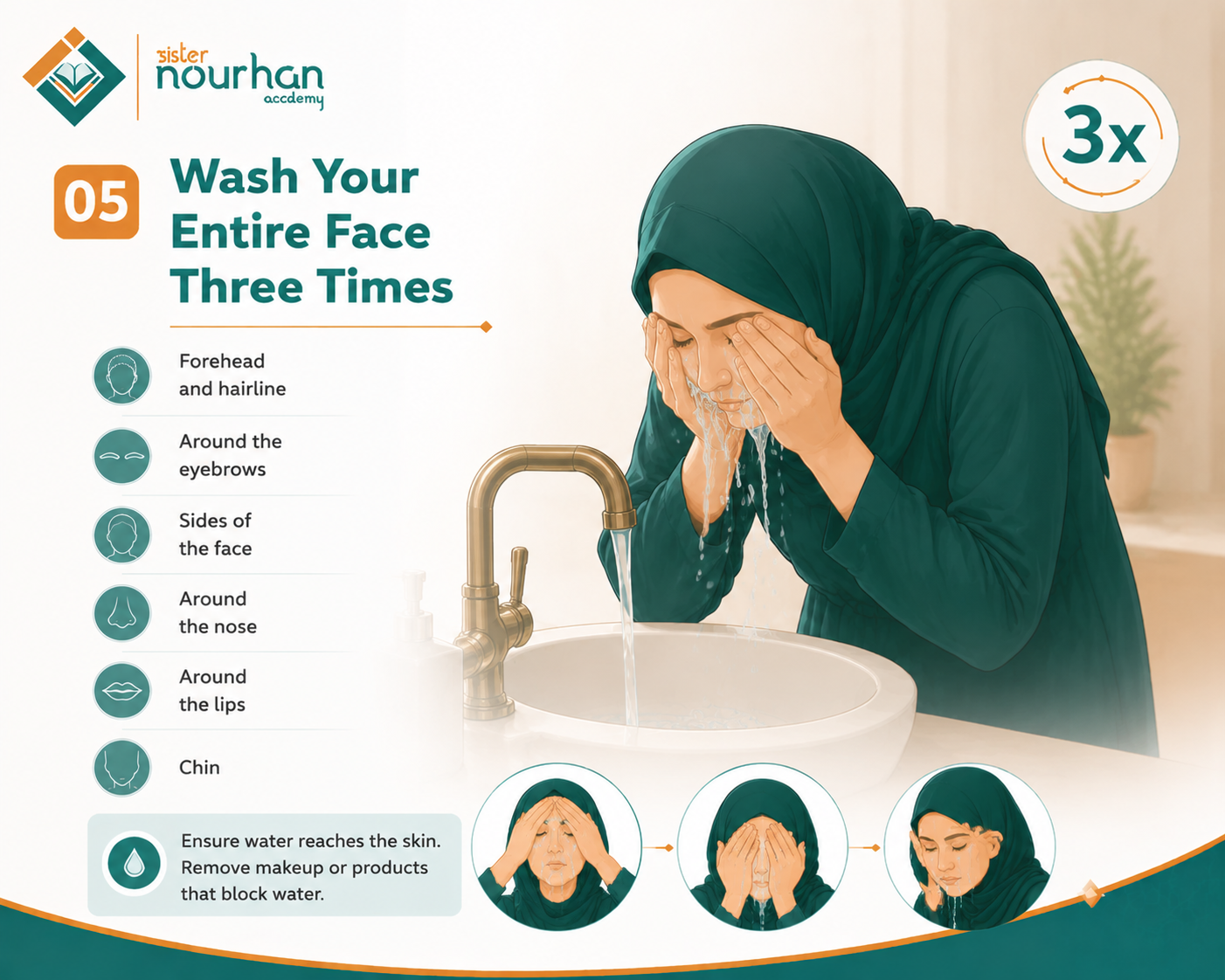
Rather than simply splashing water onto the center of your face, use your hands to help spread the water across the entire area.
Pay particular attention to:
The forehead and hairline
Around the eyebrows
The sides of the face
Around the nose
The area around the lips
The chin
For women, makeup and skincare products require special attention at this stage The important principle is that water must be able to reach the skin.
If a cosmetic product creates a waterproof layer that stops water from reaching an area that must be washed, it should be removed before performing wudu.
Not every cosmetic product automatically creates such a barrier. The issue is whether the product actually prevents water from reaching the skin.
After ensuring that the entire face has been washed, repeat the process until you have washed it three times.
Shots from Our Classes
Take a moment to view the video below to see how our teachers provide clear, supportive corrections during a session.
Shots from Our Classes
Take a moment to view the video below to see how our teachers provide clear, supportive corrections during a session.
Enrich Your Islamic Knowledge
Deepen your understanding of Fiqh, Aqeedah, and Hadith with dedicated female scholars at Sister Nourhan Academy.
Start Your Free Trial Now6. Wash Both Arms Three Times Up to and Including the Elbows
Next, wash your right arm from the fingertips all the way up to and including the elbow three times. Then do the same with your left arm Do not stop just before the elbow. The elbow itself is part of the area that must be washed.
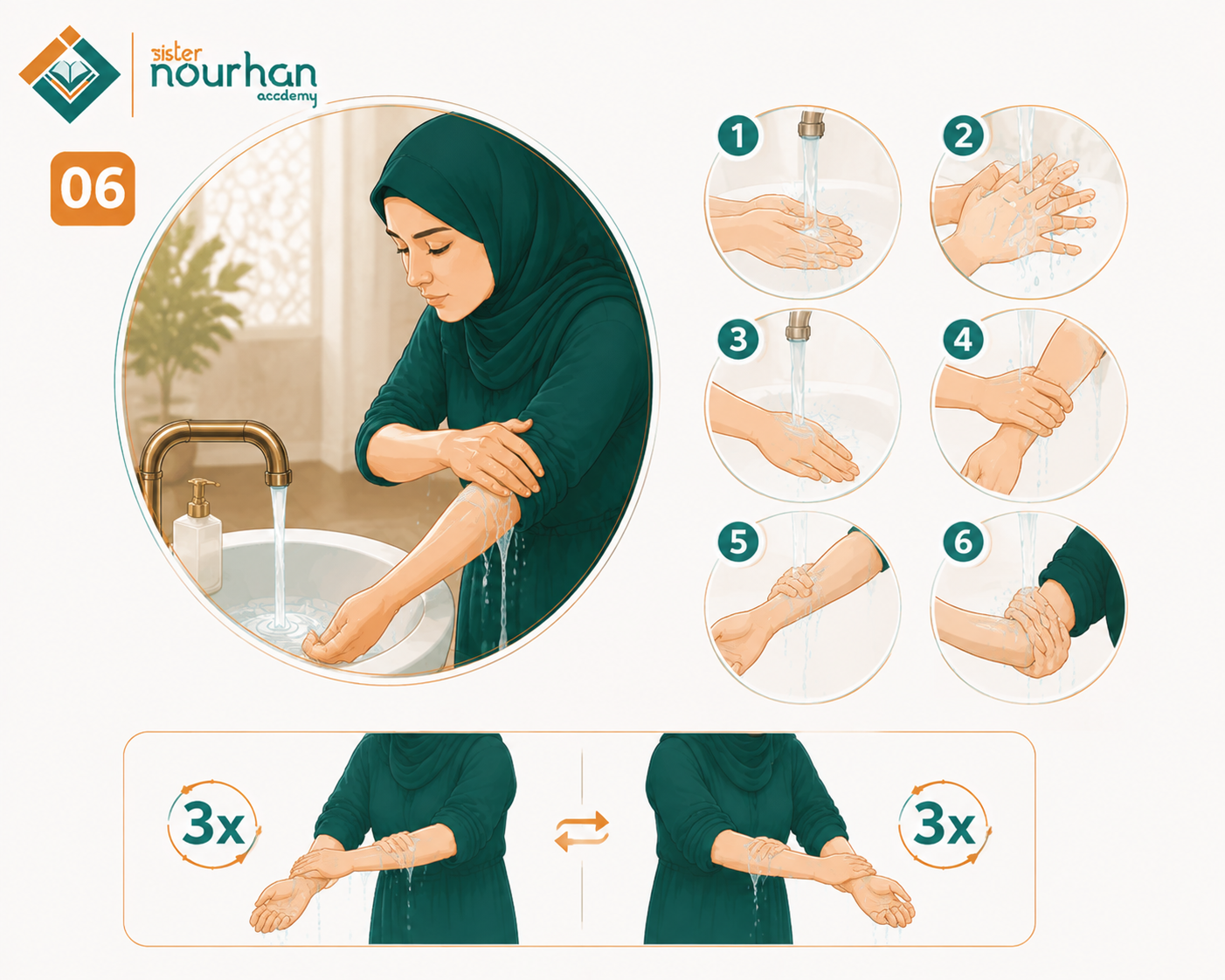
Let water reach the entire surface of each arm, including:
The fingers
Between the fingers
The back of the hand
The wrist
The forearm
Around and over the elbow
A useful habit is to run your wet hand over the arm as you wash it so that you can be confident that no area remains dry.
If you are wearing a watch, bracelet, or tight jewelry, move it when necessary so that water can reach the skin beneath it.
Start with the right arm and wash it thoroughly three times, then repeat the same process with the left arm Avoid rushing this step, especially around the elbows, where small dry areas can easily be overlooked.
7. Wipe Over Your Head Once as Part of Masah
After washing the arms, move on to masah, or wiping the head Unlike the face, arms, and feet, the head is wiped rather than washed.
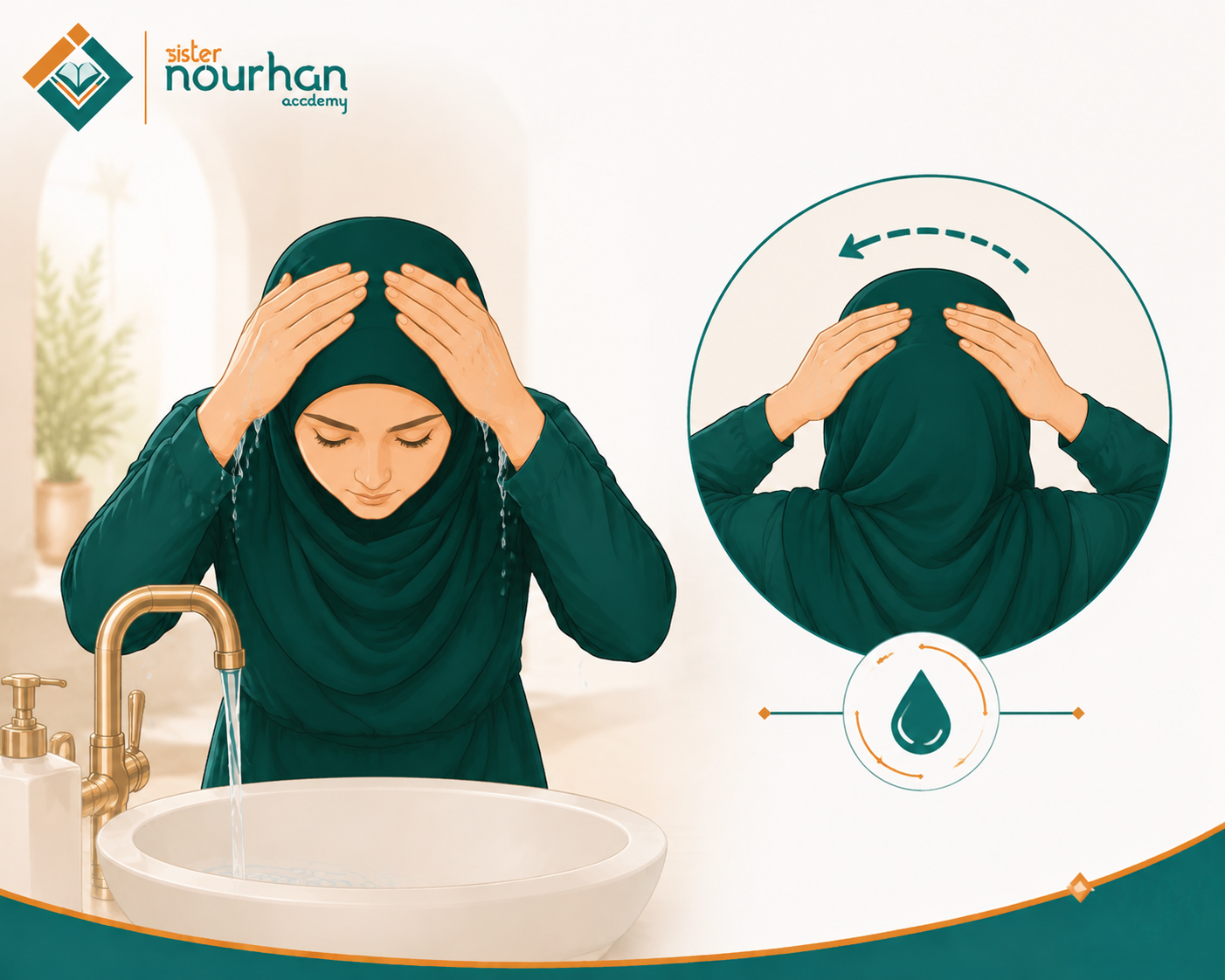
Wet your hands with fresh water. Place them at the front of the head and wipe toward the back of the head, then bring them back toward the starting point This is performed once.
8. Wipe Both Ears Once Using Moisture From Your Hands
After wiping the head, wipe both ears using the moisture on your hands You can use your index fingers to wipe the inner parts of the ears and your thumbs to wipe around the outer parts.
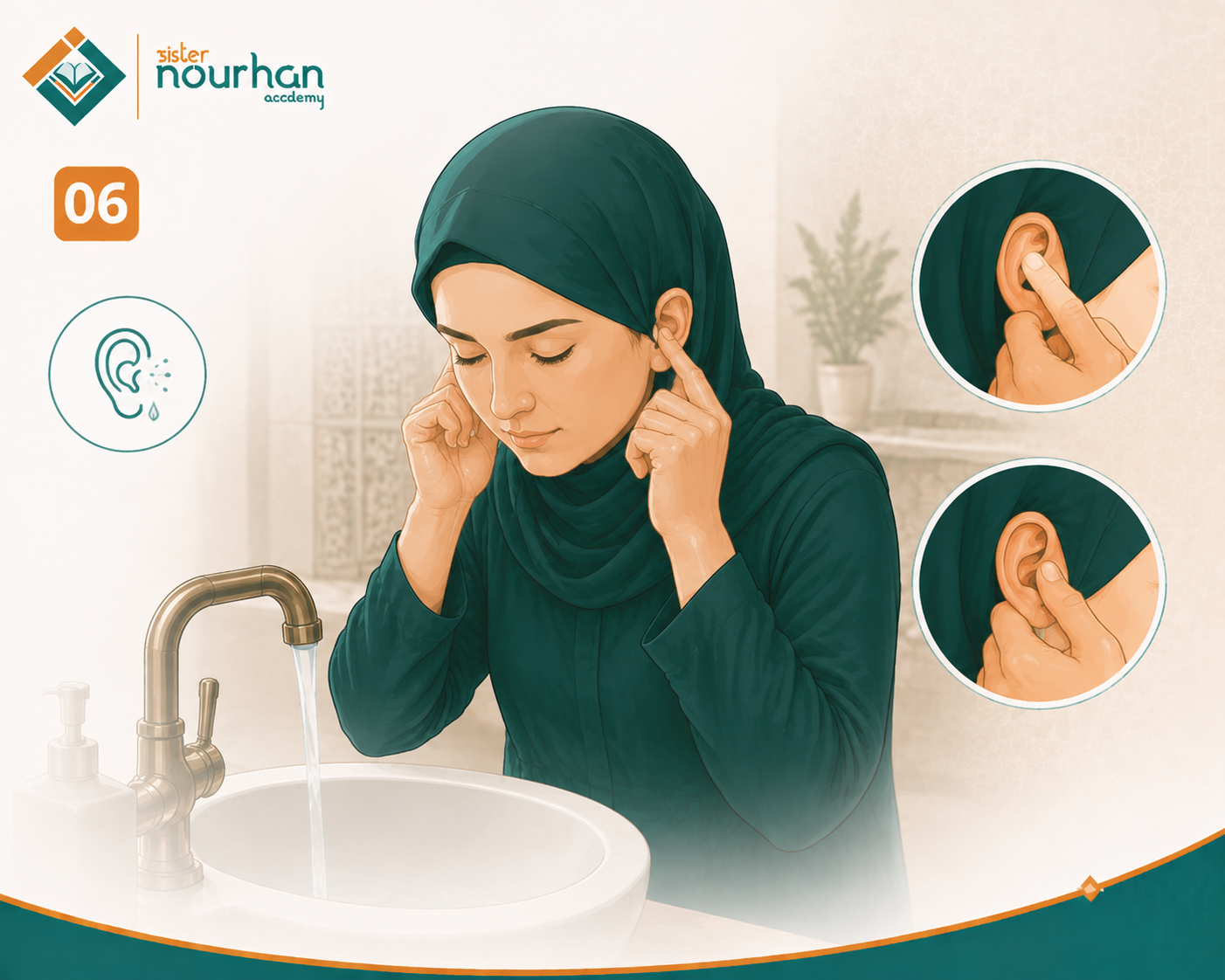
The ears are wiped once rather than washed three times There is no need to pour water directly into your ears or scrub them.
A gentle wipe with moist fingers is sufficient for this part of the complete Sunnah method Once the ears have been wiped, only the feet remain.
9. Wash Both Feet Three Times Up to the Ankles and Between the Toes
Finish your wudu by washing both feet Begin with the right foot and wash it up to and including the ankle three times. Then repeat the process with the left foot.
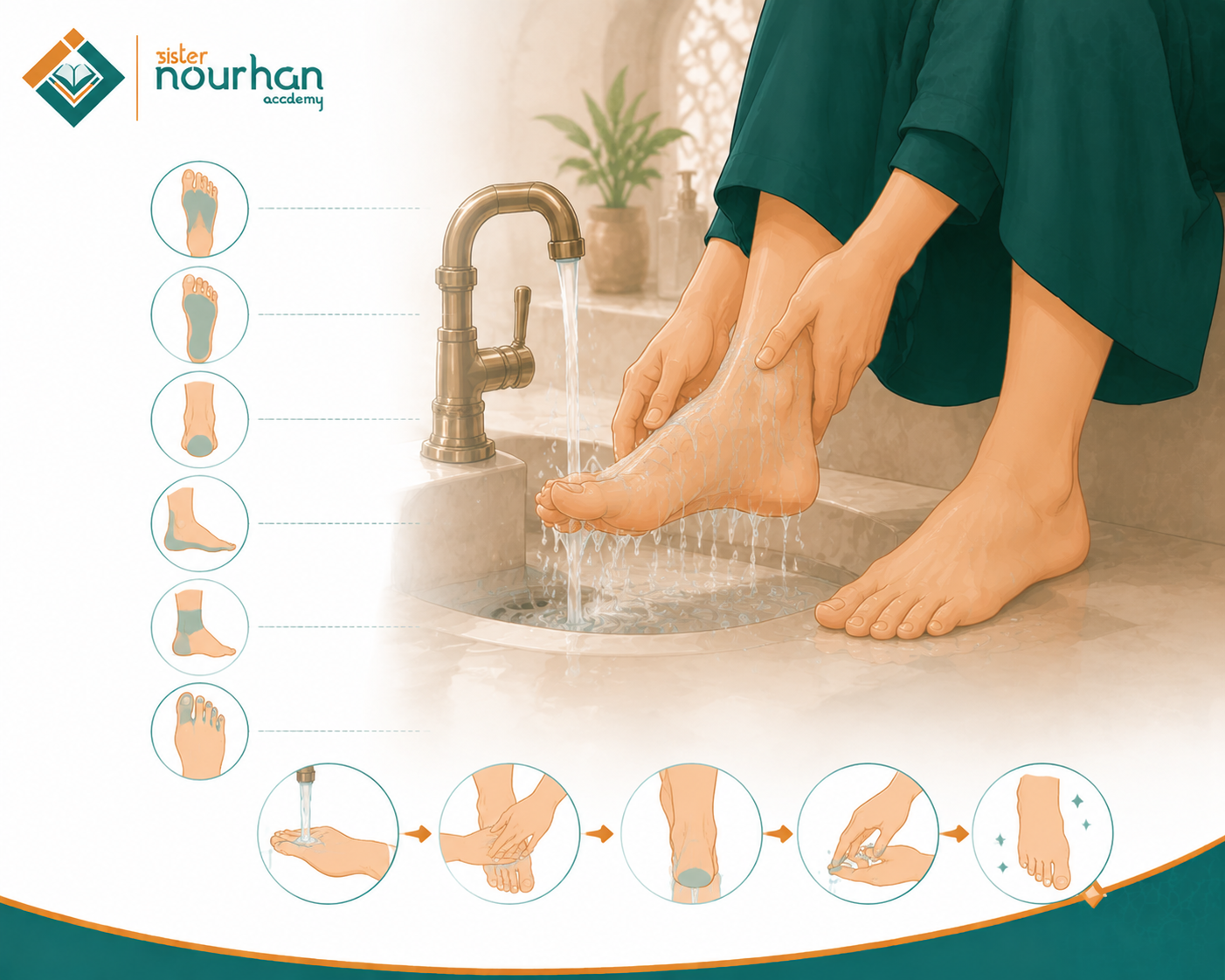
Make sure water reaches the entire foot, including:
The top of the foot
The sole
The heel
Around both sides
Both ankles
Between every toe
Take particular care with the heels and the spaces between the toes, because these are easy areas to miss when wudu is performed quickly.
You can use your fingers to help water reach between the toes. Check the back and sides of the heels rather than assuming that water has reached them simply because the top of the foot is wet.
Wash the right foot completely three times and then the left foot three times Once both feet have been washed properly, you have completed the physical steps of wudu.
Wudu Steps With Pictures Female Learners Can Follow
A visual guide is particularly useful for beginners because it can show exactly which areas need to come into contact with water.
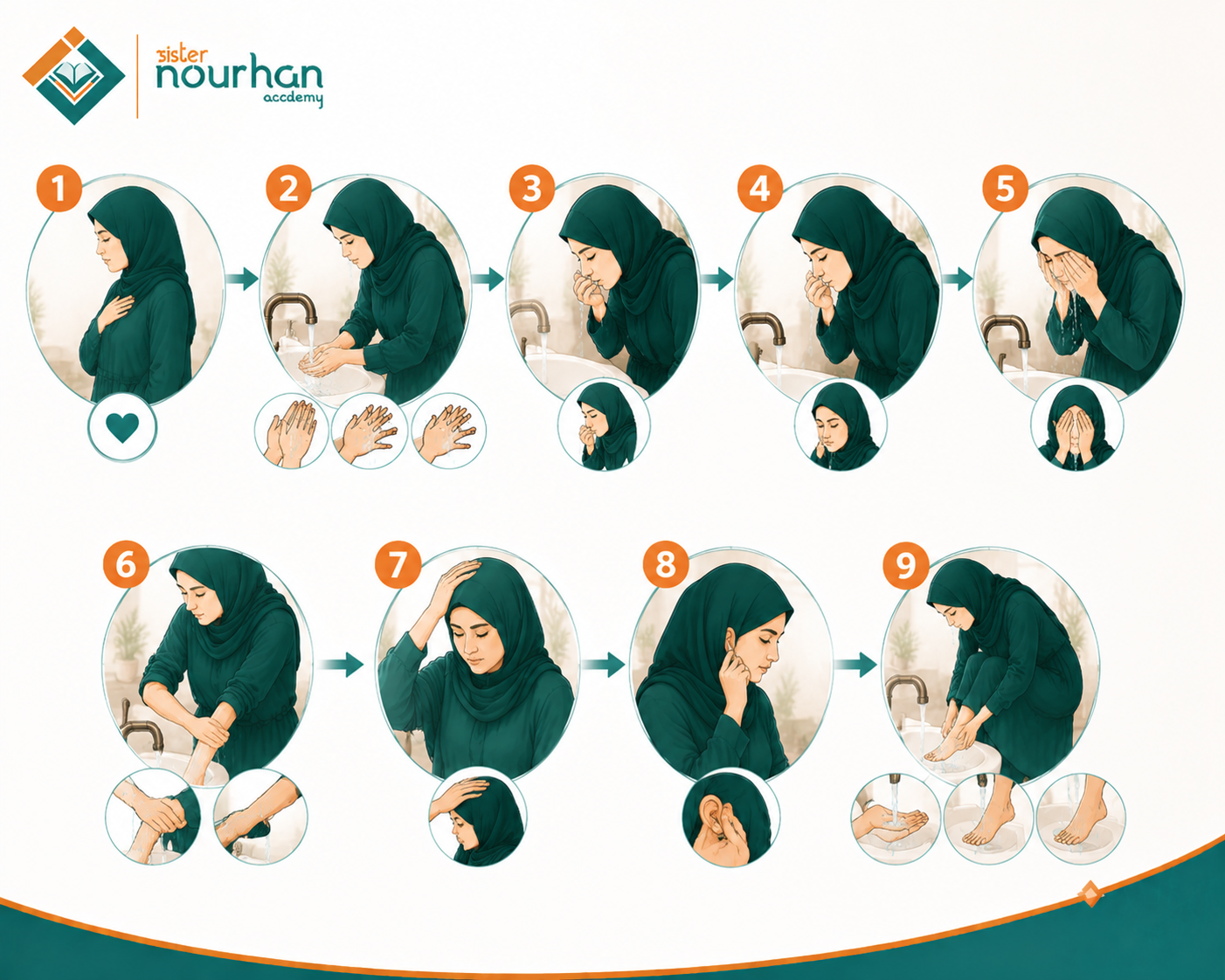
When following an illustrated guide, the sequence should show:
Intention → Hands → Mouth → Nose → Face → Arms → Head → Ears → Feet
Pictures should also highlight commonly missed areas such as the elbows, heels, spaces between the fingers, and spaces between the toes.
However, a picture should be used to understand the physical technique rather than as a substitute for learning which actions are obligatory and which belong to the Sunnah.
How to Perform Wudu for Females With Long Hair or Hijab?
Having long hair does not mean that a woman has to soak all of her hair during every wudu When performing masah, she wipes her head with wet hands. The full length of long hair does not need to be washed as part of ordinary wudu.
This is different from washing the hair during ghusl Hijab can create a practical difficulty when a woman needs to make wudu at work, university, while travelling, or in another place where privacy is limited.
When possible, find a private space where you can access the head properly for masah. A woman can loosen or adjust her hijab as necessary to wipe the required area without exposing herself unnecessarily.
Learning these details as part of broader Islamic knowledge can also help women distinguish between purification requirements, recommended practices, and cultural habits.
Sister Nourhan Academy's Alimah Course for Females provides women with an opportunity to study Islamic subjects in a more structured way.
Read also: Do you have to wear hijab when reading quran on phone?

Can You Make Wudu With Nail Polish?
Conventional nail polish forms a layer over the nail that prevents water from reaching it. It should therefore be removed before making wudu The same principle applies to artificial coatings or nail products that completely block water.
Products marketed as “breathable” or water-permeable have generated discussion because the relevant question is whether water genuinely reaches the nail. If you are uncertain about a particular product, removing it before wudu is the safer approach or you can ask a qualified scholar about the specific product and the school of jurisprudence you follow.
The goal is not to create unnecessary anxiety. It is simply to ensure that water reaches every area that must be washed.
Do Women Perform Wudu During Menstruation?
Yes, a woman can perform wudu during menstruation, but wudu does not end the state of menstruation or make Salah permissible while the menstrual period is ongoing.
The key distinction is between wudu and ghusl. Wudu removes minor ritual impurity, while after menstruation ends, a woman must perform the required ghusl before resuming Salah. Ordinary wudu alone does not replace this ghusl.
The same distinction applies to postnatal bleeding (nifas). Irregular bleeding (istihadah), however, has different rulings and should not automatically be treated as menstruation.
If you are uncertain whether bleeding is menstruation, postnatal bleeding, or istihadah, especially when its timing or pattern is unusual, consult a qualified scholar or knowledgeable female teacher for guidance relevant to your situation.
Read also: What are the steps of Ghusl for women?
What Breaks a Woman’s Wudu?
Once you have valid wudu, you do not need to repeat it simply because a certain amount of time has passed. Wudu remains until something occurs that invalidates it.
Common nullifiers include:
Urinating or defecating
Passing wind
Deep sleep in which awareness is lost
Loss of consciousness
Some additional issues have differences of opinion among the Islamic schools of jurisprudence. These can include questions surrounding physical contact between men and women, certain forms of discharge, bleeding, vomiting, and other situations.
Rather than presenting one madhhab's position as the only Islamic view, follow reliable scholarship according to the school or qualified teacher you trust when dealing with disputed matters.
Common Wudu Mistakes Women Should Avoid
Learning the correct wudu steps for woman is important, but small mistakes can leave required areas dry or prevent water from reaching the skin. Here are the most common mistakes to avoid:
1. Not Washing the Elbows Completely
Wash each arm up to and including the elbow, making sure no area remains dry.
2. Leaving the Heels or Ankles Dry
When washing the feet, make sure water reaches the heels, ankles, and sides of each foot.
3. Forgetting Between the Fingers and Toes
Ensure water reaches between the fingers and toes, as these areas can easily be missed during wudu.
4. Performing Wudu Too Quickly
Rushing may leave parts of the face, arms, or feet dry. Complete each step carefully before moving to the next.
5. Using Excessive Water
Using more water does not make wudu more complete. Use enough to wash each required area properly without unnecessary waste.
6. Confusing Wudu With Ghusl
Women do not need to wash their entire body or soak the full length of their hair during ordinary wudu. Wudu and ghusl have different requirements.
7. Keeping Products That Block Water
Nail polish and some waterproof cosmetics can prevent water from reaching the nails or skin. Remove any product that creates a barrier before performing wudu.
What Should You Say After Wudu?
After completing wudu, it is Sunnah to remember Allah with the supplication taught by the Prophet ﷺ. This dhikr combines the testimony of faith with a prayer for repentance and purification, making it a meaningful way to conclude wudu.
Umar ibn Al-Khattab رضي الله عنه reported that the Messenger of Allah ﷺ said that whoever performs wudu well and then says:
أَشْهَدُ أَنْ لَا إِلَهَ إِلَّا اللَّهُ وَحْدَهُ لَا شَرِيكَ لَهُ، وَأَشْهَدُ أَنَّ مُحَمَّدًا عَبْدُهُ وَرَسُولُهُ
Ashhadu an la ilaha illa Allah wahdahu la sharika lah, wa ashhadu anna Muhammadan ‘abduhu wa rasuluh.
“I bear witness that there is no deity worthy of worship except Allah alone, with no partner, and I bear witness that Muhammad is His servant and Messenger.”
The Prophet ﷺ explained that the eight gates of Paradise are opened for the person who completes wudu properly and says this remembrance. The hadith is recorded in Sunan an-Nasa’i 148 and graded Sahih.
Read Sunan an-Nasa’i 148 on Sunnah.com
A narration in Jami` at-Tirmidhi also includes the following addition:
اللَّهُمَّ اجْعَلْنِي مِنَ التَّوَّابِينَ، وَاجْعَلْنِي مِنَ الْمُتَطَهِّرِينَ
Allahumma-j‘alni min at-tawwabin, waj‘alni min al-mutatahhirin.
“O Allah, make me among those who repent and make me among those who purify themselves.”
Read Jami` at-Tirmidhi 55 on Sunnah.com
This supplication beautifully connects the physical and spiritual purposes of wudu. A Muslim finishes washing the body by asking Allah for a deeper form of purification through repentance and spiritual cleanliness.
See our teaching methods
Experience the quality of our instruction firsthand by watching a live lesson snippet below.
Enrich Your Islamic Knowledge
Deepen your understanding of Fiqh, Aqeedah, and Hadith with dedicated female scholars at Sister Nourhan Academy.
Start Your Free Trial NowBuild Confidence in Worship with Sister Nourhan Academy
Learning wudu correctly is an important foundation for Salah and everyday worship. At Sister Nourhan Academy, female learners can strengthen their understanding of Islamic practices, including purification and prayer, while building the knowledge needed to worship with greater confidence and consistency.
Correct wudu is not only about following the steps in order; it also means understanding what is obligatory, what is Sunnah, and how different situations may affect purification.
With reliable Islamic guidance and structured learning, Sister Nourhan Academy helps women develop a clearer understanding of their worship and a stronger connection with Allah.
Discover our Islamic Studies Courses

Frequently Asked Questions About Wudu for Women
Is wudu different for women and men?
The essential acts of wudu are the same. Women may have additional practical questions involving hair, hijab, makeup, nail products, menstruation, postpartum bleeding, and irregular bleeding.
Do I need to wash each body part three times?
Washing three times is part of the complete Sunnah practice for the washed limbs, but washing a required limb thoroughly once can fulfil the basic washing requirement. The head is wiped rather than washed three times.
Do women have to wet all their hair during wudu?
No. Ordinary wudu requires masah of the head; a woman does not have to wash the entire length of long hair every time she makes wudu.
Can I pray with makeup after making wudu?
Makeup applied after valid wudu does not itself break that wudu. When making a new wudu, however, any waterproof barrier that prevents water from reaching a required area needs to be addressed.
Does wudu have a time limit?
No. Wudu does not expire after a fixed number of minutes or hours. It remains valid until an established nullifier occurs.
Do I need a new wudu for every prayer?
Not necessarily. If your wudu has not been broken, you can pray more than one Salah with the same wudu. Renewing it is permissible, but the passage of one prayer time by itself does not automatically invalidate ordinary wudu.
What should I do if I forget one of the steps?
The answer depends on what was missed. Missing an obligatory part is different from missing a Sunnah act. If you realize that an obligatory area was not properly washed or wiped, correct it according to the applicable rulings. If you are unsure how to proceed, consult a qualified teacher rather than guessing.
What is the easiest way to remember the order?
Remember the body sequence:
Hands → Mouth → Nose → Face → Arms → Head → Ears → Feet.
After practicing it consistently, the sequence becomes natural and easy to remember.