
The Quranic text displayed on a screen is temporary, while the device itself has many other functions. For this reason, many scholars do not apply the same ruling of directly touching a physical Mushaf to holding a smartphone or using a Quran app.
However, there is an important distinction: Using the phone is one question. Verbally reciting Quran during menstruation is another.
Some scholars restrict formal Quran recitation during menstruation, while others permit it, particularly for learning, teaching, Hifz revision, or fear of forgetting memorized Quran.
So when asking can women read Quran on phone during periods, the answer depends partly on what “read” means:
looking at Quranic text on the screen.
reciting the verses aloud.
listening to Quran.
or touching a printed Mushaf.
These are related issues, but they do not all have the same ruling.
Can Women Read the Quran on the Phone During Periods?
Yes, many contemporary scholars allow women to use Quran apps and view Quranic text on their phones during menstruation.
A smartphone is not considered a physical Mushaf in the legal sense A printed Mushaf is dedicated specifically to Quranic text, which remains permanently written on its pages.
A smartphone is different. It is used for communication, banking, photography, messaging, education, and many other functions. Quranic verses only appear temporarily when the relevant app or page is opened.
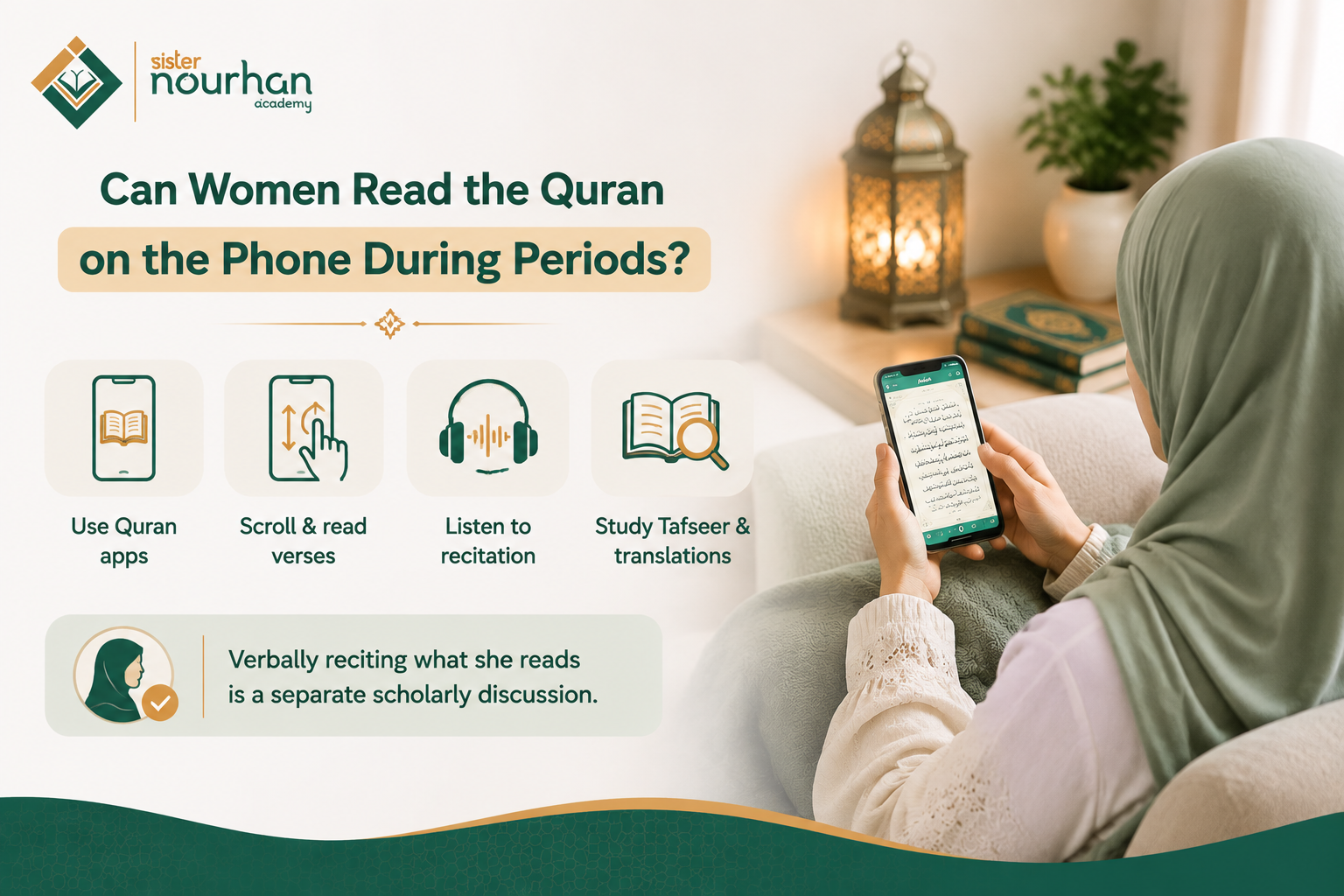
For this reason, many scholars allow a menstruating woman to:
hold her phone.
open a Quran app.
scroll through verses.
follow Quranic text on the screen.
read translations.
study Tafseer.
listen to recitation.
and use digital Quran resources.
If she also wants to verbally recite what she sees, that leads to a separate scholarly discussion.
Read also : Can I Read the Quran on My Period?
Is Reading the Quran From a Phone the Same as Touching a Mushaf?
No, reading the Quran from a phone is not generally treated the same as directly touching a physical Mushaf.
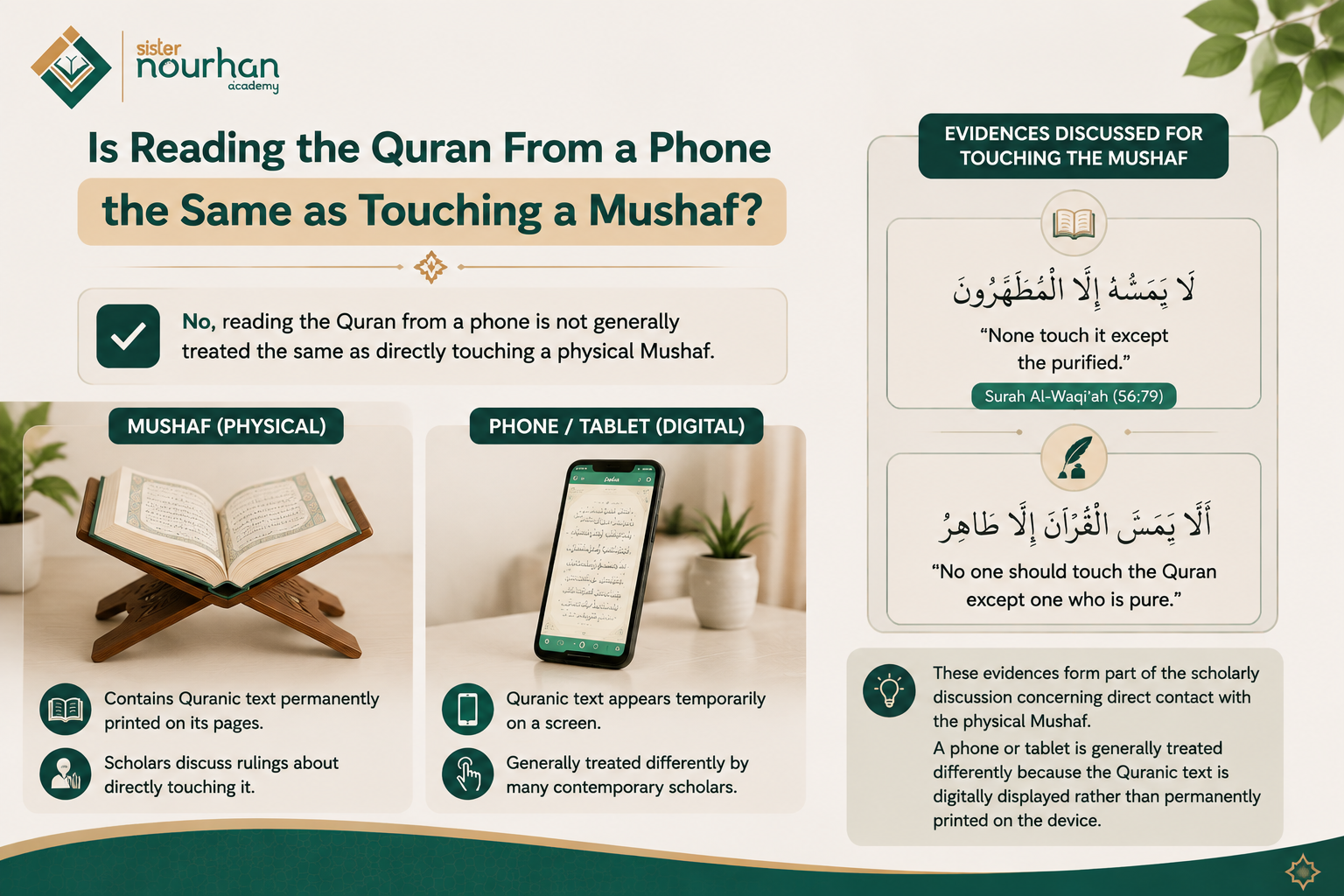
A Mushaf contains Quranic text permanently printed on its pages, while a smartphone or tablet is a multipurpose device on which Quranic text appears temporarily on a screen.
For this reason, many contemporary scholars distinguish between handling a digital device displaying Quran and directly touching the pages of a Mushaf.
Among the evidences discussed in relation to touching the Mushaf is the verse:
لَا يَمَسُّهُ إِلَّا الْمُطَهَّرُونَ
“None touch it except the purified.” Surah Al-Waqi‘ah (56:79)
Scholars have also cited the instruction:
أَلَّا يَمَسَّ الْقُرْآنَ إِلَّا طَاهِرٌ
“No one should touch the Quran except one who is pure.”
These evidences form part of the scholarly discussion concerning direct contact with the physical Mushaf. A phone or tablet, however, is generally treated differently because the Quranic text is digitally displayed rather than permanently printed on the device.
Can a Woman Read the Quran During Menstruation From a Phone Without Wudu?
Many contemporary scholars allow a woman to handle a phone displaying Quranic verses without wudu because the phone is not treated as a physical Mushaf.
Touching the screen is not considered the same as directly touching printed Quranic lettering.
The verses are digital and temporary. When the app is closed or the screen changes, they are no longer displayed.
This means a menstruating woman may generally:
hold the phone,
open a Quran app,
swipe between verses,
read translation,
study Tafseer,
or listen to Quran
without treating the device like a printed Mushaf The question of verbal Quran recitation during menstruation remains separate.
Women who want to understand questions of purity, worship, and other rulings related to Muslim women in greater depth can continue their studies through the Alimah Course for Females, which provides structured learning across Islamic studies and women's fiqh.

Can a Menstruating Woman Recite Quran From Her Phone?
Scholars differ on whether a menstruating woman may recite the Quran from her phone. The fact that a phone is not treated like a physical Mushaf addresses the issue of touching the device, but it does not by itself settle the separate question of verbal Quran recitation during menstruation.
The majority of classical jurists held that a menstruating woman should refrain from formal Quran recitation until her period ends and she becomes ritually pure. They generally distinguished formal tilawah from Quranic phrases recited as ordinary dhikr or dua.
Other scholars permit Quran recitation during menstruation, arguing that there is no clear authentic text that explicitly prohibits it.
They also distinguish menstruation from janabah: a person in janabah can normally perform ghusl immediately, while menstruation is involuntary and may continue for several days.
This distinction can be particularly relevant for women who:
Memorize or regularly review the Quran
Teach Quran
Study Quran as part of an ongoing course
Prepare for Quran assessments
Fear forgetting previously memorized verses
Therefore, using a phone removes the separate concern of directly touching a physical Mushaf, but the ruling on verbal recitation still depends on the scholarly opinion a woman follows. She may follow the school of jurisprudence or qualified scholar she trusts.
Shots from Our Classes
Take a moment to view the video below to see how our teachers provide clear, supportive corrections during a session.
Enrich Your Islamic Knowledge
Deepen your understanding of Fiqh, Aqeedah, and Hadith with dedicated female scholars at Sister Nourhan Academy.
Start Your Free Trial NowWhy Do Scholars Differ About Quran Recitation During Menstruation?
The disagreement mainly concerns the strength of the evidence used to prohibit recitation. One narration sometimes cited states that a menstruating woman and a person in janabah should not recite anything from the Quran However, some hadith scholars classified that narration as weak.
Those who restrict recitation also use analogy with janabah because both menstruation and janabah are states involving major ritual impurity Scholars who permit recitation challenge that analogy.
They argue that janabah and menstruation are not identical because janabah can usually be ended immediately through ghusl, while menstruation is involuntary and may last several days.
Read also: How to perform ghusl for women in islam
Can a Menstruating Woman Read Quran Silently From Her Phone?
Yes, if “reading silently” means looking at the Quranic text without verbally pronouncing the words, many scholars distinguish this from actual Quran recitation.
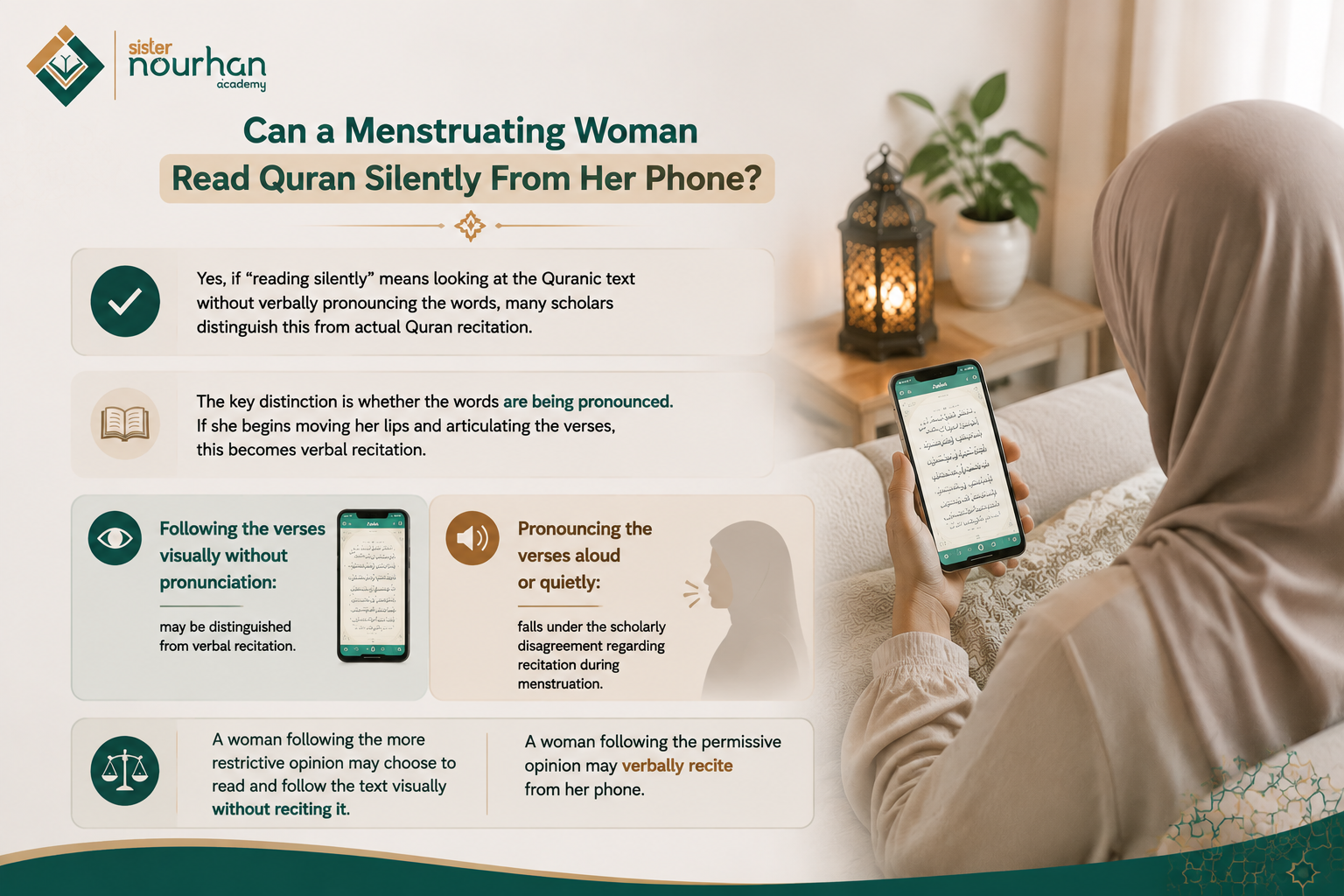
A woman may therefore visually follow verses displayed on her phone without the act necessarily being treated as formal tilawah.
The key distinction is whether the words are being pronounced. If she begins moving her lips and articulating the verses, even in a very quiet voice, this becomes verbal recitation and falls under the scholarly disagreement concerning Quran recitation during menstruation.
Therefore:
Following the verses visually without pronunciation: may be distinguished from verbal recitation.
Pronouncing the verses aloud or quietly: falls under the scholarly disagreement regarding recitation during menstruation.
A woman following the more restrictive opinion may choose to read and follow the text visually without reciting it, while a woman following the permissive opinion may verbally recite from her phone.
Can a Menstruating Woman Read Quran From Memory?
This depends on the scholarly opinion followed regarding verbal Quran recitation during menstruation. Reciting from memory does not create a separate ruling simply because no Mushaf or phone is being used.
Scholars who restrict verbal recitation during menstruation generally apply that restriction to reciting from memory as well.
Scholars who permit recitation generally allow a woman to recite memorized verses without needing to read them from a written text.
This distinction is particularly important for Hifz students, who may need regular revision to maintain previously memorized portions of the Quran.
Therefore, the main issue is not whether the verses are read from memory, a phone, or another source, but whether the scholarly opinion a woman follows permits verbal Quran recitation during menstruation.
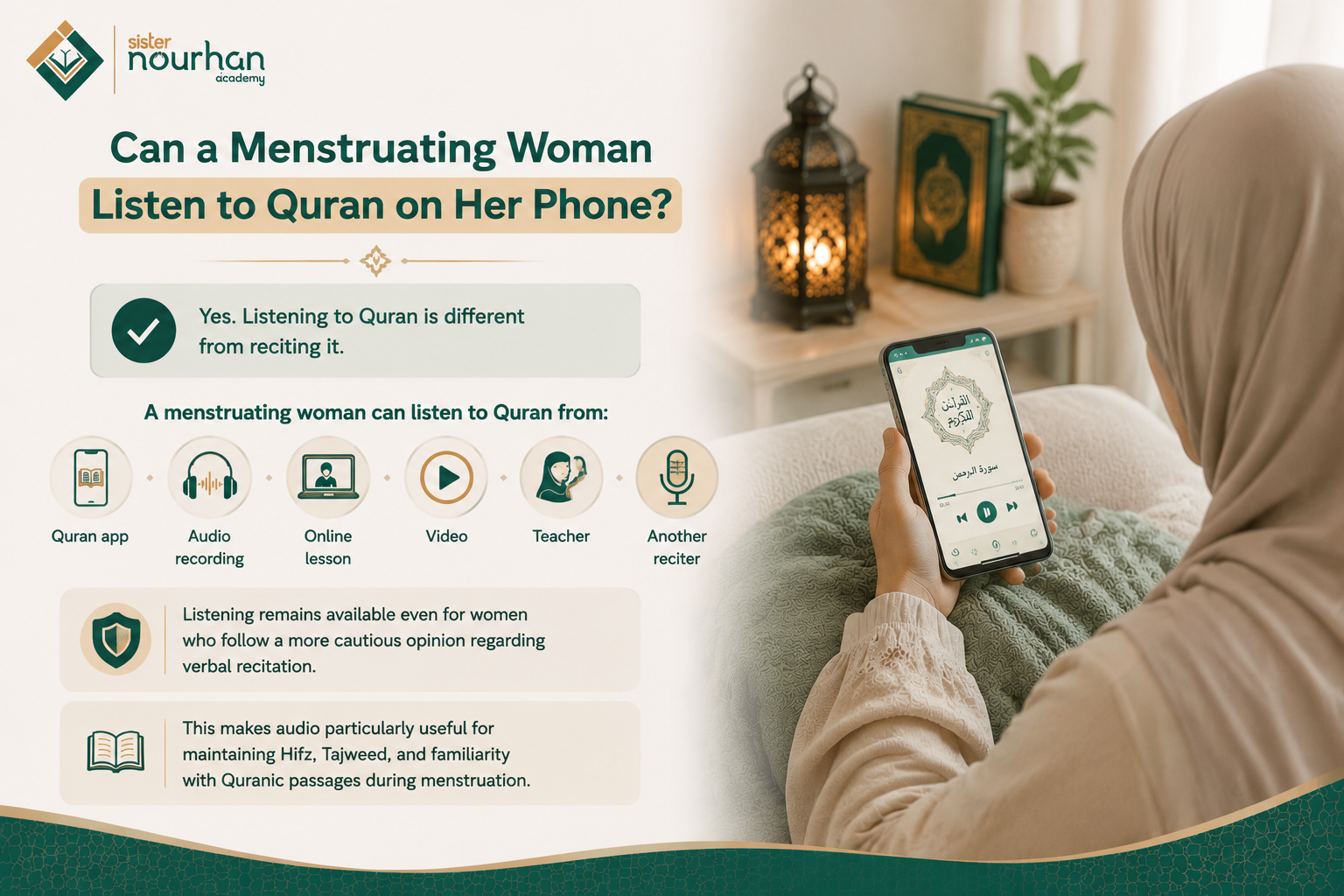
Can a Menstruating Woman Listen to Quran on Her Phone?
Yes Listening to Quran is different from reciting it. A menstruating woman can listen to Quran from:
a Quran app,
an audio recording,
an online lesson,
a video,
a teacher,
or another reciter.
Listening remains available even for women who follow a more cautious opinion regarding verbal recitation. This makes audio particularly useful for maintaining Hifz, Tajweed, and familiarity with Quranic passages during menstruation.
Does Listening to the Quran Require Wudu?
No Wudu is not required merely to listen to Quran recitation.
A menstruating woman may listen while:
resting,
studying,
traveling,
preparing food,
reviewing Hifz,
or following an online Quran lesson.
The Quran should always be treated with respect, but ritual purity is not a condition for simply hearing recitation.
Read also: Can a woman who is menstruating recite the Quran via a mobile screen?
Can a Menstruating Woman Review Hifz From Her Phone?
Yes A phone can be extremely useful for Quran memorization during menstruation. A woman who follows the opinion permitting recitation may:
read memorized verses,
recite them,
repeat difficult ayat,
compare similar passages,
and continue normal Hifz revision.
A woman who follows the more restrictive position may still:
listen repeatedly,
mentally follow the verses,
review their order,
identify transitions,
compare similar ayat,
and study the meanings of memorized passages.
This helps prevent menstruation from becoming a complete interruption in Quran memorization.
Can a Woman Read the Quran During Menstruation From a Phone for Tajweed Study?
Yes, a menstruating woman can continue studying Tajweed from a phone or tablet. She may study:
Makharij al-Huruf,
Sifat al-Huruf,
Noon Sakinah and Tanween,
Meem Sakinah,
Ghunnah,
Madd,
Qalqalah,
Tafkhim and Tarqiq,
Waqf and Ibtida.
She can also listen to a qualified reciter while following the verses on the screen. If she follows the view permitting recitation during menstruation, she may practice aloud.
If she follows the more cautious view, she can focus on listening and theory until menstruation ends.
Women who want to build greater consistency in these acts can explore the Dua and Adhkar Course for Females and develop a more structured routine of remembrance and supplication.

Can a Menstruating Woman Read Quran Translation and Tafseer on Her Phone?
Yes, reading the Quran translation and Tafseer is another way to remain connected to Quran during menstruation. A woman may study:
Quranic meanings,
Tafseer,
vocabulary,
Asbab al-Nuzul,
themes of surahs,
Quranic stories,
and connections between verses.
This is especially useful for women who follow the more restrictive opinion concerning formal recitation. Menstruation does not prevent Quran learning.
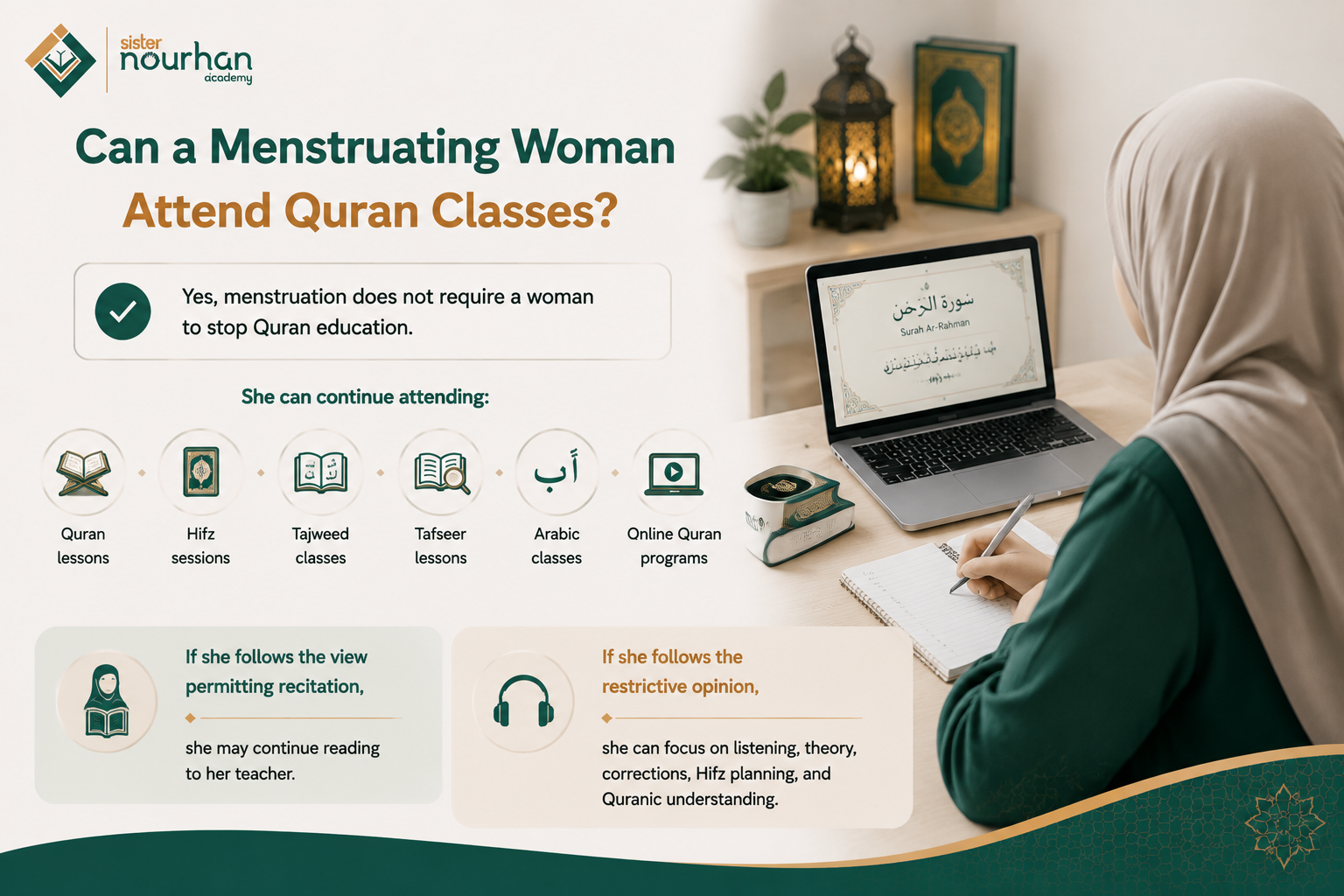
Can a Menstruating Woman Attend Quran Classes?
Yes, menstruation does not require a woman to stop Quran education. She can continue attending:
Quran lessons,
Hifz sessions,
Tajweed classes,
Tafseer lessons,
Arabic classes,
and online Quran programs.
If she follows the view permitting recitation, she may continue reading to her teacher. If she follows the restrictive opinion, she can focus on listening, theory, corrections, Hifz planning, and Quranic understanding.
What Can a Woman Do With the Quran During Her Period?
A woman does not need to abandon her relationship with the Quran during menstruation. She can continue to:
use Quran apps,
view Quranic text digitally,
listen to recitation,
study Tafseer,
read translations,
review Hifz,
study Tajweed,
attend Quran lessons,
make dhikr,
make dua,
and study Quranic vocabulary and meanings.
If she follows a scholarly opinion that permits verbal recitation during menstruation, she may also continue reciting Quran.
Menstruation changes certain rulings, but it does not mean complete disconnection from Quran.
See our teaching methods
Experience the quality of our instruction firsthand by watching a live lesson snippet below.
Enrich Your Islamic Knowledge
Deepen your understanding of Fiqh, Aqeedah, and Hadith with dedicated female scholars at Sister Nourhan Academy.
Start Your Free Trial NowContinue Your Quran and Islamic Studies With Sister Nourhan Academy
Menstruation does not have to interrupt your progress in learning the Quran or Islam. Even when certain acts of worship are temporarily affected, you can continue developing your understanding through Quran listening, Hifz revision, Tajweed, Tafseer, dua, dhikr, and Islamic studies.
At Sister Nourhan Academy, women can learn Quran and Islamic studies through structured programs designed specifically for female students. With guidance from qualified female teachers, you can continue building knowledge, strengthening your Quran skills, and maintaining a consistent learning routine throughout the month.

Discover our Islamic Studies Courses
Conclusion
Many contemporary scholars allow a menstruating woman to use a phone or Quran app to access Quranic text because a digital device is not treated in the same way as a physical Mushaf. The main scholarly disagreement concerns verbal Quran recitation during menstruation rather than simply holding or using a smartphone.
A woman who follows the permissive opinion may continue reciting from her phone or memory, while someone following the more restrictive opinion can still listen to Quran, visually follow verses, study Tafseer and Tajweed, review Hifz, and continue attending Quran lessons.
The key is to distinguish between using a phone, verbally reciting Quran, listening to Quran, and touching a physical Mushaf. Menstruation affects certain rulings, but it does not require a woman to completely disconnect from Quran learning and remembrance of Allah.
Frequently Asked Questions About Reading Quran From a Phone During Menstruation
Can Women Read the Quran on the Phone During Periods?
Yes. Many contemporary scholars allow women to access Quranic text through a phone during menstruation because the phone is not treated as a printed Mushaf. Verbal recitation remains an issue of scholarly disagreement.
Can a Menstruating Woman Read the Quran From a Phone?
Yes. She may generally use a Quran app and view Quranic verses. Whether she verbally recites depends on the scholarly opinion she follows.
Can a Woman Read the Quran During Menstruation From a Phone?
Many scholars allow digital Quran access during menstruation. A woman can use her phone for reading, listening, studying, translation, and Tafseer. Formal verbal recitation remains disputed.
Can a Menstruating Woman Read the Quran on the Phone Without Wudu?
Many contemporary scholars allow her to handle and use the phone without wudu because the device itself is not considered a Mushaf.
Is a Quran App Considered a Mushaf?
Many contemporary scholars distinguish a Quran app from a physical Mushaf because the Quranic text appears temporarily on a multipurpose digital device.
Can a Menstruating Woman Recite Quran From Her Phone?
Scholars differ. The majority of classical jurists restricted formal recitation during menstruation, while other scholars permitted it, especially for learning, teaching, or memorization.