

You spray your favourite scent, pick up your bag, reach for the door — and a thought stops you mid-step. Is there really a hadith about women wearing perfume outside, and does it apply to a walk to the supermarket?
Almost every sister meets this question at some point, usually as a half-remembered warning with no source attached. At Sister Nourhan Academy, it is one of the questions our students raise most often in their women-only classes.
So let's settle it properly. Not with a rumour, but with the actual narrations, their authenticity grading, and the reasoning scholars built on top of them.
By the end you will know exactly which text is being quoted, what its underlying reason is, and how to make a confident decision every morning without guessing.
Key Highlights of This Article:
The exact narration behind the ruling, with its source and authenticity grading.
Why scholars point to intent and diffusion rather than perfume itself.
The clear difference between hygiene, home use, and public adornment.
A simple daily test you can apply before stepping outside.
What Does the Hadith Say About Women Wearing Perfume Outside?
The hadith about women wearing perfume outside is a narration from Abu Musa al-Ash'ari in which the Prophet ﷺ warned against a woman applying fragrance and then passing by men so that they notice her scent.
It is a warning about deliberate attraction in public space, not a ban on smelling clean. Understanding the text properly means looking at three things: its wording, its authenticity, and the parallel narrations that specify the mosque.
1. The Authentic Hadith on Women Wearing Perfume in Public
The clearest hadith on women wearing perfume in public comes from Abu Musa Al-Ash‘ari (رضي الله عنه). The Prophet ﷺ specifically warned about wearing a noticeable fragrance and then passing by people so that they can smell it.
عَنْ أَبِي مُوسَى رضي الله عنه، عَنِ النَّبِيِّ ﷺ قَالَ:
«كُلُّ عَيْنٍ زَانِيَةٌ، وَالْمَرْأَةُ إِذَا اسْتَعْطَرَتْ فَمَرَّتْ بِالْمَجْلِسِ فَهِيَ كَذَا وَكَذَا» يَعْنِي زَانِيَةً.
Abu Musa reported that the Prophet ﷺ said: “Every eye commits adultery, and when a woman applies perfume and passes by a gathering, she is such and such,” meaning an adulteress. Sunan Abi Dawud 4173
Another narration from Abu Musa Al-Ash‘ari (رضي الله عنه) gives the warning more explicitly:
«أَيُّمَا امْرَأَةٍ اسْتَعْطَرَتْ فَمَرَّتْ عَلَى قَوْمٍ لِيَجِدُوا مِنْ رِيحِهَا فَهِيَ زَانِيَةٌ»
“Any woman who applies perfume and passes by people so that they may smell her fragrance is an adulteress.” Sunan An-Nasa’i 5126
The important phrase is “so that they may smell her fragrance.” The hadith therefore focuses on noticeable fragrance in the presence of others and uses particularly strong language to warn against using scent in a way that attracts attention.
2. Hadiths About Wearing Perfume When Going To The Mosque
The Sunnah also gives specific guidance about women wearing fragrance when attending the mosque. Two authentic narrations in Sahih Muslim instruct women attending prayer not to use perfume or incense, making the mosque one of the clearest applications of this guidance.
Zaynab, the wife of Abdullah ibn Mas‘ud (رضي الله عنهما), reported that the Messenger of Allah ﷺ said:
«إِذَا شَهِدَتْ إِحْدَاكُنَّ الْعِشَاءَ فَلَا تَطَيَّبْ تِلْكَ اللَّيْلَةَ»
“If one of you women attends the ‘Isha prayer, she should not apply perfume that night.” Sahih Muslim 443
A second authentic narration gives similar guidance regarding incense and fragrance. Abu Hurayrah (رضي الله عنه) reported that the Messenger of Allah ﷺ said:
«أَيُّمَا امْرَأَةٍ أَصَابَتْ بَخُورًا فَلَا تَشْهَدْ مَعَنَا الْعِشَاءَ الْآخِرَةَ»
“Any woman who has applied incense should not attend the last ‘Isha prayer with us.” Sahih Muslim 444
These authentic narrations establish specific guidance for attending the mosque while wearing noticeable fragrance. They also help explain the broader concern found in the hadith about perfume in public: fragrance should not become a means of drawing the attention of non-mahram men.
Learn the hadith you live by, straight from the source. Join the Hadith Course for Sisters and read the narrations with a qualified female teacher, chain and meaning together.

Read also: Do You Have to Wear Hijab When Reading Quran? Clear Rulings for Every Sister
3. Why the Hadith Uses Such a Strong Warning
The severity of the wording reflects the outcome the Sharia is trying to prevent, not a legal sentence being passed on the woman. Classical commentators explain that scent is one of the strongest triggers of attraction, which is why the language is deliberately shocking.
This connects directly to the Qur'anic instruction that believing women not display their adornment to those outside their circle of mahrams. To read that verse in context, refer to the English translation of Surah An-Nur, verse 31.
Strong wording in the Sunnah is a teaching device. It is meant to make you pause at the door — which is exactly what it is doing right now.
Is Perfume Forbidden for Muslim Women in Islam?
No. Fragrance is not forbidden for women in Islam, and the hadith about women wearing perfume outside was never understood by scholars as a blanket prohibition on perfume. The Prophet ﷺ himself used fragrance and taught his companions not to refuse a gift of perfume.
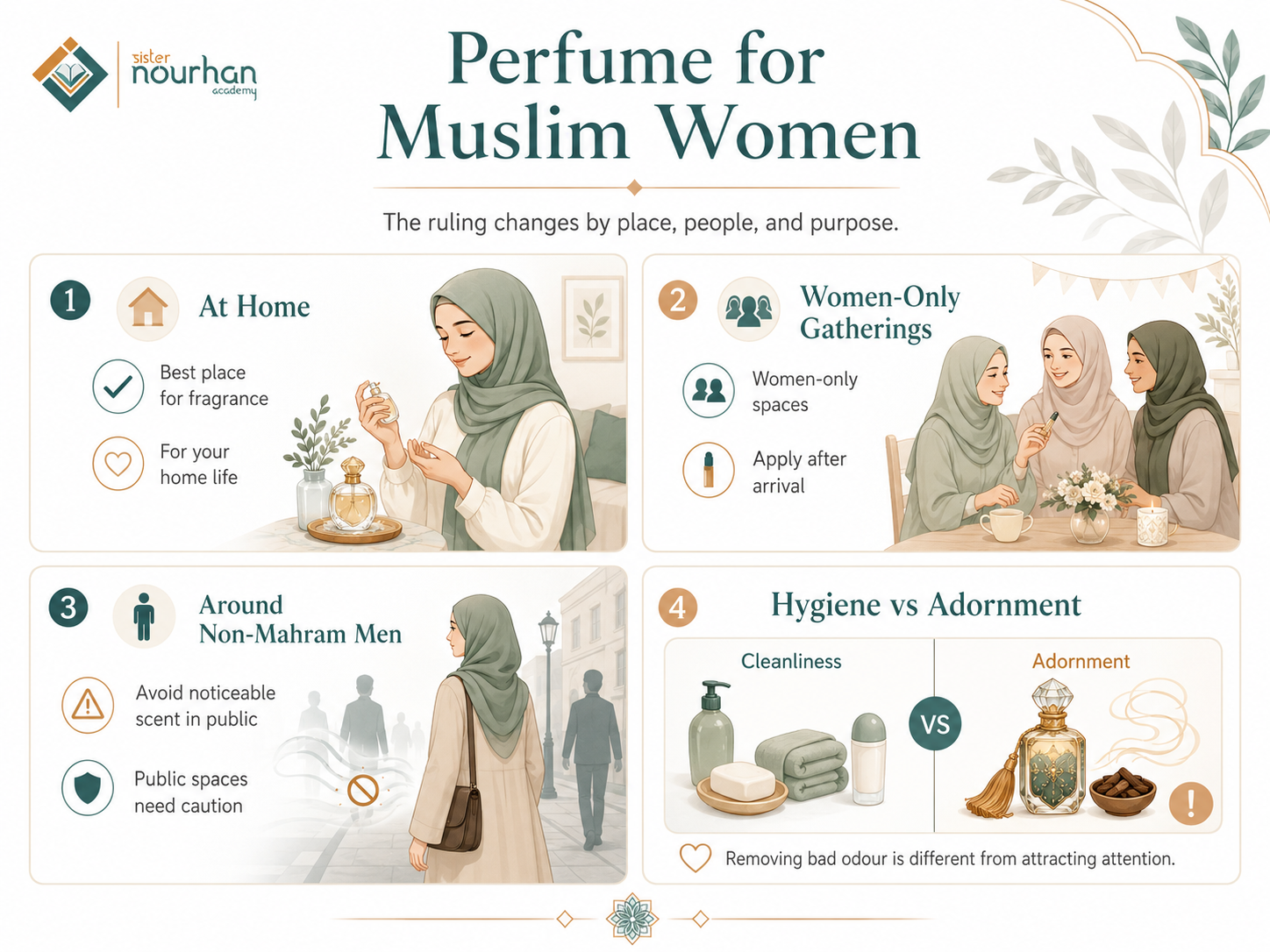
What changes the ruling is location, audience, and intent. Once you separate those three factors, the confusion disappears quickly.
1. Wearing Perfume at Home and With Your Husband
Inside your home and with your husband, perfume is not merely permitted — it is part of good marital conduct. Beautifying yourself for your spouse is encouraged, and no narration restricts a woman's fragrance in that setting.
Many sisters unintentionally invert this. Heavy scent goes on for the street, while nothing is worn at home, which is precisely the opposite of the prophetic emphasis.
Treat your best fragrance as something your household enjoys first. That single adjustment resolves most of the tension around this topic.
2. Wearing Perfume at Women-Only Gatherings
Women's gatherings, family events with mahrams present, and female-only spaces fall outside the concern the narration addresses. The reason is straightforward: the text specifies passing by men who then smell her.
A practical habit helps here. Keep a small rollerball in your bag and apply it after you arrive, rather than wearing a projecting scent through the car park and the lobby.
If men are present at the venue or on the way, the guidance in the woman wearing perfume hadith applies again for that portion of the journey.
Read also: What do the Hadiths say about a wife obeying her husband?
3. The Difference Between Hygiene and Fragrant Adornment
Islam treats cleanliness as a religious duty, so removing body odour is never the problem being discussed. The distinction scholars draw is between neutralising an unpleasant smell and projecting an attractive one.
Bathing, clean clothes, and mild personal-care products serve hygiene. Concentrated attar, oud, and sweet gourmand fragrances that fill a room serve adornment.
Keeping those two categories separate in your mind is the single most useful takeaway from this whole discussion.
Don't miss: Reading Quran On Phone During Period - Is It Allowed?
See our teaching methods
Experience the quality of our instruction firsthand by watching a live lesson snippet below.
Enrich Your Islamic Knowledge
Deepen your understanding of Fiqh, Aqeedah, and Hadith with dedicated female scholars at Sister Nourhan Academy.
Start Your Free Trial NowHow Scholars Interpret the Hadith About Women Wearing Perfume
Scholars approached the hadith on perfume for women by identifying its underlying cause, or 'illah — the reason the ruling exists. Once the cause is identified, the ruling can be applied consistently to situations the text never named directly.
That method is why two qualified scholars can read one narration and produce guidance that sounds different in wording but agrees in substance.
1. The Majority Scholarly Ruling on Perfume in Public
The dominant position across the four schools is that it is impermissible for a woman to leave her home wearing perfume that non-mahram men will notice. The cause is fitnah — the reasonable expectation of attracting attention and desire.
Because the ruling follows the cause, it tightens or loosens with circumstances. A faint trace on clothing under an abaya is not the same as a fragrance identifiable from three metres away in a lift.
This 'illah-based reasoning is the backbone of applied jurisprudence, and it is exactly what students work through in the Fiqh Course at Sister Nourhan Academy — learning to derive rulings rather than memorise verdicts.

You may also be interested in: Can I Read the Quran on My Period? What Every Muslim Woman Should Know
2. When Some Scholars Allow Light and Discreet Fragrance
A number of scholars permit very light fragrance when three conditions hold together: the scent is not diffusive, the intention is not to attract attention, and the setting is not crowded or mixed. Remove any one condition and the permission lapses.
A widely quoted narration distinguishes men's fragrance, whose scent is apparent, from women's fragrance, whose colour is apparent and scent hidden.
Note that this particular report is graded weak by hadith specialists, as recorded in Jami' at-Tirmidhi 2788, so scholars treat it as supporting context rather than independent proof.
The reliable takeaway from the authentic texts stands on its own: discretion outside, freedom inside.
How Deodorant, Scented Soap, and Hygiene Products Fit the Ruling
Deodorant, shampoo, and laundry detergent are classified as hygiene products, and their residual scent is not what the narration addresses. Their purpose is to prevent offence, not to invite attention.
The line is crossed when a product is chosen specifically for projection — a heavily perfumed body mist layered for reach, for example. Purpose determines category, not the shape of the bottle.
Turn "I think it's haram" into "I know why, and here's the evidence." Study women's fiqh properly in the Islamic Studies for Sisters (Women-Only) programme, taught live by female instructors.

How Muslim Women Can Apply the Perfume Hadith in Daily Life
Applying the hadith about women wearing perfume outside gets much easier once you replace vague anxiety with a repeatable checklist. Below are the checks our students find most workable in real daily life.
Each one takes seconds and removes the need to re-litigate the question every morning.
1. Test Whether Your Fragrance Is Noticeable Before Going Outside
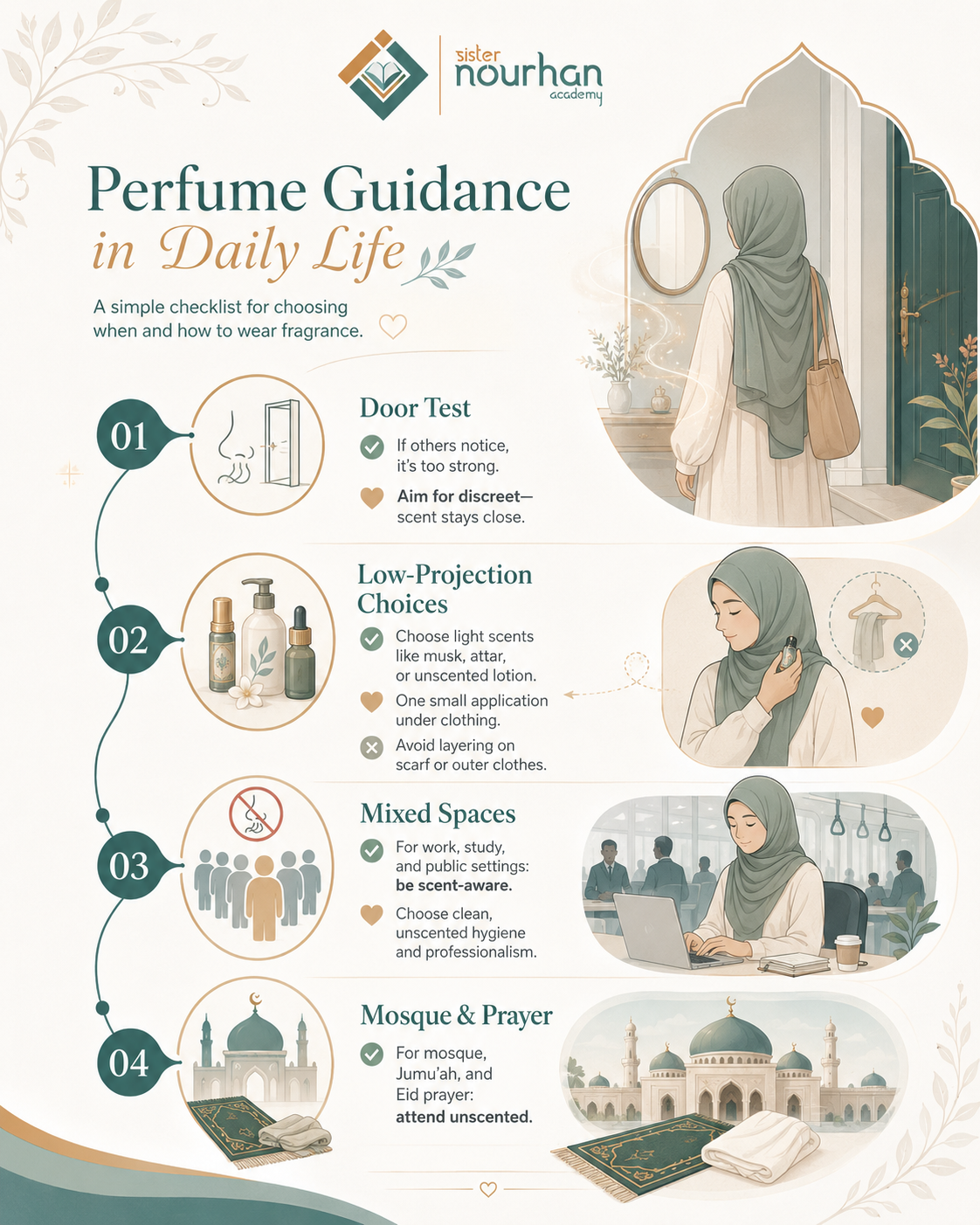
Ask one question at the door: could a stranger walking past at normal distance identify my scent? If the answer is yes, it is projecting, and the guidance in the narration applies.
If only someone standing very close — a sister sitting beside you, your husband — would notice it, you are inside the range scholars describe as discreet.
This test works because it measures the actual cause of the ruling: what reaches other people, not what the label claims.
Read also: Can you listen to the Quran on your period?
2. Choose Light, Low-Projection Fragrances for Public Settings
Formulation matters as much as quantity. Scented body lotions, light musk oils, and alcohol-free attars applied sparingly sit close to the skin, while eau de parfum sprayed on pulse points radiates outward with body heat.
Two habits make a visible difference in practice:
Apply to skin under clothing, never to an outer garment or scarf.
Choose one light application instead of layered mist, oil, and spray.
Building the habit once removes the daily decision entirely.
Read also: What do the Hadiths say about women praying at home compared to the mosque?
3. Wearing Fragrance at Work, University, and in Mixed Spaces
Offices, lecture halls, and public transport are the settings the narration most directly speaks to, because men are present and proximity is unavoidable. Air-conditioned indoor spaces also amplify diffusion far more than open air.
A workable approach is unscented hygiene for the working day, with your fragrance reserved for home and women's gatherings. Sisters who make this switch usually describe it as a relief rather than a restriction.
Colleagues remember professionalism and clean presentation, which mild hygiene products deliver perfectly well.
Wearing Perfume to the Mosque, Jumu'ah, and Eid Prayer
Here the texts are explicit, so this is the clearest case of all: attend unscented. The two authentic narrations in Sahih Muslim address precisely this setting.
Plan around it — perfume after Taraweeh rather than before, and keep the scarf and prayer garment you use for the mosque free of fragrance.
Read also: What is the best Islamic university for women in the Arab world?
If you are also refining the prayer itself, our guide on how to pray in Islam step by step pairs well with this.
Three Common Misunderstandings About Women Wearing Perfume
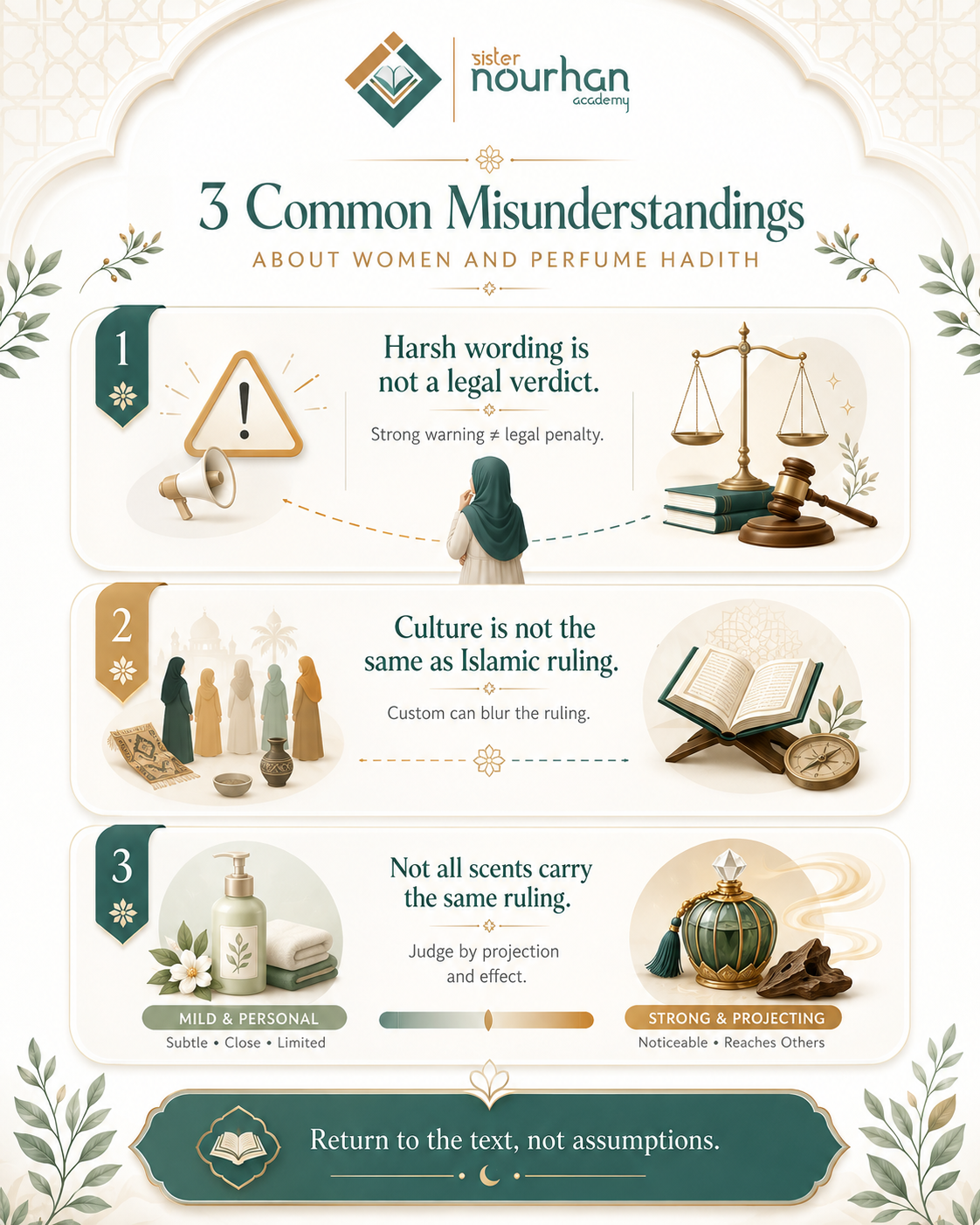
Most of the distress around the hadith women perfume discussion comes from three specific errors rather than from the text itself. Naming them tends to dissolve them.
Read through these and check which one has been shaping your assumptions.
1. Why the Word “Adulteress” Is Not a Legal Verdict
The word is a severe rebuke, not a judicial ruling. Adultery in Islamic law carries strict evidentiary conditions that a woman wearing perfume plainly does not meet, and no scholar has ever applied that penalty on this basis.
The Sunnah uses emphatic language to mark a path toward sin, exactly as it does elsewhere when describing serious matters with intense wording.
So the verse of the ruling is: avoid the action, and do not carry the label. That distinction protects both accuracy and peace of mind.
Read also: Does the Quran authorize domestic violence or striking wives?
2. Distinguishing Islamic Rulings From Cultural Restrictions
Some communities forbid women any fragrance at all; others treat overwhelming perfume in mixed settings as entirely harmless. Neither reflects what the narrations establish.
Culture is a powerful lens, and it quietly edits religious rulings in both directions. The corrective is always to return to the text and its stated cause.
3. Why Not Every Scent Has the Same Islamic Ruling
A single ruling cannot cover shampoo residue and concentrated oud equally, because the two do not produce the same effect on the people around you. The hadith about perfume for woman is concerned with noticeable, attention-drawing fragrance.
Grouping everything together produces either needless guilt or careless dismissal. Both outcomes come from ignoring the 'illah.
Judge each product by what it actually does in a room, and the ruling becomes obvious.
Read also: Are men and women granted equal status and rights in the Quran?
How Sister Nourhan Academy Helps Women Learn Islamic Rulings
One article answers one question. Structured study gives you the tools to answer the next hundred yourself — which is the real reason sisters enrol with us.
Here is what that looks like in practice.
1. Female Teachers Who Specialise In Women's Fiqh
Every sisters' class is taught by a qualified female instructor, so questions about menstruation, purity, adornment, and topics like the hadith about women wearing perfume outside are discussed without hesitation.
Our teachers hold formal training in Qur'an, Arabic, and Islamic sciences, and many are Al-Azhar qualified. You get scholarly accuracy in a setting that feels comfortable from the first session.
That combination is difficult to find, and it is the reason most of our students stay for years.

2. One-On-One Live Classes Around Your Schedule
Classes are private, live, and scheduled around your life — not a pre-recorded library you never open. Sessions run on Zoom or Google Meet and are recorded for your own review.
Because the class is yours alone, the pace follows your level. Beginners are never rushed, and advanced students are never held back.
Mothers, students, and full-time professionals all study with us across different time zones, seven days a week.

3. A Path From One Hadith To Full Scholarly Training
You can begin with a single topic and continue as far as you wish. Many sisters start with practical fiqh questions and progress to the Alimah Course for Females, a full scholarly curriculum for women.
Along the way you can add Arabic, Tafseer, Aqidah, or Hadith sciences, all inside one academy with one coordinated plan. Nothing is fragmented across platforms.
Your learning compounds instead of restarting every time a new question appears.

4. Knowledge That Changes Daily Decisions
Our teaching is deliberately applied. You leave a session knowing what to do at the door, at work, and at the mosque — not just what a book says.
Students consistently tell us the biggest change is confidence: fewer anxious searches, more settled decisions. That is the outcome we design every course around.
Knowledge is meant to move from the page into your day, and that transfer is exactly what personal instruction delivers.

Conclusion
The hadith about women wearing perfume outside addresses a specific act — applying fragrance and then passing by non-mahram men so they notice it. Its authenticity is established, and its underlying cause is the attraction that scent creates in public space.
Perfume itself remains permissible and even praiseworthy. Wear it at home, with your husband, and in women's gatherings; keep it discreet or absent in mixed spaces, and absent at the mosque, where the authentic narrations are explicit.
The ultimate takeaway is a shift in method. The women and perfume hadith is not asking you to memorise a verdict — it is teaching you to read the reason behind a ruling and apply it wisely, which is a skill that will serve you across every question you ever ask.
Shots from Our Classes
Take a moment to view the video below to see how our teachers provide clear, supportive corrections during a session.
Enrich Your Islamic Knowledge
Deepen your understanding of Fiqh, Aqeedah, and Hadith with dedicated female scholars at Sister Nourhan Academy.
Start Your Free Trial NowStart Studying With Sister Nourhan Academy Today!
Stop settling for half-answers. Book your free trial lesson with Sister Nourhan Academy and study this ruling — and every ruling you have been unsure about — with a qualified female teacher who takes your questions seriously.
Watch on our official channel:
The Moment Every Quran Teacher Dreams Of ❤️
Your first session is genuinely a conversation, not a sales call. We assess your level, understand your goals, and map a plan that fits your week, whether you have three hours or thirty minutes a day.
Discover our Islamic Studies Courses
Places with our female instructors fill quickly, especially evening and weekend slots. Reserve your trial now, bring your list of questions, and start replacing uncertainty with evidence this week.

Frequently Asked Questions
Why Is Perfume Haram For Women And Not Men?
It is not banned for women in general — the restriction applies specifically to fragrance that non-mahram men notice in public, since scent draws attention to a woman's presence. Men have no equivalent concern of enticement in that setting, which is why the same act carries a different ruling for each.
Is Wearing Perfume At Night Permissible In Islam?
Yes — no ruling in Islam ties perfume to the time of day, so night use is permissible on the same terms as daytime use. The only night-specific guidance is the instruction that women attending Isha prayer at the mosque should come unscented, recorded in Sahih Muslim.
What Was Prophet Muhammad's Favorite Fragrance?
Musk was described by the Prophet ﷺ as the best of perfumes, and authentic reports confirm he used fragrance regularly and disliked refusing a gift of it. Details like this are covered in Sister Nourhan Academy's hadith and seerah classes for sisters, where prophetic habits are studied with their sources.
Which Fragrances Are Sunnah?
Musk sits at the top, alongside oud and bakhoor incense, camphor, and rose-based attars used throughout the Prophet's era. There is no fixed list of approved brands — what makes a fragrance Sunnah is the type of scent and the manner in which it is used.
Can A Woman Wear Men's Perfume?
Yes — scents are not inherently male or female in Islamic law, so a woman may wear a fragrance marketed to men provided her intention is not to imitate men. The public-diffusion guideline still applies, and our female instructors at Sister Nourhan Academy explain how intention shapes rulings like this one.
Which Perfume Is Used In Haram?
The Kaaba and Masjid al-Haram are traditionally scented with rich blends of oud, musk, and Taif rose water applied by the appointed custodians. Sister Nourhan Academy's Islamic history and fiqh lessons for sisters cover the rituals and customs surrounding the Sacred House in depth.