
The Quran does not contain a verse that simply says, “Women may work,” or “Women may not work.” Instead, it gives a broader framework: women can own and earn wealth, men carry the primary obligation of family maintenance, women appear in the Quran performing necessary work, and both men and women are active members of the believing community.
This is why the question cannot be answered accurately by taking one verse in isolation. The Quranic picture is more balanced.
A woman is not financially obligated in the same way as a husband or father, but the Quran does not describe lawful work or a woman’s earnings as inherently forbidden.
The clearest answer to what the Quran says about women working comes from reading several verses together.
1. The Quran Recognizes Women’s Right to Earn and Own Money
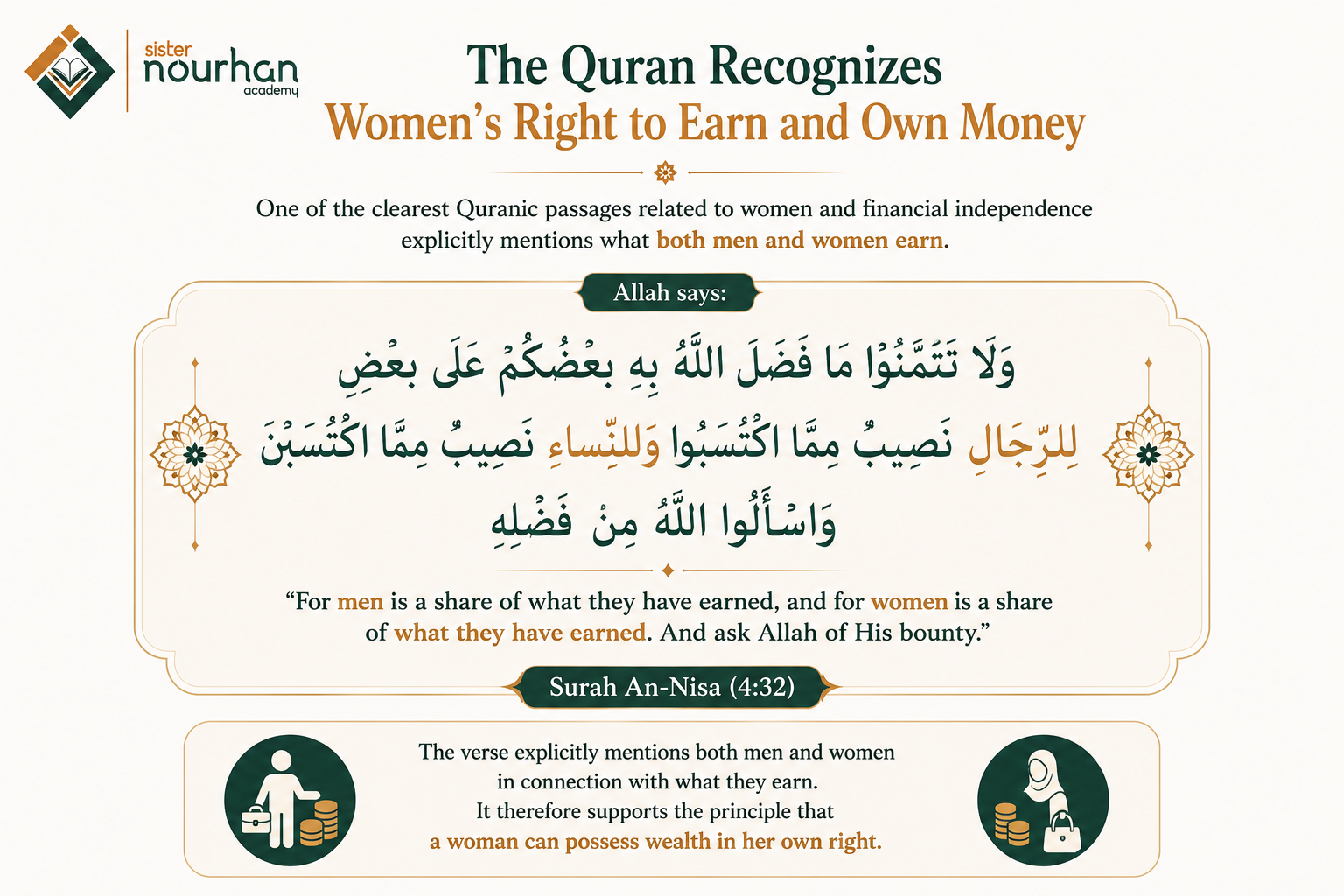
One of the clearest Quranic passages related to women and financial independence explicitly mentions what both men and women earn.
Allah says:
وَلَا تَتَمَّنَوْا مَا فَضَّلَ اللَّهُ بِهِ بَعْضَكُمْ عَلَىٰ بَعْضٍ ۚ لِّلرِّجَالِ نَصِيبٌ مِّمَّا اكْتَسَبُوا وَلِلنِّسَاءِ نَصِيبٌ مِّمَّا اكْتَسَبْنَ ۚ وَاسْأَلُوا اللَّهَ مِن فَضْلِهِ
“For men is a share of what they have earned, and for women is a share of what they have earned. And ask Allah of His bounty.” Surah An-Nisa (4:32)
The verse explicitly mentions both men and women in connection with what they earn. It therefore supports the principle that a woman can possess wealth in her own right.
Her lawful earnings do not automatically become the property of her husband, father, or another male relative.
This verse is especially relevant when asking what the Quran says about women working because employment is one possible source of lawful earnings. The verse does not describe modern employment systems, but it does not present a woman possessing her own earnings as prohibited.
2. The Quran Shows Women Carrying Out Necessary Work Outside the Home
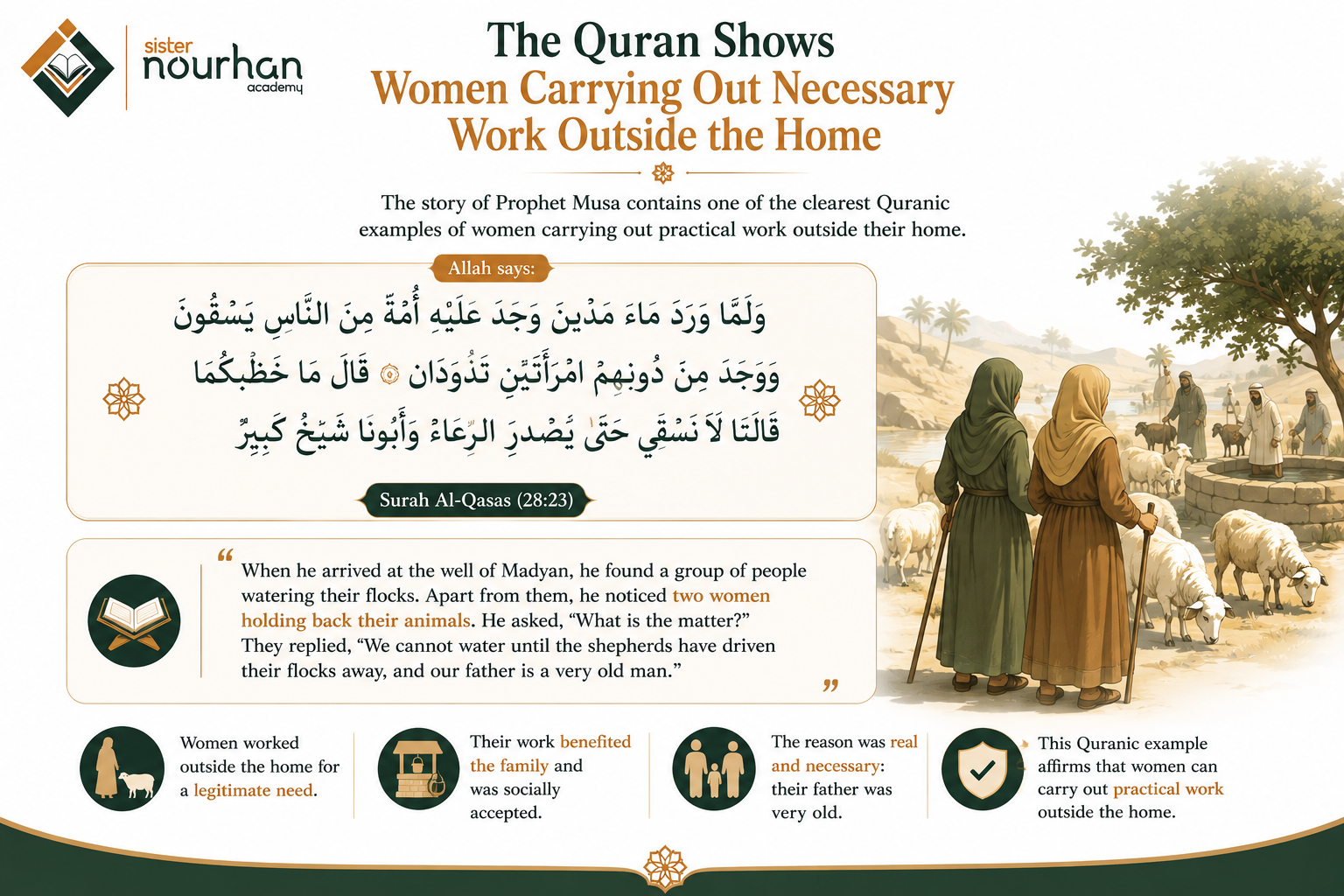
The story of Prophet Musa contains one of the clearest Quranic examples of women carrying out practical work outside their home.
Allah says:
وَلَمَّا وَرَدَ مَاءَ مَدْيَنَ وَجَدَ عَلَيْهِ أُمَّةً مِّنَ النَّاسِ يَسْقُونَ وَوَجَدَ مِن دُونِهِمُ امْرَأَتَيْنِ تَذُودَانِ ۖ قَالَ مَا خَطْبُكُمَا ۖ قَالَتَا لَا نَسْقِي حَتَّىٰ يُصْدِرَ الرِّعَاءُ وَأَبُونَا شَيْخٌ كَبِيرٌ
“When he arrived at the well of Madyan, he found a group of people watering their flocks. Apart from them, he noticed two women holding back their animals.
He asked, ‘What is the matter?’ They replied, ‘We cannot water until the shepherds have driven their flocks away, and our father is a very old man.’” Surah Al-Qasas (28:23)
The two women were caring for their family’s animals because their father was elderly. The Quran does not condemn them for being outside or for performing this responsibility.
This makes the verse difficult to reconcile with the absolute claim that the Quran requires every woman to avoid all forms of work outside the home.
At the same time, the passage shows restraint in their conduct. They remained apart from the larger group of shepherds, which is why discussions of women’s work also consider modesty, safety, and appropriate interaction.
Understanding Quranic verses in their proper context becomes easier with guided study. Women who want personalized support with Quran recitation and learning can explore 1-on-1 Private Quran Lessons Online with Sister Nourhan Academy.
3. The Quran Places Primary Financial Responsibility on the Husband
Although the Quran recognizes women’s earnings, it places the primary financial responsibility for the family upon the husband.
Allah says:
الرِّجَالُ قَوَّامُونَ عَلَى النِّسَاءِ بِمَا فَضَّلَ اللَّهُ بَعْضَهُمْ عَلَىٰ بَعْضٍ وَبِمَا أَنفَقُوا مِنْ أَمْوَالِهِمْ
“Men are caretakers of women, as Allah has given some a responsibility over others and because they spend from their wealth.” Surah An-Nisa (4:34)
This creates an important distinction:
A woman’s ability to earn money is not the same as an obligation to financially maintain her family.
A woman may own income and wealth, while the husband remains responsible for financial maintenance according to traditional Islamic family law.
This is why employment is not generally placed upon women as the same financial duty that providing for the household is placed upon men.
Shots from Our Classes
Take a moment to view the video below to see how our teachers provide clear, supportive corrections during a session.
Enrich Your Islamic Knowledge
Deepen your understanding of Fiqh, Aqeedah, and Hadith with dedicated female scholars at Sister Nourhan Academy.
Start Your Free Trial Now4. The Quran Affirms the Value of Both Men’s and Women’s Work
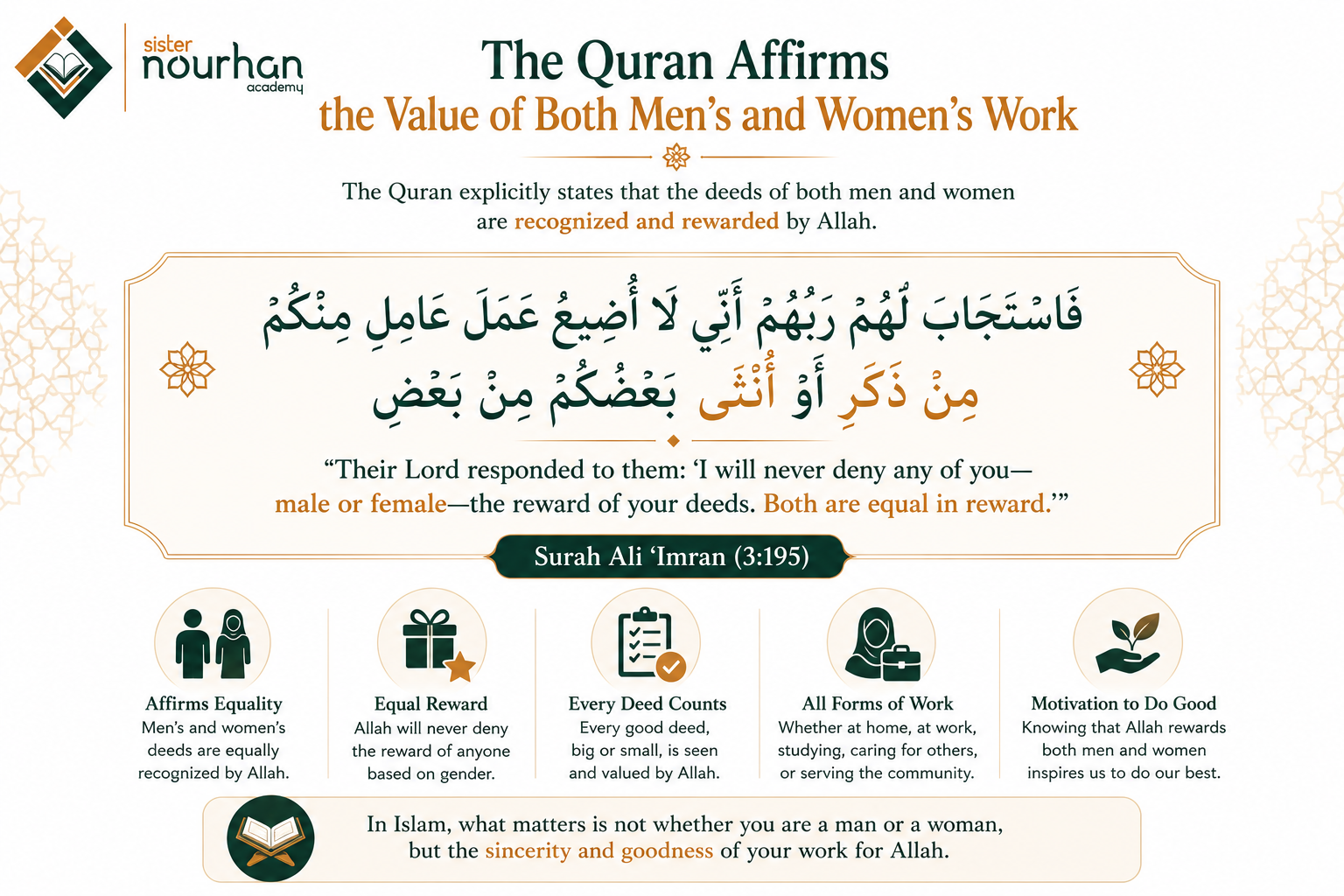
The Quran explicitly states that the deeds of both men and women are recognized and rewarded by Allah.
Allah says:
فَاسْتَجَابَ لَهُمْ رَبُّهُمْ أَنِّي لَا أُضِيعُ عَمَلَ عَامِلٍ مِنْكُمْ مِنْ ذَكَرٍ أَوْ أُنْثَىٰ بَعْضُكُمْ مِنْ بَعْضٍ
“Their Lord responded to them: ‘I will never deny any of you—male or female—the reward of your deeds. Both are equal in reward.’” Surah Ali ‘Imran (3:195)
The verse explicitly includes both men and women when speaking about deeds and their reward.
However, عَمَلَ عَامِلٍ (the work/deeds of a worker) here should not be reduced to modern employment or professional careers. The verse speaks more broadly about deeds performed in obedience to Allah.
For the discussion of working women, it provides a supporting principle: a woman’s beneficial and righteous efforts are not treated as inherently less valuable simply because she is female.
More specific questions about employment should be considered alongside verses that directly address women’s earnings and examples of women carrying out practical work.
Read also: What the Quran says about women?
Can a Woman Work According to the Quran?
The Quran does not contain a general prohibition against women working.
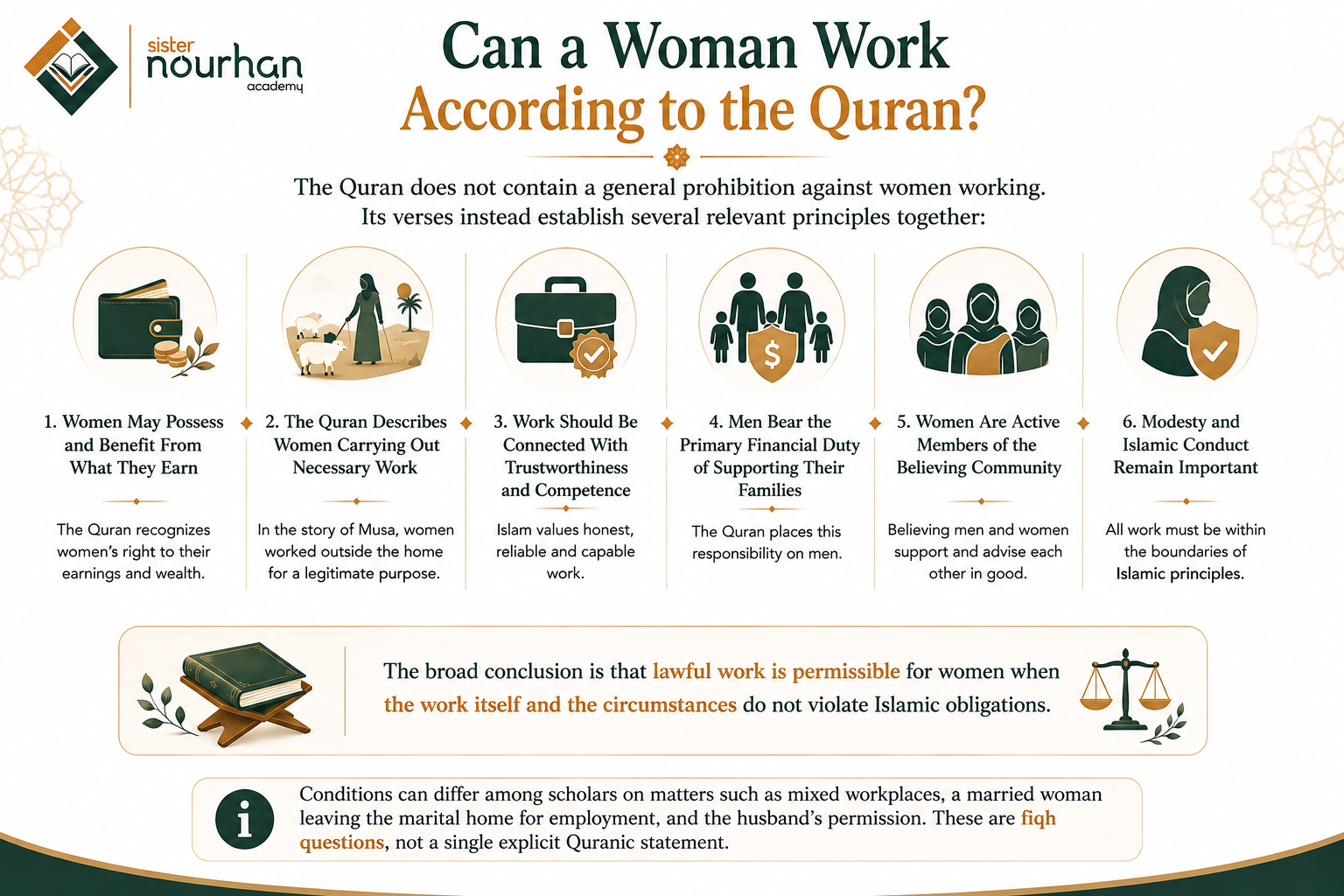
Its verses instead establish several relevant principles together:
Women may possess and benefit from what they earn.
The Quran describes women carrying out necessary work in the story of Musa.
Work should be connected with trustworthiness and competence.
Men bear the primary financial duty of supporting their families.
Women are active members of the believing community.
Modesty and Islamic conduct remain important.
For that reason, the broad conclusion reflected in many Islamic legal discussions is that lawful work is permissible for women when the work itself and the circumstances surrounding it do not violate Islamic obligations.
The precise conditions can differ between scholars and schools of Islamic law, especially concerning matters such as mixed workplaces, a married woman leaving the marital home for employment, and the husband's permission.
Those issues should therefore be presented as fiqh questions rather than falsely described as a single explicit Quranic statement.
Read also: Can women read the Quran aloud?
How Should Muslim Women Balance Work With Religious and Family Responsibilities?
A Muslim woman should balance work with her religious and family responsibilities by ensuring that her career does not lead her to neglect obligations that take priority.
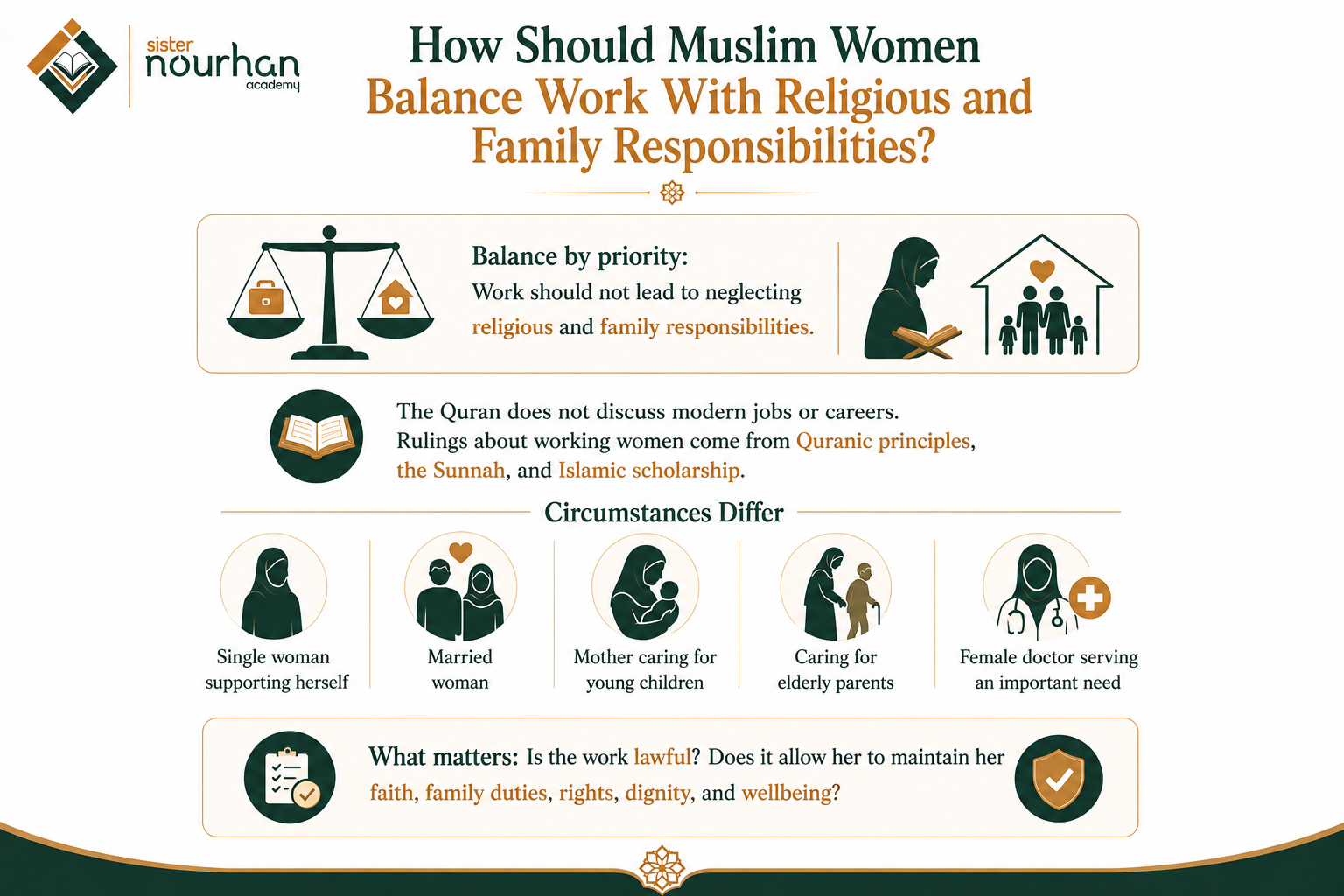
The Quran does not discuss modern office schedules, employment contracts, remote jobs, or professional careers in their present-day forms. Detailed rulings about working women are therefore understood through Quranic principles together with the Sunnah and Islamic jurisprudence.
The appropriate balance may differ according to a woman’s circumstances. A single woman supporting herself, a married woman, a mother caring for young children, a woman responsible for elderly parents, and a female doctor serving an important community need may each have different responsibilities and considerations.
Having a career is not, by itself, the determining issue. What matters is whether the work is lawful and whether her overall situation allows her to preserve her religious obligations, family responsibilities, rights, dignity, and wellbeing.
For this reason, balancing work and family in Islam cannot always be reduced to one rule that applies identically to every woman. Her responsibilities, needs, family circumstances, and the nature of her work should all be considered together.
Women who want to develop a deeper understanding of Islamic rulings, responsibilities, and everyday religious practice can also explore the Alimah Course for Females, which provides structured Islamic learning designed specifically for women.
What Types of Jobs Can Muslim Women Do?
Muslim women can work in lawful professions as long as the nature of the work and the circumstances in which it is performed are consistent with Islamic principles.
The Quran does not provide separate lists of “male professions” and “female professions.” Instead, the permissibility of work depends primarily on what the job involves and whether it requires or leads to something prohibited.
Women may therefore work in lawful fields such as education, healthcare, business, professional services, skilled trades, and other beneficial areas. Some professions may also involve an important community need for female professionals, particularly in areas such as healthcare and education.
The working environment should also be considered. Factors such as modesty, safety, religious obligations, and personal and family responsibilities may affect whether a particular job or working arrangement is appropriate.
A useful question, therefore, is not simply “Is this a job for women?” but:
“Is this work lawful, beneficial, safe, and compatible with her Islamic responsibilities?”
Receiving a salary does not make an otherwise lawful profession prohibited simply because the worker is a woman. Likewise, a high salary does not make work permissible if the work itself involves something prohibited.
Read also: What does the Quran say about the importance of education for females?
Does Islam Require Women to Have Careers?
No. Islam does not require every woman to have a job or pursue a professional career. Just as the Quran does not establish a general prohibition against women working, it also does not make employment a universal obligation for women.
In the traditional Islamic framework, the primary financial responsibility for maintaining the family is placed on the husband, which means that earning an income is not generally imposed on women in the same way.
A Muslim woman may choose or need to work for many legitimate reasons. She may support herself, use her skills and education, help her family financially, build financial independence, or provide a valuable service to her community. Another woman may choose to focus primarily on her home and family rather than pursue a career.
These circumstances can differ considerably from one woman to another. Islam therefore does not make having a career the standard by which a woman’s worth or success is measured.
A woman’s value before Allah is not determined by her salary, professional title, or employment status, but by her faith, character, and obedience to Him.
Read also: Can women read Quran on phone during periods?
Does the Quran Say Women Must Stay at Home Instead of Working?
No. The Quran does not state that every woman must remain at home and is forbidden from engaging in lawful work outside it.
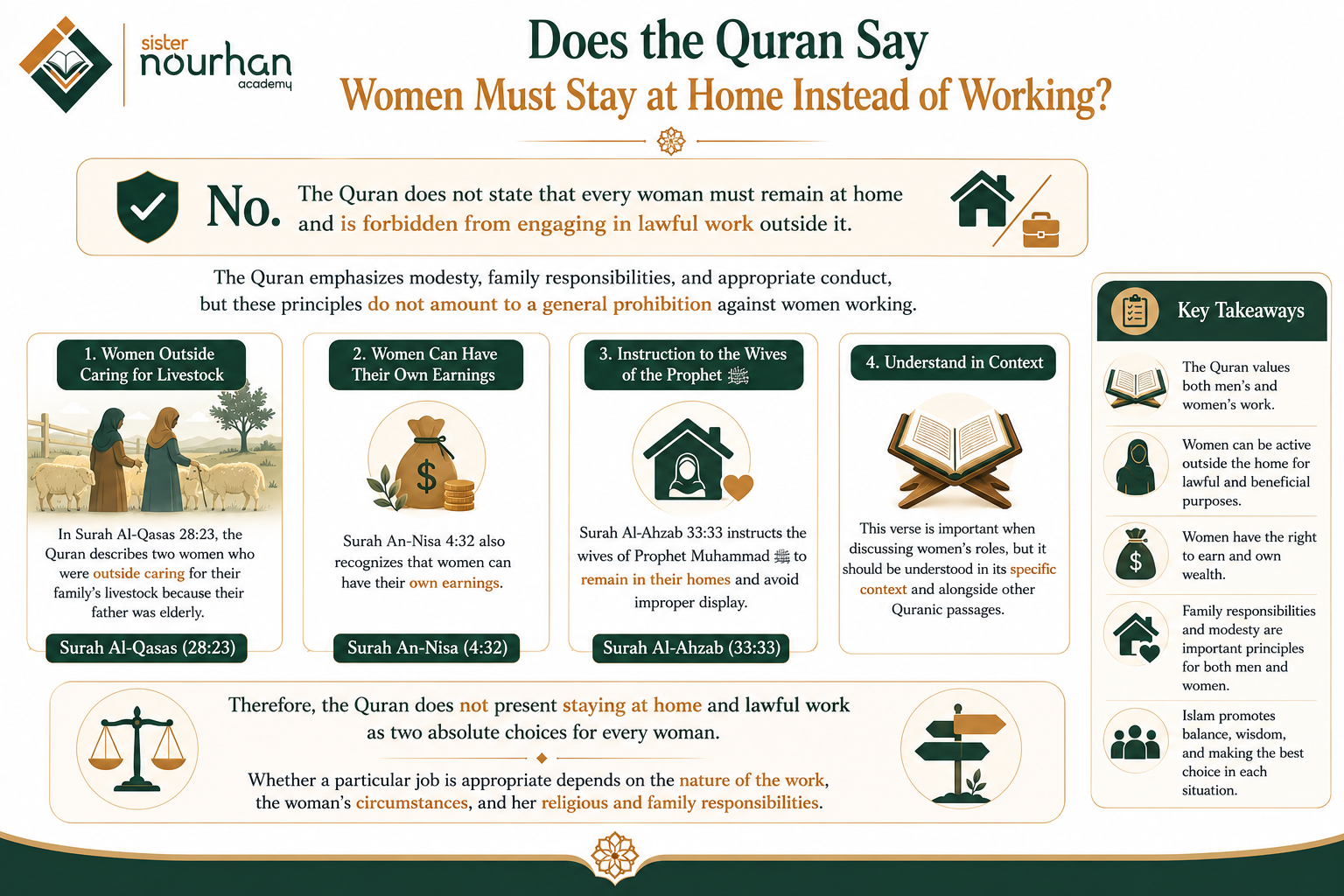
The Quran emphasizes modesty, family responsibilities, and appropriate conduct, but these principles do not amount to a general prohibition against women working.
In Surah Al-Qasas 28:23, the Quran describes two women who were outside caring for their family’s livestock because their father was elderly. Surah An-Nisa 4:32 also recognizes that women can have their own earnings.
At the same time, Surah Al-Ahzab 33:33 instructs the wives of Prophet Muhammad ﷺ to remain in their homes and avoid improper display.
This verse is important when discussing women’s roles, but it should be understood in its specific context and alongside other Quranic passages rather than treated as a standalone prohibition against all female employment.
Therefore, the Quran does not present staying at home and lawful work as two absolute choices for every woman. Whether a particular job is appropriate depends on the nature of the work, the woman’s circumstances, and her religious and family responsibilities.
See our teaching methods
Experience the quality of our instruction firsthand by watching a live lesson snippet below.
Enrich Your Islamic Knowledge
Deepen your understanding of Fiqh, Aqeedah, and Hadith with dedicated female scholars at Sister Nourhan Academy.
Start Your Free Trial NowBuild a Deeper Understanding of the Quran With Sister Nourhan Academy
Questions about women’s work, financial rights, family responsibilities, and Islamic conduct show why understanding the Quran requires more than reading individual verses in isolation.
Learning the Quran with structured guidance can help Muslim women understand its teachings in context and apply them more confidently in everyday life.
At Sister Nourhan Academy, women and girls can study Quran recitation, Tajweed, memorization, and Islamic knowledge through structured online learning with qualified teachers.
Whether you want to strengthen your Quran recitation or deepen your understanding of Islam, you can book your classes with Sister Nourhan Academy and begin learning at a level that suits you.
Discover our Islamic Studies Courses

Conclusion
The Quran does not prohibit women from engaging in lawful work, nor does it require every woman to pursue a professional career. Instead, it recognizes a woman’s ability to earn and own wealth while placing work within the broader framework of faith, responsibility, modesty, and lawful conduct.
The Quran also shows that a woman’s circumstances and responsibilities matter. Working may be necessary or beneficial for some women, while others may choose to focus primarily on their homes and families.
Ultimately, Islam does not measure a woman’s worth by whether she has a job or stays at home. A Muslim woman may work and contribute through a lawful profession as long as her work remains consistent with her religious obligations and responsibilities.
FAQs About What the Quran Says About Working Women
Questions about women’s jobs often combine Quranic teachings, family responsibilities, financial rights, and later Islamic jurisprudence, so separating these issues helps avoid misleading conclusions.
What does the Quran say about women working?
The Quran does not prohibit women from lawful work. Surah Al-Qasas 28:23 describes two women carrying out work for their elderly father, while Surah An-Nisa 4:32 explicitly recognizes a woman’s share in what she earns.
What Quran verse talks about a woman’s money?
Surah An-Nisa 4:32 is one of the clearest verses. It states that men have a share of what they earn and women have a share of what they earn, affirming women’s individual financial entitlement.
Does the Quran say a woman can have a job?
The Quran does not use the modern term “job” in the way it is used today, but it does describe women performing work and recognizes women’s earnings. There is no general Quranic verse forbidding a woman from having lawful employment.
Can a Muslim woman keep the money she earns?
Yes. A woman has independent financial ownership in Islam. Her salary or other lawful earnings belong to her unless she voluntarily chooses to spend or give from them.
Is a woman required to financially support her husband?
The Quran places the primary financial responsibility for maintenance on men. A wife may contribute voluntarily, but the fact that she earns money does not automatically make her the person legally responsible for maintaining her husband.
Can a married woman work in Islam?
Many scholars permit married women to work subject to Islamic guidelines, but details concerning marital rights and a husband's permission are matters of fiqh in which scholarly formulations differ. They should not be presented as though a single Quranic verse gives every detail.