
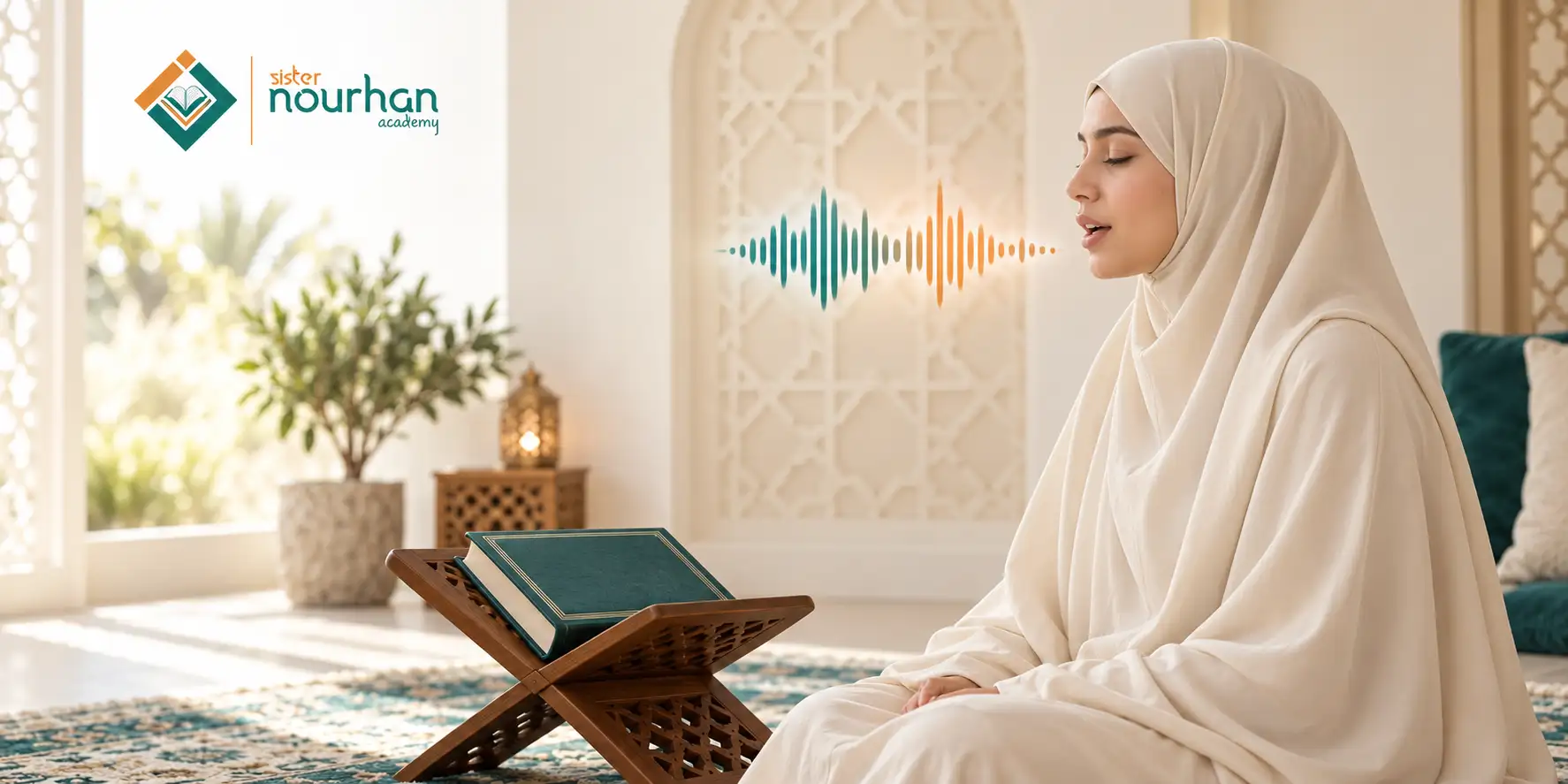
Yes, in general, a woman may recite the Quran aloud, as a woman's voice is not considered awrah in itself. However, the complete answer depends on where she is reciting, whether she is performing salah, and whether non-mahram men can hear her.
This distinction matters because several different questions are often treated as though they have the same ruling. A woman reciting Quran alone at home is not necessarily in the same situation as a woman reciting during salah, teaching Quran, participating in a competition, or reciting where unrelated men can hear her.
Islam does not establish a general rule that a woman's voice must never be heard by men. Muslim women have historically spoken, asked questions, taught Islamic knowledge, and advised others. At the same time, Islamic teachings establish guidelines concerning modesty and appropriate speech.
Therefore, understanding whether a woman can read Quran aloud requires looking at both the general ruling concerning her voice and the circumstances surrounding her recitation.
Is a Woman's Voice Awrah in Islam?
No, a woman's voice is not considered awrah in itself according to the scholarly opinion discussed here. Therefore, the mere fact that a non-mahram man hears a woman's voice does not automatically make the interaction impermissible.
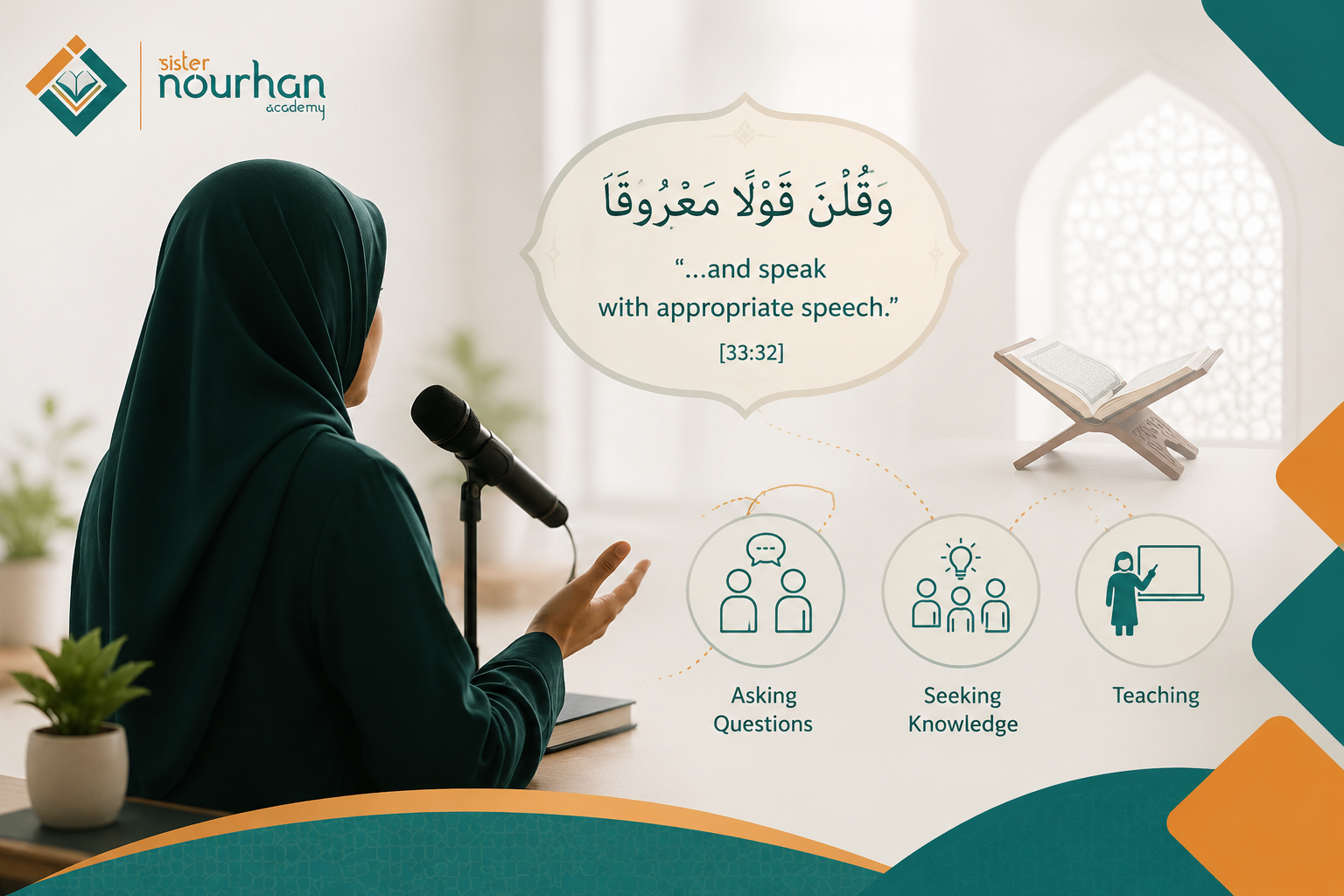
Muslim women have historically spoken to men for legitimate purposes such as asking questions, seeking knowledge, and teaching. The wives of Prophet Muhammad ﷺ, including Aishah and Umm Salama (may Allah be pleased with them), were important transmitters of Islamic knowledge.
The Quran also gives guidance on how women should speak, rather than prohibiting their voices from being heard:
فَلَا تَخْضَعْنَ بِالْقَوْلِ فَيَطْمَعَ الَّذِي فِي قَلْبِهِ مَرَضٌ وَقُلْنَ قَوْلًا مَعْرُوفًا
“Do not be soft in speech [to men], lest he in whose heart is disease should covet, but speak with appropriate speech.” Surah Al-Ahzab (33:32)
The distinction, therefore, is between a woman's voice itself and the manner in which it is used. Her voice is not inherently awrah, while appropriate speech and Islamic conduct remain important.
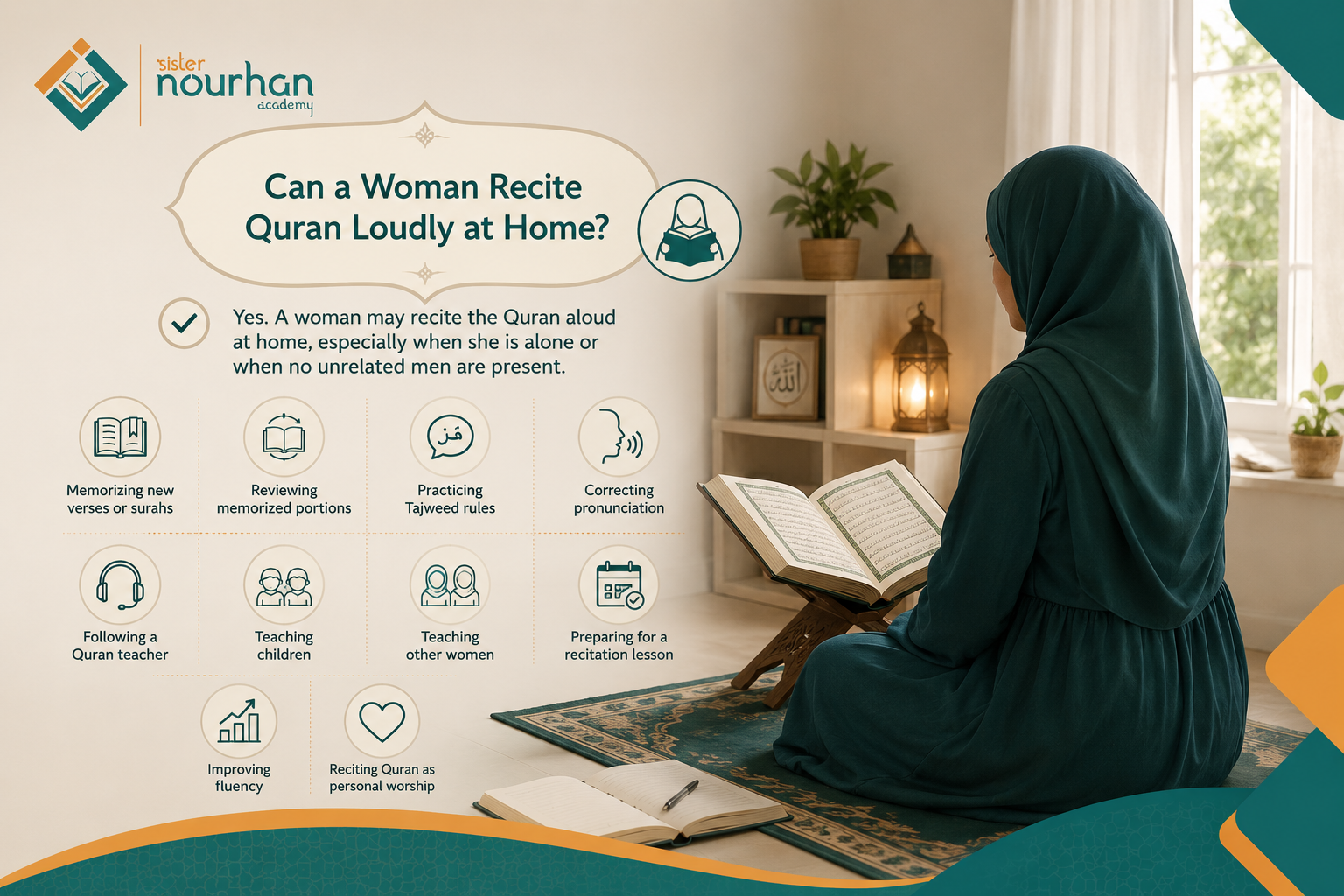
Can a Woman Recite Quran Loudly at Home?
Yes. A woman may recite the Quran aloud at home, particularly when she is alone or when no unrelated men are present.
There are many practical reasons why audible recitation may actually be beneficial. A woman studying Quran may need to hear herself clearly to identify pronunciation mistakes. Someone memorizing a surah may find repetition aloud more effective than reading silently.
A student studying Tajweed also needs to hear how letters, vowels, ghunnah, madd, and other recitation rules actually sound.
Audible recitation may therefore be used when:
Memorizing new verses or surahs
Reviewing previously memorized portions
Practicing Tajweed rules
Correcting pronunciation
Following a Quran teacher
Teaching children
Teaching other women
Preparing for a recitation lesson
Improving fluency
Reciting Quran as personal worship
Women who want to take their memorization beyond independent practice can also follow a structured Hifz course for females, where regular recitation, revision, and teacher feedback can help strengthen both memorization and accuracy.

How Loud Can a Woman Recite the Quran?
There is an important difference between saying that audible recitation is permissible and saying that there are never any considerations regarding volume.
A woman may recite at a normal audible level when the circumstances allow it. She does not need to deliberately make herself inaudible simply because she is a woman.
At the same time, Islamic etiquette applies to Quran recitation generally. A Muslim should consider whether the recitation disturbs people who are sleeping, studying, praying, or engaged in something requiring concentration.
This principle is not unique to women. The practical environment should always be considered when determining an appropriate volume The more specific issue arises when unrelated men can hear the recitation.
Can a Woman Recite Quran in Front of Non Mahram Men?
Yes, a woman may recite the Quran in front of non-mahram men in an appropriate setting, according to the scholarly position discussed here. A woman's voice is not considered awrah in itself, so the mere fact that men can hear her recitation does not automatically make it prohibited.
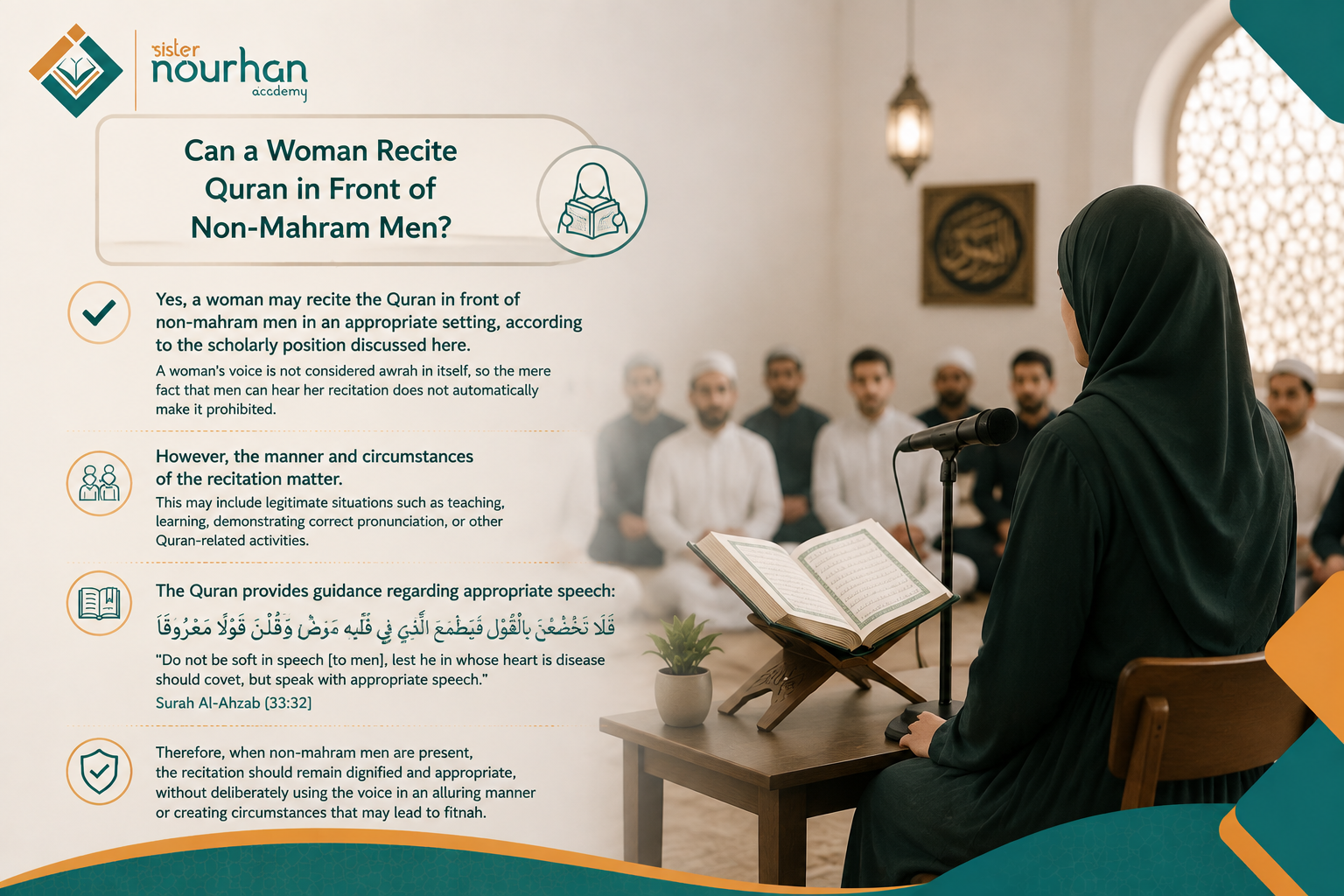
However, the manner and circumstances of the recitation matter. This may include legitimate situations such as teaching, learning, demonstrating correct pronunciation, or other Quran-related activities.
The Quran provides guidance regarding appropriate speech:
فَلَا تَخْضَعْنَ بِالْقَوْلِ فَيَطْمَعَ الَّذِي فِي قَلْبِهِ مَرَضٌ وَقُلْنَ قَوْلًا مَعْرُوفًا
“Do not be soft in speech [to men], lest he in whose heart is disease should covet, but speak with appropriate speech.” Surah Al-Ahzab (33:32)
Therefore, when non-mahram men are present, the recitation should remain dignified and appropriate, without deliberately using the voice in an alluring manner or creating circumstances that may lead to fitnah.
Shots from Our Classes
Take a moment to view the video below to see how our teachers provide clear, supportive corrections during a session.
Enrich Your Islamic Knowledge
Deepen your understanding of Fiqh, Aqeedah, and Hadith with dedicated female scholars at Sister Nourhan Academy.
Start Your Free Trial NowIs It Haram for Men to Hear a Woman Reciting Quran?
No, it is not automatically haram for a non-mahram man to hear a woman reciting the Quran. According to the scholarly position discussed here, a woman's voice is not considered awrah in itself, so simply being heard does not make the recitation impermissible.
The circumstances still matter. A woman may recite in a legitimate setting, such as learning, teaching, correcting pronunciation, or participating in a Quran-related activity.
What should be avoided is using the voice in an intentionally alluring manner or in circumstances where there is a genuine concern of fitnah.
The distinction, therefore, is between the voice itself and the way it is used. Quran recitation is an act of worship and should be approached with dignity, proper intention, and appropriate Islamic conduct.
Can Women Participate in Quran Recitation Competitions?
Yes, women may participate in Quran recitation competitions according to the scholarly opinion discussed here. This view is based on the principle that a woman's voice is not awrah in itself, so being heard while reciting the Quran does not automatically make her participation prohibited.
Quran recitation is an act of worship and a means of learning, teaching, and improving one's recitation. Competitions may also encourage participants to strengthen their memorization, Tajweed, pronunciation, and connection with the Quran.
The presence of listeners, including non-mahram men, does not by itself establish a blanket prohibition. However, the purpose and setting of the competition should be appropriate, and the recitation should be conducted with dignity and without deliberately using the voice in an alluring manner.
As with other forms of Islamic learning, appropriate boundaries and Islamic conduct should be maintained throughout the event.
Read also: Does the Quran explain the reward and status of women in heaven?
Can a Woman Recite Quran Loudly in Salah?
Yes, a woman may recite audibly in Salah in certain circumstances, but according to the Hanafi guidance discussed here, reciting quietly is generally preferred.
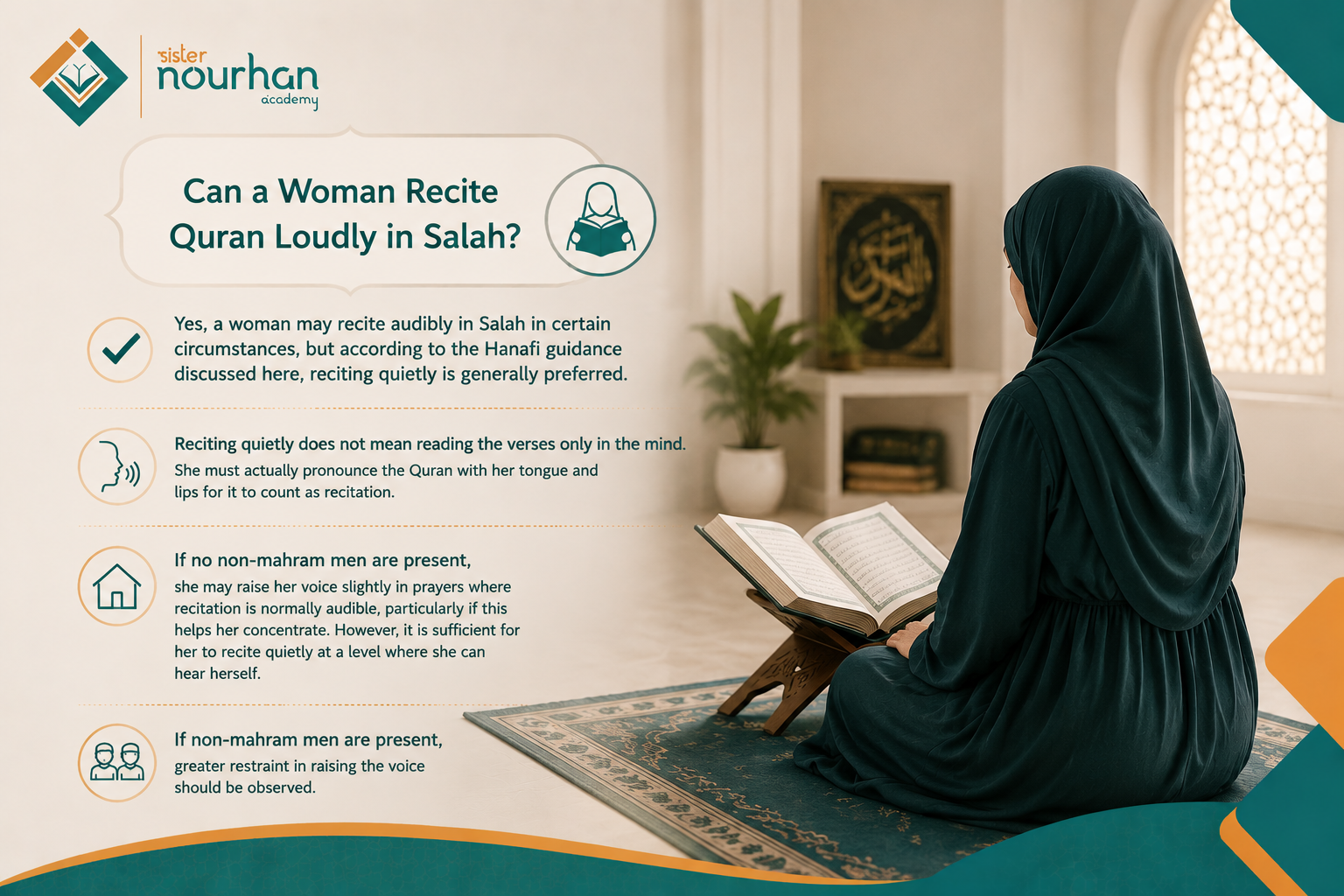
Reciting quietly does not mean reading the verses only in the mind. She must actually pronounce the Quran with her tongue and lips for it to count as recitation.
If no non-mahram men are present, she may raise her voice slightly in prayers where recitation is normally audible, particularly if this helps her concentrate.
However, it is sufficient for her to recite quietly at a level where she can hear herself. If non-mahram men are present, greater restraint in raising the voice should be observed.
Which Prayers Normally Include Audible Recitation?
The prayers that normally include audible recitation are Fajr, the first two rak‘ahs of Maghrib, and the first two rak‘ahs of Isha. Dhuhr and Asr are normally recited quietly.
According to the Hanafi guidance discussed here, a woman praying where no non-mahram men can hear her may raise her voice somewhat during the audible prayers if it helps her concentrate.
However, she does not need to recite as loudly as a male imam. The aim is to recite correctly and maintain focus in Salah.
Does Quiet Recitation Mean Reading Quran in Your Head?
No. This is one of the most important practical points in the discussion Quiet recitation and purely mental reading are not necessarily the same thing.
According to the source material, a woman should actually pronounce the letters with her tongue and lips during salah.
This means she should not merely look at the verses mentally or think through Al-Fatihah without articulating its words.
The recitation can be quiet while still being genuine recitation This distinction is especially useful for new Muslims and beginners who may hear the instruction “pray silently” and mistakenly interpret it as “do not pronounce the words.”
Can a Woman Recite Quran Loudly Outside Salah?
Yes. The scholarly guidance considered here makes a distinction between ordinary Quran recitation and Quran recitation within salah.
Outside prayer, a woman may generally recite Quran aloud, subject to the considerations already discussed This distinction is especially important for Quran students.
Learning accurate recitation often requires the student to hear her own voice. Tajweed is not purely theoretical knowledge. Knowing that a letter has a particular makhraj, for example, does not guarantee that the student is actually producing it correctly.
The student must recite She may then compare her pronunciation with correct recitation or receive feedback from a teacher.
For women who want to deepen their understanding beyond Quran recitation, structured Islamic learning can provide a broader foundation in religious knowledge. An Alimah course for females offers a dedicated path for women who want to study Islamic sciences in greater depth.
Why Is Audible Quran Recitation Useful for Learning?
Audible Quran recitation helps learners improve pronunciation, apply Tajweed correctly, and memorize verses more effectively. Hearing their own voice makes it easier to notice mistakes in Arabic letters, articulation, and the length of different sounds.
It is especially important when learning Tajweed, since rules such as ghunnah, madd, qalqalah, tafkhim, and tarqiq must be heard and practised, not simply memorized from definitions.
Audible recitation also allows a Quran teacher to identify mistakes and correct them directly. Repeating verses aloud can further strengthen memorization by helping the learner become familiar with their sound, wording, and rhythm.
For these reasons, audible recitation can be an important part of learning and improving Quran recitation.
Read also: Can I still read the Qur'an digitally while having my period?
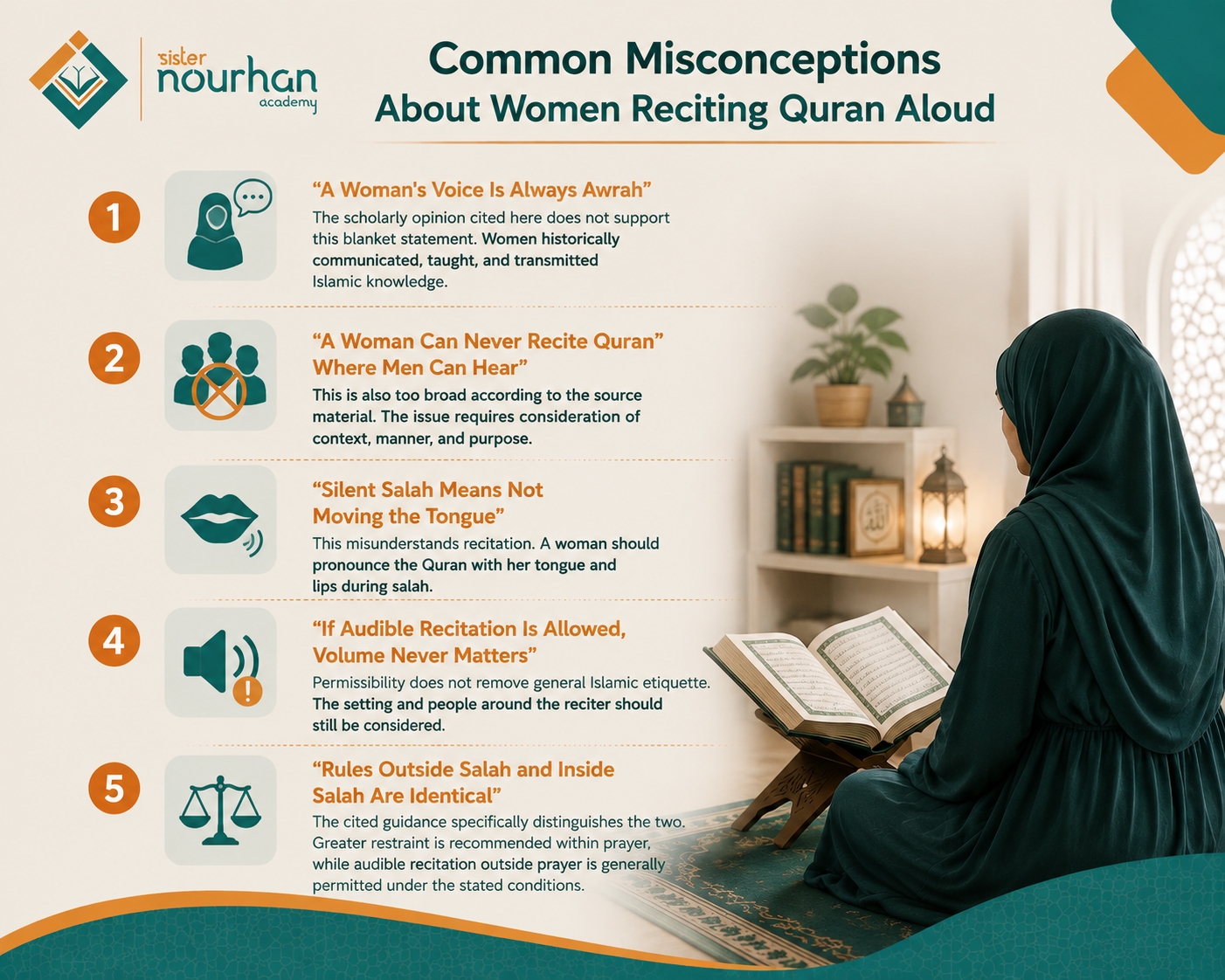
Common Misconceptions About Women Reciting Quran Aloud
Several misconceptions can make this issue more confusing than necessary.
1. “A Woman's Voice Is Always Awrah”
The scholarly opinion cited here does not support this blanket statement. Women historically communicated, taught, and transmitted Islamic knowledge.
2. “A Woman Can Never Recite Quran Where Men Can Hear”
This is also too broad according to the source material. The issue requires consideration of context, manner, and purpose.
3. “Silent Salah Means Not Moving the Tongue”
This misunderstands recitation. A woman should pronounce the Quran with her tongue and lips during salah.
4. “If Audible Recitation Is Allowed, Volume Never Matters”
Permissibility does not remove general Islamic etiquette. The setting and people around the reciter should still be considered.
5. “Rules Outside Salah and Inside Salah Are Identical”
The cited guidance specifically distinguishes the two. Greater restraint is recommended within prayer, while audible recitation outside prayer is generally permitted under the stated conditions.
Practical Guidelines for Women Who Want to Recite Quran Aloud
The ruling and appropriate volume can vary depending on the situation:
When alone: A woman may recite the Quran aloud for worship, memorization, practice, or learning.
Around women or family: Audible recitation is generally permissible, provided it does not disturb others.
Around non-mahram men: Hearing a woman's voice does not automatically make her recitation prohibited according to the scholarly view discussed here. However, appropriate Islamic conduct should be maintained.
During Salah: She must actually pronounce the verses with her tongue and lips rather than reciting them only in her mind.
During audible prayers: If no non-mahram men can hear her, the Hanafi guidance discussed here allows her to raise her voice somewhat if it helps her concentration, although a restrained volume is sufficient.
Outside Salah: There is generally broader allowance for audible Quran recitation, while consideration should still be given to the setting and people nearby.
See our teaching methods
Experience the quality of our instruction firsthand by watching a live lesson snippet below.
Enrich Your Islamic Knowledge
Deepen your understanding of Fiqh, Aqeedah, and Hadith with dedicated female scholars at Sister Nourhan Academy.
Start Your Free Trial NowLearn Quran in a Supportive Environment for Women
Learning to recite the Quran confidently often requires more than reading rules on your own. Regular practice, correction, and structured guidance can help women improve their pronunciation, Tajweed, memorization, and confidence in recitation.
At Sister Nourhan Academy, women can learn in an environment designed specifically to support female students in their Quran and Islamic studies.
Whether the goal is to improve recitation, strengthen memorization, or develop a deeper understanding of Islam, guided learning provides a clear path for continued progress.
Discover our Islamic Studies Courses

Conclusion
A woman may recite the Quran aloud, and her voice is not considered awrah in itself according to the scholarly position discussed in this article. Audible recitation can be part of worship, memorization, Tajweed practice, learning, and teaching.
What matters is the context and manner of recitation. When non-mahram men are present, appropriate Islamic conduct and modesty should be observed, while Salah has its own guidelines regarding audible and quiet recitation.
Rather than treating every situation with one blanket ruling, it is more accurate to consider where, why, and how the Quran is being recited. In all cases, the goal remains the same: to recite the words of Allah correctly, respectfully, and with sincere intention.
Frequently Asked Questions
1. Can a woman recite Quran loudly when she is alone?
Yes. A woman may recite the Quran aloud when she is alone. This can be particularly beneficial for memorization, pronunciation, Tajweed practice, and concentration.
2. Can a woman recite Quran in front of non-mahram men?
According to the scholarly view considered here, a woman's voice is not awrah in itself. Therefore, the fact that a non-mahram man hears her Quran recitation does not automatically make the recitation prohibited.
The circumstances, manner, and Islamic guidelines concerning appropriate interaction should still be considered.
3. Can a woman recite Quran loudly in salah?
According to the cited Hanafi guidance, women should generally exercise restraint in audible prayer. If no unrelated men are around, a woman may raise her voice slightly during the loud prayers when this helps her concentrate, although hearing herself is sufficient.
4. Does a woman have to move her lips when reciting Quran in salah?
Yes. The source material emphasizes that she should actually pronounce the letters with her tongue and lips. Merely thinking about the words is not the same as actual recitation.
5. Can women recite Quran in competitions?
According to Sheikh Ahmad Kutty's opinion cited in the source material, there is no general reason to prohibit women from reciting Quran aloud or participating in Quran competitions merely because their voices can be heard.
6. Can women teach Quran when male students are present?
The source material points to the historical role of women in Islamic scholarship, including women teaching and advising men and women.
Since a woman's voice is not inherently awrah according to this position, teaching is not automatically prohibited merely because men can hear her voice. Appropriate Islamic conduct should nevertheless be maintained.