

Learning Tajweed is one of the most effective ways to improve Quran recitation, pronounce Arabic letters correctly, and avoid common recitation mistakes. However, Tajweed is not learned by memorizing rules alone.
The best way to learn Tajweed is through a structured combination of learning the rules, listening to correct recitation, practicing directly from the Quran, and receiving feedback from a qualified Tajweed teacher.
A teacher is especially valuable because Tajweed is a practical skill. You may understand where a letter should originate or how a rule works but still pronounce it incorrectly without realizing it. For this reason, beginners should focus on building a strong foundation in Arabic pronunciation and Makharij before gradually learning and applying the fundamental Tajweed rules.
This can be supported by joining a structured Quran academy, taking online Tajweed classes, practicing consistently, and listening carefully to accurate Quran recitation.
Whether you are a complete beginner or want to improve your existing recitation, combining these methods can help you develop your Tajweed skills step by step.
1. Learn Tajweed With a Qualified Teacher
Learning directly from a qualified Tajweed teacher is one of the most reliable ways to develop accurate Quran recitation.
A teacher can listen to your recitation and identify mistakes that may be difficult to notice on your own, particularly mistakes related to Makharij (articulation points), Sifat (letter characteristics), Ghunnah, Madd, and other pronunciation rules.
Direct correction also prevents incorrect pronunciation habits from becoming established. This is particularly important for beginners who are still learning how Arabic letters should sound.
Ideally, look for a teacher who has strong knowledge of Tajweed, experience teaching students at your level, and the ability to explain and demonstrate rules clearly.
Best Tajweed Teachers: Sister Nourhan Academy is home to some of the best Tajweed teachers, all of whom hold Ijaza and have extensive experience in teaching both beginners and advanced students.

2. Enroll in a Quran Academy
A Quran academy provides a more structured approach to learning Tajweed. Instead of studying individual rules randomly, students can follow a curriculum that progresses from basic pronunciation to more advanced Tajweed applications.
Structured classes can also provide accountability. Regular lessons encourage students to continue practicing and allow teachers to monitor their progress over time.
When choosing a Quran academy, consider the qualifications of its teachers, whether classes are appropriate for your current level, and whether students receive individual recitation correction.
For learners who want structured guidance, Sister Nourhan Academy offers online Quran and Tajweed classes with qualified teachers who provide direct recitation correction and personalized support.
3. Learn Tajweed Online
Online Tajweed classes have made it possible to study Quran recitation with qualified teachers regardless of location.
Live online lessons can provide many of the advantages of traditional instruction, including listening to the teacher's pronunciation, reciting directly to the teacher, receiving immediate corrections, and asking questions about difficult rules.
Online learning can be especially convenient for children, advanced Tajweed for adults, busy professionals, and families who need flexible lesson schedules.

For the best results, choose interactive classes rather than relying entirely on prerecorded material. Tajweed is a practical skill, so receiving feedback on your own recitation remains essential.
4. Practice Tajweed Regularly
Consistent practice is more effective than studying Tajweed occasionally for long periods.

Even a short daily recitation session allows you to repeatedly apply the rules you have learned. Instead of focusing only on reading more pages, slow down and pay attention to pronunciation.
For example, you can dedicate one practice session to identifying and applying a specific rule, such as Ghunnah or Qalqalah. Once that rule becomes more natural, move to another while continuing to review what you have already learned.
Regular practice helps transform Tajweed rules from theoretical knowledge into natural recitation habits.
Shots from Our Classes
Take a moment to view the video below to see how our teachers provide clear, supportive corrections during a session.
Begin Your Quranic Journey
Connect with the words of Allah through personalized sessions at Sister Nourhan Academy.
Book Your Free Trial5. Use Tajweed Books and Learning Resources
Tajweed books can help you understand definitions, letter groups, examples, and the reasoning behind different rules.

They are especially useful for reviewing material between lessons or revisiting a rule you find difficult.
Visual resources can also make certain concepts easier to understand. Diagrams showing the Makharij, color-coded Quran text, charts of Tajweed letters, and carefully selected examples can support practical learning.
However, books should generally complement listening and teacher-guided practice rather than replace them. Knowing a written rule does not automatically mean you are pronouncing it correctly.
6. Join a Tajweed Study Group
Studying Tajweed with other learners can provide additional motivation and opportunities for revision.

Students can review rules together, identify examples in Quranic verses, listen to one another, and discuss concepts they find difficult.
A study group is most effective when it supports formal learning rather than becoming the main source of pronunciation correction. When there is uncertainty about the correct application of a rule, learners should refer to a qualified teacher.
7. Learn Tajweed Through Quran Recitation, Audio, and Videos
Listening carefully to skilled Quran reciters is an important part of developing your ear for correct recitation.
Choose a short passage and listen to it several times while following the Mushaf. Pay attention to the pronunciation of individual letters, Madd lengths, Ghunnah, stops, and transitions between words.
Then recite the same passage yourself and compare your pronunciation with the recitation you heard.
Recording your voice can make this exercise even more useful because it allows you to notice differences that may not be obvious while you are reciting.
Educational Tajweed videos can also help demonstrate articulation points and explain how specific rules work. However, they are most effective when combined with direct correction.
8. Work Toward an Ijaza in Tajweed
For advanced students who have developed strong Tajweed skills, taking an Advanced Tajweed Course can help refine recitation before working toward an Ijaza.

An Ijaza involves reciting under the supervision of a qualified teacher and demonstrating a high level of accuracy. It should therefore be viewed as an advanced stage of Quran study rather than the starting point for a beginner.
Before working toward an Ijaza, students should establish strong pronunciation, understand the relevant Tajweed rules, and be able to apply them consistently during recitation.
How to Start Learning Tajweed as a Beginner?
If you are new to Tajweed, trying to memorize every rule immediately can make the subject unnecessarily difficult. A gradual learning path is usually more effective.

Start by making sure you can recognize Arabic letters and vowels correctly. You do not need to understand the meaning of every Arabic word before beginning Tajweed, but you do need sufficient Arabic reading ability to work with Quranic text.
Next, focus on Makharij Al-Huruf, or the articulation points of the Arabic letters. Learn where each letter originates and practice distinguishing letters with similar sounds.
After developing this foundation, begin studying basic Tajweed rules individually and applying each one to short Quranic passages.
A simple beginner progression is:
Arabic letters and Harakat → Makharij → letter characteristics → basic Tajweed rules → short Surahs → continuous teacher correction.
This approach allows you to develop accuracy before increasing your recitation speed or moving to more advanced rules.
Which Tajweed Rules Should You Learn First?
Beginners should prioritize the Tajweed rules that appear frequently throughout Quran recitation.
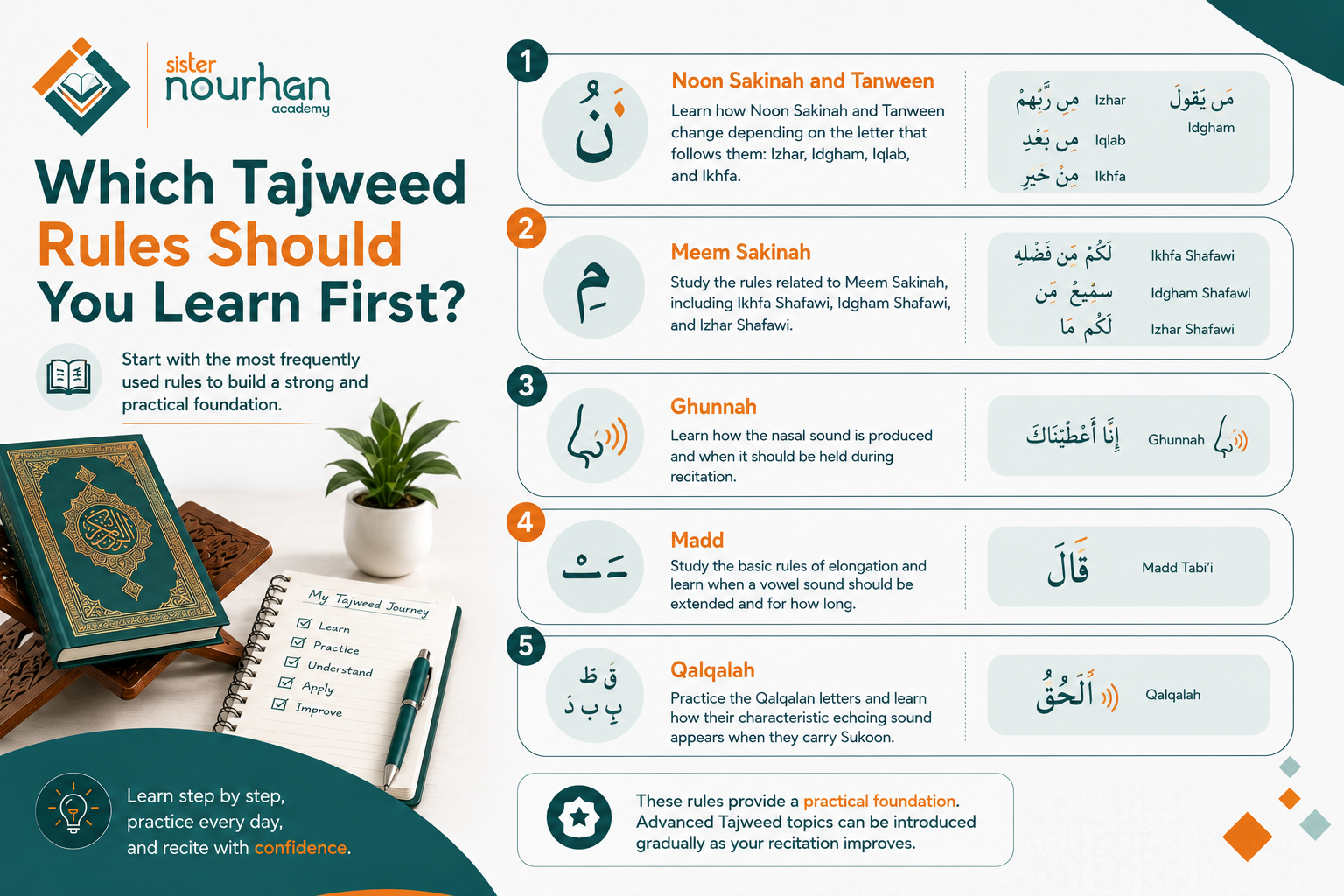
Noon Sakinah and Tanween: Learn how Noon Sakinah and Tanween change depending on the letter that follows them. This includes Izhar, Idgham, Iqlab, and Ikhfa.
Meem Sakinah: Study the rules related to Meem Sakinah, including Ikhfa Shafawi, Idgham Shafawi, and Izhar Shafawi.
Ghunnah: Learn how the nasal sound is produced and when it should be held during recitation.
Madd: Study the basic rules of elongation and learn when a vowel sound should be extended and for how long.
Qalqalah: Practice the Qalqalah letters and learn how their characteristic echoing sound appears when they carry Sukoon.
These rules provide a practical foundation. More detailed and advanced Tajweed topics can be introduced gradually as your recitation improves.
Can You Learn Tajweed by Yourself Without a Teacher?
Yes, you can learn many Tajweed rules independently through books, online lessons, videos, and listening to skilled Quran reciters. Self-study can be particularly useful for understanding concepts such as Makharij, Sifat, Ghunnah, Madd, and Qalqalah.
However, learning the rules is different from applying them accurately in recitation. Pronunciation mistakes can be difficult to recognize yourself. A letter produced from the wrong Makhraj or an incorrectly applied Madd or Ghunnah may sound correct to you even when it needs correction.
For this reason, self-study works best for learning rules, reviewing lessons, listening, and daily practice, while a qualified Tajweed teacher can listen to your recitation and correct mistakes you may not notice independently.
The most effective approach is therefore to combine consistent self-practice with regular teacher-guided correction.
How to Practice Tajweed Effectively?
Effective Tajweed practice should focus on accuracy rather than the number of pages you complete.
Start with a short passage from the Quran. Listen to an accurate recitation while following the text, then identify the Tajweed rules you have already studied.
Recite the passage slowly and concentrate on applying those rules. Record yourself when possible and compare your recitation with the original.
During your next lesson, recite the same passage to your teacher and note every correction you receive. Repeat the corrected words and verses until the correct pronunciation becomes comfortable.
Ten to twenty minutes of focused practice each day can be more useful than an occasional long session without specific goals.
Common Mistakes When Learning Tajweed
Learning Tajweed becomes easier when you know which habits can slow your progress.
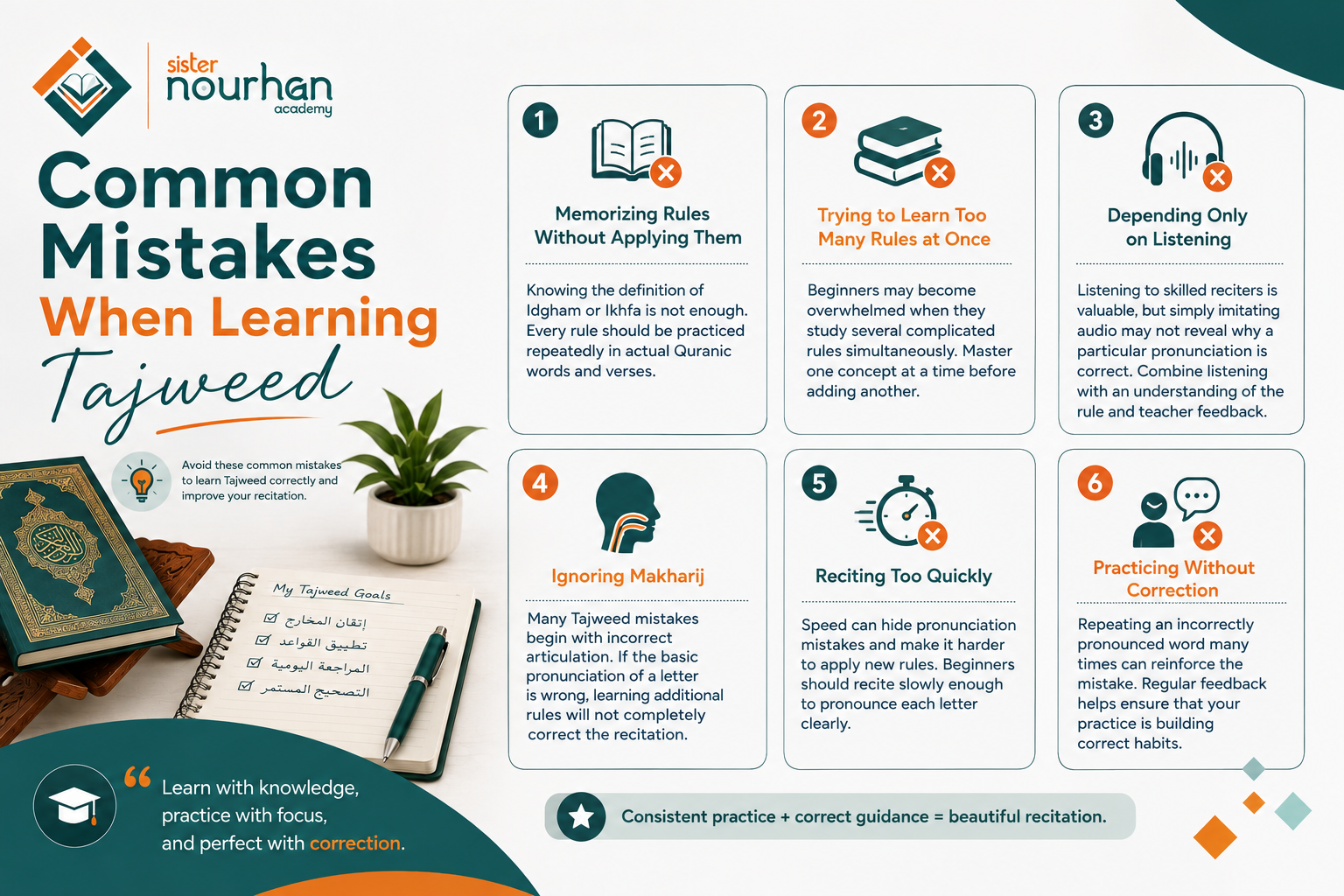
Memorizing Rules Without Applying Them
Knowing the definition of Idgham or Ikhfa is not enough. Every rule should be practiced repeatedly in actual Quranic words and verses.
Trying to Learn Too Many Rules at Once
Beginners may become overwhelmed when they study several complicated rules simultaneously. Master one concept at a time before adding another.
Depending Only on Listening
Listening to skilled reciters is valuable, but simply imitating audio may not reveal why a particular pronunciation is correct. Combine listening with an understanding of the rule and teacher feedback.
Ignoring Makharij
Many Tajweed mistakes begin with incorrect articulation. If the basic pronunciation of a letter is wrong, learning additional rules will not completely correct the recitation.
Reciting Too Quickly
Speed can hide pronunciation mistakes and make it harder to apply new rules. Beginners should recite slowly enough to pronounce each letter clearly.
Practicing Without Correction
Repeating an incorrectly pronounced word many times can reinforce the mistake. Regular feedback helps ensure that your practice is building correct habits.
See our teaching methods
Experience the quality of our instruction firsthand by watching a live lesson snippet below.
Begin Your Quranic Journey
Connect with the words of Allah through personalized sessions at Sister Nourhan Academy.
Book Your Free TrialHow Long Does It Take to Learn Tajweed?
There is no fixed amount of time required to learn Tajweed. Progress depends on your starting level, Arabic reading ability, lesson frequency, practice routine, and the level of proficiency you want to achieve.
A beginner may understand many fundamental rules within a relatively short period, but applying those rules naturally and consistently during Quran recitation usually requires longer practice.
Instead of focusing on finishing Tajweed quickly, focus on measurable improvements: clearer pronunciation, fewer repeated mistakes, better recognition of rules, and more consistent application during recitation.
Read also: How to read waqf in Quran?
Learn Tajweed Online With Sister Nourhan Academy
If you want to learn Tajweed through structured guidance rather than studying entirely on your own, Sister Nourhan Academy provides online Quran and Tajweed learning with direct teacher support.
Students can learn according to their current level, receive corrections during recitation, and gradually build their understanding and practical application of Tajweed.
This combination of structured lessons, regular practice, and personalized feedback can help learners move from understanding Tajweed rules to applying them confidently while reading the Quran.
Discover our Tajweed Courses

Conclusion
The best ways to learn Tajweed combine knowledge, listening, practice, and correction. Books and videos can teach you the rules, while listening to accurate Quran recitation helps you recognize how those rules sound. Consistent practice develops your skills, and guidance from a qualified teacher helps correct mistakes you may not notice yourself.
If you are a beginner, start with Arabic pronunciation and Makharij before progressing gradually through the fundamental Tajweed rules. Avoid rushing through the curriculum simply to finish it.
With structured learning and consistent practice, Tajweed can gradually become a natural part of your Quran recitation rather than a collection of rules you have to consciously remember every time you read.
Frequently Asked Questions About Learning Tajweed
What is the easiest way to learn Tajweed?
For most beginners, the easiest approach is to learn one rule at a time with a qualified teacher and immediately practice that rule using short Quranic verses. Regular listening and daily revision can reinforce what you learn.
Can a beginner learn Tajweed?
Yes. Beginners can start Tajweed once they have sufficient familiarity with Arabic letters and basic Quran reading. They can then progress gradually from Makharij and pronunciation to the fundamental Tajweed rules.
Do I need to know Arabic to learn Tajweed?
You do not need to understand Arabic fluently to begin learning Tajweed. However, being able to recognize Arabic letters, Harakat, and basic Quranic words makes practical Tajweed study much easier.
Can I learn Tajweed online?
Yes. Tajweed can be learned online effectively when lessons include live interaction, recitation practice, and direct pronunciation correction from a qualified teacher.
How can I improve my Tajweed quickly?
Practice consistently rather than rushing. Focus on one weakness at a time, listen to accurate Quran recitation, record yourself, and ask a teacher to correct recurring pronunciation mistakes.
Is listening to Quran recitation enough to learn Tajweed?
Listening is an important learning tool, but it is usually not enough by itself. Understanding the rules and receiving feedback on your own pronunciation helps you apply Tajweed more accurately.
What should I learn first in Tajweed?
Begin with correct Arabic pronunciation and Makharij, then progress to frequently used rules such as Noon Sakinah and Tanween, Meem Sakinah, Ghunnah, Madd, and Qalqalah.