

Ikhfa in Tajweed – meaning, letters, rule, and examples becomes much easier once you understand one central idea: the sound of Noon Sakinah (نْ) or Tanween is neither pronounced completely clearly nor merged completely into the next letter.
Instead, the Noon sound is concealed while its Ghunnah, or nasal quality, remains for approximately two counts. This places Ikhfa between Izhar and Idgham in pronunciation.
The rule applies whenever Noon Sakinah or Tanween is followed by one of 15 Ikhfa letters. Correct application also requires preparing the tongue for the following letter and adjusting the Ghunnah according to whether that letter is heavy or light.
This guide explains the definition, all 15 letters, pronunciation method, levels of Ikhfaa, Quran examples, Ikhfa Shafawi, and the mistakes that commonly prevent students from producing the rule accurately.
What Is Ikhfa in Tajweed?
Ikhfa is the pronunciation of Noon Sakinah or Tanween in a state between Izhar and Idgham, without Shaddah, while retaining Ghunnah. Linguistically, Ikhfa (إخفاء) means concealment or hiding.
This definition explains exactly what happens during recitation: you do not produce a complete, distinct ن sound as you would in Izhar, but you also do not merge it entirely into the following letter as in Idgham.
Why Does the Ikhfa Rule Exist?
Ikhfa occupies a middle position because the articulation points of Noon and the 15 Ikhfa letters are neither close enough to require complete merging nor distant enough to require complete clarification.
The resulting pronunciation therefore falls naturally between Izhar and Idgham.
This is useful for students because Ikhfa is not simply a rule to memorize. Its pronunciation reflects the relationship between the articulation point of the Noon and the letter that follows it.
When Does Ikhfa Apply to Noon Sakinah and Tanween?
Apply Ikhfa Haqiqi whenever:Noon Sakinah (نْ) or Tanween + one of the 15 Ikhfa letters
For example:
مِنْ قَبْلِ
The Noon Sakinah is followed by ق, so the Noon is concealed and replaced by a two-count Ghunnah before the Qaf is pronounced.
Noon Sakinah Ikhfa can occur inside one word or between two words. Tanween, because it occurs at the end of a word, produces Ikhfa across two words.
What Are the 15 Letters of Ikhfa?
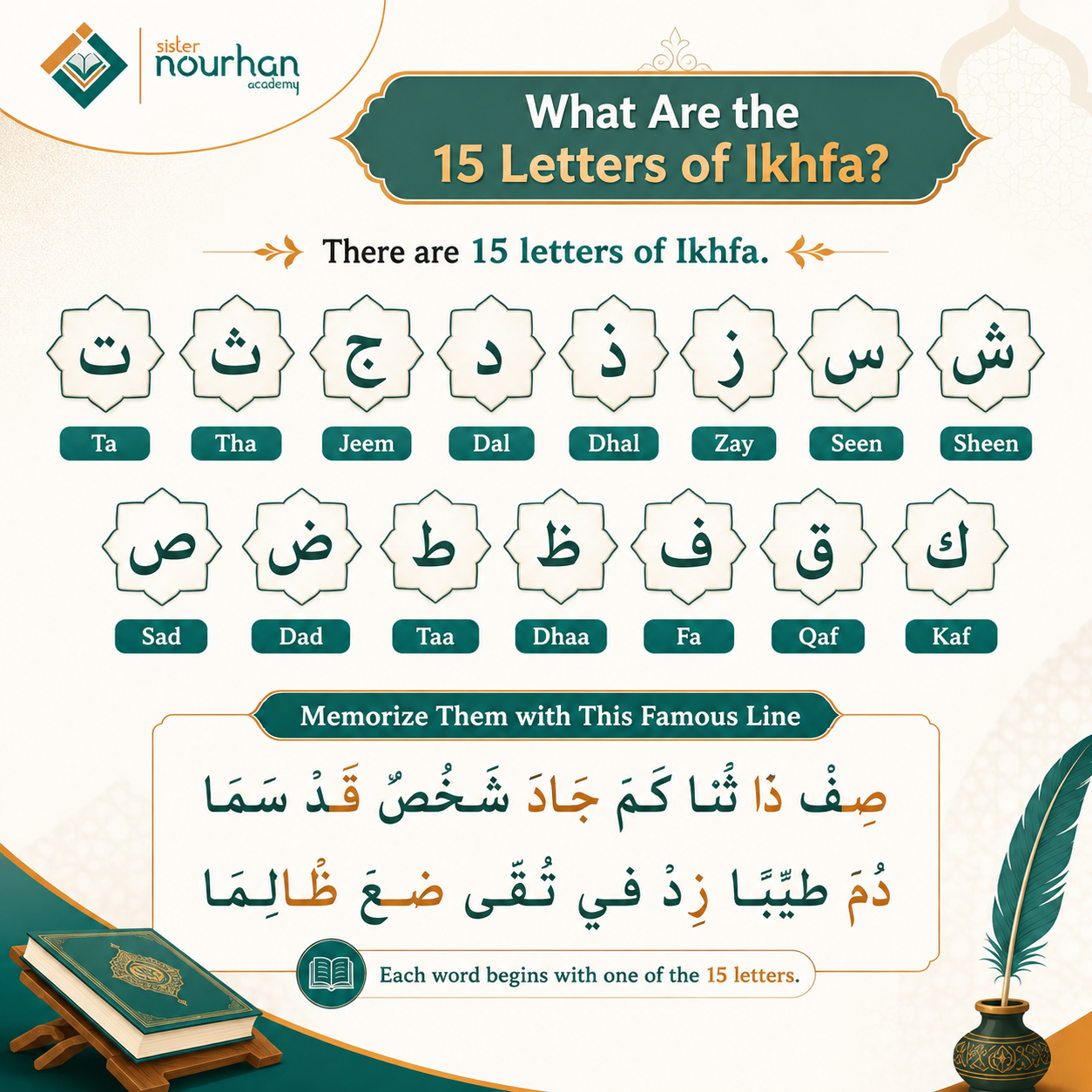
There are 15 letters of Ikhfa:
ت، ث، ج، د، ذ، ز، س، ش، ص، ض، ط، ظ، ف، ق، ك
In transliteration:
Ta, Tha, Jeem, Dal, Dhal, Zay, Seen, Sheen, Sad, Dad, Taa, Dhaa, Fa, Qaf, Kaf
Students traditionally memorize the Ikhfaa letters through the opening letters of this famous line:
صِفْ ذَا ثَنَا كَمْ جَادَ شَخْصٌ قَدْ سَمَا
دُمْ طَيِّبًا زِدْ فِي تُقًى ضَعْ ظَالِمًا
Each word begins with one of the 15 letters.
A Faster Way to Recognize Ikhfa Letters While Reciting
Do not stop at memorizing the list. When you see Noon Sakinah or Tanween, immediately check the next letter. If it is not a letter of Izhar, Idgham, or Iqlab, it will belong to the Ikhfa group.
That decision process eventually becomes much faster than mentally repeating all 15 letters during every Ayah.
If recognizing rules is easy on paper but difficult during live recitation, guided correction from Sister Nourhan Academy can help you turn Tajweed knowledge into an automatic reading skill.
Strengthen your recitation through the Advanced Tajweed Course, where you can practice advanced Tajweed rules with structured guidance and correction.

Shots from Our Classes
Take a moment to view the video below to see how our teachers provide clear, supportive corrections during a session.
Begin Your Quranic Journey
Connect with the words of Allah through personalized sessions at Sister Nourhan Academy.
Book Your Free TrialHow Do You Apply the Ikhfa Rule Correctly?
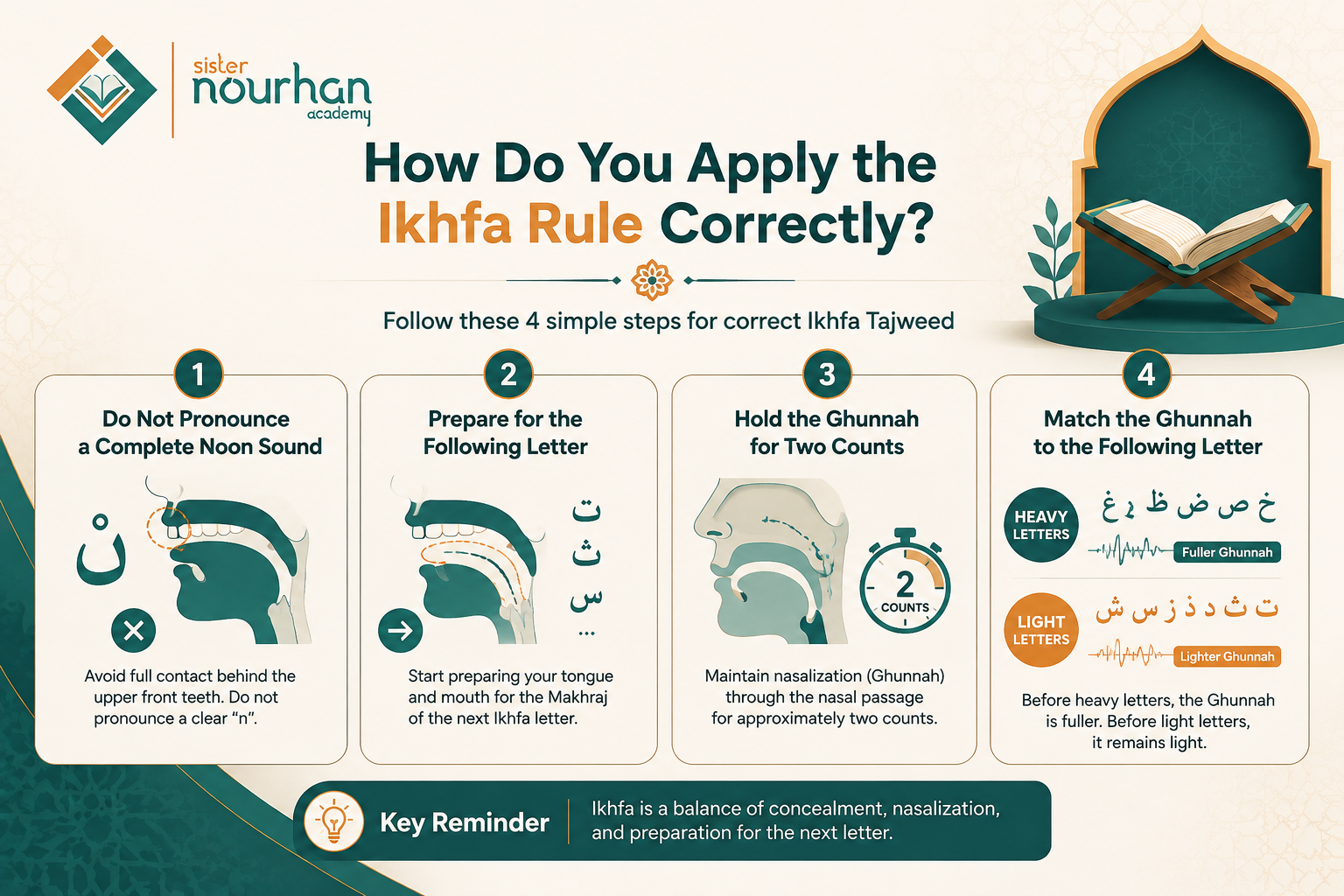
Correct Ikhfa Tajweed depends on what the tongue, nasal passage, and mouth are doing simultaneously. Follow these four steps:
1. Conceal the Noon Instead of Pronouncing It Clearly
During a normal Noon, the tongue makes contact around the articulation area behind the upper front teeth.
During Ikhfa, avoid completing that contact. Producing a distinct “n” first and then adding Ghunnah turns the concealed sound into something closer to Izhar.
2. Prepare the Mouth for the Following Ikhfa Letter
The mouth and tongue begin preparing for the articulation point of the next Ikhfa letter. This is an important practical detail: Ikhfa does not have one identical mouth position for all 15 letters because each following letter has its own Makhraj.
3. Maintain the Ghunnah for Two Counts
Ghunnah is the nasal sound produced through the nasal passage, or Khayshum. In Ikhfa, maintain this nasalization for approximately two counts, without rushing it or stretching it unnecessarily.
4. Adjust the Ghunnah to the Following Letter
The quality of the Ghunnah changes according to the next letter.
Before heavy letters, the Ghunnah becomes fuller. Before light letters, it remains light.
This detail separates mechanically correct Ikhfa from refined Tajweed pronunciation.
Knowing the four steps of Ikhfa is important, but applying them naturally during live recitation requires consistent listening, practice, and correction.
With Sister Nourhan Academy’s Advanced Tajweed Course for Adults, you can refine your Ghunnah, articulation, and advanced Tajweed rules with guided instruction designed to turn theoretical knowledge into confident recitation.
Heavy and Light Ikhfa Change the Quality of the Ghunnah
The Ghunnah in Ikhfa changes according to the letter that follows Noon Sakinah or Tanween. Before heavy letters, the Ghunnah takes on a heavier quality, while before light letters, it remains lighter.
Learning this distinction helps the reciter produce a more natural and accurate Ikhfa instead of using the same nasal quality in every example.
Which Ikhfa Letters Give the Ghunnah a Heavier Quality?
The five heavy Ikhfa letters are:
ص، ض، ط، ظ، ق
When Noon Sakinah or Tanween comes before one of these letters, the Ghunnah is pronounced with a fuller, heavier quality in preparation for the following heavy letter.
For example:
مِنْ قَبْلِ
Here, Noon Sakinah is followed by ق, a heavy letter. The Ghunnah therefore takes on a fuller quality as the mouth prepares to articulate the Qaf.
Another example is:
بِرِيحٍ صَرْصَرٍ
Here, Tanween is followed by ص, so the Ikhfa is accompanied by a heavier Ghunnah before moving naturally into the Saad.
The goal is not to exaggerate the nasal sound, but to let its quality reflect the heaviness of the letter that follows.
Which Ikhfa Letters Keep the Ghunnah Light?
The remaining ten Ikhfa letters are light:
ت، ث، ج، د، ذ، ز، س، ش، ف، ك
When Noon Sakinah or Tanween comes before one of these letters, the Ghunnah remains light rather than taking on the fuller quality heard before the heavy letters.
For example:
جَنَّاتٍ تَجْرِي
The Tanween is followed by ت, a light letter, so the Ghunnah remains light as the reciter prepares to pronounce the Taa.
One important distinction is Kaf (ك). Although Kaf may be discussed as having a different degree of concealment based on its articulation distance from Noon, it is still a light letter. Therefore, the degree of Ikhfa and the heavy or light quality of the Ghunnah are separate concepts and should not be confused.
Ikhfa Examples From the Quran
The easiest way to understand Ikhfaa examples is to classify them by what comes before the Ikhfa letter.
Additional Ikhfa examples in Quran include يَنْقَلِبُونَ, مِنْ ضَرِيعٍ, مَنْ طَغَى, and مِنْ كُلِّ أَمْرٍ.
A useful practice method is to identify the Noon or Tanween first, circle the following letter mentally, then decide whether the Ghunnah should be heavy or light before reciting the entire phrase.
How Can You Recognize Ikhfa in the Mushaf?
Many Uthmani Mushaf editions provide visual clues that help the reader identify Ikhfa.
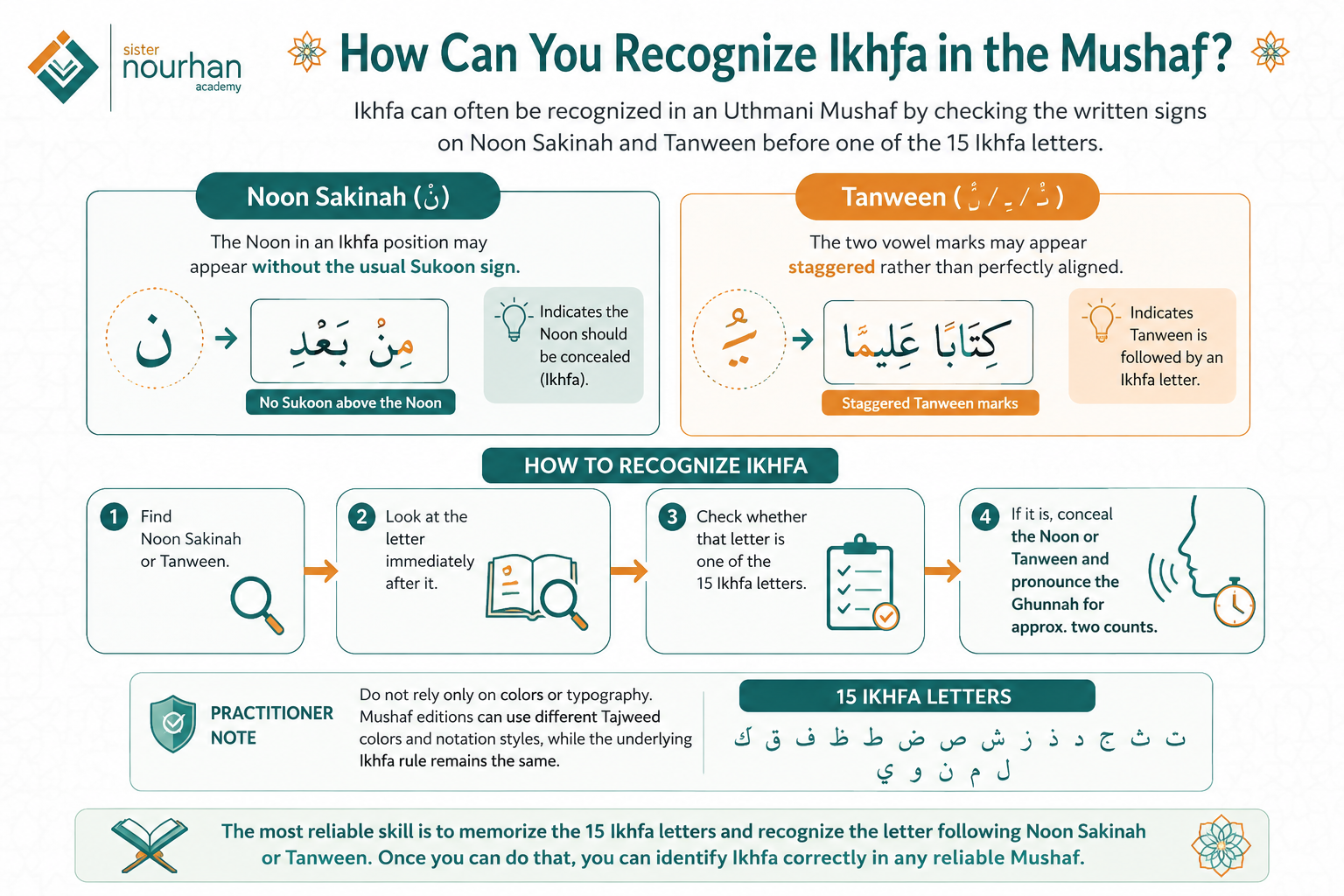
For Noon Sakinah, the Noon used in an Ikhfa position may appear without the normal Sukoon sign.
For Tanween, the two vowel marks may appear staggered rather than directly aligned.
However, typography and Tajweed notation can differ between Mushaf editions. Learn the underlying letter rule rather than depending completely on color coding or printed symbols.
That way, you can identify Ikhfa correctly in any reliable Mushaf.
What Is Ikhfa Shafawi?
Ikhfa Shafawi is the concealment of Meem Sakinah (مْ) when it is followed by Baa (ب), accompanied by Ghunnah.
It is called Shafawi, meaning labial, because both Meem and Baa are articulated using the lips.
A Quran example is:
تَرْمِيهِمْ بِحِجَارَةٍ
Another is:
فَبَشِّرْهُمْ بِعَذَابٍ
Keep the lips controlled and gentle rather than pressing them together excessively before moving into the Baa.
The Difference Between Ikhfa Haqiqi and Ikhfa Shafawi
There are two major applications commonly discussed under Ikhfa:
Common Ikhfa Mistakes to Avoid
Understanding the Ikhfa rules does not guarantee correct pronunciation. Most errors happen during the transition into the following letter.
Pronouncing a clear Noon: touching the Noon articulation point completely produces too much Izhar.
Merging the Noon completely: Ikhfa is not full Idgham; the concealed nasal quality must remain.
Shortening the Ghunnah: rushing through it makes the concealment incomplete.
Overstretching the Ghunnah: extending it beyond its proper timing distorts the recitation.
Using the same Ghunnah quality everywhere: heavy letters such as ص and ق require a different preparation from light letters such as ت and ك.
Learning the letters but ignoring articulation: knowing that ق triggers Ikhfa is only theoretical unless your mouth correctly prepares for Qaf.
Depending only on Tajweed colors: colors can help recognition, but the actual rule depends on the letters, not the printing style.
A practical self-test is simple: if listeners can hear a complete “n” before the following letter, you may be showing too much Noon. If the Noon disappears so completely that the nasal transition is lost, you may be merging too much.
See our teaching methods
Experience the quality of our instruction firsthand by watching a live lesson snippet below.
Begin Your Quranic Journey
Connect with the words of Allah through personalized sessions at Sister Nourhan Academy.
Book Your Free TrialStart Mastering Ikhfa With Sister Nourhan Academy
Master Ikhfa With Guided Tajweed Practice
Understanding which Ikhfa letters produce a heavy or light Ghunnah is important, but hearing and applying the difference correctly during Quran recitation requires guided practice.
Small mistakes in Ghunnah quality, timing, tongue position, or the transition into the following letter can easily go unnoticed when practicing alone.
With Sister Nourhan Academy, students practice Ikhfa and other Tajweed rules directly with qualified teachers who listen to their recitation, identify pronunciation mistakes, and provide immediate correction.
Instead of simply memorizing rules, you learn how to recognize, pronounce, and apply them naturally in real Quranic verses.
If you want to move from understanding Tajweed theoretically to reciting the Quran with greater accuracy and confidence, start learning with Sister Nourhan Academy and receive personalized guidance throughout your recitation journey.
Discover our Tajweed Courses

Conclusion
Ikhfa in Tajweed means concealing Noon Sakinah or Tanween when one of 15 specific letters follows it, producing a pronunciation between Izhar and Idgham while maintaining Ghunnah for approximately two counts.
The key to applying the rule is not simply memorizing the letters of Ikhfaa. Correct recitation requires avoiding a complete Noon articulation, preparing for the following letter, controlling the Ghunnah, and distinguishing heavy from light pronunciation.
Once these elements are practiced together, Ikhfa becomes less of a rule you consciously remember and more of a natural transition you automatically produce during Quran recitation.
Frequently Asked Questions
What is Ikhfa in Tajweed?
Ikhfa is the concealment of Noon Sakinah or Tanween when followed by one of 15 specific letters, with the pronunciation remaining between Izhar and Idgham and accompanied by Ghunnah.
How many Ikhfa letters are there?
There are 15 Ikhfa letters: ت، ث، ج، د، ذ، ز، س، ش، ص، ض، ط، ظ، ف، ق، ك.
What is the Ikhfa rule?
The Ikhfa rule applies when Noon Sakinah or Tanween is followed by one of the 15 Ikhfa letters. Conceal the clear Noon sound, maintain Ghunnah for approximately two counts, and prepare the mouth for the following letter.
What are examples of Ikhfa in the Quran?
Examples of Ikhfa include يَنْصُرْكُمُ, مَنْ ذَا, مِنْ قَبْلِ, خَلْقٍ جَدِيدٍ, and جَنَّاتٍ تَجْرِي. The Ikhfa letter follows either Noon Sakinah or Tanween in each example.
Which Ikhfa letters make the Ghunnah heavy?
The five heavy Ikhfa letters are ص، ض، ط، ظ، ق. When one follows Noon Sakinah or Tanween, the Ghunnah takes on a heavier quality in preparation for the next letter.
What is the difference between Ikhfa and Ikhfa Shafawi?
Ikhfa Haqiqi applies to Noon Sakinah or Tanween before 15 letters, while Ikhfa Shafawi applies to Meem Sakinah before Baa (ب). Both involve Ghunnah, but they belong to different Tajweed rules and use different articulation mechanisms.