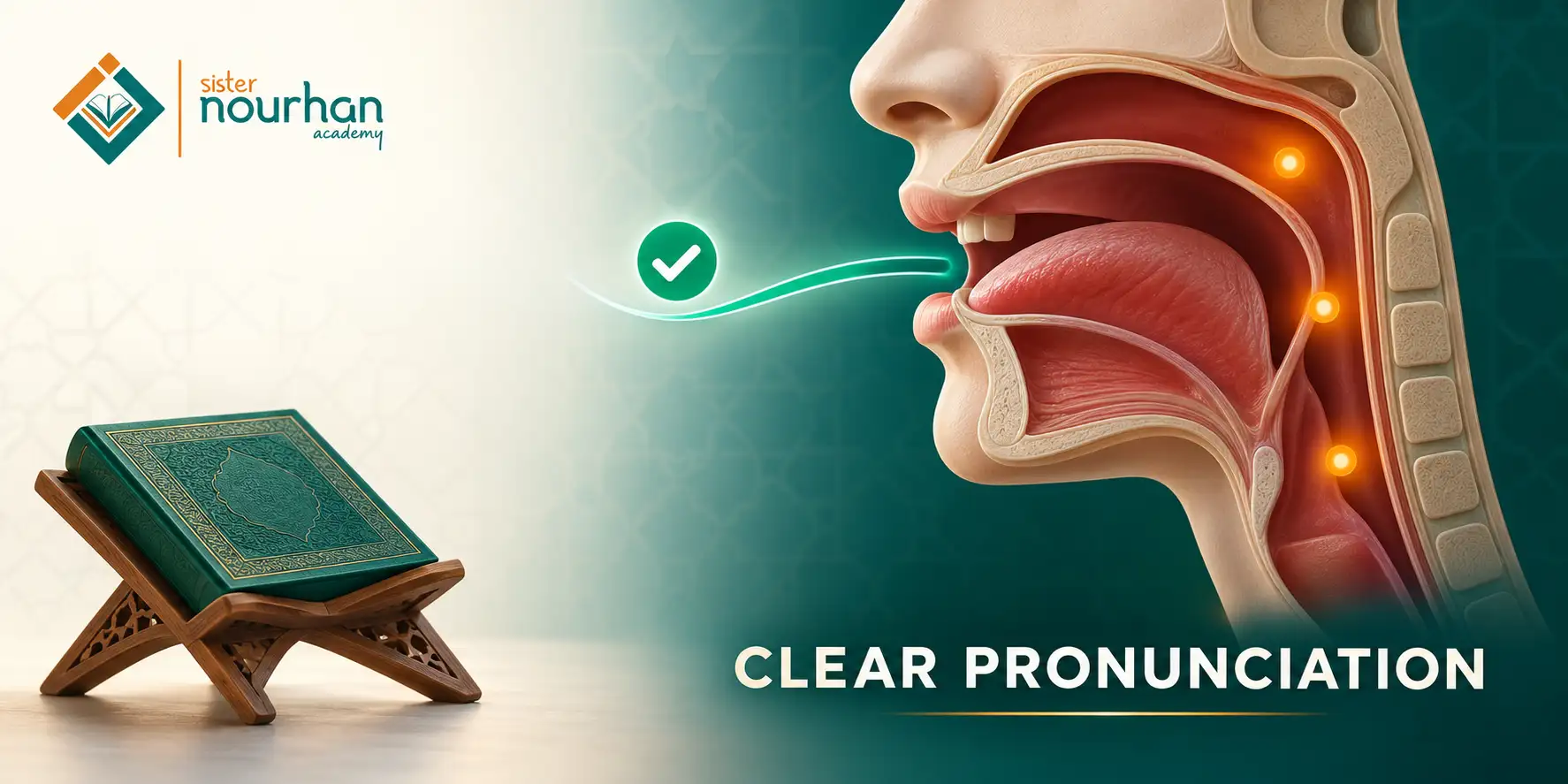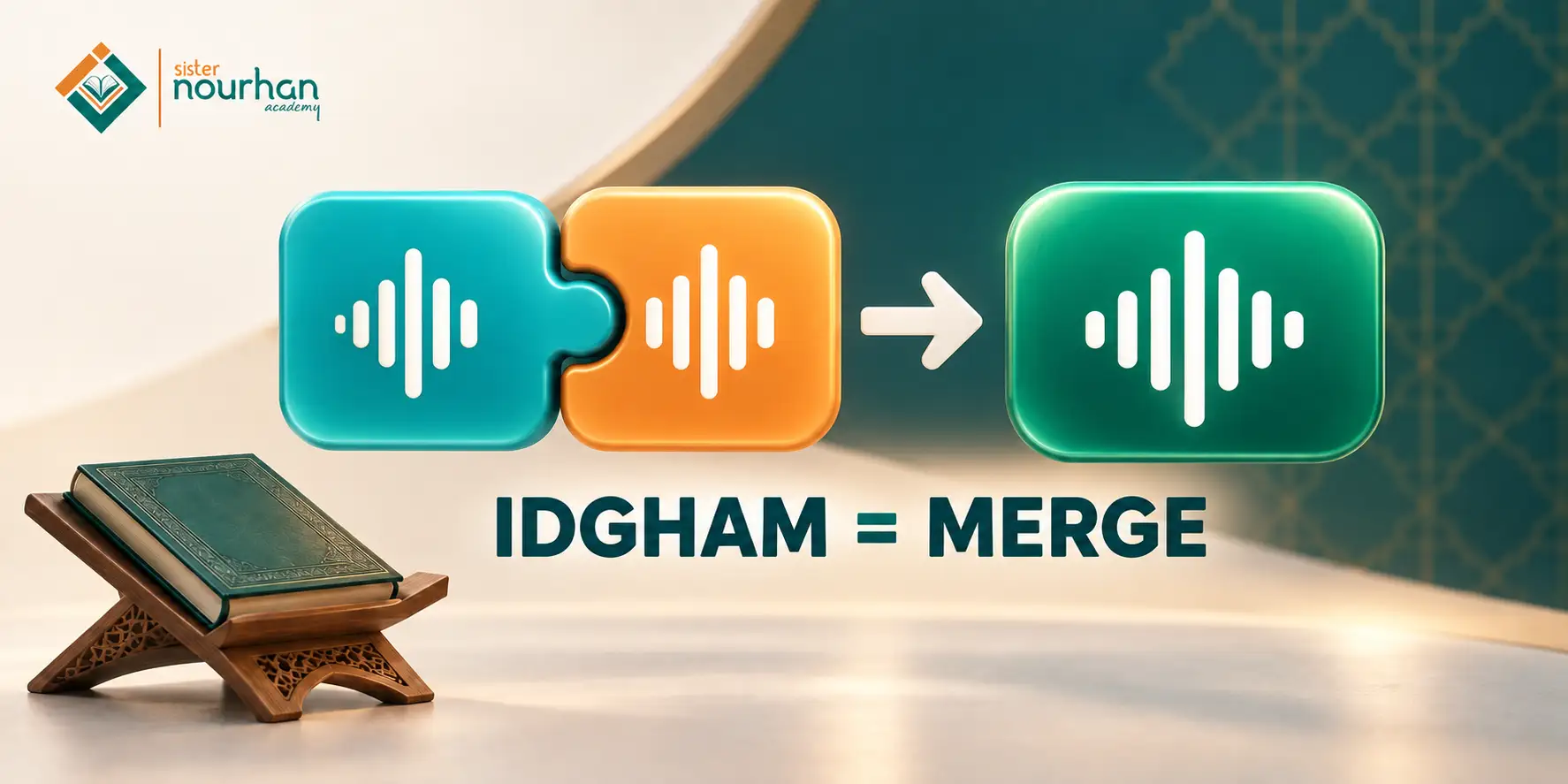

Learning the Quran with Tajweed helps Muslims recite the words of Allah accurately by pronouncing Arabic letters from their correct articulation points and applying their proper characteristics.
Tajweed is not simply about making recitation sound beautiful; it provides practical rules covering Makharij, Sifat, Ghunnah, Madd, Qalqalah, and other essential aspects of Quranic pronunciation.
So, why learn Quran with Tajweed? It helps preserve correct pronunciation, prevent recitation mistakes, improve articulation, support accurate memorization, and build confidence when reading the Quran. This is particularly valuable for beginners and non-Arabic speakers who may need guidance in distinguishing and producing unfamiliar Arabic sounds correctly.
1. Preserve the Correct Pronunciation of Quranic Letters and Words
One of the most important reasons to learn Tajweed is to preserve the correct pronunciation of Quranic words.
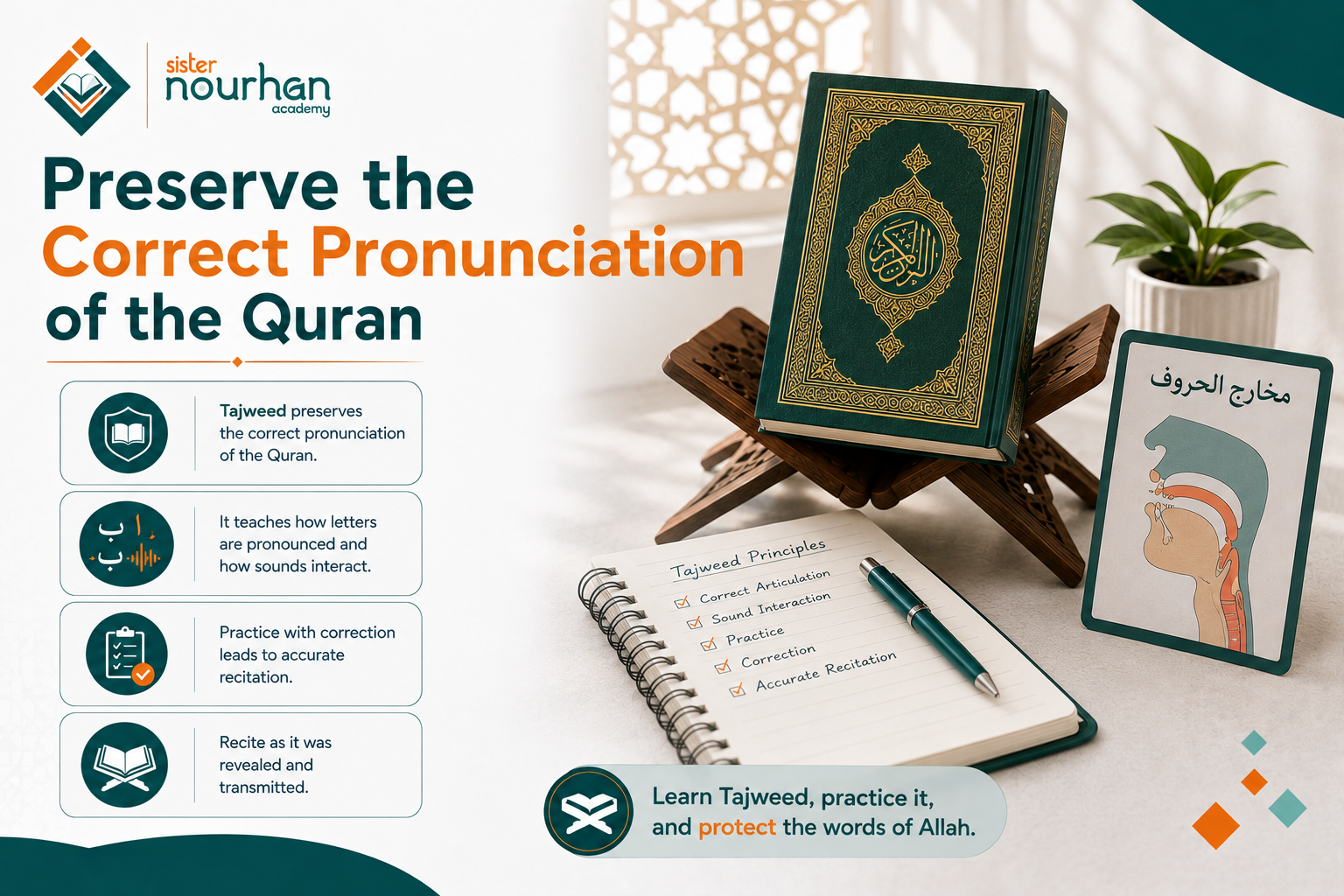
The Quran was transmitted through recitation, and accurate pronunciation has remained an important part of its oral transmission. Tajweed provides learners with principles for recognizing how letters should be articulated and how different sounds interact during recitation.
By learning these principles and practicing them with correction, students can recite more accurately rather than relying on pronunciation habits from their native language or personal assumptions.
2. Prevent Pronunciation Mistakes That Can Change Quranic Words and Meanings
Small pronunciation differences can matter in Arabic. Replacing one letter with another, changing a vowel, or producing a letter from the wrong articulation point can alter a word and, in some cases, its meaning.
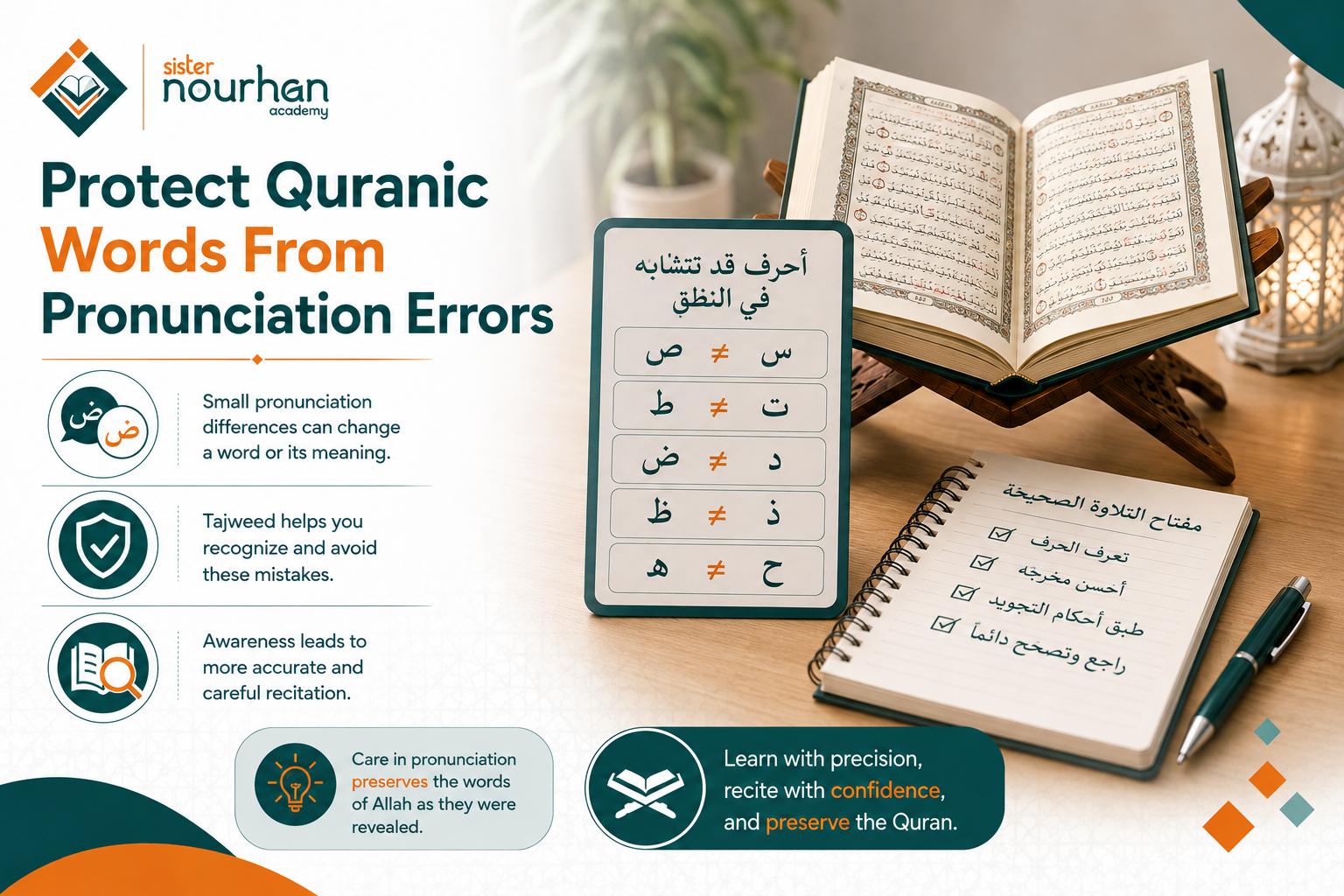
Tajweed helps learners become more aware of these differences.
For example, students learn to distinguish between letters that may initially sound similar, such as س and ص, ت and ط, د and ض, ذ and ظ, or ح and ه.
This awareness helps reduce recurring pronunciation mistakes and encourages greater care when reading the Quran.
3. Improve Quran Pronunciation Through Correct Makharij and Sifat
Tajweed provides structured training in Arabic pronunciation. Through the study of Makharij, students learn where letters originate in the mouth, throat, tongue, and lips.
Through Sifat, they learn the permanent characteristics that distinguish one letter from another.
This is particularly useful when dealing with Arabic sounds that do not have direct equivalents in other languages.
With regular practice, learners can develop clearer articulation, better control of individual sounds, and greater consistency throughout their Quran recitation.
Learners who want to develop these skills through structured Islamic study can join an Al-Azhar Course, combining guided Quran learning with a systematic approach to developing their knowledge and recitation skills.

4. Develop More Beautiful, Fluent, and Confident Quran Recitation
Beautiful Quran recitation is not simply about having a pleasant voice. Accurate pronunciation, balanced elongation, proper pauses, and controlled application of Tajweed all contribute to clear and measured recitation.
When students understand what they are doing, they may also become more confident.
Instead of constantly wondering whether they pronounced a letter or applied a rule correctly, they gradually develop reliable recitation habits through practice and feedback.
Tajweed therefore supports both accuracy and fluency, allowing the reciter to focus more naturally on the verses being read.
Shots from Our Classes
Take a moment to view the video below to see how our teachers provide clear, supportive corrections during a session.
Begin Your Quranic Journey
Connect with the words of Allah through personalized sessions at Sister Nourhan Academy.
Book Your Free Trial5. Build a Deeper Spiritual Connection Through Careful Quran Recitation
Learning Tajweed encourages students to slow down and give greater attention to every letter and word they recite.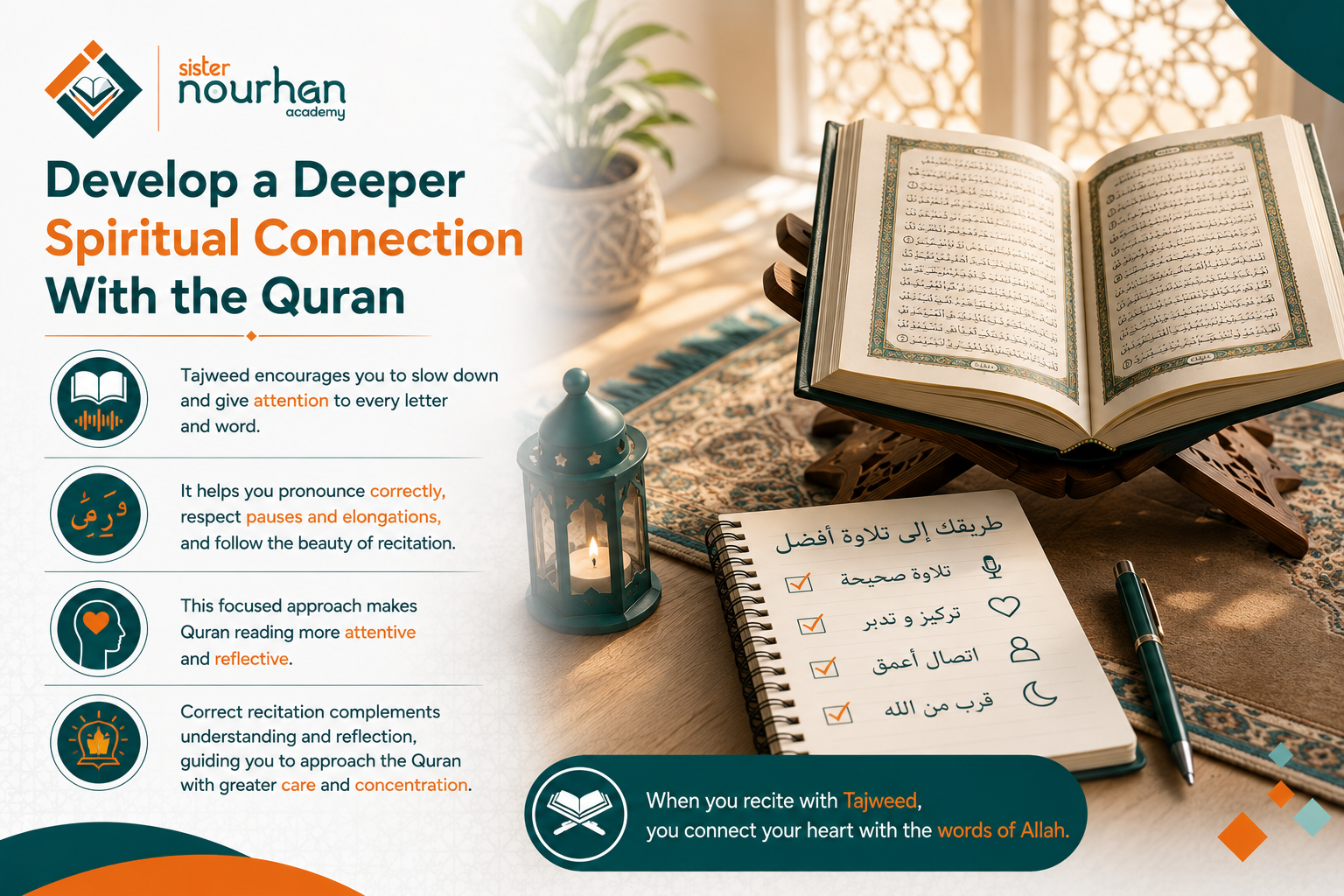
Rather than rushing through verses, the learner becomes more conscious of pronunciation, pauses, elongations, and the structure of Quranic recitation. This focused approach can make Quran reading a more attentive and reflective experience.
Correct recitation does not replace understanding and reflection on the meanings of the Quran, but it can complement them by encouraging the reader to approach the Quran with greater care and concentration.
Read also: What are the best ways to learn Tajweed?
6. Support Accurate Quran Memorization and Prevent Repeated Recitation Errors
Tajweed is especially valuable for students memorizing the Quran. When a verse is repeatedly memorized with incorrect pronunciation, the mistake can become part of the student's memory.
Correcting it later may require additional effort because the learner has already become accustomed to saying the word incorrectly.
Learning Tajweed alongside Hifz helps students memorize not only the sequence of words but also their correct pronunciation.
Listening to accurate recitation, repeating verses carefully, and reciting them to a qualified teacher can help learners identify mistakes before they become established habits.
Read also: What are the four principles of Tajweed?
7. Help Non-Arabic Speakers Master Difficult Quranic Sounds and Letters
Non-Arabic speakers can face additional challenges when learning Quran recitation because some Arabic sounds may not exist in their first language.
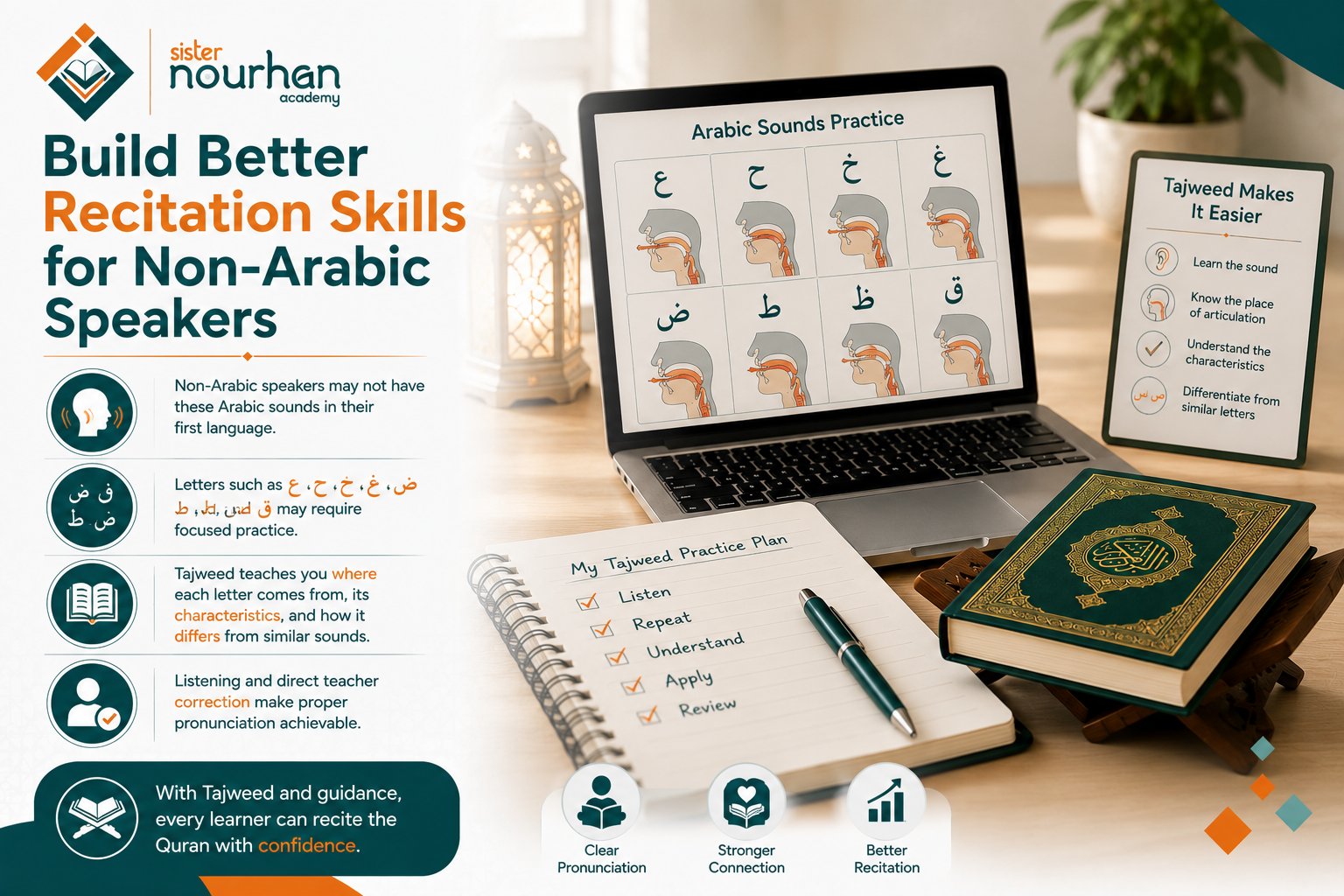
Letters such as ع, ح, خ, غ, ض, ط, ظ, and ق may require focused articulation practice.
Tajweed provides a systematic way to learn these sounds. Instead of simply trying to imitate what they hear, students can learn where a letter originates, what characteristics it carries, and how it differs from similar sounds.
Combined with listening and direct teacher correction, this can make Quran pronunciation more manageable for learners from different linguistic backgrounds.
8. Preserve Accurate Quran Recitation Through Teacher-to-Student Learning
Quran recitation has traditionally been learned through direct transmission from teachers to students.
A learner listens, recites, receives correction, and gradually develops accurate pronunciation. That knowledge can then be passed on to others.
Studying Tajweed supports this continuity by providing clear principles for correct recitation rather than leaving pronunciation to individual interpretation.
This teacher-to-student approach remains particularly important because many pronunciation errors are difficult for learners to recognize by themselves.
Read also: What are the different types of waqf?
What Happens If You Read the Quran Without Tajweed?
Reading without sufficient knowledge or application of Tajweed can lead to different types of pronunciation mistakes.

Some mistakes are relatively minor and do not change the identity of a letter or word. Others can be more serious, such as replacing one Arabic letter with another, changing a vowel, or pronouncing a word in a way that affects its form or meaning.
A beginner should not become so afraid of making mistakes that they stop reading the Quran. Mistakes are a normal part of learning. The goal is to recognize them, seek correction, and gradually improve.
This is one reason learning with a qualified teacher can be valuable. A teacher can distinguish between mistakes, explain what needs correction, and help the learner improve without becoming overwhelmed.
Is Learning Tajweed Obligatory?
The question of whether learning Tajweed is obligatory requires some distinction between reciting the Quran correctly and studying the detailed theoretical terminology of Tajweed.
Muslims should take care when reciting the Quran and work to avoid clear pronunciation mistakes, particularly errors that change letters, words, or meanings. Learning the practical rules needed to improve one's recitation supports this responsibility.
However, studying every technical classification and advanced theoretical detail of Tajweed is a different matter.
Learners who have already mastered the fundamentals can continue developing their recitation through an Advanced Tajweed Course, where they can focus on more detailed rules and their practical application.

The practical priority is to learn enough to pronounce the Quran correctly, continue improving, and seek qualified guidance when necessary.
Why Is Tajweed Important for Quran Memorization?
Tajweed and Quran memorization work best when they are learned together. When students begin memorizing a new passage, they repeat it many times. Whatever pronunciation they use during those repetitions can become strongly fixed in memory.
For this reason, it is better to correct pronunciation before and during memorization, rather than memorize an entire passage incorrectly and attempt to correct it afterward.
A useful approach is to listen to the passage from an accurate reciter, read it slowly while applying the Tajweed rules you know, recite it to a teacher, correct mistakes, and then continue repetition for memorization.
This helps connect accurate pronunciation with the memorized words from the beginning.
Is Tajweed Important for Non-Arabic Speakers?
Yes. Tajweed is especially important for non-Arabic speakers because it provides a structured way to learn Quranic sounds that may not exist in their native language.
You do not need to speak Arabic fluently before learning Tajweed. A learner can begin by recognizing Arabic letters, Harakat, and basic Quranic reading patterns, then gradually develop accurate pronunciation.
Makharij teaches where each letter is produced, while Sifat helps distinguish letters with similar articulation points. Rules such as Ghunnah, Madd, and Qalqalah then teach learners how these sounds should be applied during actual Quran recitation.
Listening to skilled reciters is valuable, but it may not be enough on its own. Non-Arabic speakers can develop pronunciation errors without realizing them, so direct correction from a qualified Tajweed teacher can help identify mistakes, correct unfamiliar sounds, and build more accurate recitation habits.
Read also: What is Iqlab in Tajweed?
How to Start Learning Quran with Tajweed?
Beginners should approach Tajweed gradually rather than trying to learn every rule at once.
Start with Arabic letters and Harakat so that you can recognize and read the basic written forms correctly. Then study Makharij Al-Huruf to understand where each letter is articulated.
After that, begin learning the characteristics of letters and frequently occurring Tajweed rules, including Noon Sakinah and Tanween, Meem Sakinah, Ghunnah, Madd, and Qalqalah.
The learning path can be summarized as:
Arabic Letters and Harakat → Makharij → Sifat → Basic Tajweed Rules → Guided Quran Recitation → Regular Correction
Most importantly, apply each rule to actual Quranic verses rather than memorizing definitions without practice.
See our teaching methods
Experience the quality of our instruction firsthand by watching a live lesson snippet below.
Begin Your Quranic Journey
Connect with the words of Allah through personalized sessions at Sister Nourhan Academy.
Book Your Free TrialLearn Quran with Tajweed With a Qualified Teacher
Tajweed is both theoretical and practical. Books, videos, and recorded recitations can explain rules and provide useful examples, but they cannot always tell you whether your own pronunciation is correct.
A qualified teacher can listen to your recitation, identify mistakes in Makharij and Tajweed application, demonstrate the correct pronunciation, and help you practice until the correction becomes natural.
At Sister Nourhan Academy, students can learn Quran with Tajweed through personalized online sessions designed around their age, current level, and learning needs. Learners receive direct feedback while practicing Quran recitation, allowing them to work on specific pronunciation difficulties rather than studying rules in isolation.
Whether you are a beginner, an adult learner, a sister looking for personalized instruction, or a parent seeking Tajweed lessons for your child, structured teacher-guided learning can provide a clearer path toward accurate recitation.
Book Your Free Trial and start learning Quran with Tajweed with personalized guidance.
Discover our Tajweed Courses

Conclusion
Learning the Quran with Tajweed is about much more than making recitation sound beautiful. It helps learners pronounce Quranic words accurately, avoid recurring mistakes, strengthen memorization, improve articulation, and develop greater confidence while reading the Quran.
For beginners, the most effective approach is gradual: build a foundation in Arabic letters and pronunciation, learn Makharij and basic Tajweed rules, apply them directly to Quranic verses, and receive regular correction.
With consistent practice and qualified guidance, Tajweed can gradually become a natural part of your Quran recitation, helping you read the words of Allah with greater accuracy, care, and attention.
Frequently Asked Questions About Learning Quran with Tajweed
Why should we learn the Quran with Tajweed?
Learning Tajweed helps preserve correct Quranic pronunciation, reduce recitation mistakes, improve articulation, and develop more accurate and confident Quran reading.
Can I read the Quran if I don't know Tajweed?
Beginners should continue reading and learning rather than avoiding the Quran because their Tajweed is not yet perfect. The important thing is to work on clear mistakes, learn gradually, and seek correction when possible.
Is Tajweed necessary for Quran recitation?
Correct pronunciation is an important part of Quran recitation. Tajweed provides the practical principles that help learners pronounce letters and words accurately and avoid errors, particularly those that may affect words or meanings.
Does Tajweed help with Quran memorization?
Yes. Tajweed helps students memorize verses with correct pronunciation from the beginning, reducing the risk of repeatedly memorizing pronunciation mistakes that may be harder to correct later.
Can beginners learn Quran with Tajweed?
Yes. Beginners can start with Arabic letters, Harakat, and Makharij before gradually learning basic Tajweed rules and applying them to short Quranic passages.
Can non-Arabic speakers learn Tajweed?
Yes. Non-Arabic speakers can learn Tajweed through structured pronunciation training, listening, regular practice, and correction from a qualified Quran teacher.
How long does it take to learn Quran with Tajweed?
There is no fixed timeline. Progress depends on the learner's starting level, Arabic reading ability, lesson frequency, practice consistency, and desired level of proficiency. Regular focused practice is generally more important than trying to finish quickly.